


The front page of one of UAE's main newspapers tomorrow
PHOTOS FROM AN HISTORIC DAY
[Note by Tom Gross]
I attach (above) a few photos from the Israeli-UAE-US meetings today in Abu Dhabi, since most media so dislike (perhaps with good reason) Donald Trump and Benjamin Netanyahu that they are unlikely to cover this historic moment properly. Nor are they likely to give credit to four years of very patient diplomacy by the Trump administration, and in particular by Jared Kushner, which has made this peace breakthrough possible. Nor are most international media likely to show the Israeli flags being prominently displayed today in the emirates, or the speech given in Arabic today in Abu Dhabi by Netanyahu’s National Security Advisor.
Today’s accords are the most significant step towards peace in the Middle East in 25 years. The significance is not only about the UAE. This is the breakthrough that Israel has been waiting for with the entire Arab world, especially with the Saudis allowing El Al to fly through their air space today. Several other Arab countries are likely to sign peace treaties with Israel in the near future.
For those who missed these comments yesterday, they are worth listening to, including those by US National Security Advisor Robert O'Brien and Jared Kushner. (Most international media declined to show them.)
KUSHNER MAY NOT BE KISSINGER BUT HE’S WISER THAN JOHN KERRY
I have for years been saying that the Kushner approach to the Middle East was much more clearheaded and more likely to achieve peace breakthroughs that the policy approach of previous US administrations, both Democrat and Republican.
See for example, this TV interview I gave two months into Trump’s presidency in early April 2017.
I am also of the view that peace between Israel and the Palestinians has a much better prospect of coming about as a result of the Arab world first making peace with Israel, for reasons I have explained in previous dispatches and also alluded to in various podcasts over the years, for example, here.
* You can also find other items that are not in these dispatches if you “like” this page on Facebook www.facebook.com/TomGrossMedia

Dozens of emaciated men crippled by the summer heat inside one of Saudi Arabia’s detention centers

The migrants, several displaying scars on their backs, said they are beaten with whips and electric cords by guards who hurl racial abuse at them
“THE GUARDS JUST THROW THE BODIES OUT BACK AS IF THEY WERE TRASH”
Tom Gross writes:
Below I attach an “exclusive” report from today’s (London) Sunday Telegraph (a paper I used to report for from the Middle East).
As the Telegraph notes: “Saudi Arabia, one of the wealthiest countries on earth, is keeping hundreds if not thousands of African migrants locked in heinous conditions reminiscent of Libya’s slave camps.”
The detention centers in the photos above show mainly Ethiopian men but there are believed to be others packed with women. One of the centers is believed to be in Al Shumaisi, near the holy city of Mecca, and one is in Jazan, a port town near Yemen. There are believed to be several other such detention centers.
There are similar conditions in migrants’ detention centers in Libya, and there are also reports of appalling abuse of thousands of Ethiopian domestic servants in Lebanon.
* Among other recent dispatches on Saudi Arabia: “The models arrived first. Boats carrying some 150 women…” (August 23, 2020)
* You may also be interested in my past interview with the exiled wife of Saudi Arabia’s leading liberal political prisoner, who was sentenced to 1000 lashes
In separate news…
ARAFAT’S WIDOW THREATENS TO “OPEN THE GATES OF HELL” ON PALESTINIAN AUTHORITY CHIEFS, FOLLOWING THEIR ANTI-PEACE STANCE
Tom Gross adds:
You wouldn’t know it from biased media such as CNN and the BBC but a great many Palestinians support the recent Israel-UAE peace deal. One of them is Yasser Arafat’s widow Suha, who has been smeared and branded a traitor by the hardline Palestinian President Mahmoud Abbas for her support of the UAE for making peace with Israel.
The attacks on Suha Arafat, who lives in Malta, started after she wrote an Instagram post on August 21, saying she wished to apologize “in the name of the Palestinian people” for Palestinians’ burning of UAE flags and other insults made against the Emirates in the wake of the deal.
Suha Arafat has now warned in a TV interview that she will “open the gates of hell” on the Palestinian Authority chiefs if the attacks on her don’t stop. She says she has dirt on where top Palestinian officials have stashed huge sums of western aid money that Western governments have foolishly given them. She also says that she will make public Yasser Arafat’s diary (which is said to detail a lot of their crimes).
(My interview last week with Palestinian academic Mostafa Elostaz can be seen here. You can fast forward to 15 minutes into the interview for our discussion on the Israel-UAE deal, the Trump plan, and how the Palestinians should best react to Israeli offers to negotiate.)
‘PEACE’ PAINTED IN ENGLISH, HEBREW AND ARABIC ON EL AL PLANE THAT WILL FLY TO ABU DHABI
The word “peace” in English, Hebrew and Arabic has been painted on the El Al plane that will tomorrow make the first ever commercial passenger flight between Israel and the UAE.
According to reports, Saudi Arabia has granted El Al permission to fly over its airspace for the first time for this flight.
US National Security Adviser Robert O’Brien and special advisor to President Trump Jared Kushner, who is a key architect of the UAE-Israel peace deal, will be on the flight, as well as Israeli National Security Adviser Meir Ben-Shabbat, and ordinary passengers.
In remarks in Jerusalem today, O’Brien said the future for Israel and Arab countries “has never been brighter” and that he was optimistic that Israel will soon establish diplomatic ties with other regional states, following the peace agreement between Jerusalem and Abu Dhabi.
(In May, an Etihad Airways plane flew from the UAE to Tel Aviv’s Ben-Gurion Airport to deliver coronavirus supplies to the Palestinians, marking the first publicly admitted flight by a UAE carrier to Israel, but there were no regular passengers on that flight.)
After the article on Saudi Arabia below, I attach a comment piece from the Daily Telegraph, on the UAE-Israel deal and the failure by the British (and European) governments to acknowledge the importance of the peace-making approach that the Trump administration has brought to the Middle East.
ARTICLES
INVESTIGATION: AFRICAN MIGRANTS ‘LEFT TO DIE’ IN SAUDI ARABIA’S HELLISH COVID DETENTION CENTERS
Investigation: African migrants ‘left to die’ in Saudi Arabia’s hellish Covid detention centres
By Will Brown and Zecharias Zelalem
Sunday Telegraph
August 30, 2020
https://www.telegraph.co.uk/global-health/climate-and-people/investigation-african-migrants-left-die-saudi-arabias-hellish/
Saudi Arabia, one of the wealthiest countries on earth, is keeping hundreds if not thousands of African migrants locked in heinous conditions reminiscent of Libya’s slave camps as part of a drive to stop the spread of Covid-19, an investigation by The Sunday Telegraph has found.
Graphic mobile phone images sent to the newspaper by migrants held inside the detention centres show dozens of emaciated men crippled by the Arabian heat lying shirtless in tightly packed rows in small rooms with barred windows.
One photo shows what appears to be a corpse swathed in a purple and white blanket in their midst. They say it is the body of a migrant who had died of heatstroke and that others are barely getting enough food and water to survive.
Another image, too graphic to publish, shows a young African man hanged from a window grate in an internal tiled wall. The adolescent killed himself after losing hope, say his friends, many of whom have been held in detention since April.
The migrants, several displaying scars on their backs, claim they are beaten by guards who hurl racial abuse at them. “It’s hell in here. We are treated like animals and beaten every day,” said Abebe, an Ethiopian who has been held at one of the centres for more than four months.
“If I see that there is no escape, I will take my own life. Others have already,” he added via an intermediary who was able to communicate on a smuggled phone.
“My only crime is leaving my country in search of a better life. But they beat us with whips and electric cords as if we were murderers.”
The images and testimony have sparked outrage among human rights activists, and have particular resonance in light of the global Black Lives Matter protests.
“Photos emerging from detention centres in southern Saudi Arabia show that authorities there are subjecting Horn of Africa migrants to squalid, crowded, and dehumanising conditions with no regard for their safety or dignity,” said Adam Coogle, deputy director of Human Rights Watch in the Middle East, after being shown the images by The Sunday Telegraph.
“The squalid detention centres in southern Saudi Arabia fall well short of international standards. For a wealthy country like Saudi Arabia, there’s no excuse for holding migrants in such deplorable conditions,” Mr Coogle added.
Oil-rich Saudi Arabia has long exploited migrant labour from Africa and Asia. In June 2019, an estimated 6.6m foreign workers made up about 20 per cent of the Gulf nation’s population, most occupying low paid and often physically arduous jobs.
The migrants work mainly in construction and manual domestic roles that Saudi nationals prefer not to do themselves. Many are from South Asia, but a large contingent come from the Horn of Africa, which lies across the Red Sea.
The detention centres identified by The Sunday Telegraph house mainly Ethiopian men and there are said to be others packed with women.
Over the last decade, tens of thousands of young Ethiopians have made their way to the Gulf state, often aided by Saudi recruitment agents and people traffickers, in a bid to escape poverty back home.
They have been trapped partly as a result of the pandemic but also by the ‘Saudization’ of the kingdom’s workforce, a policy introduced by Muhamad Bin Salman, the Crown Prince who took power three years ago.
The testimonies gathered by The Sunday Telegraph directly from migrants on encrypted channels about the conditions they now find themselves in are harrowing.
“Plenty of inmates are suicidal or suffering from mental illnesses as a result of living this for five months,” said one. “The guards mock us, they say ‘your government doesn’t care, what are we supposed to do with you?”
“A young boy, about sixteen, managed to hang himself last month. The guards just throw the bodies out back as if it was trash,” said another.
When the pandemic struck in March, the Saudi government in the capital Riyadh feared the migrants, who are often housed in overcrowded conditions, would act as vectors for the virus.
Almost 3,000 Ethiopians were deported by the Saudi security services back to Ethiopia in the first ten days of April and a leaked UN memo said a further 200,000 were to follow. A moratorium was then placed on the deportations after international pressure was brought to bear on Riyadh.
The Sunday Telegraph has found many of the migrants who were slated for deportation five months ago have been left to rot in disease-ridden detention centres. “We have been left to die here,” said one, who said he has been locked in a room the size of a school classroom and not been outside since March.
“Covid19? Who knows?, he added, “There are a lot of diseases here. Everyone is sick here; everyone has something.”
The images smuggled out show many of those held are plagued by disfiguring skin infections. They claim they have received no medical treatment.
“We eat a tiny piece of bread in the day and rice in the evening. There’s almost no water, and the toilets are overflowing. It spills over to where we eat. The smell, we grow accustomed to. But there’s over a hundred of us in a room, and the heat is killing us,” said another young Ethiopian man.
A short video clip smuggled out shows several rooms covered with filth from an overflowing squat toilet. One Ethiopian man can be heard shouting out: “The toilets are clogged. We tried unblocking them, but we’re unable to. So we live in this filth, we sleep in it too.”
“To [the Saudis] or even to Abiy, it’s like we’re ants. When we die, it’s as if an ant died, no one cares or pays attention,” the man added, referring to Ethiopia’s Nobel Peace Prize-winning Prime Minister Abiy Ahmed.
Saudi Arabia is deeply stratified by race and cast. African migrants enjoy few legal rights and many complain of exploitation, sexual and racial abuse from employers.
New laws further limiting the rights and employment prospects of foreign labourers were introduced in 2013 and crackdowns have continued under the rule of the young Crown Prince Muhamad Bin Salman, who took power in 2017.
The Sunday Telegraph was able to geolocate two of the centres. One is in Al Shumaisi, near the holy city of Mecca and one is in Jazan, a port town near Yemen. There are believed to be others housing thousands of Ethiopians.
Migrants in each of the centres said there were hundreds of them in each room. Satellite imagery shows there are several buildings at both centres, meaning there may be far more migrants in each centre who are uncontactable.
Several of the migrants said they had been rounded up from their homes in various Saudi Arabian cities before being placed in the camps. Others are African refugees from war-torn Yemen.
Earlier this month, Human Rights Watch reported that Houthi forces used Covid-19 as a pretext to expel thousands of Ethiopian migrants into neighbouring Saudi Arabia.
Testimonies gathered by the NGO say that the Houthis killed dozens of Ethiopians and forced others at gunpoint over the Saudi border. Saudi border guards then fired on the fleeing migrants, killing dozens more.
“Saudi Arabia, a wealthy country, has long held undocumented migrants including many from the Horn of Africa in conditions that are so crowded, unsanitary, and appalling that migrants often emerge traumatised or sick,” said Mr Coogle.
“It’s fair to question whether Saudi authorities are purposefully allowing these detention conditions to exist in order to punish migrants,” he added.
The Sunday Telegraph approached the Saudi Arabian embassy in London for comment but had not received any at the time of going to press.
A representative of the Ethiopian government in the Middle East was also unsuccessfully approached for comment.
“DONALD TRUMP IS DOING GOOD IN THE MIDDLE EAST. WHY WON’T THE BRITISH FOREIGN OFFICE SUPPORT HIM?”
Donald Trump is doing good in the Middle East. Why won’t the Foreign Office support him?
By Tim Stanley
Daily Telegraph (London)
August 22, 2020
https://www.telegraph.co.uk/news/2020/08/22/donald-trump-good-middle-east-wont-foreign-office-support/
The peace deal between Israel and the United Arab Emirates is a win for Donald Trump and a win for the world. He won’t get a Nobel Prize; no Netflix docudrama on how he did it. But it is a substantive achievement that nudges the Middle East in a whole new direction. Unfortunately, Britain lags behind. The Foreign Office does not see the potential for progress; it probably doesn’t want to. Someone at the top needs to give it a kick.
The traditional US/UK view is that everything in the Middle East begins and ends with the Palestinians: you have to fix that issue before you can do anything else. Trump was elected on a different prospectus. Israel, he thought, is the West’s one constant ally; the real challenge is Iran. America can’t withdraw its military presence from the Middle East, he reasoned, until it puts Iran back in its box.
Ergo, Trump has reversed Barack Obama’s policies: he relocated the US embassy to Jerusalem and walked away from the Iranian nuclear deal. He launched a charm offensive on the gulf states, trying to build an anti-Iranian coalition that would include Israel. The UAE’s peace deal is, one hopes, just the first fruit; the administration predicts Saudi Arabia will be next. Sudan’s foreign minister said his own country would push for normalisation and was dismissed from office – yet this is still heady stuff. Sudan was the site of the 1967 Khartoum Declaration that pledged no peace with Israel, no recognition and no negotiations.
Critics say Trump can’t take credit for an inevitable development. Dismissing his leadership, however, is not only unfair but dangerous. The Middle East is an arena in which the foreign policy consensus has done a lot of harm, so we need to acknowledge and learn from what the President did that was new. He was mocked for deploying his family as diplomats, but it circumvented the State Department and Arab states seemed to like it.
It was wrong, said the experts, to partner so openly with Benjamin Netanyahu, but the back slapping paid off; and how could anyone deal with the ghastly tyrant Mohammad bin Salman of Saudia Arabia? Ideally, no one would – but, as an Iraqi once said to me, “in this part of the world, the choice is between bad or worse”. The attempts by Europe to work with Iran have strayed into the latter category.
The US has triggered a process at the UN to reinstate sanctions on Iran. France, Germany and the UK have opposed it. The UK also lobbied against America leaving the nuclear deal, and its response to the UAE peace deal was remarkable for its leaden orthodoxy, almost damning with faint praise. Dominic Raab welcomed the normalisation of relations along with Israel’s pledge not to annex land in the West Bank, adding, “there is no substitute for direct talks between the Palestinians and Israel, which is the only way to reach a two state solution and a lasting peace.” To repeat: “There is no substitute.”
Well, there is, and this is it. The UAE’s move has shown that Arab states can be persuaded to deal with Israel if they face a greater threat, namely Iran. So why, even when the Iran nuclear deal is dead, won’t Europe accept the new dynamic and follow Trump’s lead? The other curiosity, of course, is why Brexit Britain is falling in line with the Europeans at all, and why it sticks to outdated formulas on Israel like a parrot reciting the Nicean creed.
Lack of bandwidth is one answer: in the middle of Covid, the Government just can’t process events. Another is the Foreign Office’s prejudice against Israel, fuelled by guilt for the way we carved up the Middle East. As the foreign policy thinker Ed Husain points out, this is likely to get worse because the Department for International Development is about to be rolled into the Foreign Office, stuffing an already biased department with “Left-leaning” bureaucrats whose raison d’etre is to hand out cash as penance for British imperial history.
There is a third calculation: Trump is going to lose the election, putting the Democrats – and the State Department – back in charge. But even if this is correct, why not recognise that the Trump doctrine has brought real movement to Middle East politics, that the anti-Iranian coalition could be the basis for an Arab detente with Israel and that the Palestinian question could be settled on a new, more realistic basis?
Never mind what the Foreign Office feels comfortable with, let’s start by examining what Britain wants and needs in 2020. Several Arab states like and trust us and Israel is always ready to talk, so why not make ourselves indispensable to this process as the champions of engagement? The long-term destination remains peace and it would be an act of utter madness not to walk through that door just because Donald Trump was the one who opened it.
* You can also find other items that are not in these dispatches if you “like” this page on Facebook www.facebook.com/TomGrossMedia
Tom Gross gives a strategic overview of the Middle East
Here: https://youtu.be/HIgwM0Q4Ijk
Also here: https://www.youtube.com/watch?v=4PPMhTRZR6I
Tom Gross gives a strategic overview of the Middle East, including European and international attitudes to it, and his own experience as a journalist covering it.
Interviewed by John O’Sullivan, the president of the Danube Institute (and former senior advisor to British Prime Minister Margaret Thatcher).
Interview by zoom on July 7, 2020, but only posted on line on August 20.
Recent “conversations with friends”
Tom Gross
https://www.youtube.com/watch?v=T4Pg-IDYJYE
As part of a series of informal conservations with friends, Paul Lewis asks Tom Gross about his own life experiences and views: growing up surrounded by cultural and literary luminaries in London and New York; Sunday brunches with Elvis Presley’s songwriter; crossing Checkpoint Charlie into East Berlin with his grandmother during communism; helping the Roma when almost no one else would; Tom’s close relationship with his godmother Sonia Orwell (the model for the heroine Julia of her husband’s masterpiece ‘1984’); being in Manhattan on 9/11; the Mideast; the importance and legacy of the Holocaust; and other matters.
(Discussion by zoom on June 28, 2020.)
World aclaimed pianist Evgeny Kissin (Prague)
Described by The Economist magazine as “the world’s most acclaimed classical pianist” Evgeny Kissin talks about being a child prodigy; his favorite concert halls and musicians; learning new repertoires and visiting Kafka’s grave during coronavirus lockdown; about Stalin’s murder of Yiddish writers, his own love for Yiddish, his support for Israel, and his political views about Russia and the West.
(Discussion by zoom, while under coronavirus lockdown in Prague, on May 24, 2020.)
* You can see shorter extracts from the conversation with Evgeny Kissin here: Conversations with friends: Evgeny Kissin on music, the Yiddish language, Israel and the Soviet Union
Zoe Johnson (Oxfordshire)
Zoe Johnson is the second woman ever to be appointed Senior Treasury Counsel by the attorney general to prosecute the UK’s most serious cases including Islamic terrorism, organized crime, abuse of public office, and honor killings. And she has done all this with the added difficulty of being confined to a wheelchair for almost her whole life.
(Discussion by zoom on August 12, 2020.)
Mostafa Elostaz (Paris / Jerusalem)
https://www.youtube.com/watch?v=WduAASj4C4k
Tom Gross speaks to Palestinian academic and peace activist Mostafa Elostaz about his life and views. Mostafa grew up in Kuwait to parents who moved there from Gaza, and were originally from Majdal Asqalan (Arabic) / Ashkelon (Hebrew). Mostafa taught many years at Al Quds university in east Jerusalem, and now teaches at Tel Aviv University. Should the Palestinians welcome the UAE-Israel peace deal? Should they take up Trump and Netanyahu’s offers to negotiate?
In case you want to skip to the political parts, these start at 15 minutes into this interview, where we begin our discussion about the Israel-UAE deal, the Trump plan, and how the Palestinians should best react to Israeli peace offers, and offer to negotiate.
(Discussion by zoom on August 19, 2020.)
Jonathan Freedland
https://www.youtube.com/watch?v=Y_3phYh8WMU
Award-winning Guardian columnist Jonathan Freedland in conversation with Tom Gross about the state of the world; the Trump presidency (and whether some of his policies might be good); Britain’s coronavirus failures; early Zionism; whether Britain can still learn from the American constitution and system of government; and as a teenager how Jonathan was a mentor to Sasha Baron Cohen before he became Ali G and Borat.
* There is also a separate shorter conversation: Should statues of antisemites come down?
Jonathan Freedland & Tom Gross discuss left-wing antisemitism, and English antisemitism
Jonathan Freedland: Most British people aren’t aware that “one of Britain’s gifts to the world, which originated in England, is the blood libel” -- which led to countless Jewish deaths over many centuries of European history.
Tom Gross: Should the large statue outside the British Parliament of Richard the Lionheart (who was responsible for murder of tens of thousands of Jews) and the bust of Karl Marx (who wrote about Jewish vermin) come down?
(Answer: no they should remain. But schoolchildren should be taught at least a bit about historic English antisemitism, in addition to the wrongs, as well as rights, of the British Empire.)
(Conversation by zoom while under coronavirus lockdown on June 18, 2020)
The last Nazi-hunter Efraim Zuroff (Jerusalem)
Efraim Zuroff speaks about why he became a Nazi hunter, his pursuit of war criminals all over the world over many decades, and his efforts to make countries such as Lithuania, Latvia and Croatia admit to their own nation’s very substantial collaboration with the Nazi genocide. As the last survivors die out where does Holocaust education and memory go from here?
Why did it take Steven Spielberg’s 1993 film Schindler’s List to make Holocaust education finally become incorporated into the British education system some years later? Why did western countries and the Vatican and Red Cross help Nazi criminals escape at the end of the war? Why were so many doctors Nazis?
We also discuss the trial of Bruno Dey (charged for his part in the murder of 5,230 people at Stutthof death camp) which is continuing now in Hamburg – it is 75 years late but the German judge insisted it continue despite the coronavirus restrictions.
(Discussion by zoom, while under coronavirus lockdown in Jerusalem, on June 8, 2020.)
Oscar-nominated filmmaker Hossein Amini (London)
Born in Tehran to a distinguished Iranian family (his grandfather was prime minister under the shah) Oscar-nominated screenwriter and film director Hossein Amini speaks with his friend Tom Gross about Iran before and after the Islamic revolution, his career as a filmmaker, his work with Martin Scorsese and Harvey Weinstein, his favorite films, and says that ‘it’s no accident that the MeToo movement started in tolerant Hollywood’. We also discuss racism in Britain.
(Discussion by zoom, while under coronavirus lockdown in London, on May 30, 2020.)
David Pryce-Jones (London, Wales, Florence)
Writer David Pryce-Jones discusses his childhood escape from the Nazis, his friendships with Isaac Bashevis Singer, Arthur Koestler, Stalin’s daughter Svetlana, John Gross and others; and Israel, Italy, and the New York Times.
(Discussion by zoom, while under coronavirus lockdown in Wales, on May 21, 2020.)
John O’Sullivan (Budapest)
Born to modest parents near Liverpool (his father was a ship steward, his mother a shop girl) John O’Sullivan rose to become one of Margaret Thatcher’s most trusted aides and advisors in 10 Downing Street. In this zoom conversation, he discusses Thatcher’s personality and how she developed her views, and other leading figures he met. (On one occasion John had breakfast with Thatcher in London, then flew to Washington and had dinner with President Reagan that same evening.) He and Tom Gross also discuss Donald Trump’s presidency; the future of journalism; and his lifelong love for musical theatre.
(Discussion by zoom, while under coronavirus lockdown in Budapest, on May 29, 2020.)
Amanda Foreman
https://www.youtube.com/watch?v=lFHkJcf0qO0
Historian and writer Amanda Foreman talks with Tom Gross about her life and career; her father Carl Foreman (who wrote the films Bridge on the River Kwai, High Noon, and Guns of Navarone, but who was then driven out of town by Senator McCarthy’s witchhunts); Amanda’s own encounter with John Wayne; her books; her TV series on the ascent of women; her nonprofit that helps deprived American kids to read; and about curating an exhibition last year on Queen Victoria for the current English queen in Buckingham Palace. Amanda also discusses why statues and icons are such popular targets in History wars.
(Discussion by zoom to New York on July 14, 2020.)
Rt Hon Lord (David) Young of Graffham
Lord David Young talks about his life, his ten years in Downing Street working closely with Margaret Thatcher, his five years in Downing Street with David Cameron, and about Boris Johnson, Donald Trump, and modern multicultural Britain.
(Discussion by zoom in Graffham, Sussex, in England, while under coronavirus lockdown, on May 20, 2020.)
Bahra Saleh (Kirkuk, Iraq)
Tom Gross talks with Bahra Saleh about her life and about Kurdistan.
(Discussion by zoom in Kirkuk, Iraq, while under coronavirus lockdown, on May 20, 2020.)
Shmuel Bar (Herzliya)
https://www.youtube.com/watch?v=j_ekSPVLMAg
Shmuel Bar, who worked for Israel’s government for 30 years in various analytical and operational capacities, and who is a world-class expert in a variety of fields, discusses the state of America, Europe, the Mideast and the world, and what dangers may lay ahead.
(Discussion by zoom, on July 2, 2020.)
Orit Yasu (Shoham, near Tel Aviv)
Born to recently arrived Ethiopian-Israeli parents, Orit Yasu talks with Tom Gross about growing up in Kiryat Malachi, the rescue of Ethiopian Jews by the Mossad, her participation in the 1999 Columbine High School shooting memorial while on a school trip to Colorado, on how NYC is too crowded, her trip to see her parents village Ethiopia, and why many Ethiopian-Israelis vote Likud.
(Discussion by zoom, while under coronavirus lockdown, on May 31, 2020.)
Charlotte Cunningham (Yorkshire / London / Luxembourg)
https://www.youtube.com/watch?v=kva8JQ1Jgsw
Charlotte, who has established a successful arts organization in England that helps people with mental and physical disabilities, has managed to forge her own path distinct from her illustrious family background -- her grandmother was the ruling monarch of Luxembourg after whom Charlotte is named; and on the other side of her family, her grandfather was US secretary of state under a Republican, Eisenhower, and then US treasury secretary under two Democrats, Kennedy and Johnson.
(Discussion by zoom, while under coronavirus lockdown in London, on June 19, 2020.)
Nidra Poller (Paris)
Writer Nidra Poller discusses hanging out with James Baldwin and other African-American writers and musicians in 1970s Paris, the origins of the name Nidra, how her Japanese partner introduced her to Israel, and the position of women in the modern world.
(Discussion by zoom, while under coronavirus lockdown in Paris, on May 19, 2020.)
Susan Loewenthal Lourenco (Berlin)
Educator Susan Lourenco talks about being the child of refugees from Berlin, her life in four different countries and how she reconciled herself with modern Germany.
(Discussion by zoom, while under coronavirus lockdown in Berlin, on May 12, 2020.)
* You can also find other items that are not in these dispatches if you “like” this page on Facebook www.facebook.com/TomGrossMedia
Mostafa Elostaz (Paris / Jerusalem)
https://www.youtube.com/watch?v=WduAASj4C4k
Tom Gross speaks to Palestinian academic and peace activist Mostafa Elostaz about his life and views. Mostafa grew up in Kuwait to parents who moved there from Gaza, and were originally from Majdal Asqalan (Arabic) / Ashkelon (Hebrew). Mostafa taught many years at Al Quds university in east Jerusalem, and now teaches at Tel Aviv University. Should the Palestinians welcome the UAE-Israel peace deal? Should they take up Trump and Netanyahu’s offers to negotiate?
In case you want to skip to the political parts, these start at 15 minutes into this interview, where we begin our discussion about the Israel-UAE deal, the Trump plan, and how the Palestinians should best react to Israeli peace offers, and offer to negotiate.
(Discussion by zoom on August 19, 2020.)
Other conversations in this series:
Tom Gross
https://www.youtube.com/watch?v=T4Pg-IDYJYE
As part of a series of informal conservations with friends, Paul Lewis asks Tom Gross about his own life experiences and views: growing up surrounded by cultural and literary luminaries in London and New York; Sunday brunches with Elvis Presley’s songwriter; crossing Checkpoint Charlie into East Berlin with his grandmother during communism; helping the Roma when almost no one else would; Tom’s close relationship with his godmother Sonia Orwell (the model for the heroine Julia of her husband’s masterpiece ‘1984’); being in Manhattan on 9/11; the Mideast; the importance and legacy of the Holocaust; and other matters.
(Discussion by zoom on June 28, 2020.)
World aclaimed pianist Evgeny Kissin (Prague)
Described by The Economist magazine as “the world’s most acclaimed classical pianist” Evgeny Kissin talks about being a child prodigy; his favorite concert halls and musicians; learning new repertoires and visiting Kafka’s grave during coronavirus lockdown; about Stalin’s murder of Yiddish writers, his own love for Yiddish, his support for Israel, and his political views about Russia and the West.
(Discussion by zoom, while under coronavirus lockdown in Prague, on May 24, 2020.)
* You can see shorter extracts from the conversation with Evgeny Kissin here: Conversations with friends: Evgeny Kissin on music, the Yiddish language, Israel and the Soviet Union
Zoe Johnson (Oxfordshire)
Zoe Johnson is the second woman ever to be appointed Senior Treasury Counsel by the attorney general to prosecute the UK’s most serious cases including Islamic terrorism, organized crime, abuse of public office, and honor killings. And she has done all this with the added difficulty of being confined to a wheelchair for almost her whole life.
(Discussion by zoom on August 12, 2020.)
Jonathan Freedland
https://www.youtube.com/watch?v=Y_3phYh8WMU
Award-winning Guardian columnist Jonathan Freedland in conversation with Tom Gross about the state of the world; the Trump presidency (and whether some of his policies might be good); Britain’s coronavirus failures; early Zionism; whether Britain can still learn from the American constitution and system of government; and as a teenager how Jonathan was a mentor to Sasha Baron Cohen before he became Ali G and Borat.
* There is also a separate shorter conversation: Should statues of antisemites come down?
Jonathan Freedland & Tom Gross discuss left-wing antisemitism, and English antisemitism
Jonathan Freedland: Most British people aren’t aware that “one of Britain’s gifts to the world, which originated in England, is the blood libel” -- which led to countless Jewish deaths over many centuries of European history.
Tom Gross: Should the large statue outside the British Parliament of Richard the Lionheart (who was responsible for murder of tens of thousands of Jews) and the bust of Karl Marx (who wrote about Jewish vermin) come down?
(Answer: no they should remain. But schoolchildren should be taught at least a bit about historic English antisemitism, in addition to the wrongs, as well as rights, of the British Empire.)
(Conversation by zoom while under coronavirus lockdown on June 18, 2020)
The last Nazi-hunter Efraim Zuroff (Jerusalem)
Efraim Zuroff speaks about why he became a Nazi hunter, his pursuit of war criminals all over the world over many decades, and his efforts to make countries such as Lithuania, Latvia and Croatia admit to their own nation’s very substantial collaboration with the Nazi genocide. As the last survivors die out where does Holocaust education and memory go from here?
Why did it take Steven Spielberg’s 1993 film Schindler’s List to make Holocaust education finally become incorporated into the British education system some years later? Why did western countries and the Vatican and Red Cross help Nazi criminals escape at the end of the war? Why were so many doctors Nazis?
We also discuss the trial of Bruno Dey (charged for his part in the murder of 5,230 people at Stutthof death camp) which is continuing now in Hamburg – it is 75 years late but the German judge insisted it continue despite the coronavirus restrictions.
(Discussion by zoom, while under coronavirus lockdown in Jerusalem, on June 8, 2020.)
Oscar-nominated filmmaker Hossein Amini (London)
Born in Tehran to a distinguished Iranian family (his grandfather was prime minister under the shah) Oscar-nominated screenwriter and film director Hossein Amini speaks with his friend Tom Gross about Iran before and after the Islamic revolution, his career as a filmmaker, his work with Martin Scorsese and Harvey Weinstein, his favorite films, and says that ‘it’s no accident that the MeToo movement started in tolerant Hollywood’. We also discuss racism in Britain.
(Discussion by zoom, while under coronavirus lockdown in London, on May 30, 2020.)
David Pryce-Jones (London, Wales, Florence)
Writer David Pryce-Jones discusses his childhood escape from the Nazis, his friendships with Isaac Bashevis Singer, Arthur Koestler, Stalin’s daughter Svetlana, John Gross and others; and Israel, Italy, and the New York Times.
(Discussion by zoom, while under coronavirus lockdown in Wales, on May 21, 2020.)
John O’Sullivan (Budapest)
Born to modest parents near Liverpool (his father was a ship steward, his mother a shop girl) John O’Sullivan rose to become one of Margaret Thatcher’s most trusted aides and advisors in 10 Downing Street. In this zoom conversation, he discusses Thatcher’s personality and how she developed her views, and other leading figures he met. (On one occasion John had breakfast with Thatcher in London, then flew to Washington and had dinner with President Reagan that same evening.) He and Tom Gross also discuss Donald Trump’s presidency; the future of journalism; and his lifelong love for musical theatre.
(Discussion by zoom, while under coronavirus lockdown in Budapest, on May 29, 2020.)
Amanda Foreman
https://www.youtube.com/watch?v=lFHkJcf0qO0
Historian and writer Amanda Foreman talks with Tom Gross about her life and career; her father Carl Foreman (who wrote the films Bridge on the River Kwai, High Noon, and Guns of Navarone, but who was then driven out of town by Senator McCarthy’s witchhunts); Amanda’s own encounter with John Wayne; her books; her TV series on the ascent of women; her nonprofit that helps deprived American kids to read; and about curating an exhibition last year on Queen Victoria for the current English queen in Buckingham Palace. Amanda also discusses why statues and icons are such popular targets in History wars.
(Discussion by zoom to New York on July 14, 2020.)
Rt Hon Lord (David) Young of Graffham
Lord David Young talks about his life, his ten years in Downing Street working closely with Margaret Thatcher, his five years in Downing Street with David Cameron, and about Boris Johnson, Donald Trump, and modern multicultural Britain.
(Discussion by zoom in Graffham, Sussex, in England, while under coronavirus lockdown, on May 20, 2020.)
Bahra Saleh (Kirkuk, Iraq)
Tom Gross talks with Bahra Saleh about her life and about Kurdistan.
(Discussion by zoom in Kirkuk, Iraq, while under coronavirus lockdown, on May 20, 2020.)
Shmuel Bar (Herzliya)
https://www.youtube.com/watch?v=j_ekSPVLMAg
Shmuel Bar, who worked for Israel’s government for 30 years in various analytical and operational capacities, and who is a world-class expert in a variety of fields, discusses the state of America, Europe, the Mideast and the world, and what dangers may lay ahead.
(Discussion by zoom, on July 2, 2020.)
Orit Yasu (Shoham, near Tel Aviv)
Born to recently arrived Ethiopian-Israeli parents, Orit Yasu talks with Tom Gross about growing up in Kiryat Malachi, the rescue of Ethiopian Jews by the Mossad, her participation in the 1999 Columbine High School shooting memorial while on a school trip to Colorado, on how NYC is too crowded, her trip to see her parents village Ethiopia, and why many Ethiopian-Israelis vote Likud.
(Discussion by zoom, while under coronavirus lockdown, on May 31, 2020.)
Charlotte Cunningham (Yorkshire / London / Luxembourg)
https://www.youtube.com/watch?v=kva8JQ1Jgsw
Charlotte, who has established a successful arts organization in England that helps people with mental and physical disabilities, has managed to forge her own path distinct from her illustrious family background -- her grandmother was the ruling monarch of Luxembourg after whom Charlotte is named; and on the other side of her family, her grandfather was US secretary of state under a Republican, Eisenhower, and then US treasury secretary under two Democrats, Kennedy and Johnson.
(Discussion by zoom, while under coronavirus lockdown in London, on June 19, 2020.)
Nidra Poller (Paris)
Writer Nidra Poller discusses hanging out with James Baldwin and other African-American writers and musicians in 1970s Paris, the origins of the name Nidra, how her Japanese partner introduced her to Israel, and the position of women in the modern world.
(Discussion by zoom, while under coronavirus lockdown in Paris, on May 19, 2020.)
Susan Loewenthal Lourenco (Berlin)
Educator Susan Lourenco talks about being the child of refugees from Berlin, her life in four different countries and how she reconciled herself with modern Germany.
(Discussion by zoom, while under coronavirus lockdown in Berlin, on May 12, 2020.)
* You can also find other items that are not in these dispatches if you “like” this page on Facebook www.facebook.com/TomGrossMedia
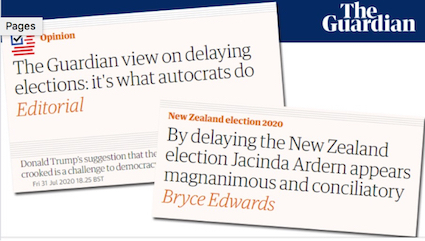
Above: an example of the double standards so prevalent in many leading media.
Compare this: http://www.theguardian.com/us-news/2020/jul/30/trump-election-delay-distraction-tweet-economic-figures
...with this: http://www.theguardian.com/world/2020/aug/17/by-delaying-the-new-zealand-election-jacinda-ardern-appears-magnanimous-and-conciliatory
SHOWING YOUR VACCINE CERTIFICATE TO GET INTO A RESTAURANT?
[Note by Tom Gross]
This is another in series of occasional dispatches concerning Covid-19.
The first article below is more political, the rest are strictly medical.
In the first piece, the Wall Street Journal asks “Is it reasonable to blame a single politician for the spread of a highly infectious virus, especially in a free country with 50 states and 330 million people? Joe Biden is lucky that wasn’t the standard a decade ago.
“If the Democratic convention produced one theme it’s that Donald Trump is personally at fault for every coronavirus death. As Kamala Harris said “Donald Trump’s failure of leadership has cost lives.” …
[Yet] “H1N1 began much like corona, with panicked stories in late April 2009 about a novel “hybrid” flu strain in Mexico that was popping up in the U.S. It was even more alarming, in that it especially affected children. Yet the new administration began with a muddled message. … Within days, some 30 states had suspected cases, and by April 27 the U.S. had its first death, a 23-month-old child. [Hundreds of other American children went on to die.] Other countries started shutting facilities, telling citizens to stay home, quarantining visitors. The Obama administration still had no idea how deadly the disease was, though the World Health Organization called the outbreak a threat to “all humanity,” and health experts predicted hospitals would be overloaded….”
The second article below predicts: “After a COVID-19 vaccine is available, you may need to get inoculated to go to the office, attend a sporting event, or even get a seat at a restaurant.”
The third article says: “More than 150 coronavirus vaccines are in development across the world – and hopes are high to bring one to market in record time to ease the global crisis. Several efforts are underway to help make that possible, including the U.S. government’s Operation Warp Speed initiative, which has pledged $10 billion and aims to develop and deliver 300 million doses of a safe, effective coronavirus vaccine by January 2021. The World Health Organization is also coordinating global efforts to develop a vaccine, with an eye toward delivering two billion doses by the end of 2021…
“It can typically take 10 to 15 years to bring a vaccine to market; the fastest-ever – the vaccine for mumps – required four years in the 1960s. Vaccines go through a multi-stage clinical trial process, which starts by checking their safety and whether they trigger an immune response in a small group of healthy humans. The second phase widens the testing pool to include groups of people who may have the disease or be more likely to catch it, to gauge the vaccine’s effectiveness. The third phase expands the pool up to the thousands to make sure the vaccine is safe and effective among a wider array of people, given that immune response can vary by age, ethnicity, or by underlying health conditions. It then goes to regulatory agencies for approval – which can be a lengthy process itself….”
CONTENTS
1. “The Obama-Biden Virus Response” (By Kimberley Strassel, Wall St Journal, Aug. 21, 2020)
2. “COVID-19 vaccines could become mandatory. Here’s how it might work” (National Geographic, Aug. 19, 2020)
3. “Dozens of COVID-19 vaccines are in development. Here are the ones to follow” (National Geographic, Aug. 21, 2020)
4. “Scientists See Signs of Lasting Immunity to Covid-19, Even After Mild Infections” (New York Times, Aug. 17, 2020)
5. “The Treatment That Could Crush Covid” (Wall St Journal, Aug. 14, 2020)
6. “New research suggests that some of us may be partially protected due to past encounters with common cold coronaviruses” (Washington Post, Aug. 15, 2020)
ARTICLES
THE OBAMA-BIDEN VIRUS RESPONSE
The Obama-Biden Virus Response
If H1N1 had proved as deadly as Covid-19, it could have killed nearly two million.
By Kimberley A. Strassel
Wall Street Journal
Aug. 21, 2020
https://www.wsj.com/articles/the-obama-biden-virus-response-11597966209
Democratic National Convention speakers are claiming Joe Biden already has a proven track record of handling pandemics. But the reality of the Obama-Biden response to H1N1 in 2009 differs from their own version of events.
Is it reasonable to blame a single politician for the spread of a highly infectious virus, especially in a free country with 50 states and 330 million people? Joe Biden is lucky that wasn’t the standard a decade ago.
If the Democratic convention produced one theme it’s that Donald Trump is personally at fault for every coronavirus death. The message is that crazy, that blunt. Kamala Harris: “Donald Trump’s failure of leadership has cost lives.” Barack Obama: “Donald Trump hasn’t grown into the job because he can’t. And the consequences of that failure are severe: 170,000 Americans dead.”
Democrats even claim Mr. Biden saved lives in 2014. Michelle Obama: “Our leaders had worked hand in hand with scientists to help prevent an Ebola outbreak from becoming a global pandemic.” Ms. Harris last week: “Remember that pandemic? Barack Obama and Joe Biden did their job. Only two people died in the United States.”
Ebola is a terrifying disease, but outbreaks tend to happen only in very poor nations, and if caught early the virus is difficult to transmit outside hospitals. Anthony Fauci said in 2014 that a U.S. outbreak was “very, very, very unlikely.” Mr. Obama told Americans to chill out: “Ebola is actually a difficult disease to catch. It’s not transmitted through the air like the flu.”
The Ebola example is designed to divert attention from a more relevant comparison: the H1N1 swine-flu outbreak of 2009-10. Democrats don’t like to talk about H1N1, because it didn’t go well. If it had been as deadly as Covid-19, the toll would have been catastrophic. The history is a powerful reminder that governments can’t stop a virus – although they can make epidemics worse.
H1N1 began much like corona, with panicked stories in late April 2009 about a novel “hybrid” flu strain in Mexico that was popping up in the U.S. It was even more alarming, in that it especially affected children. Yet the new administration began with a muddled message. Mr. Obama encouraged calm, while Mr. Biden rambled a warning about staying off airplanes and public transport – prompting backlash. “Biden’s flu gaffe a headache for Obama,” read one headline.
Within days, some 30 states had suspected cases, and by April 27 the U.S. had its first death, a 23-month-old child. Other countries started shutting facilities, telling citizens to stay home, quarantining visitors. The Obama administration still had no idea how deadly the disease was, though the World Health Organization called the outbreak a threat to “all humanity,” and health experts predicted hospitals would be overloaded.
The administration nonetheless took a resigned approach to its spread. Mr. Obama didn’t close the Mexican border, saying that would “be akin to closing the barn doors after the horses are out.” His officials did declare a health emergency (Mr. Obama was golfing that day) and distributed the national stockpile (which they never replenished). The administration recommended schools “consider” closing if experiencing an outbreak, though the Centers for Disease Control and Prevention chief said this might not help with spread and warned about taking kids out of classrooms. No one considered a national lockdown, especially not an administration focused on a fragile economic recovery. Mr. Obama promised to “control” the “impact” of the virus – not the virus itself. He asked Congress for all of $1.5 billion.
Authorities grew more optimistic as H1N1 turned out to be less deadly than had been feared, but they still faced the risk of an uglier strain in the fall. Team Obama promised 100 million doses of vaccine by mid-October. (A flu vaccine is easier to produce than a coronavirus vaccine). But government setbacks in production, manufacturing and dosing protocols resulted in only 11 million doses, prompting national outrage. By that point, the CDC estimated 22 million Americans had been infected, 36,000 children hospitalized, and 540 kids had died.
Before Covid-19, Democrats were willing to admit they’d dodged a bullet. Former Biden chief of staff Ron Klain said at Texas A&M in 2019: “We did every possible thing wrong. Sixty million Americans got H1N1 in that period of time, and it is just purely a fortuity that this isn’t one of the great mass-casualty events in American history. [It] had nothing to do with us doing anything right; just had to do with luck. If anyone thinks that can’t happen again, they don’t have to go back to 1918. Just go back to 2009, 2010. Imagine a virus with a different lethality, and you can just do the math.”
Yes, let’s do the math. The U.S. has some five million reported cases of coronavirus and 170,000 deaths. A virus with the spread of H1N1 and fatality rate of Covid-19 could produce a death toll approaching two million. The Trump administration response has been flawed – in particular its initial testing delays. But let’s acknowledge (as Democrats once did) that there is only so much government can do to “control” a germ. As for distributing equipment, providing antivirals and developing a vaccine, the current response has so far met or exceeded 2009-10. Mr. Biden is free to argue he’s a better man for the White House; he shouldn’t get to rewrite history, or virology.
COVID-19 VACCINES COULD BECOME MANDATORY. HERE’S HOW IT MIGHT WORK
COVID-19 vaccines could become mandatory. Here’s how it might work.
After a COVID-19 vaccine is available, you may need to get inoculated to go to the office, attend a sporting event, or even get a seat at a restaurant.
National Geographic magazine
August 19, 2020
https://www.nationalgeographic.com/science/2020/08/how-coronavirus-covid-vaccine-mandate-would-actually-work-cvd
You walk toward the arena, ready for a big game, tickets in hand. But what you see is a long line wrapping around the corner of the building and a bottleneck at the entrance as people search their pockets and purses for a small piece of paper. To be cleared to enter, you’ll also need that document – proof that you’ve received a COVID-19 vaccination.
This is the future as some experts see it: a world in which you’ll need to show you’ve been inoculated against the novel coronavirus to attend a sports game, get a manicure, go to work, or hop on a train.
“We’re not going to get to the point where the vaccine police break down your door to vaccinate you,” says Arthur Caplan, a bioethicist at New York University’s School of Medicine. But he and several other health policy experts envision vaccine mandates could be instituted and enforced by local governments or employers – similar to the current vaccine requirements for school-age children, military personnel, and hospital workers.
In the United States, most vaccine mandates come from the government. The Advisory Committee on Immunization Practices (ACIP) makes recommendations for both pediatric and adult vaccines, and state legislatures or city councils determine whether to issue mandates. These mandates are most commonly tied to public school attendance, and all 50 states require students to receive some vaccines, with exemptions for medical, religious, and philosophical reasons.
Adult vaccine mandates – compelling employees and the public to inoculate themselves – aren’t nearly as widespread, but they’re not unheard of. U.S. states and cities can and have forced compulsory vaccinations on citizens. In 1901, for example, Cambridge, Massachusetts, adopted a law that required all citizens aged 21 and older to get vaccinated against smallpox. Failure to comply could lead to a five-dollar fine, or the equivalent of $150 today. Those who challenged the order in court lost. (The last outbreak of smallpox in the U.S. occurred in 1949.)
SHIRT, SHOES, AND INOCULATION REQUIRED
Today, the U.S. military requires troops to be immunized against multiples diseases, including tetanus, diphtheria, hepatitis A, and polio. Several states require workers at healthcare facilities to be vaccinated against diseases such as pertussis, chickenpox, measles, mumps, and rubella. Hospital systems often require additional vaccinations as a condition of employment. And legally, all employers, in any industry, can compel their employees to get vaccinated.
The mandates can be directed toward customers, as well. Just as business owners can bar shoeless and shirtless clients from entering their restaurants, salons, arenas, and stores, they can legally keep people out for any number of reasons, “as long as they’re not running afoul of any antidiscrimination laws,” says Dorit Rubinstein Reiss, a professor of health and vaccine law at the University of California, Hastings College of the Law.
When a COVID-19 vaccine becomes available, some experts think states will require targeted industries to enforce vaccine mandates for their employees, especially those we’ve come to know as “essential workers.”
“Grocery store workers get exposed to a lot of people, but also have the chance to infect a lot of people because of the nature of their work and the fact that virtually everybody needs to buy food,” says Carmel Shachar, executive director of the Petrie-Flom Center for Health Law Policy, Biotechnology, and Bioethics at Harvard Law School. Hospitality industry workers – those who work in restaurants, bars, and coffee shops, for example – could also see similar mandates.
“It’s in an employer’s interest to make sure that their workplace is protected and that you can’t infect your colleagues,” Shachar says. “Having a widely accessible vaccine gets a lot of employers out of having to control their clients’ behavior.” And with a vaccinated workforce, “you don’t need to worry if the people you’re serving at the restaurant have COVID-19.”
Even the general public could be incentivized to get vaccinated. “Oddly enough, the best way to impose a mandate is to reward people with more freedom if they follow that mandate,” Caplan says. For example, with proof of inoculation, you would be able to attend a sporting event “as a reward for doing the right thing,” he says. “And I can imagine people saying, If you want to go to my restaurant, my bowling alley, or my tattoo parlor, then I want to see a vaccine certificate, too.”
Booster shots could also be required, depending on the efficacy of future vaccines. Flu vaccines are effective about 70 percent of the time, says Lauren Grossman, professor of emergency medicine at the University of Colorado Denver, and new shots are needed each year. Yvonne Maldonado, a health policy professor at Stanford University, warns that any COVID-19 vaccine may not elicit lasting immunity and could require frequent boosters. If that’s the case, mandates would likely also include proof of booster shots.
CERTIFIED VACCINATED
While the enforcement of such mandates wouldn’t be without its challenges, it would hardly be impossible or without precedent. To board an Emirates flight to Dubai today, for example, all passengers must present a negative COVID-19 test certificate. Once a vaccine is available, airlines could put in place sweeping regulations requiring COVID-19 vaccination certificates.
Reiss says federal laws could require proof of a COVID-19 vaccine to get a passport – which would then display an emblem showing your vaccination status. Driver’s licenses could be updated in a similar fashion, Caplan says. At work, employee badges could carry vaccination stickers, and a paper certificate from your doctor could serve as vaccine proof for public events.
“Perhaps we’ll get to a point where we need to sign proof of immunity to book an appointment,” Grossman says.
More than 150 COVID-19 vaccines are currently in development. Prices for various vaccines have begun to emerge, with some front-runners saying shots could cost as little as four dollars or as much as $37 per dose – which is about what a flu shot costs. Employers who mandate COVID-19 vaccines may help cover the costs, provide time off to obtain the vaccine, or offer on-site vaccinations, says Amber Clayton, director of the Society for Human Resource Management HR Knowledge Center. To help people without insurance or who are low-income or unemployed, some officials have suggested that the federal government could provide shots for free, but details of such a program have not been released.
If such mandates are put into place, not everyone will welcome them: a recent Gallup poll shows that as many as 35 percent of Americans wouldn’t get a COVID-19 vaccine even if it were free. And while anti-vaccine sentiment across the country remains low overall, vaccine hesitancy is growing, with some studies indicating childhood vaccine rates are dropping across the country.
Those with anti-vaccine sentiments are what Caplan describes as a loud minority: They often use compelling campaigns to spread fear about vaccines. For instance, some purport that the measles, mumps, and rubella (MMR) vaccine – required for all school-age children – causes autism. This assertion has been proven false, but it has also caused a decline in MMR vaccination.
Similar anti-vaccine campaigns directed at the vaccines under development for COVID-19 have started to spread, even before a vaccine has been approved for the public. Vaccine mandates, experts say, could be the target of aggressive campaigns from groups that say they are concerned with the safety and efficacy of a vaccine developed at record speed.
People who express hesitancy about a potential COVID-19 vaccine often say their top worry is safety, which raises concerns that some Americans could shy away from inoculation. But if a COVID-19 vaccine is proven safe, “I think the majority of people will want it,” Caplan says. “And if the majority of people want it, you won’t have to mandate it – they’ll be looking for it.”
DOZENS OF COVID-19 VACCINES ARE IN DEVELOPMENT. HERE ARE THE ONES TO FOLLOW
Dozens of COVID-19 vaccines are in development. Here are the ones to follow.
Here are the COVID-19 vaccine prospects that have made it to phase three trials and beyond.
National Geographic magazine
August 21, 2020
https://www.nationalgeographic.com/science/health-and-human-body/human-diseases/coronavirus-vaccine-tracker-how-they-work-latest-developments-cvd
More than 150 coronavirus vaccines are in development across the world – and hopes are high to bring one to market in record time to ease the global crisis. Several efforts are underway to help make that possible, including the U.S. government’s Operation Warp Speed initiative, which has pledged $10 billion and aims to develop and deliver 300 million doses of a safe, effective coronavirus vaccine by January 2021. The World Health Organization is also coordinating global efforts to develop a vaccine, with an eye toward delivering two billion doses by the end of 2021.
The candidates, like all vaccines, essentially aim to instruct the immune system to mount a defense, which is sometimes stronger than what would be provided through natural infection and comes with fewer health consequences.
To do so, some vaccines use the whole coronavirus, but in a killed or weakened state. Others use only part of the virus – whether a protein or a fragment. Some transfer the coronavirus proteins into a different virus that is unlikely to cause disease or even incapable of it. Finally, some vaccines under development rely on deploying pieces of the coronavirus’s genetic material, so our cells can temporarily make the coronavirus proteins needed to stimulate our immune systems. (Here’s what vaccines are and how they work.)
It can typically take 10 to 15 years to bring a vaccine to market; the fastest-ever – the vaccine for mumps – required four years in the 1960s. Vaccines go through a multi-stage clinical trial process, which starts by checking their safety and whether they trigger an immune response in a small group of healthy humans. The second phase widens the testing pool to include groups of people who may have the disease or be more likely to catch it, to gauge the vaccine’s effectiveness. The third phase expands the pool up to the thousands to make sure the vaccine is safe and effective among a wider array of people, given that immune response can vary by age, ethnicity, or by underlying health conditions. It then goes to regulatory agencies for approval – which can be a lengthy process itself.
Even after a vaccine is approved, it faces potential roadblocks when it comes to manufacturing and distribution, from scaling up the production to meet demands to deciding which populations should get it first – and at what cost. Many vaccines also stay in what’s called phase four, a perpetual stage of regular study. (Here’s how we’ll know when a COVID-19 vaccine is ready.) But vaccine developers are attempting to compress that process for SARS-CoV-2 by running clinical trial phases simultaneously, and the U.S. Food and Drug Administration has promised to fast-track the approval process.
Though it’s too soon to say which candidates will ultimately be successful, here’s a look at the vaccine prospects that have made it to phase three and beyond – including a quick primer on how they work and where they stand.
MODERNA THERAPEUTICS
Name: mRNA-1273
Who: A Massachusetts-based biotech company, in collaboration with the National Institutes of Health.
What: This vaccine candidate relies on injecting snippets of a virus’s genetic material, in this case mRNA, into human cells. They create viral proteins that mimic the coronavirus, training the immune system to recognize its presence. This technology has never been licensed for any disease. If successful, it would be the first mRNA vaccine approved for human use. (Here’s how mRNA vaccines work.)
Status: On July 27, Moderna announced it had started the third phase of its clinical trials, even as it continues to monitor phase two results. Preliminary findings from phase one have shown that healthy subjects produced coronavirus antibodies and a reaction from T-cells, another arm of the human immune response. Phase three will test the vaccine in 30,000 U.S. participants. Moderna says it is on track to deliver at least 500 million doses per year beginning in 2021, thanks in part to the deal it has struck with Swiss manufacturer Lonza that will allow it to manufacture up to one billion doses a year.
PFIZER
Name: BNT162b2
Who: One of the world’s largest pharmaceutical companies, based in New York, in collaboration with German biotech company BioNTech.
What: Pfizer and BioNTech are also developing an mRNA vaccine based on the German company’s earlier efforts to use the technology in experimental cancer vaccines. Pfizer has signed a nearly $2 billion contract with the U.S. government to provide 100 million doses by December 2020 – an agreement that goes into effect when and if the drug is approved and delivered.
Status: On July 27, Pfizer and BioNTech launched a trial that combines phase two and three by enrolling a diverse population in areas with significant SARS-CoV-2 transmission. It will examine the vaccine’s effect in 30,000 people from 39 U.S. states and from Brazil, Argentina, and Germany. The project is aiming to seek regulatory review as early as October 2020 to meet the December deadline – and hopes to supply 1.3 billion doses by the end of 2021. Preliminary results of phase one/two data show the vaccine produces antibodies and T-cell responses specific to the SARS-CoV-2 protein.
UNIVERSITY OF OXFORD
Name: ChAdOx1 nCoV-19
Who: The U.K. university, in collaboration with the biopharmaceutical company AstraZeneca.
What: Oxford’s candidate is what’s known as a viral vector vaccine, essentially a “Trojan horse” presented to the immune system. Oxford’s research team has transferred the SARS-CoV-2 spike protein – which helps the coronavirus invade cells – into a weakened version of an adenovirus, which typically causes the common cold. When this adenovirus is injected into humans, the hope is that the spike protein will trigger an immune response. AstraZeneca and Oxford plan to produce a billion doses of vaccine that they’ve agreed to sell at cost.
Status: Preliminary results from this candidate’s first two clinical trial phases revealed that the vaccine had triggered a strong immune response – including increased antibodies and responses from T-cells – with only minor side effects such as fatigue and headache. It has now moved into phase three of clinical trials, aiming to recruit up to 50,000 volunteers in Brazil, the United Kingdom, the United States, and South Africa.
SINOVAC
Name: CoronaVac
Who: A Chinese biopharmaceutical company, in collaboration with Brazilian research center Butantan.
What: CoronaVac is an inactivated vaccine, meaning it uses a non-infectious version of the coronavirus. While inactivated pathogens can no longer produce disease, they can still provoke an immune response, such as with the annual influenza vaccine.
Status: On July 3, Brazil’s regulatory agency granted this vaccine candidate approval to move ahead to phase three, as it continues to monitor the results of the phase two clinical trials. Preliminary results in macaque monkeys, published in Science, revealed that the vaccine produced antibodies that neutralized 10 strains of SARS-CoV-2. Sinovac has also released preprint results of its phase two human trial that likewise showed the vaccine produced antibodies with no severe adverse reactions. Phase three will recruit nearly 9,000 healthcare professionals in Brazil. Sinovac will also conduct phase three trials in Indonesia and Bangladesh.
SINOPHARM
Who: China’s state-run pharmaceutical company, in collaboration with the Wuhan Institute of Biological Products.
What: Sinopharm is also using an inactivated SARS-CoV-2 vaccine that it hopes will reach the public by the end of 2020. Preliminary findings from two randomized trials, published in JAMA, have shown the vaccine can trigger an antibody response with no serious adverse effects. The study did not measure T cell-mediated immune responses. These results are significant, though, as they are the first published data from human clinical trials for a COVID-19 vaccine that uses a whole, inactivated virus.
Status: In mid-July, Sinopharm launched its first phase three trial among 15,000 volunteers – aged 18 to 60, with no serious underlying conditions – in the United Arab Emirates. The company selected the UAE because it has a diverse population made up of approximately 200 nationalities, making it an ideal testing ground. Sinopharm will also undertake phase three trials in locations such as Peru and Bahrain.
MURDOCH CHILDREN’S RESEARCH INSTITUTE
Name: Bacillus Calmette-Guerin BRACE trial
Who: The largest child health research institute in Australia, in collaboration with the University of Melbourne.
What: For nearly a hundred years, the Bacillus Calmette-Guerin (BCG) vaccine has been used to prevent tuberculosis by exposing patients to a small dose of live bacteria. Evidence has emerged over the years that this vaccine may boost the immune system and help the body fight off other diseases as well. Researchers are investigating whether these benefits may also extend to SARS-CoV-2, and this trial has reached phase three in Australia. Though as of April 12, the World Health Organization says there is no evidence that the BCG vaccine protects people against infection with the coronavirus.
Status: In April, researchers from the Murdoch Children’s Research Institute began a series of randomized controlled trials that will test whether BCG might work on the coronavirus as well. They aim to recruit 10,000 healthcare workers in the study.
CANSINO BIOLOGICS
Name: Ad5-nCoV
Who: A Chinese biopharmaceutical company.
What: CanSino has also developed a viral vector vaccine, using a weakened version of the adenovirus as a vehicle for introducing the SARS-CoV-2 spike protein to the body. Preliminary results from phase two trials, published in The Lancet, have shown that the vaccine produces “significant immune responses in the majority of recipients after a single immunisation.” There were no serious adverse reactions documented.
Status: Though the company was still technically in phase two of its trial, on June 25, CanSino became the first company to receive limited approval to use its vaccine in people. The Chinese government has approved the vaccine for military use only, for a period of one year. On August 15, Russian biopharmaceutical company Petrovax announced it had launched the first phase three clinical trial of Ad5-nCoV.
THE GAMALEYA NATIONAL CENTER OF EPIDEMIOLOGY AND MICROBIOLOGY
Name: Sputnik V
Who: A Russian research institution, in partnership with the state-run Russian Direct Investment Fund.
What: Gamaleya has developed a viral vector vaccine that also uses a weakened version of the common cold-causing adenovirus to introduce the SARS-CoV-2 spike protein to the body. This vaccine uses two strains of adenovirus, and it requires a second injection after 21 days to boost the immune response. Russia has not published any data from its clinical trials, but officials with the institute state that they have completed phases one and two. The researchers also claim the vaccine produced strong antibody and cellular immune responses.
Status: Despite the lack of published evidence, Russia has cleared the Sputnik V vaccine for widespread use and claimed it as the first registered COVID-19 vaccine on the market. Russia reports that it will start phase three clinical trials on August 12; the World Health Organization, however, lists the Sputnik V vaccine as being in phase one of clinical trials.
SCIENTISTS SEE SIGNS OF LASTING IMMUNITY TO COVID-19, EVEN AFTER MILD INFECTIONS
Scientists See Signs of Lasting Immunity to Covid-19, Even After Mild Infections
New research indicates that human immune system cells are storing information about the coronavirus so they can fight it off again.
By Katherine J. Wu
New York Times
Aug. 17, 2020
https://www.nytimes.com/2020/08/16/health/coronavirus-immunity-antibodies.html?
“This is exactly what you would hope for,” said Marion Pepper, an immunologist at the University of Washington and an author on another of the new studies, which is currently under review at the journal Nature. “All the pieces are there to have a totally protective immune response.”
Protection against reinfection cannot be fully confirmed until there is proof that most people who encounter the virus a second time are actually able to keep it at bay, Dr. Pepper said. But the findings could help quell recent concerns over the virus’s ability to dupe the immune system into amnesia, leaving people vulnerable to repeat bouts of disease.
Researchers have yet to find unambiguous evidence that coronavirus reinfections are occurring, especially within the few months that the virus has been rippling through the human population. The prospect of immune memory “helps to explain that,” Dr. Pepper said.
In discussions about immune responses to the coronavirus, much of the conversation has focused on antibodies – Y-shaped proteins that can latch onto the surfaces of pathogens and block them from infecting cells. But antibodies represent just one wing of a complex and coordinated squadron of immune soldiers, each with their own unique modes of attack. Viruses that have already invaded cells, for instance, are cloaked from antibodies, but are still vulnerable to killer T cells, which force infected cells to self-destruct. Another set of T cells, nicknamed “helpers,” can coax B cells to mature into antibody-making machines.
(Yet another sector of the immune system assails pathogens within minutes of their arrival, while sending out signals called cytokines to mobilize forces from elsewhere in the body. Some evidence suggests that severe cases of Covid-19 may stem from this early process going awry.)
Notably, several of the new studies are finding these powerful responses in people who did not develop severe cases of Covid-19, Dr. Iyer added. Some researchers have worried that infections that take a smaller toll on the body are less memorable to the immune system’s studious cells, which may prefer to invest their resources in more serious assaults. In some cases, the body could even jettison the viruses so quickly that it fails to catalog them. “This paper suggests this is not true,” Dr. Iyer said. “You can still get durable immunity without suffering the consequences of infection.”
THE TREATMENT THAT COULD CRUSH COVID
The Treatment That Could Crush Covid
Early trials show signaling cells eliminate the virus, calm the immune response and repair tissue damage.
By Kevin Kimberlin
Wall Street Journal
Aug. 14, 2020
https://www.wsj.com/articles/the-treatment-that-could-crush-covid-11597360709
More than 500 clinical trials are under way world-wide in the race to find an effective treatment for Covid-19. Everybody wants it; nobody has it – yet. But one of the most promising therapies for Covid-19 patients uses “medicinal signaling cells,” or MSCs, which are found on blood vessels throughout the body.
In preliminary studies, these cells cut the death rate significantly, particularly in the sickest patients. With a powerful 1-2-3 punch, these cells eliminate the virus, calm the immune overreaction known as a cytokine storm, and repair damaged lung tissue – a combination offered by no other drug. This type of regenerative medicine could be as revolutionary as Jonas Salk’s polio vaccine.
In one pilot study in March, doctors at Mount Sinai Hospital in New York treated a dozen severely ill Covid-19 patients on ventilators with MSCs. Two infusions modulated their hyperactive immune systems, and 83% of those patients survived. With such promising results, the team at Mount Sinai and the supplier of the cells, Mesoblast Ltd., won Food and Drug Administration clearance and National Institutes of Health funding to conduct a randomized trial on 300 patients. The first patients in the trial received the treatment in early May.
A July 10 article in the Lancet reported on 13 critically ill Covid-19 patients also treated with MSCs. Eleven of the 13 patients lived – an 85% survival rate, which mirrors the results from Mount Sinai. The number of virus-fighting T-cells rose even as inflammation fell, suggesting that these cells can control the immune response as needed. In addition, chest X-rays showed that the drug repaired lung tissue, in some cases within 48 hours.
Healing tissue is essential because the cytokine battle with the Covid-19 virus is so vicious that it punches holes in the delicate lung membranes, allowing the virus to flood into the bloodstream and body cavities. These holes must be repaired, as virus leaks create some of the complications not usually associated with respiratory infections – blood clotting, heart attacks, stroke and multiple organ failure, which cause about 40% of Covid-19-related deaths. Blood-vessel density, and thereby the number of MSCs, decreases as we age, gain weight or develop diseases, which may explain why the elderly and those with chronic health conditions are faring worst.
In other words, this disease appears to be both a respiratory and a vascular infection. That is why the ability to fight infection, control the immune response and repair damaged tissue is such a valuable combination.
How can one drug do all this? MSCs were first identified and named by Prof. Arnold Caplan and colleagues at Case Western Reserve University in Ohio nearly 30 years ago. To translate this discovery into therapies, Mr. Caplan and I in 1993 launched Osiris Therapeutics, Inc. which developed this MSC into the world’s first approved systemically delivered cell therapy. During early years of scientific inquiry, Mr. Caplan and colleagues discovered that MSCs monitor and protect virtually every vessel in our bodies – the 60,000 miles of vessels that transport oxygen, nutrition and waste to and from every one of our cells.
When a MSC detects an infection or an injury to those vessels, it transforms into a factory to recruit and pump out immune-modulating and vessel-repair agents. These cells ameliorate crippling and deadly conditions when traditional chemical or biochemical drugs fail. The number of potential uses is enormous. MSCs are being tested on more than 900 different human ailments. Mr. Caplan describes these cells not as a “wonder drug,” but as a wonder drugstore.
Consider the results from trials conducted by Mesoblast on graft-versus-host Disease. Children with this horrible affliction suffer such a violent immune reaction that the skin and the lining of their intestines peel off. Up to 80% of children die if steroids don’t stop the inflammation. But in one trial, 160 of 239 patients (67%) who didn’t respond to steroids and other treatments survived after infusion with MSCs. Their cytokine storm disappeared. Injured tissues normalized. Based on these results, the FDA agreed to expedite its review and grant a decision by Sept. 30.
This is exactly the type of cell being tested for Covid-19 in the May trial. If the cells perform as they did at Mount Sinai in March and elsewhere, the results should be available before the end of September. A positive finding could help those most at risk of the disease’s worst effects. But the medical community and wider public are largely unaware of the potential for using MSCs to treat Covid.
Amid so much darkness, MSCs are a ray of hope – not only for the most desperate coronavirus patients, but all of us ready to end the pandemic and discover new ways to fix the body’s broken systems.
NEW RESEARCH SUGGESTS THAT SOME OF US MAY BE PARTIALLY PROTECTED DUE TO PAST ENCOUNTERS WITH COMMON COLD CORONAVIRUSES
New research suggests that some of us may be partially protected due to past encounters with common cold coronaviruses
Forty percent of people with coronavirus infections have no symptoms. Might they be the key to ending the pandemic?
By Ariana Eunjung Cha
Washington Post
August 15, 2020
https://www.washingtonpost.com/health/2020/08/08/asymptomatic-coronavirus-covid/
During its seven-month global rampage, the coronavirus has claimed more than 700,000 lives. But Gandhi began to think the bigger mystery might be why it has left so many more practically unscathed.
What was it about these asymptomatic people, who lived or worked so closely to others who fell severely ill, she wondered, that protected them? Did the “dose” of their viral exposure make a difference? Was it genetics? Or might some people already have partial resistance to the virus, contrary to our initial understanding?
Efforts to understand the diversity in the illness are finally beginning to yield results, raising hope the knowledge will help accelerate development of vaccines and therapies – or possibly even create new pathways toward herd immunity in which enough of the population develops a mild version of the virus that they block further spread and the pandemic ends.
“A high rate of asymptomatic infection is a good thing,” said Gandhi, an infectious-disease specialist at the University of California at San Francisco. “It’s a good thing for the individual and a good thing for society.”
The coronavirus has left numerous clues – the uneven transmission in different parts of the world, the mostly mild impact on children. Perhaps most tantalizing is the unusually large proportion of infected people with no symptoms. The Centers for Disease Control and Prevention last month estimated that rate at about 40 percent.
Those clues have sent scientists off in different directions: Some are looking into the role of the receptor cells, which the virus uses to infiltrate the body, to better understand the role that age and genetics might play. Others are delving into face masks and whether they may filter just enough of the virus so that those wearing them had mild cases or no symptoms at all.
The theory that has generated the most excitement in recent weeks is that some people walking among us might already have partial immunity.
When SARS-CoV-2 was first identified on Dec. 31, 2019, public health officials deemed it a “novel” virus because it was the first time it had been seen in humans who presumably had no immunity from it whatsoever. There’s now some very early, tentative evidence suggesting that assumption might have been wrong.
One mind-blowing hypothesis – bolstered by a flurry of recent studies – is that a segment of the world’s population may have partial protection thanks to “memory” T cells, the part of our immune system trained to recognize specific invaders. This could originate from cross protection derived from standard childhood vaccinations. Or, as a paper published Tuesday in Science suggested, it could trace back to previous encounters with other coronaviruses, such as those that cause the common cold.
“This might potentially explain why some people seem to fend off the virus and may be less susceptible to becoming severely ill,” National Institutes of Health Director Francis Collins remarked in a blog post this past week.
On a population level, such findings, if validated, could be far-reaching.
Hans-Gustaf Ljunggren, a researcher at Sweden’s Karolinska Institute, and others have suggested that public immunity to the coronavirus could be significantly higher than what has been suggested by serology studies. In communities in Boston, Barcelona, Wuhan and other major cities, the proportion of people estimated to have antibodies and therefore presumably be immune has mostly been in the single digits. But if others had partial protection from T cells, that would raise a community’s immunity level much higher.
This, Ljunggren said, would be “very good news from a public health perspective.”
Some experts have gone so far as to speculate whether some surprising recent trends in the epidemiology of the coronavirus – the drop in infection rates in Sweden where there have been no widespread lockdowns or mask requirements, or the high rates of infection in Mumbai’s poor areas but little serious disease – might be due to preexisting immunity.
Others say it’s far too early to draw such conclusions. Anthony S. Fauci, the United States’ top infectious-disease expert, said in an interview that while these ideas are being intensely studied, such theories are premature. He agreed that at least some partial preexisting immunity in some individuals seems a possibility.
And he said the amount of virus someone is exposed to – called the inoculum – “is almost certainly an important and likely factor” based on what we know about other viruses.
But Fauci cautioned there are multiple likely reasons – including youth and general health – that determine whether a particular individual shrugs off the disease or dies of it. He also emphasized that even those with mild illness may have lingering medical issues.
That reinforces the need, in his view, for continued vigilance in social distancing, masking and other precautions.
“There are so many other unknown factors that maybe determine why someone gets an asymptomatic infection,” Fauci said. “It’s a very difficult problem to pinpoint one thing.”
MEMORY MACHINE
News headlines have touted the idea based on blood tests that 20 percent of some New York communities might be immune, 7.3 percent in Stockholm, 7.1 percent in Barcelona. Those numbers come from looking at antibodies in people’s blood that typically develop after they are exposed to a virus. But scientists believe another part of our immune system – T cells, a type of white blood cell that orchestrates the entire immune system – could be even more important in fighting against the coronavirus.
Recent studies have suggested that antibodies from the coronavirus seem to stick around for only two to three months in some people. While work on T cells and the coronavirus is only getting started – testing T cells is much more laborious than antibody testing – previous research has shown that, in general, T cells tend to last years longer.
One of the first peer-reviewed studies on the coronavirus and T cells was published in mid-May in the journal Cell by Alessandro Sette, Shane Crotty and others at the La Jolla Institute for Immunology near San Diego.
The group was researching blood from people who were recovering from coronavirus infections and wanted to compare that to samples from uninfected controls who were donors to a blood bank from 2015 to 2018. The researchers were floored to find that in 40 to 60 percent of the old samples, the T cells seemed to recognize SARS-CoV-2.
“The virus didn’t even exist back then, so to have this immune response was remarkable,” Sette said.
Research teams from five other locations reported similar findings. In a study from the Netherlands, T cells reacted to the virus in 20 percent of the samples. In Germany, 34 percent. In Singapore, 50 percent.
The different teams hypothesized this could be due to previous exposure to similar pathogens. Perhaps fortuitously, SARS-CoV-2 is part of a large family of viruses. Two of them – SARS and MERS – are deadly and led to relatively brief and contained outbreaks. Four other coronavirus variants, which cause the common cold, circulate widely each year but typically result in only mild symptoms. Sette calls them the “less-evil cousins of SARS-CoV-2.”
This week, Sette and others from the team reported new research in Science providing evidence the T cell responses may derive in part from memory of “common cold” coronaviruses.
“The immune system is basically a memory machine,” he said. “It remembers and fights back stronger.”
Interestingly, the researchers noted in their paper, the strongest reaction they saw was against the spike proteins that the virus uses to gain access to cells – suggesting that fewer viral copies get past these defenses.
“The current model assumes you are either protected or you are not – that it’s a yes or no thing,” Sette added. “But if some people have some level of preexisting immunity, that may suggest it’s not a switch but more continuous.”
CHILDHOOD VACCINES
Nearly 2,000 miles away, at the Mayo Clinic in Rochester, Minn., Andrew Badley was zeroing in the possible protective effects of vaccines.
Teaming up with data experts from nference, a company that manages their clinical data, he and other scientists looked at records from 137,037 patients treated at the health system to look for relationships between vaccinations and coronavirus infection.
They knew that the vaccine for smallpox, for example, had been shown to protect against measles and whooping cough. Today, a number of existing vaccines are being studied to see if any might offer cross-protection against SARS-CoV-2.
The results were intriguing: Seven types of vaccines given one, two or five years in the past were associated with having a lower rate of infection with the new coronavirus. Two vaccines in particular seemed to show stronger links: People who got a pneumonia vaccine in the recent past appeared to have a 28 percent reduction in coronavirus risk. Those who got polio vaccines had a 43 percent reduction in risk.
Venky Soundararajan, chief scientific officer of nference, remembers when he first saw how large the reduction appeared to be, he immediately picked up his phone and called Badley: “I said, ‘Is this even possible?’”
The team looked at dozens of other possible explanations for the difference. They adjusted for geographic incidence of the coronavirus, demographics, comorbidities, even whether people had had mammograms or colonoscopies under the assumption that people who got preventive care might be more apt to social distance. But the risk reduction still remained large.
“This surprised us completely,” Soundararajan recalled. “Going in we didn’t expect anything or maybe one or two vaccines showing modest levels of protection.”
The study is only observational and cannot show a causal link by design, but Mayo researchers are looking at a way to quantify the activity of these vaccines on the coronavirus to serve as a benchmark to the new vaccines being created by companies such as Moderna. If existing vaccines appear as protective as new ones under development, he said, they could change the world’s whole vaccine strategy.
GENETICS AND BIOLOGY
At NIH headquarters in Bethesda, Md., meanwhile, Alkis Togias has been laser-focused on one group of the mildly impacted: children. He wondered if it might have something to do with the receptor known as ACE2, through which the virus hitchhikes into the body.
In healthy people, the ACE2 receptors perform the important function of keeping blood pressure stable. The novel coronavirus latches itself to ACE2, where it replicates. Pharmaceutical companies are trying to figure out how to minimize the receptors or to trick the virus into attaching itself to a drug so it doesn’t replicate and travel throughout the body.
Was it possible, Togias asked, that children naturally expressed the receptor in a way that makes them less vulnerable to infection?
He said recent papers have produced counterintuitive findings about one subgroup of children – those with a lot of allergies and asthma. The ACE2 receptors in those children were diminished, and when they were exposed to an allergen such as cat hair, the receptors were further reduced. Those findings, combined with data from hospitals showing that asthma did not seem to be a risk factor for the respiratory virus, as expected, have intrigued researchers.
“We are thinking allergic reactions may protect you by down-regulating the receptor,” he said. “It’s only a theory of course.”
Togias, who is in charge of airway biology for the National Institute of Allergy and Infectious Diseases, is looking at how those receptors seem to be expressed differently as people age, as part of a study of 2,000 U.S. families. By comparing those differences and immune responses within families, they hope to be able to better understand the receptors’ role.
Separately, a number of genetic studies show variations in genes associated with ACE2 with people from certain geographic areas, such as Italy and parts of Asia, having distinct mutations. No one knows what significance, if any, these differences have on infection, but it’s an active area of discussion in the scientific community.
MASKS
Before the pandemic, Gandhi, the University of California researcher, specialized in HIV. But like other infectious-disease experts these days, she has spent many of her waking hours thinking about the coronavirus. And in scrutinizing the data on outbreaks one day, she noticed what might be a pattern: People were wearing masks in the settings with the highest percentage of asymptomatic cases.
The numbers on two cruise ships were especially striking. In the Diamond Princess, where masks weren’t used and the virus was likely to have roamed free, 47 percent of those tested were asymptomatic. But in the Antarctic-bound Argentine cruise ship, where an outbreak hit in mid-March and surgical masks were given to all passengers and N95 masks to the crew, 81 percent were asymptomatic.
Similarly high rates of asymptomatic infection were documented at a pediatric dialysis unit in Indiana, a seafood plant in Oregon and a hair salon in Missouri, all of which used masks. Gandhi was also intrigued by countries such as Singapore, Vietnam and the Czech Republic that had population-level masking.
“They got cases,” she noted, “but fewer deaths.”
The scientific literature on viral dose goes back to around 1938 when scientists began to find evidence that being exposed to one copy of a virus is more easily overcome than being exposed to a billion copies. Researchers refer to the infectious dose as ID50 – or the dose at which 50 percent of the population would become infected.
While we don’t know what that level might be for the coronavirus (it would be unethical to expose humans in this way), previous work on other nonlethal viruses showed that people tend to get less sick with lower doses and more sick with higher doses. A study published in late May involving hamsters, masks and SARS-CoV-2 found those given coverings had milder cases than those who did not get them.
In an article published this month in the Journal of General Internal Medicine, Gandhi noted that in some outbreaks early in the pandemic in which most people did not wear masks, 15 percent of the infected were asymptomatic. But later on, when people began wearing masks, the rate of asymptomatic people was 40 to 45 percent.
She said the evidence points to masks not just protecting others – as U.S. health officials emphasize – but protecting the wearer as well. Gandhi makes the controversial argument that while we’ve mostly talked about asymptomatic infections as terrifying due to how people can spread the virus unwittingly, it could end up being a good thing.
“It is an intriguing hypothesis that asymptomatic infection triggering immunity may lead us to get more population-level immunity,” Gandhi said. “That itself will limit spread.”
* You can also find other items that are not in these dispatches if you “like” this page on Facebook www.facebook.com/TomGrossMedia
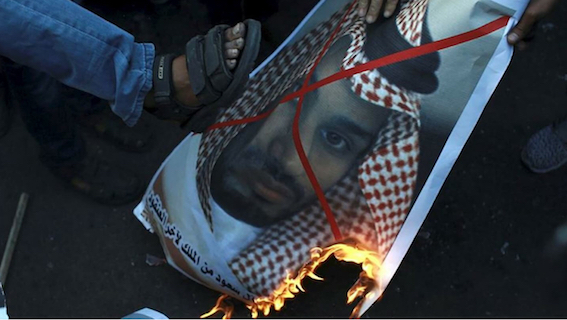
An image of the Saudi crown prince being burned by a Hamas-organized protest in Gaza
[Note by Tom Gross]
I attach an extract from a new book to be published in September by two Wall Street Journal correspondents.
They write:
“Prince Mohammed had worked doggedly for a year, outmaneuvering rivals and easing the path for his septuagenarian father Salman to assume the Saudi throne…
“By that July, Mohammed wanted a break. His privacy-obsessed entourage booked the entire Velaa resort for a month, at a cost of $50 million. Staff were banned from bringing cellphones with cameras. The American rapper Pitbull and the South Korean pop star Psy performed…”
“The models arrived first. Boats carrying some 150 women, from Brazil, Russia and elsewhere… Upon arrival, each woman was tested for sexually transmitted diseases and settled into a private villa.The women were due to spend the better part of a month with their hosts, several dozen friends of Saudi Arabia’s Prince Mohammed bin Salman, for a party marking his ascent…
“For much of Prince Mohammed’s life, his branch of the family was nowhere near as rich as others….”
BOOK EXTRACT
INSIDE THE RISE OF MOHAMMED BIN SALMAN
Inside the Rise of Mohammed bin Salman
The Saudi crown prince ascended with a taste for opulence, a hunger for money and a drive for power
By Bradley Hope and Justin Scheck
Wall Street Journal
Aug. 21, 2020
https://www.wsj.com/articles/inside-the-rise-of-mohammed-bin-salman-11597931772
The models arrived first. Boats carrying some 150 women, from Brazil, Russia and elsewhere, docked in the summer of 2015 at Velaa Private Island, an opulent Maldives resort. Upon arrival, each woman was driven in a golf cart to a clinic, tested for sexually transmitted diseases and settled into a private villa.
The women were due to spend the better part of a month with their hosts, several dozen friends of Saudi Arabia’s Prince Mohammed bin Salman, for a party marking his ascent. A 29-year-old prince with a taste for opulence, a hunger for money and a need for power found himself with an abundance of all three.
Prince Mohammed had worked doggedly for a year, outmaneuvering rivals and easing the path for his septuagenarian father Salman to assume the Saudi throne. After Salman took the crown in early 2015, he delegated extraordinary powers to Mohammed, who consolidated control of the military and security services and began upending the sleepy kingdom’s oil-dependent economy.
By that July, Mohammed wanted a break. His privacy-obsessed entourage booked the entire Velaa resort for a month, at a cost of $50 million, according to people familiar with the trip. Staff were banned from bringing cellphones with cameras. The American rapper Pitbull and the South Korean pop star Psy performed. The Maldives party was described by several people in attendance, including some involved in its planning.
During this time of excess, the young prince also bought the Serene – a 439-foot yacht rented by Bill Gates the year before – for 429 million euros, as well as a château near Versailles with fountains and a moat for more than $300 million.
Suddenly, the party was over. Word of Prince Mohammed’s visit leaked in a Maldivian publication. Media in Iran, Saudi Arabia’s enemy, picked it up and started blasting out the news. Less than a week after the trip started, Prince Mohammed and his delegation were gone.
The little-known party was a brief stop on Prince Mohammed’s wild ride. Over the next few years, he would curb Saudi Arabia’s notorious religious police, expand the rights of Saudi women, plunge into a war in Yemen, and lock up billionaires and relatives in Riyadh’s Ritz-Carlton Hotel on corruption allegations. His security forces would also assassinate the journalist Jamal Khashoggi in Istanbul. (Prince Mohammed has said he didn’t order the killing.)
Now, with the kingdom’s 84-year-old King Salman suffering health problems that have him in and out of the hospital – recently for a gallbladder operation – understanding the young prince’s rise is increasingly important for assessing the direction Saudi Arabia may take if Prince Mohammed becomes King Mohammed.
The Saudi heir apparent’s ostentatious spending and focus on wealth grew from a family secret. For much of Prince Mohammed’s life, his branch of the family was nowhere near as rich as others. As a senior prince, his father Salman received a huge monthly stipend but spent it running his palaces, paying staff and doling out largess.
It hit 15-year-old Mohammed like a brick when a cousin told him that Salman hadn’t amassed what Saudi royals deem a serious fortune. Even worse, Salman was dangerously indebted. Family friends were shocked in the first decade of the 2000s when word spread through Paris that Salman’s contractors and employees hadn’t been paid for six months. Rather than relying on the good graces of whoever was king, Prince Mohammed decided to become the family businessman.
This account is based on interviews with dozens of people across three continents who knew Prince Mohammed through business, familial or personal ties. Prince Mohammed declined to comment on his business interests or rise to power. When a CBS News reporter asked him about his spending in a TV interview two years ago, the prince said, “As far as my private expenses, I’m a rich person and not a poor person.”
By the time he was 16, Mohammed was able to pull together about $100,000 after selling gold and luxury watches he’d been given. It became the starting capital for a stock-trading foray.
It was soon lost. But first, Prince Mohammed’s portfolio briefly gained value, giving him a thrill he would keep chasing. He decided to go abroad after university and get into banking, telecommunications or real estate. He wasn’t expecting real political power in Riyadh; as a younger son of a prince with slim chances of becoming king, Mohammed had little hope of getting near the throne.
PRINCE MOHAMMED TALKED OF HIS PLANS TO BECOME A BILLIONAIRE LIKE STEVE JOBS OR BILL GATES
Some evenings, Prince Mohammed took friends into the Saudi desert, where staff made up tents and a campfire. He talked of his plans to become a billionaire like Steve Jobs and Bill Gates. He also spoke with mounting frustration about Saudi youth. “We are the ones who can decide the future of our generation,” he said one night, an attendee recalls. “If we don’t step up, who else will?”
Prince Mohammed focused on building a fortune, creating companies and acquiring stakes in others. In 2008, through intermediaries, he persuaded Verizon to bring fiber-optic infrastructure to Saudi Arabia. The deal saw Verizon take a minority stake in a joint venture whose biggest partner was one of Prince Mohammed’s many firms.
Verizon’s legal department was then headed by William Barr, now the U.S. attorney general. The deal helped Prince Mohammed’s stature at home – “My son made millions for the family,” Salman boasted to one visitor after the deal closed – but didn’t go anywhere. Prince Mohammed’s organization didn’t have the experience to deliver the project; Verizon took a write-down and left.
IN 2013, REGULATORS DETECTED SUSPICIOUS TRADING PATTERNS LINKED TO ACCOUNTS BELONGING TO PRINCE MOHAMMED AND OTHER PRINCES
Prince Mohammed’s stock trading also hit turbulence. In 2013, regulators detected suspicious trading patterns linked to accounts belonging to him and other princes. Saudi Arabia’s chief stock regulator at the time, Mohammed al Shaikh, investigated and determined that a trader acting on Prince Mohammed’s behalf was responsible for the suspicious trading. The incident incensed King Abdullah, and Prince Mohammed was pushed out of government affairs. (A spokesman for Prince Mohammed declined to comment on the episode.)
But it would be temporary. Even during his moneymaking days, Prince Mohammed was carefully studying how to gain – or, if necessary, regain – status in the Royal Court. He knew how to make himself useful to powerful old men like King Abdullah, performing tasks too distasteful for other princes, like evicting the widow of a former king from a palace she refused to vacate.
When Salman took the throne, Prince Mohammed’s ideas were suddenly the highest priority. The day after Abdullah’s funeral, Mohammed took charge of the Royal Court. At 4 a.m., he summoned officials and businessmen to meet later that day. Prince Mohammed asked them if remaking the Saudi government by getting rid of Abdullah’s governance committees was risky. Some counseled moving slowly to monitor for unforeseen impacts.
“Nonsense,” Prince Mohammed replied, according to a person who attended the meeting. “If it’s the right thing to do, we do it today.”
Within a week, Prince Mohammed was put in charge of the kingdom’s economy and military. Such haste would become a trademark. He surrounded himself with new advisers, some with little government background, and encouraged them to argue with him into the night on policy ideas. He elevated Mohammed al Shaikh – the man who investigated him in 2013 for insider trading – as a senior economic adviser.
Soon after, Prince Mohammed would take control of the state oil producer Saudi Aramco, the world’s most profitable company. With its money at his disposal, he would set to work turning the kingdom’s moribund sovereign-wealth fund into the most influential investor in Silicon Valley. The teenager obsessed with building his own fortune and emulating Steve Jobs now controlled more money than he knew what to do with. Building wealth and power became Prince Mohammed’s obsession.
(The authors are Wall Street Journal reporters. This essay is adapted from their book “Blood and Oil: Mohammed bin Salman’s Ruthless Quest for Global Power,” to be published Sept. 1.)
* You can also find other items that are not in these dispatches if you “like” this page on Facebook www.facebook.com/TomGrossMedia
Zoe Johnson
Zoe Johnson is the second woman ever to be appointed Senior Treasury Counsel by the attorney general to prosecute the UK’s most serious cases including Islamic terrorism, organized crime, abuse of public office, and honor killings. And she has done all this with the added difficulty of being confined to a wheelchair for almost her whole life.
(Discussion by zoom on August 12, 2020.)
Other conversations in this series:
Tom Gross
https://www.youtube.com/watch?v=T4Pg-IDYJYE
As part of a series of informal conservations with friends, Paul Lewis asks Tom Gross about his own life experiences and views: growing up surrounded by cultural and literary luminaries in London and New York; Sunday brunches with Elvis Presley’s songwriter; crossing Checkpoint Charlie into East Berlin with his grandmother during communism; helping the Roma when almost no one else would; Tom’s close relationship with his godmother Sonia Orwell (the model for the heroine Julia of her husband’s masterpiece ‘1984’); being in Manhattan on 9/11; the Mideast; the importance and legacy of the Holocaust; and other matters.
(Discussion by zoom on June 28, 2020.)
Jonathan Freedland
https://www.youtube.com/watch?v=Y_3phYh8WMU
Award-winning Guardian columnist Jonathan Freedland in conversation with Tom Gross about the state of the world; the Trump presidency (and whether some of his policies might be good); Britain’s coronavirus failures; early Zionism; whether Britain can still learn from the American constitution and system of government; and as a teenager how Jonathan was a mentor to Sasha Baron Cohen before he became Ali G and Borat.
* There is also a separate shorter conversation: Should statues of antisemites come down?
Jonathan Freedland & Tom Gross discuss left-wing antisemitism, and English antisemitism
Jonathan Freedland: Most British people aren’t aware that “one of Britain’s gifts to the world, which originated in England, is the blood libel” -- which led to countless Jewish deaths over many centuries of European history.
Tom Gross: Should the large statue outside the British Parliament of Richard the Lionheart (who was responsible for murder of tens of thousands of Jews) and the bust of Karl Marx (who wrote about Jewish vermin) come down?
(Answer: no they should remain. But schoolchildren should be taught at least a bit about historic English antisemitism, in addition to the wrongs, as well as rights, of the British Empire.)
(Conversation by zoom while under coronavirus lockdown on June 18, 2020)
The last Nazi-hunter Efraim Zuroff (Jerusalem)
Efraim Zuroff speaks about why he became a Nazi hunter, his pursuit of war criminals all over the world over many decades, and his efforts to make countries such as Lithuania, Latvia and Croatia admit to their own nation’s very substantial collaboration with the Nazi genocide. As the last survivors die out where does Holocaust education and memory go from here?
Why did it take Steven Spielberg’s 1993 film Schindler’s List to make Holocaust education finally become incorporated into the British education system some years later? Why did western countries and the Vatican and Red Cross help Nazi criminals escape at the end of the war? Why were so many doctors Nazis?
We also discuss the trial of Bruno Dey (charged for his part in the murder of 5,230 people at Stutthof death camp) which is continuing now in Hamburg – it is 75 years late but the German judge insisted it continue despite the coronavirus restrictions.
(Discussion by zoom, while under coronavirus lockdown in Jerusalem, on June 8, 2020.)
Oscar-nominated filmmaker Hossein Amini (London)
Born in Tehran to a distinguished Iranian family (his grandfather was prime minister under the shah) Oscar-nominated screenwriter and film director Hossein Amini speaks with his friend Tom Gross about Iran before and after the Islamic revolution, his career as a filmmaker, his work with Martin Scorsese and Harvey Weinstein, his favorite films, and says that ‘it’s no accident that the MeToo movement started in tolerant Hollywood’. We also discuss racism in Britain.
(Discussion by zoom, while under coronavirus lockdown in London, on May 30, 2020.)
David Pryce-Jones (London, Wales, Florence)
Writer David Pryce-Jones discusses his childhood escape from the Nazis, his friendships with Isaac Bashevis Singer, Arthur Koestler, Stalin’s daughter Svetlana, John Gross and others; and Israel, Italy, and the New York Times.
(Discussion by zoom, while under coronavirus lockdown in Wales, on May 21, 2020.)
John O’Sullivan (Budapest)
Born to modest parents near Liverpool (his father was a ship steward, his mother a shop girl) John O’Sullivan rose to become one of Margaret Thatcher’s most trusted aides and advisors in 10 Downing Street. In this zoom conversation, he discusses Thatcher’s personality and how she developed her views, and other leading figures he met. (On one occasion John had breakfast with Thatcher in London, then flew to Washington and had dinner with President Reagan that same evening.) He and Tom Gross also discuss Donald Trump’s presidency; the future of journalism; and his lifelong love for musical theatre.
(Discussion by zoom, while under coronavirus lockdown in Budapest, on May 29, 2020.)
World aclaimed pianist Evgeny Kissin (Prague)
Described by The Economist magazine as “the world’s most acclaimed classical pianist” Evgeny Kissin talks about being a child prodigy; his favorite concert halls and musicians; learning new repertoires and visiting Kafka’s grave during coronavirus lockdown; about Stalin’s murder of Yiddish writers, his own love for Yiddish, his support for Israel, and his political views about Russia and the West.
(Discussion by zoom, while under coronavirus lockdown in Prague, on May 24, 2020.)
* You can see shorter extracts from the conversation with Evgeny Kissin here: Conversations with friends: Evgeny Kissin on music, the Yiddish language, Israel and the Soviet Union
Amanda Foreman
https://www.youtube.com/watch?v=lFHkJcf0qO0
Historian and writer Amanda Foreman talks with Tom Gross about her life and career; her father Carl Foreman (who wrote the films Bridge on the River Kwai, High Noon, and Guns of Navarone, but who was then driven out of town by Senator McCarthy’s witchhunts); Amanda’s own encounter with John Wayne; her books; her TV series on the ascent of women; her nonprofit that helps deprived American kids to read; and about curating an exhibition last year on Queen Victoria for the current English queen in Buckingham Palace. Amanda also discusses why statues and icons are such popular targets in History wars.
(Discussion by zoom to New York on July 14, 2020.)
Rt Hon Lord (David) Young of Graffham
Lord David Young talks about his life, his ten years in Downing Street working closely with Margaret Thatcher, his five years in Downing Street with David Cameron, and about Boris Johnson, Donald Trump, and modern multicultural Britain.
(Discussion by zoom in Graffham, Sussex, in England, while under coronavirus lockdown, on May 20, 2020.)
Bahra Saleh (Kirkuk, Iraq)
Tom Gross talks with Bahra Saleh about her life and about Kurdistan.
(Discussion by zoom in Kirkuk, Iraq, while under coronavirus lockdown, on May 20, 2020.)
Shmuel Bar (Herzliya)
https://www.youtube.com/watch?v=j_ekSPVLMAg
Shmuel Bar, who worked for Israel’s government for 30 years in various analytical and operational capacities, and who is a world-class expert in a variety of fields, discusses the state of America, Europe, the Mideast and the world, and what dangers may lay ahead.
(Discussion by zoom, on July 2, 2020.)
Orit Yasu (Shoham, near Tel Aviv)
Born to recently arrived Ethiopian-Israeli parents, Orit Yasu talks with Tom Gross about growing up in Kiryat Malachi, the rescue of Ethiopian Jews by the Mossad, her participation in the 1999 Columbine High School shooting memorial while on a school trip to Colorado, on how NYC is too crowded, her trip to see her parents village Ethiopia, and why many Ethiopian-Israelis vote Likud.
(Discussion by zoom, while under coronavirus lockdown, on May 31, 2020.)
Charlotte Cunningham (Yorkshire / London / Luxembourg)
https://www.youtube.com/watch?v=kva8JQ1Jgsw
Charlotte, who has established a successful arts organization in England that helps people with mental and physical disabilities, has managed to forge her own path distinct from her illustrious family background -- her grandmother was the ruling monarch of Luxembourg after whom Charlotte is named; and on the other side of her family, her grandfather was US secretary of state under a Republican, Eisenhower, and then US treasury secretary under two Democrats, Kennedy and Johnson.
(Discussion by zoom, while under coronavirus lockdown in London, on June 19, 2020.)
Nidra Poller (Paris)
Writer Nidra Poller discusses hanging out with James Baldwin and other African-American writers and musicians in 1970s Paris, the origins of the name Nidra, how her Japanese partner introduced her to Israel, and the position of women in the modern world.
(Discussion by zoom, while under coronavirus lockdown in Paris, on May 19, 2020.)
Susan Loewenthal Lourenco (Berlin)
Educator Susan Lourenco talks about being the child of refugees from Berlin, her life in four different countries and how she reconciled herself with modern Germany.
(Discussion by zoom, while under coronavirus lockdown in Berlin, on May 12, 2020.)
* You can also find other items that are not in these dispatches if you “like” this page on Facebook www.facebook.com/TomGrossMedia
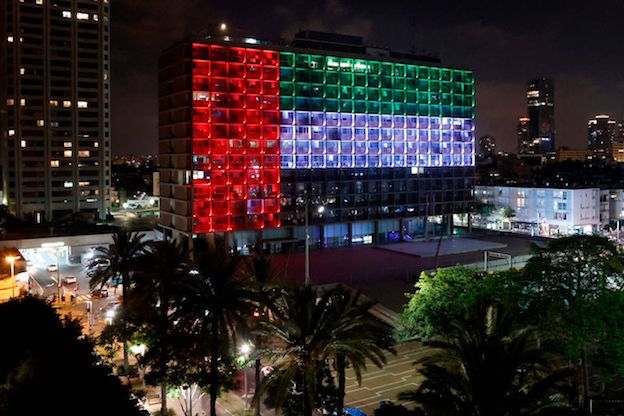
Tel Aviv city hall lit up in the colors of the UAE national flag last night
SOME MEDIA REACTION TO THE HISTORIC UAE-ISRAEL PEACE DEAL
[Note by Tom Gross]
Following yesterday’s dispatch (Saudi & Bahrain next? UAE becomes third Arab country to make peace with Israel), below is some commentary from today’s newspapers on the Israel-UAE peace deal.
In the first article below, a Wall Street Journal editorial says “President Trump’s liberal critics insisted his strong backing for Israel, and his hard pushback against Iranian imperialism would lead to catastrophe. [Instead] Trump’s strategy has delivered a diplomatic achievement… the first Arab League country to recognize the Jewish state in 20 years…”
“For decades Israel was treated as a pariah state in the Middle East, but that era may be ending… Recall that mandarins of Obama foreign policy said moving the U.S. Embassy to Jerusalem would cause an Arab backlash. In fact, it is being followed by some of the closest Arab-U.S.-Israeli cooperation on record.”
RARE PRAISE FOR TRUMP AND KUSHNER IN THE NEW YORK TIMES
In the second piece, New York Times, columnist Thomas Friedman gives some unusual (for the Times) backing for President Trump saying the president was right to call the deal his administration helped broker a “huge breakthrough.” Friedman, who has been a harsh critic of Trump and Netanyahu, calls the move yesterday “a breath of fresh air” and gives some cautious backing for “Trump’s peace plan drawn up by Jared Kushner” which he urges the Palestinian Authority to use as a basis for negotiations.
He notes: “The Palestinian Authority, led by Mahmoud Abbas, was also stripped of something by this deal, which may force him to the negotiating table. It stripped him of his biggest ace in the hole – the idea that the gulf Arabs would normalize with Israel only after the Israelis satisfied the demands of the Palestinian Authority with a state to its liking…
“This deal will certainly encourage the other gulf sheikhdoms – Bahrain, Oman, Qatar, Kuwait and Saudi Arabia – all of which have had covert and overt business and intelligence dealings with Israel, to follow the Emirates’ lead. They will not want to let the U.A.E. have a leg up in being able to marry its financial capital with Israel’s cybertechnology, agriculture technology and health care technology, with the potential to make both countries stronger and more prosperous.”
***
(See also my article in The Spectator of April 4, 2019: Could Donald Trump unexpectedly triumph in his bid for peace in the Middle East?)
HARDLINERS IN THE PALESTINIAN AUTHORITY AND IRAN SLAM THE DEAL
In the third piece below, Haaretz notes various Middle East reaction. Senior PLO official (and a favorite guest of the BBC and CNN) Hanan Ashrawi accuses the UAE of “selling out” the PLO. Palestinian President Mahmoud Abbas called it a “betrayal of the Al-Aqsa Mosque and the Palestinian cause.”
Iran’s Tasnim news agency, which is affiliated with the country’s elite Revolutionary Guards, likewise slammed the deal, saying it was “shameful.”
Meanwhile UN Secretary-General Antonio Guterres said he welcomed “any initiative that can promote peace and security in the Middle East region,” and U.S. Secretary of State Mike Pompeo praised the deal, saying “Blessed are the peacemakers. Mabruk and Mazal Tov.”
The Gulf state of Bahrain was among those welcoming yesterday’s accord between the United Arab Emirates and Israel, state news agency BNA reported.
SAUDI DIVISIONS
In the fourth piece below, Stephen Kalin points out that while Saudi Crown Prince Mohammed bin Salman (MbS), is eager to move ahead and sign a formal peace treaty with Israel, his father King Salman, who is 84 and in poor health, is resisting the move.
“The surprise move of the United Arab Emirates to normalize ties with Israel piles pressure on Saudi Arabia to follow suit” before other Gulf Arab nations such as Bahrain and Oman do so and get a head start.
BIDEN: “I WILL SEEK TO BUILD ON THIS PROGRESS”
In additional commentary not covered in the articles below:
Presumptive Democratic presidential candidate Joe Biden said: “Israel and the United Arab Emirates have taken a historic step to bridge the deep divides of the Middle East. The UAE’s offer to publicly recognize the State of Israel is a welcome, brave, and badly-needed act of statesmanship. And it is a critical recognition that Israel is a vibrant, integral part of the Middle East that is here to stay. Israel can and will be a valued strategic and economic partner to all who welcome it … a Biden-Harris Administration will seek to build on this progress, and will challenge all the nations of the region to keep pace.”
NETANYAHU’S ISRAELI CRITICS GIVE HIM CREDIT
Writing in Haaretz today, Anshel Pfeffer, Netanyahu’s biographer and a fierce critic of the Israeli prime minister, says that that Netanyahu has achieved something that his predecessors, who were prepared to make major concessions to the Palestinians, only dreamed of – and he paid nothing for it beyond what he called the “temporary suspension” of the annexation he was never going to carry out anyway.
Yediot Ahronot columnist Nahum Barnea writes that Netanyahu deserves credit for the historic agreement with the UAE, and says that the Israeli hard right will have to adjust its approach, after Netanyahu failed to push ahead with applying Israeli sovereignty to parts of Judea and Samaria (the West Bank).
Another Yediot Ahronot columnist, Ben-Dror Yemini, asks: “Is it possible to reach peace with the Arab world without resolving the Palestinian issue, based on the formula of ‘peace in exchange for peace?” (rather than land for peace). He says yes it is, and yesterday’s deal undermines the central theory of the American and Israeli Left that if you don’t first cave into maximalist demands from the Palestinian Authority, Israel won’t be able to make peace with Arab countries.
***
Tom Gross adds: The central tenet of Netanyahu’s approach dating back decades, is that the only way the Palestinian Authority may agree to compromise and make a true peace agreement with Israel is if it sees that the Arab world is going to make peace with Israel anyway.
(Incidentally, for Arabic speakers you can see extracts from an interview I gave earlier today to BBC Arabic about the UAE-Israel accord, on the BBC Arabic website.)
CONTENTS
1. “Trump’s Mideast Breakthrough” (Wall St Journal editorial, Aug. 14, 2020)
2. “A Geopolitical Earthquake Just Hit the Mideast” (By Thomas Friedman, New York Times, Aug. 14, 2020)
3. “Palestinians Slam ‘Betrayal’ by UAE in Deal With Israel: ‘Reward of the Occupation’s Crimes’” (Haaretz, Aug. 14, 2020)
4. “Israel’s Normalization With U.A.E. Squeezes Saudi Arabia” (By Stephen Kalin, Wall St Journal, Aug. 14, 2020)
ARTICLES
TRUMP’S MIDEAST BREAKTHROUGH
Trump’s Mideast Breakthrough
The Israel-UAE accord discredits Obama’s regional vision.
Wall Street Journal editorial
Aug. 14, 2020
https://www.wsj.com/articles/trumps-mideast-breakthrough-11597360774?mod=opinion_lead_pos3
President Trump’s Mideast strategy has been to strongly back Israel, support the Gulf monarchies, and press back hard against Iranian imperialism. His liberal critics insisted this would lead to catastrophe that never came, and on Thursday it delivered a diplomatic achievement: The United Arab Emirates and Israel agreed to normalize relations, making the UAE the first Arab League country to recognize the Jewish state in 20 years.
The agreement is worth celebrating on its own terms but it also holds lessons for U.S. foreign policy. On regional strategy, this shows the benefit of the U.S. standing by its historic allies in the Middle East.
President Obama shunned Israel and the Gulf states and sought to normalize Iran. His nuclear deal, an economic boon to Tehran, was a means to that end. But Iran does not want to be normalized. It’s a revolutionary regime that wants to disrupt the non-Shiite countries, spread its military influence from Syria to Lebanon to Yemen, and destroy Israel.
Mr. Trump’s pivot from Iran reassured Israel and the Gulf states and put the U.S. in a position to broker agreements. Israel and the UAE have worked together covertly, but the agreement will allow deeper economic ties and strengthen regional checks on Iranian power. UAE’s move could also spur Bahrain and possibly Oman to seek the benefits, in Jerusalem and Washington, from closer Israel ties. For decades Israel was treated as a pariah state in the Middle East, but that era may be ending.
As for the Israel-Palestine question, as part of the deal Israeli Prime Minister Benjamin Netanyahu agreed to call off annexation of parts of the West Bank. Public support in Israel for annexation was shaky. It was also opposed by the military establishment and would have carried diplomatic costs. With the UAE deal, Mr. Netanyahu can avoid annexation while protecting against criticism from his right.
The UAE can say it blocked annexation and protected the Palestinian cause. But the fact that annexation was a bargaining chip at all shows how the balance of power in the Israel-Palestine conflict has shifted in Israel’s favor. Arab states would previously have demanded far greater concessions in exchange for recognition. But the Iran threat, plus the Palestinians’ long-running rejectionism, has made that issue less important to Arab states.
Recall that mandarins of Obama foreign policy said moving the U.S. Embassy to Jerusalem would cause an Arab backlash. In fact, it is being followed by some of the closest Arab-U.S.-Israeli cooperation on record. Larger strategic realities in the Middle East are more important and are driving this change.
One question is whether a Joe Biden Administration would grasp this, or whether it would follow the Obama model of retrenchment against Iran plus browbeating Israelis for their supposed moral failings. The Biden campaign praised the deal while Ben Rhodes, an architect of Obama Administration policy, blasted it for “the total exclusion of Palestinians.”
Yet the coterie of anti-Israel and Iran-friendly Democratic foreign-policy hands may soon find their influence reduced. The UAE deal strengthens the anti-Iran coalition and withdraws an excuse – annexation – that the left could use to attack Israel. Whoever wins in November, the breakthrough leaves the U.S. in a better position in the Middle East.
A GEOPOLITICAL EARTHQUAKE JUST HIT THE MIDEAST
A Geopolitical Earthquake Just Hit the Mideast
The Israel-United Arab Emirates deal will be felt throughout the region.
By Thomas L. Friedman
The New York Times
Aug. 14, 2020
https://www.nytimes.com/2020/08/13/opinion/israel-uae.html
For once, I am going to agree with President Trump in his use of his favorite adjective: “huge.”
The agreement brokered by the Trump administration for the United Arab Emirates to establish full normalization of relations with Israel, in return for the Jewish state forgoing, for now, any annexation of the West Bank, was exactly what Trump said it was in his tweet: a “HUGE breakthrough.”
It is not Anwar el-Sadat going to Jerusalem – nothing could match that first big opening between Arabs and Israelis. It is not Yasir Arafat shaking Yitzhak Rabin’s hand on the White House lawn – nothing could match that first moment of public reconciliation between Israelis and Palestinians.
But it is close. Just go down the scorecard, and you see how this deal affects every major party in the region – with those in the pro-American, pro-moderate Islam, pro-ending-the-conflict-with-Israel-once-and-for-all camp benefiting the most and those in the radical pro-Iran, anti-American, pro-Islamist permanent-struggle-with-Israel camp all becoming more isolated and left behind.
It’s a geopolitical earthquake.
To fully appreciate why, you need to start with the internal dynamics of the deal. It was Trump’s peace plan drawn up by Jared Kushner, and their willingness to stick with it, that actually created the raw material for this breakthrough. Here is how.
The Kushner plan basically called for Israel and the Palestinians to make peace, with Israel being able to annex some 30 percent of the West Bank, where most of its settlers were, and the Palestinians getting to establish a demilitarized, patchwork state on the other 70 percent, along with some land swaps from Israel.
The Palestinians rejected the deal outright as unbalanced and unjust. But Israeli Prime Minister Benjamin Netanyahu, who basically helped to write the very pro-Israel plan, said he intended to proceed with the annexation part of the plan by July 1 – without agreeing to the part that his political base of Jewish settlers rejected: Palestinians later getting a state on the other 70 percent. (I wonder if Trump’s ambassador to Israel, David Friedman, a pro-settler extremist himself, encouraged Bibi to think he could get away with this.)
It didn’t work, because Kushner, who was hearing regularly from Egypt, Jordan and the gulf Arabs that such a unilateral Israeli annexation would be a total deal-breaker for them, told Bibi, “Not so fast.” Kushner persuaded Trump to block Bibi’s cherry-picking of the plan by taking annexation now.
This was causing Netanyahu to lose support from the settlers – and, at a time when he is on trial on corruption charges and facing daily protests outside his home over his poor performance in leading Israel out of the coronavirus epidemic, left him sinking in the polls.
So what Trump, Kushner, Prince Mohammed bin Zayed, the de facto leader of the Emirates, and Netanyahu did was turn lemons into lemonade, explained Itamar Rabinovich, one of Israel’s leading Middle East historians and a former ambassador to Washington.
“Instead of Israeli annexation for a Palestinian state, they made it Israeli non-annexation in return for peace with the U.A.E.,” said Rabinovich in an interview. Kushner, he added, “basically generated an asset out of nothing, which Israel could then trade for peace with the U.A.E. It was peace for peace, not land for peace.”
This process apparently started after the U.A.E.’s ambassador to Washington, Yousef al-Otaiba, published a letter in Hebrew in the Israeli newspaper Yediot Ahronot in June directly warning that Israeli annexation of the West Bank would undermine the quiet progress Israel had made with the gulf Arabs.
The U.A.E. had been mulling going for more open diplomatic ties with Israel for a while, but it was the discussions over how to stop annexation that created a framework where the U.A.E. could be seen as getting something for the Palestinians in return for its normalization with Israel.
The Netanyahu dynamics here are fascinating, or as Israeli writer Ari Shavit remarked to me: “Netanyahu is trying to get out of his own personal Watergate by going to China. He’s like Nixon in reverse.”
What he meant was that Netanyahu had been doing everything he could to appease the right-wing forces in Israel – with shiny objects like annexation – so they would side with him in his corruption trial against Israel’s court system and attorney general.
By taking this deal, Netanyahu, as Nixon did with China, abandoned his natural ideological allies – the settlers who supported him because they thought he would deliver annexation – “and this will force Netanyahu to become more dependent on the center and center-right in Israel going forward,” said Shavit. “This deal may help save Israeli democracy by now depriving Bibi” of the full army of right-wing forces “he needed to destroy the Israeli Supreme Court.”
The Palestinian Authority, led by Mahmoud Abbas, was also stripped of something by this deal, which may force him to the negotiating table. It stripped him of his biggest ace in the hole – the idea that the gulf Arabs would normalize with Israel only after the Israelis satisfied the demands of the Palestinian Authority with a state to its liking.
(Free advice for Abbas: Come back to the table now and say you view the Trump plan as a “floor,” not a “ceiling” for Palestinian aspirations. You will find a lot of support from Trump, the Europeans and the Arabs for that position. You still have leverage. Israel still has to deal with you, because your people in the West Bank are not going to just disappear, no matter what happens with the U.A.E. and Israel.)
This deal will certainly encourage the other gulf sheikhdoms – Bahrain, Oman, Qatar, Kuwait and Saudi Arabia – all of which have had covert and overt business and intelligence dealings with Israel, to follow the Emirates’ lead. They will not want to let the U.A.E. have a leg up in being able to marry its financial capital with Israel’s cybertechnology, agriculture technology and health care technology, with the potential to make both countries stronger and more prosperous.
Three other big winners here are: 1) King Abdullah of Jordan. He feared that Israeli annexation would energize efforts to turn Jordan into the Palestinian state. That threat is for the moment defused. 2) The American Jewish community. If Israel had annexed part of the West Bank, it would have divided every synagogue and Jewish community in America, between hard-line annexationists and liberal anti-annexationists. This was a looming disaster. Gone for now. And 3) Joe Biden. Biden, if he succeeds Trump, will not have to worry about the thorny issue of annexation, and he should have a much stronger pro-American alliance in the region to work with.
The big geopolitical losers are Iran and all of its proxies: Hezbollah, the Iraqi militias, Syrian President Bashar al-Assad, Hamas, Islamic Jihad, the Houthis in Yemen and Turkey. This is for a number of reasons. Up to now, the U.A.E. has kept up a delicate balance between Iran and Israel, not looking to provoke Iran, and dealing with Israel covertly.
But this deal is right in Iran’s face. The tacit message is: “We now have Israel on our side, so don’t mess with us.” The vast damage Israel inflicted on Iran through apparent cyberwarfare in recent months may have even given the U.A.E. more breathing room to do this deal.
But there is another message, deeper, more psychological. This was the U.A.E. telling the Iranians and all their proxies: There are really two coalitions in the region today – those who want to let the future bury the past and those who want to let the past keep burying the future. The U.A.E. is taking the helm of the first, and it is leaving Iran to be the leader of the second.
When the Trump administration assassinated Qassim Suleimani, the head of Iran’s Quds Force, the foreign-operations branch of the Islamic Revolutionary Guards Corps in January, I wrote a column saying that America had just killed “the dumbest man in Iran.”
Why? Because what was Suleimani’s business model, which became Shiite Iran’s business model? It was to hire Arab and other Shiites to fight Arab Sunnis in Iraq, Lebanon, Yemen and Syria – to project Iran’s power. And what was the result of all this? Iran has helped to turn all four into failed states. Iran’s clerical leadership has become the largest facilitator of state failure in the Middle East – including its own – which is why so many Lebanese blame it and Hezbollah for their country’s mismanagement that led to the devastating explosion last week in Beirut’s port.
I have followed the Middle East for too long to ever write the sentence “the region will never be the same again.” The forces of sectarianism, tribalism, corruption and anti-pluralism run deep there. But there are other currents – young men and women who are just so tired of the old game, the old fights, the old wounds being stoked over and over again. You could see them demonstrating all over the streets of Beirut last week demanding good governance and a chance to realize their full potential.
The U.A.E. and Israel and the U.S. on Thursday showed – at least for one brief shining moment – that the past does not always have to bury the future, that the haters and dividers don’t always have to win.
It was a breath of fresh air. May it one day soon turn into a howling wind of change that spreads across the whole region.
PALESTINIANS SLAM ‘BETRAYAL’ BY UAE IN DEAL WITH ISRAEL: ‘REWARD OF THE OCCUPATION’S CRIMES’
Palestinians Slam ‘Betrayal’ by UAE in Deal With Israel: ‘Reward of the Occupation’s Crimes’
UAE defends normalization with Israel, which it says ‘stopped annexation of Palestinian lands,’ while top PLO official lashes out at UAE for ‘selling out’ Palestinians
Haaretz news report
August 14, 2020
https://www.haaretz.com/israel-news/.premium-plo-official-lashes-out-at-uae-for-selling-out-palestinians-in-israel-agreement-1.9071095
The announcement on Thursday of normalization of ties between Israel and the United Arab Emirates drew harsh responses from Palestinian officials and organizations, with senior PLO official Hanan Ashrawi accusing the crown prince of “selling out” her people and Palestinian President Mahmoud Abbas convening an emergency meeting of Palestinian leaders ahead of a statement.
Palestinian President Mahmoud Abbas said he “rejects and denounces the surprising announcement by Israel, the United States and the UAE,” and called it a “betrayal of Jerusalem, Al-Aqsa Mosque and the Palestinian cause.” A senior adviser to Abbas read the statement from outside the PA president’s Ramallah headquarters.
Israel got rewarded for not declaring openly what it’s been doing to Palestine illegally & persistently since the beginning of the occupation,” senior Palestinian official Hanan Ashrawi wrote on Twitter. She also said the UAE has come forward with its “secret dealings/normalization with Israel.”
“Please don’t do us a favor. We are nobody’s fig leaf!” she wrote.
In another tweet, addressed at the UAE’s crown prince, she wrote: “May you never experience the agony of having your country stolen; may you never feel the pain of living in captivity under occupation; may you never witness the demolition of your home or murder of your loved ones. May you never be sold out by your ‘friends.’”
According to the agreement, brokered by the United States, Israel had agreed to stop plans to annex parts of the West Bank. The Palestinians have repeatedly urged Arab governments not to normalize relations with Israel until a peace agreement establishing an independent Palestinian state is reached.
The Hamas militant group accused the United Arab Emirates of stabbing the Palestinians in the back by agreeing to establish full diplomatic ties with Israel. “This announcement is a reward for the Israeli occupation’s crimes,” said Hamas spokesman Fawzi Barhoum. “The normalization is a stabbing in the back of our people.”
Iran’s Tasnim news agency, which is affiliated with the country’s elite Revolutionary Guards, likewise slammed deal, saying it was “shameful.”
While Iran’s clerical leaders did not immediately react to the deal, a special adviser on international affairs to the speaker of Iran’s parliament condemned it on Twitter. “UAE’s new approach for normalizing ties w/fake, criminal #Israel doesn’t maintain peace & security, but serves ongoing Zionists’ crimes,” tweeted Hossein Amir-Abdollahian, also a former deputy foreign minister. “Abu Dhabi’s behavior has no justification, turning back on the Palestine cause. W/ that strategic mistake, #UAE will be engulfed in Zionism fire.”
Israel’s President Reuven Rivlin meanwhile hailed an “impressive achievement” and said he has invited Abu Dhabi’s Crown Prince Sheikh Mohammed Bin Zayed to visit Jerusalem.
Several Israeli lawmakers meanwhile welcomed the news.
Defense Minister Benny Gantz, who is also the so-called alternate prime minister under a power sharing deal, said Thursday’s agreement expressed an “alliance” between countries in the region who aim for stability and prosperity. He said the agreement will have “many positive implications” on the region and called on other Arab states to pursue peace deals with Israel.
He thanked U.S. President Donald Trump, calling him a “true friend of Israel.”
Foreign Minister Gabi Ashkenazi, part of Gantz’s Kahol Lavan party, said he welcomed Israel’s backing down from “unilateral annexation” of the West Bank, saying Trump’s Mideast plan would be discussed in consultation with countries in the region.
Opposition leader Yair Lapid said “negotiations and agreements, not unilateral steps like annexation” were key to Israel’s diplomatic relations.
United Nations Secretary-General Antonio Guterres welcomes “any initiative that can promote peace and security in the Middle East region,” a UN spokesman said after the announcement.
U.S. Secretary of State Mike Pompeo praised the deal. “This is a remarkable achievement for two of the world’s most forward leaning, technologically advanced states, and reflects their shared regional vision of an economically integrated region,” he said in a statement. “It also illustrates their commitment to confronting common threats, as small – but strong – nations.”
He added: “Blessed are the peacemakers. Mabruk and Mazal Tov.”
Top Emirati official Anwar Gargash told reporters Thursday that the move dealt a “death blow” to moves by Israel to annex Palestinian lands.
Anwar Gargash, the UAE Minister of State for Foreign Affairs, told reporters on Thursday that the Emiratis wanted to “try and put one on one together” and develop an organic relationship that was already existing in many fields.
“Let us try and get something tangible,” he said.
He described it as a “bold step.” “We’ve come up with a realization,” he said. “Our relationship has not always been central... but we came out and argued that in every difficult political file in the region, when you do have bridges and contacts you become more important and influential in trying to affect results and trying to help.”
“The UAE is using its gravitas and promise of a relationship to unscrew a time bomb that is threatening a two-state solution,” Gargash said. When asked about a time frame for embassies opening, Gargash said it will not be long and “this is for real”. “We are not talking about step by step.”
Foreign Ministry spokeswoman Hend Al Otaiba defended the agreement in a tweet, saying: “The three-way call resulted in an agreement to stop Israeli annexation of Palestinian lands. UAE has worked strenuously over the past months for this diplomatic achievement, which will bring stability to the region and support the peace process.”
Egyptian President Abdel Fattah al-Sisi meanwhile reacted positively to the news.
“I followed with interest and appreciation the joint statement between the United States, United Arab Emirates and Israel to halt the Israeli annexation of Palestinian lands and taking steps to bring peace in the Middle East,” Sisi said on Twitter.
“I value the efforts of those in charge of the deal to achieve prosperity and stability for our region.”
Jordan said that the deal could push forward stalled peace negotiations if it succeeds in prodding Israel to accept a Palestinian state. “If Israel dealt with it as an incentive to end occupation ... it will move the region towards a just peace,” Foreign Minister Ayman Safadi said in a statement on state media.
The Gulf state of Bahrain welcomed an accord between the United Arab Emirates and Israel which stops Israeli annexation plans and raises the chances of peace, state news agency BNA said on Thursday.
The small island state of Bahrain is a close ally of Saudi Arabia, which has not yet commented on the agreement to normalize diplomatic ties announced on Thursday.
Bahrain praised the Untied States for its efforts towards securing the deal.
(The Associated Press and Reuters contributed to this story.)
ISRAEL’S NORMALIZATION WITH U.A.E. SQUEEZES SAUDI ARABIA
Israel’s Normalization With U.A.E. Squeezes Saudi Arabia
The U.S. could exert significant leverage, given President Trump’s unwavering support for the Saudi crown prince
By Stephen Kalin
Wall Street Journal
Aug. 14, 2020
https://www.wsj.com/articles/israels-normalization-with-u-a-e-squeezes-saudi-arabia-11597397402
The surprise move of the United Arab Emirates to normalize ties with Israel piles pressure on Saudi Arabia to follow suit – at the risk of inflaming public sentiment and breaking from the monarchy’s track record of promoting the Palestinian cause.
Other Gulf Arab nations such as Bahrain and Oman – which have already held high-level public meetings and given tentative backing to a U.S. proposal for Middle East peace – are more likely to move closer to Israel first, officials and analysts said.
But given President Trump’s unwavering support for Saudi Crown Prince Mohammed bin Salman, particularly in the face of intense international criticism over the 2018 killing of a dissident Saudi journalist, the U.S. administration also has significant leverage should it try to extract another diplomatic breakthrough in the Middle East.
“They’ve got to be feeling pressure. But as long as Salman is king it won’t happen,” said Kirsten Fontenrose of the Atlantic Council think tank.
Prince Mohammed has spearheaded Saudi Arabia’s warming outreach to Israel in recent years and quietly pressed the Palestinians to support President Trump’s peace plan from its early inception.
But King Salman, 84 and in poor health, has taken pains to reiterate the monarchy’s steadfast support for an independent Palestinian state and an Arab League plan that has formed the basis for broad Arab normalization with Israel for two decades.
Saudi Arabia, which hosts the holiest Muslim sites in Mecca and Medina, has long claimed the mantle of Islamic leadership. A turnaround on Israel could spark domestic unrest.
“Saudi Arabia will probably eventually follow a similar path, but it will be more hesitant and move slower,” Ayham Kamel, Middle East head at political-risk advisory firm Eurasia Group, said in a note. “The deal could not have been sealed without some form of coordination with Riyadh.”
David Schenker, assistant secretary of state for near eastern affairs, said the U.S. was talking about normalization with other states “that have quiet relations with Israel and find it very much in their interest,” but denied that explicit pressure was being applied.
He compared the U.A.E. deal with Israel’s 1979 peace treaty with Egypt, which was followed 15 years later by one with Jordan. “I would expect that this too will have an impact on regional perceptions and how states define their interests and what they can do to advance those interests,” Mr. Schenker said in an online interview with the Kuwait-based Reconnaissance Research think tank.
Following the announcement, the Palestinian Authority warned Arab countries against “bowing” to American pressure and following in Abu Dhabi’s footsteps. It recalled its ambassador from the U.A.E.
Trump administration officials said they were cautiously optimistic that Saudi Arabia would be willing to follow suit in a few years. Prince Mohammed’s ascension to the throne, expected within a few years, could speed up the thawing relations with Israel.
Minister of State for Foreign Affairs Anwar Gargash said the U.A.E. had not contacted its allies before Thursday’s three-way call with Israel and the U.S. But one U.S. official said Riyadh was told in advance that the deal was coming.
In addition to domestic concerns, Saudi Arabia is wary of criticism from regional rivals Iran and Turkey, which both also aspire to lead the Muslim world.
Hossein Amir-Abdollahian, a special adviser on international affairs to the speaker of Iran’s parliament, slammed the U.A.E. deal, tweeting: “Abu Dhabi behavior has no justification, turning back on the Palestine cause. W/ that strategic mistake, UAE will be engulfed in Zionism fire.”
* You can also find other items that are not in these dispatches if you “like” this page on Facebook www.facebook.com/TomGrossMedia

Israeli Prime Minister Benjamin Netanyahu speaking by phone this afternoon from his Jerusalem office with UAE leader Mohammed Bin Zayed shortly after they confirmed the two leaders would sign a formal peace treaty.
HISTORIC BREAKTHROUGH: UAE BECOMES THIRD ARAB COUNTRY TO FORMALLY MAKE PEACE WITH ISRAEL
[Note by Tom Gross]
This afternoon in an historic move, Israel and United Arab Emirates agreed to sign a formal peace treaty and establish diplomatic relations.
The United Arab Emirates will be the third Arab country to establish full diplomatic ties with the Jewish state following Egypt and Jordan.
US President Donald Trump, who first announced the deal, minutes before Israel and the UAE confirmed it, hinted that other peace treaties between Arab states and Israel may be announced soon.
A White House spokesperson said delegations from Israel and UAE will meet in the coming weeks to sign bilateral agreements on investment, tourism, direct flights, security and the establishment of reciprocal embassies.
US Secretary of State Mike Pompeo described it as “a historic day and a significant step forward for peace in the Middle East. The United States hopes that this brave step will be the first in a series of agreements that ends 72 years of hostilities in the region.”
Israel’s Channel 12 news reported that Israeli Foreign Minister Gabi Ashkenazi and Defense Minister Benny Gantz were kept out of the loop by Netanyahu who secretly held negations with the UAE, and Netanyahu only updated his colleagues on the agreement shortly before it was announced today.
NEW YORK TIMES PUNDITS, WRONG AGAIN
Tom Gross adds:
Having been present at meetings with officials from Israel and various Arab countries for many years, I have for some time been saying that the Arab world was quietly making peace with Israel, and have observed that Arab leaders were particularly keen to do so under the auspices of hardline Israeli leader Benjamin Netanyahu and hardline American leader Donald Trump.
While journalists I know from papers such as the New York Times and Haaretz repeatedly told me in private that I “didn’t know what I was talking about” others acknowledged I might be right. For example, Robert Fulford, who has been described as Canada’s most eminent columnist, wrote in an article in April 2019 in Toronto’s National Post:
https://nationalpost.com/opinion/robert-fulford-why-the-arabs-are-ready-for-a-peace-with-israel
“Tom Gross, probably Europe’s leading observer of the Middle East, suggested recently that much of the Arab world is already quietly establishing ties with Israel.”
(While Trump and Netanyahu are despised by many New York liberals, one hears considerable admiration for them when one speaks behind the scenes with Arab governmental figures and opinion-makers, who in turn loathe President Obama, in large part because of what is regarded as Obama and John Kerry’s appeasement of the Iranian regime which made the rest of the Middle East a much more dangerous place.)
Last year, I became the first journalist who is broadly sympathetic to Israel to be selected to be favorably profiled in Asharq Al-Awsat, the Arab world’s leading newspaper. The pan-Arab paper is edited from Beirut, Saudi-government owned, and printed in 14 different countries.
Among past related dispatches:
* UAE, Bahraini FMs mark Holocaust Memorial Day, ally of Saudi monarch says ‘Never again’ (January 26, 2020)
* Israeli warplanes hold joint exercise with UAE (March 28, 2017)
* Four Israeli ministers visit Gulf states in the space of just over a week - and without headscarves (November 10, 2018)
* Netanyahu returns from secret trip to Oman (October 26, 2018)
UPDATE
See also this follow up dispatch on the UAE-Israel peace accord:
“Blessed are the peacemakers. Mabruk and Mazal Tov” (& Peace for peace formula paying dividends) (Aug. 14, 2020)
* You can also find other items that are not in these dispatches if you “like” this page on Facebook www.facebook.com/TomGrossMedia