

Delegations from the UAE and Bahrain prepare to take part in a Western Wall Hanukah lighting ceremony with Israeli orthodox rabbis in Jerusalem yesterday.
VIDEO: JEWISH-MUSLIM HANUKAH IN DUBAI
[Note by Tom Gross]
It is worth watching this one-minute video:
Or here:
https://www.facebook.com/TomGrossMedia/posts/3532629640107863
TRENDS THAT CAN POTENTIALLY PROVE GLOBALLY IMPORTANT FOR THE GENERAL MODERATION OF EXTREMISM
It is not just that peace agreements have been forged in the last couple of years between Israel and several Arab governments. More importantly, a remarkably warm peace between peoples is emerging too. There are now countless examples every day, far too many to send out on this Mideast dispatch list.
Crucially this is manifesting itself not just on a national level -- with Arab interest in Israeli society, sport, culture, with Morocco starting to teach thousands of years of Jewish history on its national school curriculum -- but there are also now examples of reconciliation between Islam and Judaism. These trends can potentially prove globally important for the general moderation of extremism, I feel.
As readers of these dispatches know, I have spent considerable time over the past 20 years with people from different walks of life in countries throughout the Arab world, including Saudi, Bahrain, Yemen, Iraq and others.
THE VILE AND IRRATIONAL HATRED THAT IS ANTISEMITISM
While of course there are still problems and prejudices (as there are among some Jews too), I’ve always felt and long argued that the worst of the vile and irrational hatred of Israel (no doubt stemming from conscious or subconscious antisemitism) was to be found among some people in Europe and North America (including some journalists, academics and even some European diplomats) -- and not as a general rule among the many middle easterners I have met (with the exception of Muslims who grew up in the west who have also been influenced by western antisemitism).
That is not to say that full peace is about to break out, or there isn’t still a great amount of prejudice against Jews in countries like Egypt or among the Iranian regime.
But there has been remarkable progress over the last two or three years. One can’t help feeling that if the Abraham Accords and other polices that led to this progress had been the result of another president’s polices other than President Trump’s (who handpicked his former lawyers and his son-in-law to come up with them), the western media would have paid a lot more attention and given more positive coverage to these pieces of good news.
(Of course, one understands the reluctance to praise Trump given his sheer obnoxiousness at times, but the media should nonetheless give credit where credit is due.)
UAE AND BAHRAIN GROUPS ATTEND WESTERN WALL HANKKAH LIGHTING CEREMONY
The above photo shows delegations from the UAE and Bahrain preparing to take part in Western Wall Hanukah lighting ceremony with Israeli orthodox rabbis in Jerusalem yesterday.
Rabbi Shmuel Rabinovitch, chief rabbi of the Western Wall, said “It is a Hanukah miracle to see the delegation from the UAE and Bahrain here with us participating in the Hanukkah candle-lighting ceremony. Who would have believed that peace would come to our house in such a magnificent way?”
Dr. Majid a-Sarah from the University of Dubai, said: “To visit Israel for the first time as part of this delegation is a historic moment. Israel is a prime example of tolerance in the region. This is a new era of peace and stability between peoples.”
Mashaal a-Shamri said: “As a Bahraini woman visiting Israel, it is a great honor for me to be here and also to have met the Israeli president today. We see Israel as a place of peace, success and coexistence.”
MEANWHILE IN RAMALLAH
Meanwhile in the West Bank, things are often not nearly as bad as certain western journalists would like to claim:
Here is a new video from Ramallah:
https://www.youtube.com/watch?v=RJ2qS-BXbew
* You can also find other items that are not in these dispatches if you “like” this page on Facebook www.facebook.com/TomGrossMedia

PEACE WITH MOROCCO; QATAR DEAL MAY BE IMMINENT
[Note by Tom Gross]
U.S. president Donald Trump has just announced that Morocco has agreed to full diplomatic relations with Israel. (The Israeli and Moroccan governments are yet to confirm the news.)
Morocco will become the fourth Arab country to normalize relations with Israel in just the last four months, following the UAE, Bahrain and Sudan.
The peace moves all emanate from the diplomacy resulting from the Trump Middle East peace plan that his team spent most of his administration working on -- a team largely composed of persons such as former Trump (real estate) Organization lawyers Jason Greenblatt and David Friedman who had no background in professional diplomacy.
Trump sealed the agreement in a phone call today with Morocco’s King Mohammed VI, a senior U.S. official said.
Under the agreement, Morocco will establish full diplomatic relations with Israel, grant overflights and also direct flights to and from Israel for all Israelis.
Trump’s son-in-law White House senior adviser Jared Kushner has just said:
“The two countries are going reopen their liaison offices in Rabat and Tel Aviv immediately with the intention to open embassies. And they are going to promote economic cooperation between Israeli and Moroccan companies.”
WEST SAHARA SOVEREIGNTY
More controversially, as part of the agreement, the U.S. has agreed to recognize Morocco’s sovereignty over the Western Sahara, where there has been a decades-long territorial dispute with Morocco confronting the Algeria-backed Polisario Front, a breakaway movement that seeks to establish an independent state in the territory.
“Morocco recognized the United States in 1777. It is thus fitting we recognize their sovereignty over the Western Sahara,” Trump said in another tweet within the last few minutes.
QATAR DEAL IMMINENT?
Last week Kushner and his team traveled to Saudi Arabia and Qatar seeking an end to the bitter conflict between Doha and the Gulf Cooperation Council countries. There is speculation that recognition of Israel by Qatar could be part of a deal Kushner is trying to broker.
Many Middle East experts have urged the incoming Biden team to continue with the Trump Middle East policies in the hope that more deals, including between Israel and Saudi Arabia, will be forthcoming, and not to return to the Obama-era polices which were perceived as being far too soft on the Iranian regime but relatively hostile to Israel and several Arab countries.
* You can also find other items that are not in these dispatches if you “like” this page on Facebook www.facebook.com/TomGrossMedia
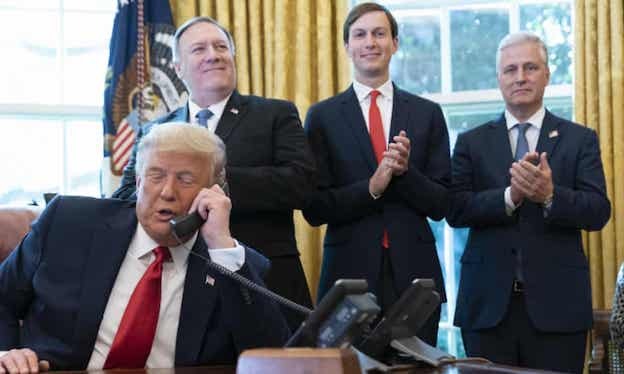
Donald Trump on a joint phone call with the leaders of Sudan and Israel in October as Trump announced that Secretary of State Mike Pompeo had successfully brokered a Sudan-Israel peace deal.
SUDAN-ISRAEL PEACE DEAL MAY BE AT RISK
[Note by Tom Gross]
I attach two articles below, from today’s Wall Street Journal, and from The Spectator magazine in the UK, concerning the Israel-Sudan peace deal. This is potentially one of the most important American foreign policy achievements of recent decades.
The Wall Street Journal strongly criticizes Democrat senators Senate Minority Leader Chuck Schumer and Bob Menendez, for trying to block it.
The senators seem more interested in undermining the Trump administration’s achievements than in advancing what is strategically an extremely important peace deal for the wider African continent and for the Middle East. As I pointed out in recent dispatches, Sudan has previously been one of the Iranian regime’s closest allies, as well as a sponsor of terrorism against America and others. It also played host to Osama bin Laden and al Qaeda.
As The Spectator points out “For decades, Khartoum has punched above its weight in the gruesome league table of states that sponsor terror. Sitting on the shores of the Red Sea, the predominantly Arab country controls maritime routes towards the port of Eilat, and has been a major player in smuggling arms to Gaza and [to Isis-affiliated groups in] the Sinai.”
“Peace with Sudan would be a gamechanger on a number of levels. Not only would it create a greatly enhanced security landscape to the south, permanently locking out Iranian interests, but it would send a powerful message to others in the region that no hatred is too bitter to overcome,” writes Jake Wallis Simons (who is a subscriber to this list).
“Muslim-majority countries like Mali, Niger and Mauritania – maybe even Somalia and Libya – will be watching carefully. With up to 80 per cent of Sudanese scratching a living from the land, [promised] Israeli agricultural expertise could be of profound benefit, showcasing the Jewish state’s reinvention as a prize Arab ally.”
ARTICLES
TRIAL LAWYERS Vs. ARAB-ISRAELI PEACE
Trial Lawyers vs. Arab-Israeli Peace
Schumer and Menendez block a deal to bring Sudan closer to the West.
Lead editorial
The Wall Street Journal
December 7, 2020
When the White House announced in October that Sudan planned to normalize relations with Israel, it showed that the peace movement could extend beyond the Persian Gulf. The northeast African country is changing for the better, but a pair of self-interested Senators could derail this progress.
Sudan had been a geopolitical nightmare for most of dictator Omar al-Bashir’s 30 years in power. He fell last year, and Abdalla Hamdok, an economist and reformer, became Prime Minister. A quarter-century after the country hosted Osama bin Laden and al Qaeda, the transitional government is opening up civil society and promising democratic elections in 2022.
Washington and Khartoum have negotiated a broad deal to improve ties. On top of the agreement with Jerusalem, Sudan has put $335 million in an escrow account to pay victims of al Qaeda’s 1998 U.S. embassy bombings. In exchange the U.S. would lift its state sponsor of terrorism designation and restore Sudan’s sovereign immunity. The deal would open the country to foreign investment, which its shrinking economy desperately needs. But Congress needs to approve.
Mr. Hamdok leads a fragile government and has survived an assassination attempt. Many Islamists are unhappy with his turn to the West, and some problematic officials from the Bashir era remain influential. It could be tough for the reformer to keep pushing change—or even remain in office—if the agreement falls through and his legitimacy becomes questionable. Israeli-Sudanese normalization would be off the table, and Sudan’s currently poor ties with Iran would likely warm up.
This seems like an easy U.S. call, and the deal has overwhelming support on Capitol Hill. But Senate Minority Leader Chuck Schumer and Senator Bob Menendez (D., N.J.) blocked a bipartisan legal-peace bill in September on grounds that 9/11 victims would no longer be able to pursue claims against Sudan as a state sponsor of terrorism. Yet the compromise bill would have let victims use the Justice Against Sponsors of Terrorism Act (Jasta) to pursue Sudan alongside Saudi Arabia. Some of the 9/11 victims’ lawyers found this compromise acceptable.
Messrs. Schumer and Menendez have provided two counteroffers that amount to ransom notes. Khartoum would outright reject the first bill because it doesn’t provide immunity from state-sponsor-of-terrorism claims. The second includes several major amendments to Jasta—providing more avenues of attack for trial lawyers—that even went beyond the public demands of some 9/11 victims’ lawyers. Other unrelated demands would enrich attorneys without making the world safer. The two Democrats are willing to damage U.S. interests to massage their lawyer donors.
The Senate plans to adjourn Dec. 18, and there isn’t much time to pass legislation. Theoretically the next Congress can take up the issue, as the payment in escrow won’t return to Sudan until October. But there’s no guarantee that the Sudanese government, under more strain without a deal, would survive that long.
The Sudanese people want to move on from the Bashir era, and they deserve help in making a clean break. A failure to get the deal done would be a tragedy for them—and for U.S. interests in an already tough neighborhood.
A SUDAN-ISRAEL PEACE DEAL COULD BE TRUMP’S CROWNING ACHIEVEMENT
A Sudan-Israel peace deal could be Trump’s crowning achievement
By Jake Wallis Simons
The Spectator
December 5, 2020
Twitter is not always kind to the Jewish state. But the peace accord between Israel, UAE and Bahrain that was signed in Washington in September has opened the floodgates to a social media love-in. In one video, recently shared by Ivanka Trump, an Israeli called Amit Deri expresses his astonishment at finding produce from his country in a food market in Dubai. Elsewhere, in pictures that were shared thousands of times, a vast Emirati flag is seen projected onto the façade of Tel Aviv’s city hall. Even Israel's prime minister Benjamin Netanyahu has got involved, posting in Arabic this week to mark UAE’s national day, alongside a video in which he referred to the Arab state as ‘our new friends’.
These were not empty tweets. Joint initiatives have been announced almost daily, from collaboration between Israeli and Arab newspapers to the opening of a Jewish school in Dubai – not to mention meaningful cooperation on trade and tourism. It is no surprise that, having been treated like a pariah for decades, Israel’s Twitter community is displaying existential levels of relief. But amid the flurry of memes and hashtags, an even more important peace agreement is in danger of collapse.
In the sweltering heat of the late summer of 1967, the impoverished North African state of Sudan became synonymous with the most anti-Israel pronouncement in history. Two months earlier, Israel had all but obliterated three Arab armies in the Six Day War. In response, the Arab League met in the Sudanese capital to issue a notorious resolution dubbed the ‘Three Nos of Khartoum’: no to peace, no to recognition, no to negotiation.
For decades, this became the regional benchmark. Yet in October, Israel and Sudan agreed to normalise relations, marking the greatest advance for peace since the Jordan agreement 26 years ago. The pivot from foe to friend – Sudanese troops have seen action against Israel in the past – was far more dramatic than those of the UAE and Bahrain the previous month. This made it an extraordinary landmark on the road to peace.
This week, however, Khartoum applied the brakes, demanding that Congress grants immunity from terror charges before any deal is finalised. Given the helter-skelter nature of the Trump-Biden transition period, this is no simple matter. A deal with Sudan has always been ambitious. It required serious American incentives to lure Khartoum to the negotiating table, including a promise to remove it from the State Department’s list of sponsors of terrorism and a reported £3 billion in aid.
From a Sudanese point of view, legal immunity is another vital piece of the puzzle. Without it, potential foreign investors would be spooked by fears of hefty compensation payouts in the future. According to the New York Times, Secretary of State Mike Pompeo promised that immunity would be conferred by late December, when a peace ceremony is already pencilled in. But nerves on all sides are jangling.
None more so, perhaps, than in Jerusalem. Sudan, a war-ravaged, poorly-educated and largely agrarian state, may lack the charisma of its flashy Gulf counterparts. But even without any ‘I heart Sudan’ hashtags, this deal is a serious geostrategic goal for the Israelis. For decades, Khartoum has punched above its weight in the gruesome league table of states that sponsor terror. Sitting on the shores of the Red Sea, the predominantly Arab country controls maritime routes towards the port of Eilat, and has been a major player in smuggling arms to Gaza and the Sinai.
When Omar al-Bashir – who later gained notoriety as the butcher of Darfur – seized power in 1989, he lost no time in fast-tracking the country to Islamisation, teaming up with Tehran and acting as a bridge for the theocracy’s interests in North Africa. Not only did Sudan become a key arms supplier to Hamas, Hezbollah and militants in Yemen and Somalia, but in the early Nineties it offered a safe haven to Osama Bin Laden and his Al Qaeda goons after they were hounded out of Saudi Arabia.
The country soon became a theatre for a covert conflict. Following its ‘Campaign Between Wars’ strategy, the Jewish state sought to maintain its security by launching attack after attack on Iranian interests in the country. In 2009, Israeli warplanes destroyed a convoy of trucks that were said to be transporting Tehran’s missiles to Hamas, and naval commandos attacked an Iranian arms ship in Port Sudan. In 2012, a weapons factory near Khartoum, reportedly belonging to Iran's Revolutionary Guards, was blown up in what was widely believed to be an Israeli operation. These are only some of the raids that were reported.
In Israeli eyes, peace with Sudan would be a gamechanger on a number of levels. Not only would it create a greatly enhanced security landscape to the south, permanently locking out Iranian interests, but it would send a powerful message to others in the region that no hatred is too bitter to overcome.
Muslim-majority countries like Mali, Niger and Mauritania – maybe even Somalia and Libya – will be watching carefully. With up to 80 per cent of Sudanese scratching a living from the land, Israeli agricultural expertise could be of profound benefit, showcasing the Jewish state’s reinvention as a prize Arab ally.
So why the sudden hesitation from Khartoum? The answer is rooted in internal tensions. After Bashir was ousted in a coup last year, the country was placed under the care of a ‘provisional government’ of military and civilian factions, until a promised election in 2022.
The military figures, chairman Abdel Fattah al-Burhan and the national rottweiler Muhammad Hamdan ‘Hemedti’ Dagalo, have traditionally been in favour of peace with Israel. Civilian leaders such as prime minister Abdalla Hamdok are said to be less convinced.
In truth, by the twilight of Bashir’s rule, Sudan had already fallen out of love with Iran. It joined the Saudi coalition in Yemen in 2015, and severed diplomatic ties with Tehran the following year. Despite its continued links with Qatar and Turkey, this brought it into Israel’s wider orbit.
Over the last three years, the US has steadily been lifting trade embargoes on the country. And as a further taste of the rewards on offer, UAE, Israel’s new friend, has started investing heavily in Sudan, seeking to draw the country deeper into Western-friendly embrace.
From the point of view of Sudan’s military chiefs, building on this trajectory makes sense. Not only would a peace deal win international legitimacy and enable an Egypt-style military cooperation with Israel, it would camouflage their personal complicity in the Darfur atrocities.
Sanitising the country’s pariah status, they argue, would open the door to wider foreign investment, which is sorely needed with 43,000 Ethiopian refugees fleeing across the border from the conflict in Tigray. Civilian leaders, meanwhile, are wary of provoking a Sudanese public that has long subsisted on a diet of anti-Israel propaganda. Hamdok has dragged his feet in the peace talks, trying to persuade Pompeo to wait until the 2022 elections.
After decades of civil war, military coups and regional power games, Sudan is in a period of transition, making the popular mood hard to read. While the prospect of a peace deal was met with a smattering of demonstrations on the streets of Khartoum, this has not developed into a wider movement.
One poll found that 32 per cent of the Sudanese public believed Arab states should coordinate foreign policy with Israel. Another, however, suggested that a similar number saw the Jewish state as Sudan’s ‘greatest threat to stability’.
Either way, much work is to be done. Seen through Israeli eyes, despite the economic incentives – including tasty local projects once electricity is pumped out from a huge new dam in neighbouring Ethiopia – it’s not easy to get into bed with an unstable country run by a junta with such a bloody record.
Given the complicated backstory, if the Trump administration does sneak a peace deal over the line, we’re unlikely to see Twitter lighting up with Sudan-Israeli love. Some bad blood is hard to expunge.
But there is more at stake here than social media likes. In the hard light of geopolitics, a cold peace with a sworn enemy can be more valuable than videos of effusive Israelis retweeted by Ivanka Trump. If the pieces do fall into place, a Sudan deal could be one of the most important moves Trump makes for the region before his curtain call.
* You can also find other items that are not in these dispatches if you “like” this page on Facebook www.facebook.com/TomGrossMedia

This film version of Roald Dahl’s ‘Charlie and the Chocolate Factory’ stars Johnny Depp.
Among the letters Dahl (author of ‘Matilda’ and other children’s bestsellers) got in response to his remarks excusing the Holocaust and his repeated denigration of Jews was one from two San Francisco schoolchildren. It read: “Dear Mr Dahl, We love your books, but we have a problem ... we are Jews!! We love your books but you don’t like us because we are Jews. That offends us! Can you please change your mind about what you said about Jews. Love, Aliza and Tamar.”
His family have now finally apologized for his decades-long antisemitism.

The annual Hannukah concert will once again take place at the Royal Concert Hall in Amsterdam this month. The concert, at the prestigious Dutch music venue, was suspended for over seven decades after the Nazis and their Dutch helpers put an end to it and went on to murder at least 75% of Dutch Jewry in the Holocaust.
[Notes below by Tom Gross]
NEW YORK TIMES OMIT’S DAHL’S HITLER REMARKS
At the end of this dispatch, I attach the piece from yesterday’s (London) Sunday Times, which first revealed that the family of best-selling children’s author Roald Dahl has quietly apologized for his decades-long antisemitism.
Since the news broke yesterday morning, it has been reported widely around the world.
Yet, whereas all other reports I have read from media in seven different countries (for example, in The Guardian) prominently highlight the worst of Dahl’s antisemitism – his attempt to excuse Hitler and justify the Holocaust – only one paper, the New York Times, omits this key part of Dahl’s antisemitism from its story.
***
Many have questioned why the Dahl family apology did not include any regret for previously refusing to apologize, despite the issue being raised by many people (including by myself in past writings).
The apology comes as the family are attempting to secure new commercial contracts in America.
Historically, there have of course been a number of successful antisemitic writers in Britain and elsewhere (TS Eliot for example), but it is particularly offensive that Dahl was still trying to justify Hitler or excuse the Holocaust decades after it happened.
NEW YORK TIMES: “GOODBYE TO HANNUKAH”
Another unpleasant piece in the New York Times (on December 5) was titled “Goodbye to Hannukah.”
(The celebratory Jewish festival starts this Thursday.)
As a friend commented to me: Tom, will the next New York Times article will be “Goodbye to Jews”. Do you think they would publish an article by a non-Muslim saying “Goodbye to Ramadan” before Ramadan?”
“PUPPY FOR HANUKKAH”
Here is something more fun about Hannukah.
A new rap-klezmer mix song by Daveed Diggs titled, “Puppy for Hanukkah”:
It has been watched over 450,000 times on YouTube since it was posted three days ago.
Diggs is best known for his starring roles as the Marquis de Lafayette and Thomas Jefferson in the original cast of the megahit musical “Hamilton,” which also premiered in a recorded stage version on Disney+ this summer.
“My mom is a white Jewish lady and my dad is black,” Diggs told Broadway.com in 2015.
‘D IS FOR DAVID’: GERMANY TO RETURN TO PRE-NAZI ALPHABET TABLE WITH JEWISH NAMES
German schools have announced that they plan a return to pre-World War II alphabet tables that existed before the Nazis removed all names with Jewish associations.
The old version of the tables that use names to help children learn to spell – such as “A for Anton” and “B for Berta” – will be used from fall 2021.
The Nazis removed all Jewish names from the alphabet tables in 1934. For example, “D for David” became “D for Dora” and “N is for Nathan” became “N for North Pole”.
The change was decided by a committee at the German Institute for Standardization after a campaign launched by Michael Blume, the antisemitism commissioner for the state of Baden-Wuerttemberg.
Blume said “My concern is that the Nazis’ table should not simply be continued. It is a nice gesture for the year in which we celebrate 1,700 years of Jewish life in Germany to make it clear what the table originally looked like.”
ARTICLE
ROALD DAHL’S FAMILY POSTS QUIET APOLOGY FOR ANTISEMITISM
Roald Dahl’s family posts quiet apology for antisemitism
The late writer’s estate has issued a discreet statement online expressing regret
By Gabriel Pogrund
The Sunday Times (of London)
December 6 2020
Roald Dahl died 30 years ago, but as his official website boasts, he has continued his “extraordinary mission to amaze, thrill and inspire generations of children and their parents”.The enduring popularity of his books decades after he died, aged 74 in 1990, has also proved lucrative for generations of his descendants. His estate posted revenues of £23m in its latest accounts. However, one unfortunate detail continues to cast a shadow over his legacy and brand: Dahl’s self-confessed antisemitism, which manifested itself in a notorious interview with the New Statesman in 1983.
In it, he said: “There is a trait in the Jewish character that does provoke animosity, maybe it’s a kind of lack of generosity towards non-Jews. I mean, there’s always a reason why anti-anything crops up anywhere.” He added: “Even a stinker like Hitler didn’t just pick on them for no reason.”
Today, it can be revealed that the Dahl family recently met for the first time in several years to discuss the problem and published a discreet apology for his racism on his website. The statement was never displayed prominently, or sent to the media or Jewish groups.
Instead, to find it from the home page of Dahl’s official website, one must scroll down to the bottom, click “About us”, then choose to “Find out more about the Roald Dahl Story Company” [RDSC], the little-known corporate entity that runs his literary estate. You must then click on “RDSC and family notice”, which does not mention the words “apology”, “antisemitism” or Roald Dahl.
There is no way of accessing the apology from the website’s main menu. Nor is there any mention of Dahl’s antisemitism in his biography on the website.
The apology itself is full-throated. It reads: “The Dahl family and the Roald Dahl Story Company deeply apologise for the lasting and understandable hurt caused by some of Roald Dahl’s statements. Those prejudiced remarks are incomprehensible to us and stand in marked contrast to the man we knew and to the values at the heart of Roald Dahl’s stories, which have positively impacted young people for generations.” It adds: “We hope that, just as he did at his best, at his absolute worst, Roald Dahl can help remind us of the lasting impact of words.”
Might the lack of prominence given to the apology simply be the result of a lack of access to public relations know-how?
That is unlikely; this year the estate has paid the lobbying firm Portland Communications to do other work including organising celebrity readings of Dahl’s works and charity events linked to his name.
There is a powerful incentive to do so. In 2018, the latest period for which data exists, the estate posted annual pretax profits of £12.7m, thanks to television and cinema deals, royalties, fancy-dress costumes and a line of baby toiletries. In March, Netflix announced that the Oscar-winning director Taika Waititi was making an adaptation of Charlie and the Chocolate Factory, Dahl’s 1964 classic, and a second one about the factory workers, the Oompa-Loompas.
During the same month, Matilda the Musical completed an international tour. In October, Warner Bros released its film Witches, based on his 1983 book, with the Hollywood star Anne Hathaway taking the role played by Anjelica Huston in the original 1990 film.
Every year, his estate gives a percentage of its profits to charity, equal to 8% of revenue in 2018. But philanthropy aside, his family have benefited handsomely from his abiding popularity. His daughter Ophelia Dahl, 56, owns the majority of the estate. Luke Kelly, 34, Dahl’s grandson and the half-brother of the former model Sophie Dahl, was one of three directors of the Roald Dahl Story Company who together received remuneration totalling £2.2m, according to the 2018 accounts.
Promoting Dahl’s work and linking him to charitable causes is crucial to the estate. Earlier this year, Portland oversaw a campaign in which stars such as Meryl Streep, Benedict Cumberbatch and Cate Blanchett narrated James and the Giant Peach, Dahl’s 1961 novel, to raise funds to help poor countries tackle the Covid-19 crisis. Yet such activities cannot erase Dahl’s lengthy back catalogue of racism. Although he fought the Nazis as an RAF pilot during the Second World War, he expressed his dislike of Jewish people in numerous interviews.
As well as his infamous 1983 statement in the New Statesman, in 1990 he acknowledged that he was an antisemite. “I’m certainly anti-Israeli and I’ve become antisemitic in as much as that you get a Jewish person in another country like England strongly supporting Zionism,” he said in The Independent.
Some also believe Dahl used antisemitic themes and stereotypes in his work, including inventing a character in the screenplay for the film Chitty Chitty Bang Bang (1968) who did not appear in Ian Fleming’s original novel: the Child Catcher. The character wore a black hat, long black coat and had a huge pointed nose.
Dahl’s racism has received some attention in recent years. In 2017, the comedian David Baddiel, who is Jewish, said he would not be celebrating Roald Dahl Day, which takes place every year on the author’s birthday — September 13 — despite being a fan of his work.
Many close to the estate and family are thought to believe the problem could receive more attention as they court film and television deals in America, on which the estate has become increasingly reliant. Company accounts show that 82% of its revenue comes from outside the UK.
The estate’s apology is in marked contrast to Dahl’s own approach to complaints about his antisemitism.
Shortly before his death, he received a letter from two San Francisco schoolchildren that read: “Dear Mr Dahl, We love your books, but we have a problem ... we are Jews!! We love your books but you don’t like us because we are Jews. That offends us! Can you please change your mind about what you said about Jews. Love, Aliza and Tamar.”
In response Dahl merely said he was against injustice, not Jewish people.
He was less cordial when The Jewish Chronicle called. “I’m an old hand at dealing with you buggers,” he is recorded as saying. “No comment.”
The Roald Dahl Story Company said: “Apologising for the words of a much-loved grandparent is a challenging thing to do, but made more difficult when the words are so hurtful to an entire community. We loved Roald, but we passionately disagree with his antisemitic comments.
“This is why we chose to apologise on our website, an apology easily found on Google. The Sunday Times now provides an opportunity to repeat this apology. These comments do not reflect what we see in his work — a desire for the acceptance of everyone equally — and were entirely unacceptable. We are truly sorry.”
* You can also find other items that are not in these dispatches if you “like” this page on Facebook www.facebook.com/TomGrossMedia