

Above: The photograph known as “The Last Jew in Vinnitsa” taken during the Holocaust in Ukraine showing a Jewish man about to be shot dead. The Nazis and their Ukrainian Fascist allies murdered about 1.5 million Jews in Ukrainian towns and shtetls during the Holocaust, including about 35,000 Jews in the Vinnitsa area.
After an international outcry 18 months ago, Amazon’s UK site took down advertisements promoting T-shirts celebrating the Holocaust with the photograph of “The Last Jew in Vinnitsa”. However, the items, including T-shirts, tank tops and hoodies, remained available on Amazon’s French site for some time after that.
-- Tom Gross
Today is International Holocaust Remembrance Day. I’m still not that well and don’t have energy to write a longer dispatch but for those interested in this subject, you may wish to view some previous dispatches.
THE CHILDREN OF BULLENHUSER DAMM
This was an article I wrote last April to mark the 75th anniversary of a virtually unknown massacre.
With British troops only three miles away, doctors working for the SS ordered 20 Jewish children (ten girls and ten boys, aged between five and 12 years old, from Italy, Slovakia, France, Poland and Holland), to be hanged during the night in the basement of a school at Bullenhuser Damm in Hamburg. They were hanged in order to cover up the experiments (torture) that the Austrian and German doctors had been conducting on the children.
http://www.tomgrossmedia.com/mideastdispatches/archives/001918.html
HONOURING THE DEAD, ONE STONE AT A TIME
This is an article I wrote in May 2019 about Czech Jews.
http://www.tomgrossmedia.com/mideastdispatches/archives/001843.html
HOW ONE FILM (SCHINDLER’S LIST) REVOLUTIONIZED HOLOCAUST COMMEMORATION
This is an article my father wrote in 1994.
http://www.tomgrossmedia.com/mideastdispatches/archives/001254.html
THE LAST NAZI-HUNTER EFRAIM ZUROFF
This is my recorded conversation last year with Efraim Zuroff.
http://www.tomgrossmedia.com/mideastdispatches/archives/001933.html
VIOLINIST BELA DEKANY
This is my recorded conversation last year with distinguished violinist Bela Dekany, who aged 93, is one of the oldest subscribers to this email dispatch list.
As a teenager, Bela (who grew up in Hungary) survived an Austrian slave labor camp, the Bergen-Belsen death camp in Germany, and Theresienstadt (Terezin) concentration camp north of Prague.
http://www.tomgrossmedia.com/mideastdispatches/archives/001957.html
GERMANY’S PRESIDENT SPEAKS IN HEBREW, AND OTHER SPEECHES
Many of these speeches made to mark International Holocaust Remembrance Day in January 2020 are very powerful:
http://www.tomgrossmedia.com/mideastdispatches/archives/001899.html
THE LAST SURVIVORS OF AUSCHWITZ (& ‘I HAVE A MESSAGE FOR YOU’)
There is a personal note at the end of this dispatch.
http://www.tomgrossmedia.com/mideastdispatches/archives/001898.html
It is also worth viewing the short film in the above dispatch (‘I Have a Message for You’) with Belgian-born Holocaust survivor Klara Prowisor.
“MY AUNT HAD A DINNER PARTY, AND THEN SHE TOOK HER GUESTS TO KILL 180 JEWS”
To save you time, since this dispatch also has other items in it, the article in question is also copied below.
http://www.tomgrossmedia.com/mideastdispatches/archives/001711.html
My Aunt Had a Dinner Party, and Then She Took Her Guests to Kill 180 Jews
Swiss journalist Sacha Batthyany knew he belonged to an aristocratic family, centered around his respected aunt. He didn’t know about the murderous ball held in 1945, that led to a personal quest, threats from relatives and a book.
By Gili Izikovich
Haaretz
June 29, 2017
One morning in April 2007 journalist Sacha Batthyany was approached by an elderly colleague at the Swiss daily where they both worked at the time.
The colleague waved a newspaper clipping in front of him. It was an investigative report entitled, “The Hostess from Hell,” published by a German daily.
Glancing at the headline, Batthyany didn’t understand why he was being shown this article, but then he looked at the picture of the hostess and recognized it immediately. It was Margit, his father’s aunt – someone to whom the family demonstrated the utmost respect and also around whom they tended to tread carefully.
So he started to read the piece. In March 1945, it said, just before the end of World War II, Margit held a large party in the town of Rechnitz on the Austrian-Hungarian border to fete her Nazi friends. She, the daughter and heiress of European baron and tycoon Heinrich Thyssen, and her friends drank and danced the night away.
At the height of the evening, just for fun, 12 of the guests boarded trucks or walked to a nearby field, where 180 Jewish slave laborers who had been building fortifications were assembled. They had already been forced to dig a large pit, strip, and get down on their knees. The guests took turns shooting them to death before returning to the party. The organizer of this operation was Margit’s lover Hans Joachim Oldenberg. Margit’s husband, Count Ivan Batthyany, Sacha’s grandfather’s brother, was also at the party.
It was the first time that Batthyany, then 34, had heard about this incident. He was shocked. “Let’s set aside that it was my aunt,” said Batthyany, who visited Israel last week as a guest of the Jerusalem Book Fair. “It’s just an incredible, brutal story of this night. I mean, I know there are hundreds and thousands of other [violent stories] from the war – I don’t want to compare, but if you read what happened that night it is just unbelievable.”
In the article in Frankfurter Allgemeine Zeitung, the writer, David Litchfield, describes the party as a celebration of death. Killing for dessert. “I was in shock. I was shocked and surprised that I had never heard of this. And I had studied history, I knew more than the average person, but I’d never heard about this massacre or about Rechnitz, or about my family’s connection to any kind of story connected to the Holocaust.
“I remember that I had to finish a stupid assignment I was working on but all I was thinking was that I couldn’t wait to talk to my father.
“This area between Budapest and Vienna is where my family comes from, where my family owned land and castles and stuff. I remember asking him, ‘Did you ever hear of Rechnitz?’ And he said, ‘Yes, of course.’ Then I asked him, ‘Did you know about the massacre?’ and he said, ‘Yeah, yeah. I knew about it. I heard about it, of course, I’m not stupid.’ So I asked, ‘Did you know that Margit was at the party that night when it happened?’ And he replied, ‘Yes, everyone knew it.’
“So I wasn’t talking as logically as I am now, but I said more or less, ‘So you knew A and you knew B, but you never made the connection?’ And he said no. I asked him why not and he said, ‘I don’t know why not.’
“And it was this moment that was the starting point of all the emotional stuff about not drawing the connection. Why not? Who has the power to decide not to ask? He said he never thought about it. He never thought there was a connection between the people in the castle and what happened there. Everyone knew that [Margit] had affairs with Nazis, she was a German who was very much into the Nazi regime and she had affairs, but no one ever wanted to ask the questions.”
PERSONAL UPHEAVAL
These questions led to the appearance a decade later of “A Crime in the Family,” the fascinating book that Batthyany wrote about the incident, originally in German, and translated into English by Anthea Bell. Batthyany set out that morning in April 2007 on an in-depth search.
With the caution of a sapper dismantling a bomb, he peeled away the historical details he needed to expose. The fact that he was asking questions of his aristocratic family, the fact that he was uncovering the layers of this embarrassing history demanded a great deal of courage. It was also a personal upheaval: How was he connected to this history? How had it shaped his life, his personality, and his image?
Everything is integrated in the book from several points of view. It’s not just the story of that sickening night. Batthyany also explores the connection between his grandmother, Marita, and an Argentinean woman named Agnes Mandel, a Jewish refugee from the village in which the two grew up, one as the daughter of the local nobleman and the other as the daughter of village Jews who were murdered.
He also tells the story of his grandfather, who was imprisoned for a decade in Siberia and came out a shadow of a man; of how his paternal grandparents fled with his father, then a teenager, from Soviet-occupied Hungary to the home of the wealthy Countess Margit. And he examines the family pathology, the pathology of men who were eternally grateful to Margit and who preferred never to ask any questions.
The Batthyanys were European aristocrats who lost most of their property under the Soviet occupation but who had obviously been important. Batthyany says that when he visited Hungary, his name jolted the hotel staff, who treated him with great respect and sent champagne and fruit to his room.
Growing up in Switzerland he was regarded as the slightly strange son of immigrants (“I have a difficult name and people thought I was from India”) and had no clue that somewhere there were streets, castles, parks and even a chocolate cake bearing the family’s name. He also had no knowledge of the dozens of Batthyany descendants who held periodic family gatherings in Austria or Hungary.
But what Batthyany saw in that German newspaper report changed everything. He responded like a journalist, getting his editor to agree to give him time off to investigate. He began reading and searching in archives and also began to question distant relatives whom he had never met. When some of the cousins told him about a family gathering that was to take place, he announced that he was coming and that he planned to discuss the story.
In his book he describes the meeting: A few dozen Batthyanys, eating sandwiches and drinking coffee from elegant cups, none of them too thrilled to discuss the matter. “After a while it became really nasty,” he says. “One of the old uncles said, ‘What if it’s all not true’ and ‘Who owns the media’ and about vested interests and all this anti-Semitic stuff. Elfriede Jelinek, an Austrian playwright, wrote a play about the story, and they were talking about her and it became nasty.”
He recalls that the deeper he dug, the more intense the reactions became, to the point that relatives warned him to stop. “They called me like in a Mafia movie – no joke, anonymous calls saying ‘your name doesn’t matter, I’m just telling you to stop.’” At that family gathering an uncle of his with whom he’d actually been quite close said, ‘Don’t play with the name of our family. You have no idea what could happen.’”
But Batthyany continued his search, travelling to Rechnitz three times, the first time as a tourist. “Then I talked to the mayor; the mayor was nice. I even spoke to a woman who was that the party that night, who has since died. She told me that not only was my aunt there, but also her husband, Ivan, who is directly my family. My father and Ivan were friendly.
“It took months. I was working at a magazine then and my boss at the time allowed me to focus on this, but after some weeks I realized that this was going to be different than any other investigative piece I’d done.”
Batthyany’s initial research resulted in a magazine feature, but the topic gave him no rest. Though it was only one night in the history of a family that ostensibly felt distant enough from the event to be able to suppress it, Batthyany was tormented. He continued to work, married and had a family. Today he and his wife and three children live in Washington, where he is a correspondent for the Germany daily Süddeutsche Zeitung and other publications. But what he thought would end with a magazine article continued to haunt him.
When the Soviets occupied Hungary, tens of thousands of people, including his father and grandfather, fled. But unlike others, who ended up in a Red Cross refugee camp, their journey ended when the rich aunt sent a private chauffeur to pick them up and bring them to a castle near the Italian-Swiss border. Their first meal was an elegant dinner with glasses of sherry.
Aunt Margit employed Batthyany’s grandfather in one of her factories, completely financed his father’s education and, as he later understood, was the dominant matriarchal figure in the family.
“I couldn’t let it go,” he says. “I knew what I had to know, but I wasn’t done. I understood that this was my family and the questions didn’t stop. The title of the book in German is exactly the question that intrigued me then: ‘What Does it Have to do With Me?’ I realized this was the question I was interested in, but I had no idea how to approach it and answer.”
The answer he found was complex. Batthyany started to see a psychoanalyst, and the insights he derived from the conversations with him appear in the book. There are also sections of a diary his grandmother wrote and diligently edited in the last years of her life. The grandmother talks about the Mandels, the parents of Agnes who ended up in Argentina. Batthyany found Agnes and her daughters and formed a close relationship with them based on a shared fate and shared insights.
He also traveled with his family to Siberia to trace his grandfather’s life in the gulag and to understand what happened to him during that decade no one ever spoke about.
The picture that emerges from the book is well-rounded, moving from the personal to the historic, as it emerges that the victim and the criminal are part of the same family. Batthyany’s obsession with the past, with what happened and who was involved, seems at times like a mirror image of what so preoccupies Israelis, a desire to dig deeply and to decipher the present through people who are long lost.
Batthyany writes on the last page of the book about the similarity between him and the children and grandchildren of Agnes, again like a mirror image. He says that Agnes and the daughters and even the children of the daughters “always went to Hungary to this little tiny village in the middle of nowhere.”
He recalls: “There’s really nothing there. And they always went there to – I don’t know, to look for something or just to be there, and it was always surprising to me that even the generation afterwards, is still kind of haunted and interested in their roots.”
He says that while he studied history and psychology in university, even as a journalist he never, or hardly ever did stories on Hungary or World War II. “Before [2007] I wasn’t that interested in my family’s history. I knew just that the name is a very important name in Hungary.
“It was out of the blue,” he says that he became interested, “and I really think it probably has to do with my character,” he reflects.
“But I think [the lack of interest in history] also has to do with Switzerland. I really do think that Switzerland, although it’s in the midst of everything, is some kind of historic vacuum. There’s nothing that makes it think about what happened. There are no monuments, for example. When you’re in Hungary, even the tiniest village has three, four, five monuments in the center of the village. For example, one is for the victims of the Holocaust, the other is for the victims of Stalin’s gulags, and they are still fighting about which one is higher. That’s Hungary.
“So the only thing connected to all of these things and all these dark chapters of our history is in school, when you have your teacher – but it’s all in theory, not something you share on an emotional level.”
He says most Swiss children do not ask their parents and grandparents what they did during the war. “You don’t ask because there wasn’t much,” he says. Basically, he observes, life in Switzerland doesn’t demand any confrontation with your past, or any past at all.
He recalls that his first readers were friends or journalists from Switzerland. While they liked his writing, they would also write things like ‘I don’t really understand this thing with the past,’ he says. In Switzerland, this connection with the past is considered odd, he says.
“I think I’m a bit jealous.”
Batthyany laughs and says: “I was scared because I thought I shouldn’t have done it.
“But then the book was received entirely differently in Hungary, Germany and Austria [than in Switzerland]. You always carry the past with you, it’s what you are. There are those who don’t want to be aware, but if you feel the burden of the past you will see the connection to the present, to who you are.”
* You can also find other items that are not in these dispatches if you “like” this page on Facebook www.facebook.com/TomGrossMedia
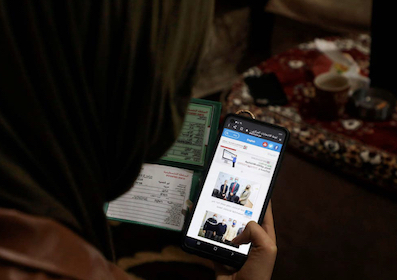
A Palestinian registers to vote in the forthcoming elections through the Palestinian Elections website last week.
HAARETZ PIECE: “WHY BIDEN MUST NOT BOYCOTT HAMAS”
[Note by Tom Gross]
I attach three articles below, with extracts for two of them first. (The third piece, unrelated to the Middle East, is about how Chaucer is to be scrapped as a British university ‘decolonizes’ its curriculum.)
EXTRACTS
In the first piece, Muhammad Shehada (an activist from Gaza currently living in Sweden) writes in today’s Haaretz about the planned Palestinian elections, the first in over 15 years:
“In late 2005, during what would be the last pan-Palestinian elections for a decade and a half, Hamas leader Ahmed Bahar was driving his modest 1971 Subaru Leone, from one campaign gathering in Gaza to another. At each stop, Bahar would point to his inexpensive vehicle, contrasting it with Fatah leaders’ extravagant motorcades. He promised that he’d never upgrade: he’d never be corrupted by power…
All Hamas’ high-minded one-of-the-people talk was soon forgotten. As soon as Hamas took over Gaza in after armed clashes in 2007… Ahmed Bahar, the now Deputy Speaker of the Palestinian Legislative Council was switching cars between an armored Mercedes-Benz S350 and a Toyota Land Cruiser. Everyone in the Hamas leadership got his fair share of fancy cars, offices, and titles. Patronage, nepotism, mismanagement and capricious taxation ran wild…
Hamas campaigned on the promise of eliminating the obscenity of corruption. Instead, the same stench has become so prevalent, there is very little to distinguish Hamas’s government from Fatah’s…
In May, that Palestinian public has a chance to make official what everyone knows by heart; that Palestinians are repulsed by its current leadership.
“The familiar [Hamas] faces know that people loath them…they are unlikely to run again,” a moderate Hamas leader recently told me, adding that Hamas’ internal polls have been shockingly dismal for the movement’s prime figures…
Many young Gazans loathe Abbas as much as Hamas…
But Hamas doesn’t want to be faced with a humiliating wipeout at the polls either. So it is now contemplating multiple alternatives to running directly and facing that hour of reckoning. One proposal is to form a joint slate with Fatah as a pre-emptive form of power-sharing…
A joint list – leading to a joint government which would endorse both non-violence and the bilateral agreements with Israel from Oslo onwards – would be far more convenient for the EU as well. Jordan and Egypt favor that arrangement too, and are pushing for it.
However, some Fatah leaders have publicly objected to the idea, whether because they loathe Hamas, or because they see a joint list as erasing voter choice and therefore being undemocratic…”
(The full piece is below.)
FRENCH PRESIDENT SAYS NO APOLOGY FOR COLONIZATION OF ALGERIA
EXTRACTS
“French President Emmanuel Macron said he would not apologize for France’s colonization of Algeria. It is not the first time Macron, heavily active on the world stage, has made controversial comments related to North Africa…
“The comments pertain to the French occupation of Algeria from 1830 to 1962, as well as the independence war during the last eight years of that period. France had a massive colonial empire at the time that also included Tunisia, Lebanon and Syria in the 20th century. Algeria was a unique example because Paris ruled the North African country as a part of France. Hundreds of thousands of European settlers known as pieds-noirs moved there. … Macron’s comment coincided with the release of a report he commissioned on improving ties between France and Algeria….
“In July, as Black Lives Matter protests broke out internationally, Algerian President Abdelmadjid Tebboune asked France to apologize for its treatment of Algerians during the occupation.
“Macron’s other controversial comments on Africa include his 2017 statement that Africa’s problems were “civilizational” and the result of African families producing “seven or eight children.” …
(The full piece is below.)
DISCUSSIONS ON THE PALESTINIAN FUTURE
You may also be interested in recent zoom conversations I held with two of my Palestinian friends.
PALESTINIAN ACADEMIC MOSTAFA ELOSTAZ
https://www.youtube.com/watch?v=WduAASj4C4k
Palestinian academic and child of refugees Mostafa Elostaz talks about his life and views. Should the Palestinians welcome the UAE-Israel and Bahrian-Israel peace deals?
PALESTINIAN JOURNALIST ISSAM IKIRMAWI
Born in the old city of Jerusalem, near the Damascus Gate, Issam Ikirmawi has forged a 30-year career as a senior news broadcaster and producer working for CNN, ABC, Al Jazeera, Channel 4 (UK), and TV stations in Canada, Japan, Norway, Saudi Arabia, Abu Dhabi, and elsewhere.
Issam discusses his life and career, the state of Israeli-Palestinian relations, and how Palestinians feel about their own leaders.
ARTICLES
WHY BIDEN MUST NOT BOYCOTT HAMAS
Why Biden Must Not Boycott Hamas
If Hamas wins significant representation in the May elections, the international community, including Israel and the Biden administration, must prioritize the welfare of Palestinians – by engaging with them
By Muhammad Shehada
Haaretz
January 25, 2021
https://www.haaretz.com/middle-east-news/.premium-why-biden-must-not-boycott-hamas-1.9478994
In late 2005, during what would be the last pan-Palestinian elections for a decade and a half, Hamas leader Ahmed Bahar was driving his modest 1971 Subaru Leone, from one campaign gathering in Gaza to another. At each stop, Bahar would point to his inexpensive vehicle, contrasting it with Fatah leaders’ extravagant motorcades. He promised that he’d never upgrade: he’d never be corrupted by power.
Back then, Hamas’ “Reform and Change” campaign was pragmatically centered around key economic and security matters of concern; they promised to eliminate the PA’s infamous corruption, dramatically reduce the prices of consumer goods (for instance, reducing the price of a staple necessity like cooking gas from 40 to 10 shekels, by preventing the skimming of unnecessary taxes that went into PA officials’ private pockets), to create jobs and restore law and order.
Their 2006 manifesto avoided hot topics, such as the movement’s 1988 charter, which called for the destruction of Israel. It instead called for an “independent state whose capital is Jerusalem” and emphasized the Palestinian right of return.
Hamas’ promises worked well at a moment of Palestinian despair and disillusionment with the peace process. Camp David, Oslo and the Second Intifada were all dead. The unilateral Israeli withdrawal from Gaza was not a product of negotiations with the Palestinian Authority; indeed, Hamas claimed it a win for its own military efforts, a message the movement pushed on billboards reading “Futile negotiations led us nowhere, our resistance liberated Gaza.”
There was a dire economic situation, particularly in Gaza, because Israel’s disengagement cut tens of thousands of Gazan laborers from its job market. Buoyed by its competitor Fatah divided into two slates, Hamas won 45 percent of the overall vote and 58 percent of the seats of the Palestinian Legislative Council in 2006. In Gaza, Hamas won 56.7 percent of the vote.
All Hamas’ high-minded one-of-the-people talk was soon forgotten.
As soon as Hamas took over Gaza in after armed clashes with Fatah in 2007, it inherited and quickly appropriated Fatah’s abandoned motorcades and offices. Just a few years after Ahmed Bahar had boasted of his humility, the now Deputy Speaker of the Palestinian Legislative Council was switching cars between an armored Mercedes-Benz S350 and a Toyota Land Cruiser. Everyone in the Hamas leadership got his fair share of fancy cars, offices, and titles. Patronage, nepotism, mismanagement and capricious taxation ran wild.
Since Palestinian President Mahmoud Abbas finally issued the long-awaited elections decree in mid-January, it’s been hard to see how Hamas would kick off its campaign, let alone pull off another victory. What would Hamas – or Fatah, for that matter – campaign on? Reform, anti-corruption, resistance, steadfastness? All those slogans have now gone from tired to meaningless to ridiculous after a decade of disillusionment in the political elites’ failures and idleness.
Hamas campaigned on the promise of eliminating the obscenity of corruption. Instead, the same stench has become so prevalent, there is very little to distinguish Hamas’s government from Fatah’s.
Perhaps the Islamist movement was most fit to acquire authority, but it was least fit to exercise it. As the longtime opposition for decades, Hamas knew which buttons to press against the ruling party, exploiting well-established popular grievances and frustration. But they had no experience running a government.
Hamas restored order to the besieged Gaza, but with an iron fist that substantially eroded civil liberties. Its economic performance has been far more dismal, and the public’s frustration, even amongst the movement’s own ranks, is now at its zenith.
Beleaguered Gazans are simultaneously frustrated with Abbas’s PA, which for years has neglected, marginalized and even imposed sanctions on its own employees in Gaza to pressure Hamas. In May, that public has a chance to make official what everyone knows by heart; that Palestinians are repulsed by its current leadership.
With life far worse than in 2006, in Gaza in particular, both Hamas and Fatah are doubtful they could secure a compelling victory. “The familiar [Hamas] faces know that people loath them…they are unlikely to run again,” a moderate Hamas leader recently told me, adding that Hamas’ internal polls have been shockingly dismal for the movement’s prime figures.
That leaves open the possibility of a protest vote, to punish the ruling parties in their heartlands. In the West Bank, many Palestinians are likely to cast a protest vote against Fatah, for either Hamas or a third party. In Gaza, voters might vote against Hamas, to a third party or to Fatah, but that would only happen if the octogenarian Abbas isn’t running. Many young Gazans loathe Abbas as much as Hamas.
The best service that President Mahmoud Abbas and Hamas’ current leadership could offer the Palestinian public and its national cause – a leadership that has already remained in office a decade beyond its term – is to refrain from running in the next elections altogether. That humble acknowledgement is, of course, not going to happen.
But Hamas doesn’t want to be faced with a humiliating wipeout at the polls either. So it is now contemplating multiple alternatives to running directly and facing that hour of reckoning. One proposal is to form a joint slate with Fatah as a pre-emptive form of power-sharing.
There are several reasons for this innovation. Hamas wins power in Gaza but also deniability for non-performance: they win leverage to retain their security apparatus but can wiggle out of sole responsibility for the civilian population. The movement knows that a full Hamas government would be internationally boycotted, by the Biden administration as well, and therefore Gaza would be stuck in the same deteriorating stalemate post-elections as it is now.
A joint list – leading to a joint government which would endorse both non-violence and the bilateral agreements with Israel from Oslo onwards – would be far more convenient for the EU as well. Jordan and Egypt favor that arrangement too, and are pushing for it.
However, some Fatah leaders have publicly objected to the idea, whether because they loathe Hamas, or because they see a joint list as erasing voter choice and therefore being undemocratic. Those objections mean its chances are slim.
Two other proposals are gaining traction in Hamas. One is to form a slate of independent technocrats sympathetic to, but disassociated from, the movement. This was Hamas’ choice in the 2016 municipal elections, until they were canceled in Gaza.
The other is to form a political party formally distant from the movement’s armed wing and its militant rhetoric, to preempt an international boycott like that of 2006. In 1996, Hamas formed such party, called the party of “National Islamic Salvation,” to compete in the PLC election. After its candidates, including prominent figures like Ismael Haniyeh, lost the election, Hamas disavowed the party, and it quickly dissolved.
While Hamas is gaming out what would be its most favorable outcomes and what it can do, pragmatically, to get there, the same spirit of pragmatism is less visible in Fatah. As long as Abbas holds a monopoly on decision-making, the menu is tried and old, even though a win is essential to block a political comeback by exiled-in-Dubai Mohammed Dahlan’s loyalists.
Fatah seems to be leaning in on bribes and comforting words to win over Gazan votes. As soon as the election was called, the PA started softening its tune on Gaza; last week, PA minister Ahmed Majdalani instantly promised that “all the problematic issues” regarding Gaza would soon be resolved – that means Abbas’ blanket imposition of sanctions on Gaza in 2018 which included budget cuts for PA employees and services, even a reduced fuel supply for Gaza’s power plant.
However, the closer elections get, the divsions within Fatah over power and successions will grow even more pronounced. They could even trigger the collapse of the movement.
Regardless of Hamas and Fatah’s plans, it’s highly unlikely that either group, running separately, would secure a legislative majority. The electoral system was recently changed to proportional representation, similar to Israel’s. That means there will be no alternative to intra-Palestinian negotiations, coalition-building and power-sharing.
Elections also offer a rare opportunity for two Palestinian demographics to express themselves with any leverage – or at least, a greater chance they’ll be listened to. The first group is Palestinian youth. As elections would temporarily increase the margin for freedom of speech and assembly, it would be a rare avenue for youth mobilization outside the traditional Fatah-Hamas spectrum.
The second group is diaspora Palestinians, long confined to the status of a symbolic asset for both the PA’s and Hamas’ sloganeering. The PLO’s Palestinian National Council election, scheduled a few months after the general election, on August 31, is a key chance for diaspora representation . Rarely seen and never heard, Palestinian refugees in Lebanon, whose suffering is second only to Gaza’s, will have PNC representation, and therefore a voice, increasing their value to politicians keen to earn their votes.
The most prominent hurdle to Palestinian democracy is whether the international community will even acknowledge the results of the elections and engage constructively with the government it produces – even if includes representatives deemed as terror-supporters, from Hamas or the Popular Front to Liberate Palestine. The EU and US policy of choosing partners, of conferring legitimacy on certain actors and withholding it from others has contributed substantially to creating and maintaining a fragmented Palestinian polity.
To see how this could play out, take the recent example of Trump’s last-minute decision to put Yemen’s Houthis on the terror list.
Despite committing unforgivable atrocities and war crimes, mainstream humanitarian groups including the UN and ex-Obama officials like Rob Malley have argued that blacklisting Houthis is an act of grandstanding, because sanctioning any area under Houthi control is a collective punishment of the Yemeni civilians who are already suffering malnutrition, famine and disease. They argue that listing the Houthis will also hurt efforts to end the war.
Opposing the formal sanctioning of the Houthis as terrorists does not make one a pro-Houthi sympathizer or apologist. Rather, it foregrounds suffering Yemeni civilians as the key subject for international action. Uncomfortable though it may appear, neutrality towards all warring Yemeni parties is paramount towards ending the population’s misery.
The same inference should be applied to Palestinian politics, where blacklisting unfavorable groups furthers the general population’s suffering and deepens national division.
The upcoming elections, if conducted according to democratic norms, will produce a legitimate representative Palestinian government, one that all parties, from its neighbor Israel to the EU and the U.S., should engage with constructively, for the sake of alleviating the suffering of a slowly dying population – regardless of what factions that government includes.
FRENCH PRESIDENT SAYS NO APOLOGY FOR COLONIZATION OF ALGERIA
French president says no apology for colonization of Algeria
Algeria asked France to apologize for its actions during the more than 100 years of occupation.
Al-monitor
January 22, 2021
https://www.al-monitor.com/pulse/originals/2021/01/macron-will-not-apologize-france-algeria-colonization.html
French President Emmanuel Macron said he would not apologize for France’s colonization of Algeria. It is not the first time Macron, heavily active on the world stage, has made controversial comments related to North Africa.
Macron said there would be “no repentance nor apologies,” the French news service Agence France-Presse reported.
The comments pertain to the French occupation of Algeria from 1830 to 1962, as well as the independence war during the last eight years of that period. France had a massive colonial empire at the time that also included Tunisia, Lebanon and Syria in the 20th century. Algeria was a unique example because Paris ruled the North African country as a part of France. Hundreds of thousands of European settlers known as pieds-noirs moved there. The majority Arab and Berber Muslim population did not have the same rights as the newcomers.
Atrocities were committed by both French and Algerian forces during the war. After independence, there was a massive exodus of pieds-noirs as well as Algerian Jews and Muslims who had obtained French citizenship to France.
Macron’s comment coincided with the release of a report he commissioned on improving ties between France and Algeria. The report recommended a “memories and truth” commission to investigate French rule in Algeria and Macron agreed to establish it, according to The New York Times.
Algerian-French ties are wrapped up in their colonial history. In July, as Black Lives Matter protests broke out internationally, Algerian President Abdelmadjid Tebboune asked France to apologize for its treatment of Algerians during the occupation.
Macron’s other controversial comments on Africa include his 2017 statement that Africa’s problems were “civilizational” and the result of African families producing “seven or eight children.”
Macron, who took office in 2017, has led international efforts to help Lebanon after the Beirut explosion last August. France also conducts military operations in the Sahel region of North Africa against Islamist forces.
Here is a third article on a completely unrelated subject. As a friend writes to me: “What is exactly colonial about this very native piece of literature?”
CHAUCER TO BE SCRAPPED AS BRITISH UNIVERSITY ‘DECOLONISES’ CURRICULUM
Chaucer to be scrapped as British university ‘decolonises’ curriculum
By Craig Simpson
Daily Telegraph
January 21, 2021
London: The University of Leicester will stop teaching the great English medieval poet and author Geoffrey Chaucer in favour of modules on race and sexuality, according to new proposals.
Management told the English department that courses on canonical works would be dropped in favour of modules that “students expect” as part of plans now under consultation.
Foundational texts such as The Canterbury Tales and the Anglo-Saxon epic Beowulf would no longer be taught, under proposals to scrap medieval literature. Instead, the English faculty will be refocused to drop centuries of the literary canon and deliver a “decolonised” curriculum devoted to diversity.
Academics now facing redundancy were told via email: “The aim of our proposals [is] to offer a suite of undergraduate degrees that provide modules which students expect of an English degree.”
New modules described as “excitingly innovative” would cover: “A chronological literary history, a selection of modules on race, ethnicity, sexuality and diversity, a decolonised curriculum, and new employability modules.”
Professors were told that, to facilitate change, management planned to stop all English language courses, cease medieval literature, and reduce early modern literature offerings.
Despite Chaucer’s position as “the father of English literature”, he will no longer be taught if plans currently under consultation go ahead.
They would end all teaching on texts central to the development of the English language, including the Dark Age epic poem Beowulf, as well as Sir Gawain and the Green Knight.
Sir Thomas Malory’s Le Morte D’Arthur, the Viking sagas, and all works written earlier than 1500 would also be removed from the syllabus.
Cuts to early modern English modules could see texts such as John Milton’s Paradise Lost omitted, according to concerned academics, with teaching on Christopher Marlowe and John Donne potentially reduced.
The University of Leicester has said it would continue teaching William Shakespeare’s work.
Staff were alerted to the change and to redundancies on Monday, with 60 jobs under threat.
Plans for restructuring were announced in 2020, with management seeking to ensure courses were “sustainable” for the next decade of student intake.
President and vice-chancellor Professor Nishan Canagarajah said that changing modules was part of the long-term strategy to “compete on a global level”, adding: “To facilitate this, we may need to cease activity in a limited number of areas.”
While teaching on almost 1000 years of the English language and its literature may be subject to cuts, the university pledged that students would still receive a comprehensive education.
A spokesman said: “We are currently considering some proposed changes to our English program and are consulting with staff as part of these discussions. We are committed to the future sustainability of teaching English, and we will continue to work with our staff and our students to deliver this.”
* You can also find other items that are not in these dispatches if you “like” this page on Facebook www.facebook.com/TomGrossMedia
(I continue to be unwell – suffering from a variety of problems including a series of days-long migraines – and therefore there are less dispatches than usual at present. Below are five of the articles I have placed on Facebook in recent days. There are short extracts first. -- Tom Gross)
EXTRACTS
* Former British foreign secretary (minister) William Hague:
“Democracy is in far greater peril than the complacent West realizes… There is no certainty that free societies can survive the twin threats of China and the death of truth… Allegations about the dangers of vaccinations have led many millions of people in France to be unwilling to be vaccinated at all. In China, the foreign minister, Wang Yi, spoke last week of his country having “raced to report the epidemic first” and that “the pandemic is likely to have emerged in many places around the world”, in spite of all the evidence to the contrary.
The combination of a loss of trust in elections in the world’s most powerful home of freedom, the cost-free snuffing out of democratic ideas by totalitarians and the steady erosion of the public’s grip on what is true or false add up to a gathering crisis for the future of free and open societies. In Moscow, Tehran and Beijing, there is much satisfaction at the chaos in Washington and at the state of the West: increasingly unsure of its own institutions, polarized within nations and suffering severely in a pandemic that hits free people particularly hard.”
* The Wall Street Journal: “President Trump has ordered that the major U.S. military command for the Middle East be expanded to include Israel, in a last-minute reorganization of the American defense structure that pro-Israel groups have long advocated, U.S. officials said Thursday… It is the latest in a series of Trump administration policy moves to shape the national security agenda President-elect Joe Biden will inherit….
Following the Abraham Accords that led to the normalization of Israel’s relations with the United Arab Emirates and Bahrain, pro-Israel groups had stepped up their push to have the Central Command take on responsibility for military operations and planning involving Israel to foster greater cooperation between Israel and its Arab neighbors.
Anthony Zinni, a retired Marine general and former head of the Central Command, said Thursday that “It will make security cooperation better.”
Martin Indyk, a former U.S. special envoy to the Middle East under Barack Obama, said “I think it is a good thing.”
Dennis Ross, a former U.S. peace negotiator and special advisor to Hillary Clinton, said that the change was overdue.”
* Israel Hayom: A 78-year-old man who has been blind in both eyes for 10 years has regained his sight after receiving the first implant of an artificial cornea developed by Israeli startup CorNeat. Pro implant is designed to replace deformed, scarred or opacified corneas, and it integrates with the eye wall with no reliance on donor tissue.
Professor Irit Bahar, head of the Ophthalmology Department at Rabin Medical Center (formerly Beilinson Hospital) in Petah Tikva, performed the procedure.
Once the bandages were removed, the patient was able to recognize family members and read text.
“The result exceeded all of our expectations. The moment we took off the bandages was emotional and significant. Moments like these are the fulfillment of our calling as doctors. We are proud of being at the forefront of this exciting and meaningful project which will undoubtedly impact the lives of millions,” Bahar said.
* Jerusalem Post: Israel will work to provide coronavirus vaccinations for Holocaust survivors globally, Israel’s Diaspora Affairs Ministry announced. The campaign will be conducted through vaccination centers in a number of different countries. Survivors who cannot leave their homes will have medical staff and volunteers come to them.
* Daily Telegraph: “UK-based IosBio has found a way to turn injected covid vaccines into tablets and signed a deal with California’s ImmunityBio…
Clinical trials in monkeys have shown the oral vaccine made using iosBio technology to be highly effective. The jab version, developed by ImmunityBio, is already in phase two/three trials.
The oral vaccine will begin clinical trials on Americans this month and ImmunityBio is applying for regulatory approval to run tests in Britain too.
Approval remains many months away if it happens at all, but a pill-based vaccine would be far easier to transport and administer than injections and could drastically speed up the race to immunise the world’s population.”
ARTICLES
BLIND MAN REGAINS SIGHT THANKS TO ISRAELI STARTUP’S SYNTHETIC CORNEA
Blind man regains sight thanks to Israeli startup’s synthetic cornea
Immediately after bandages were removed, 78-year-old patients was able to recognize family members and read text. Professor Irit Bahar: We are proud to be at the forefront of this project, which will impact millions of people’s lives.
Israel Hayom newspaper
January 12, 2021
https://www.israelhayom.com/2021/01/12/blind-man-sees-again-thanks-to-israeli-startups-artificial-cornea
A 78-year-old man who has been blind in both eyes for 10 years has regained his sight after receiving the first implant of an artificial cornea developed by Israeli startup CorNeat, the company announced Monday.
The CorNeat KPro implant is designed to replace deformed, scarred or opacified corneas, and it integrates with the eye wall with no reliance on donor tissue.
Professor Irit Bahar, head of the Ophthalmology Department at Rabin Medical Center (formerly Beilinson Hospital) in Petah Tikva, performed the procedure.
Once the bandages were removed, the patient was able to recognize family members and read text.
“The surgical procedure was straightforward and the result exceeded all of our expectations. The moment we took off the bandages was emotional and significant. Moments like these are the fulfillment of our calling as doctors. We are proud of being at the forefront of this exciting and meaningful project which will undoubtedly impact the lives of millions,” Bahar said.
CorNeat KPro inventor and company co-founder Dr. Gilad Litvin said, “Unveiling this first implanted eye and being in that room, in that moment, was surreal.”
“After years of hard work, seeing a colleague implant the CorNeat KPro with ease and witnessing a fellow human being regain his sight the following day was electrifying and emotionally moving, there were a lot of tears in the room.”
DEMOCRACY IS IN FAR GREATER PERIL THAN THE COMPLACENT WEST REALIZES
Democracy is in far greater peril than the complacent West realises
There is no certainty that free societies can survive the twin threats of China and the death of truth
By William Hague
Daily Telegraph (London)
January 12, 2021
https://www.telegraph.co.uk/news/2021/01/11/democracy-far-greater-perilthan-complacent-west-realises/
For anyone who believes in democracy, the year 2021 has had a very bad start. The Capitol building in Washington DC, the great cathedral of “government of the people, by the people, for the people” was invaded and desecrated. Worse still, this happened at the hands of a mob incited and motivated by the president of the United States himself.
On the same day, in Hong Kong, 53 pro-democracy legislators and campaigners were arrested for “subverting state power”. Their offence was to have organised or taken part in primary voting to choose candidates for an entirely legal election. Such activity now amounts to “disrupting and undermining the Hong Kong government”. These arrests took place conveniently just after the EU had signed a new investment agreement with China, with European leaders played for fools.
Meanwhile, voters anywhere trying to make sense of events are battered by categoric assertions that have no basis in fact. Trump has continued to maintain that he won by a landslide an election that he lost by seven million votes, even though there isn’t a single scrap of evidence to support him. Allegations about the dangers of vaccinations have led many millions of people in France to be unwilling to be vaccinated at all. In China, the foreign minister, Wang Yi, spoke last week of his country having “raced to report the epidemic first” and that “the pandemic is likely to have emerged in many places around the world”, in spite of all the evidence to the contrary.
The combination of a loss of trust in elections in the world’s most powerful home of freedom, the cost-free snuffing out of democratic ideas by totalitarians and the steady erosion of the public’s grip on what is true or false add up to a gathering crisis for the future of free and open societies. In Moscow, Tehran and Beijing, there is much satisfaction at the chaos in Washington and at the state of the West: increasingly unsure of its own institutions, polarised within nations and suffering severely in a pandemic that hits free people particularly hard.
Global surveys have demonstrated a growing loss of faith in democracy among young people. Even in countries with democratic traditions going back decades, the space for effective opposition to incumbent governments is being constrained. In Hungary, the media and judiciary have fallen under the control of ministers;
in India, the Modi government is showing autocratic tendencies; in Erdogan’s Turkey, some opposition politicians are in prison; in Sri Lanka the government is empowering the military and abandoning commitments to justice and human rights.
Complacency about democracy is too easy. We all believe the 20th century made the world safe for it and the Cold War proved its timeless superiority. And in the decades since, we have felt able to get on with our inward-looking disagreements without worrying about its future. We reassure ourselves that democracy has proved its resilience time and again. Isn’t it great that the courts in the US refused to entertain the baseless arguments of Trump’s legal team? Didn’t the Republicans do well to finally turn against him, rather than set aside the outcome of a presidential election? The system did indeed hold up. But we cannot be sure that it could withstand another president trying to stay in office whatever the cost, or another time that vast numbers of people believed an election was stolen.
We can no longer be sure that the faltering performance of many Western nations in the face of a pandemic, the growing gulf between populations and elites, the discontent over inequality, the loss of trust in public institutions and the disaffection among young people are just problems we can overcome eventually, with the system still intact at the end. Attention needs to be given to repairing, sustaining, justifying, strengthening and defending democratic values. The virtues of freedom, and the human dignity and fulfilment that come from allowing competing ideas in a tolerant framework within the rule of law need to be advocated and championed again.
Of course, this is a vast and complex task. Democracies like ours will have to forge a stronger common national purpose so that conflicting cultural identities don’t pull us apart. We will have to allow more decentralised decision-making. It will be vital to regulate social media so that varied views are heard instead of a stream of assertions that reinforce our prejudices. We will have to be better prepared for an unexpected crisis such as the pandemic. Such challenges will be the work of decades.
But we can at least begin, with a robust defence against external interference, a clear-eyed understanding of what is going on under authoritarian regimes, and a reinvigoration of the Western alliance with intensified cooperation on trade, technology and security. Joe Biden’s election is a rare opportunity to do so, since he is committed to at least trying to bring the world’s democracies together. Given that Twitter last year alone deleted more than 1,000 accounts promoting state-backed Russian propaganda and thousands spreading Chinese official opinion, it is fair to assume that a massive effort is still going on to ensure voters are misinformed and misled.
The world’s democratic leaders should agree to pool their efforts to disarm such attacks. They should speak frankly about the conditions in countries without the freedoms we take for granted. Tomorrow, the Conservative Party Human Rights Commission will publish a new report on China, detailing a wide range of abuses including torture, arbitrary arrest, forced confessions and the incarceration of huge numbers of people in Xinjiang.
Such findings should be taken seriously by leaders who still prefer to turn a blind eye to the nature of a ruthless one-party system. And with Trump’s go-it-alone attitude on the way out, Western nations should work towards finding solidarity on trade, so that Australia isn’t being penalised by the Chinese at the same time as Brussels pushes for a trade agreement with Beijing.
If Joe Biden can muster the clarity and create the unity that is needed, democracy could be in better shape by the end of this year. He needs support from those who love freedom, anywhere in the world.
TRUMP ORDERS MILITARY SHIFT TO SPUR ISRAELI-ARAB COOPERATION AGAINST IRAN
Trump Orders Military Shift to Spur Israeli-Arab Cooperation Against Iran
Defense policy move is latest step by administration to shape Middle East agenda for Biden
Wall Street Journal
January 15, 2021
https://www.wsj.com/articles/trump-orders-u-s-military-reorganization-favored-by-pro-israel-groups-11610670130
President Trump has ordered that the major U.S. military command for the Middle East be expanded to include Israel, in a last-minute reorganization of the American defense structure that pro-Israel groups have long advocated to encourage cooperation against Iran, U.S. officials said Thursday.
The move means that the U.S. Central Command would oversee American military policy involving both Israel and Arab nations, a departure from decades of U.S. military command structure put in place because of acrimony between Israel and some of the Pentagon’s Arab allies.
It is the latest in a series of Trump administration policy moves to shape the national security agenda President-elect Joe Biden will inherit. The change was recently ordered by Mr. Trump but hasn’t yet been made public. A Biden transition official declined to comment on the move.
U.S. military responsibility for Israel had long been allocated to its European command. That arrangement enabled U.S. generals in the Middle East to interact with Arab states without having a close association with Israel, which at the time was seen as an adversary in the Arab world.
Following the Abraham Accords that led to the normalization of Israel’s relations with the United Arab Emirates and Bahrain, pro-Israel groups have stepped up their push to have the Central Command take on responsibility for military operations and planning involving Israel to foster greater cooperation between Israel and its Arab neighbors.
“Now, Gen. Frank McKenzie can go to Saudi Arabia, Emirates and Israel and visit everyone in his newly enlarged parish,” a U.S. official said, referring to the four-star Marine general who heads the Central Command.
The Jewish Institute for National Security of America, a Washington-based group that supports close military cooperation between the U.S. and Israel, urged the shift in December as a way to encourage the emerging alignment between Israel and key Arab states against Iran.
Anthony Zinni, a retired Marine general and former head of the Central Command, said Thursday that “the timing could be right to do this.”
“We could see more Arab countries recognize Israel, so it makes sense to bring them all in under one unified American command,” Gen. Zinni added. “It will make security cooperation better. It would not have made sense in the past because there was too much mistrust. There was a fear then that if Israel was in the Central Command there would be U.S. intelligence sharing with Israel on its Arab neighbors.”
Another retired U.S. military officer agreed that the move that would reinforce U.S. efforts to normalize ties between Israel and Arab states. He cautioned, however, that it would add to the burden on a Central Command headquarters that already has responsibility for U.S. military operations in Afghanistan, Iraq and Syria and other hot spots in the Middle East.
Another potential complication for Central Command could come if the American effort to strengthen ties between Israel and Arab states falters and their relations sour. Such a development could put the U.S. military in the awkward position of working with allies suspicious of each other’s intentions.
While Israel has improved ties with Gulf states, the dispute between Israel and the Palestinians is deep and unresolved. Saudi Arabia, the most important Arab state in the Gulf region, also has yet to normalize relations with Israel.
By making the decision during his last days in office, Mr. Trump has left it to his successor to fully implement the decision and deal with the consequences, this former military officer added.
Spokesmen for the Central Command and the Israeli embassy in Washington declined to comment.
Martin Indyk, a former U.S. ambassador to Israeli who is now at the Council on Foreign Relations, said that some Israelis previously had seen some benefit in working with the European Command because it associated them with a headquarters that plays a central role in the North Atlantic Treaty Organization. But as Iran has become a growing worry for Israel and Gulf Arab states, working with the Central Command makes more sense for Israel, he added.
“I think it is a good thing,” Mr. Indyk said.
Dennis Ross, a former U.S. peace negotiator, said that the change was overdue. “I don’t think the Biden people will have a problem with it, and I think the Israelis will welcome it as a reflection of the new realities in the region,” Mr. Ross said.
PILLS COULD REPLACE COVID JABS WITH BRITISH BIOTECH BREAKTHROUGH
Pills could replace Covid jabs with British biotech breakthrough
Sussex-based IosBio has found a way to turn injected vaccines into tablets and signed a deal with California’s ImmunityBio
By Julia Bradshaw
Daily Telegraph (London)
January 13, 2021
https://www.telegraph.co.uk/business/2021/01/13/pills-could-replace-covid-jabs-british-biotech-breakthrough/
A groundbreaking pill-based vaccine which could one day transform the fight against Covid is being developed by a Sussex biotech firm.
Burgess Hill-based IosBio has come up with a way to turn injected vaccines into orally administered tablets and is now working with Californian firm ImmunityBio to test the technology in clinical trials.
Clinical trials in monkeys have shown the oral vaccine made using iosBio technology to be highly effective. The jab version, developed by ImmunityBio, is already in phase two/three trials.
The oral vaccine will begin clinical trials on Americans this month and ImmunityBio is applying for regulatory approval to run tests in Britain too.
Approval remains many months away if it happens at all, but a pill-based vaccine would be far easier to transport and administer than injections and could drastically speed up the race to immunise the world’s population.
Wayne Channon, chief executive of iosBio, said: “With our capsule you wouldn’t need medical professionals to administer the vaccine, you could send this out on Amazon Prime and have everyone vaccinated by Saturday.”
IosBio’s technology is called OraPro. It engineers vaccines into pills that can withstand temperatures of up to 50C, allowing them to pass through the stomach and be directly absorbed into the mucous membranes.
Mr Channon said: “You catch Covid in your mucosal cells.
“But with jabs you get injected into the arm which goes into the muscles and blood cells. Our tablets go straight into mucosal cells to elicit mucosal immunity so we hit the virus where it is.
“When you catch this virus you breathe it in or swallow it, and 80pc of your immune system cells are mucosal so we are addressing that directly. I think this will be a new paradigm in vaccination.”
Under the terms of the licensing agreement, ImmunityBio has exclusive rights to OraPro. In return, IosBio will get royalties on global sales of the approved vaccine.
Mr Channon said: “The results from the non-human primate trial were outstanding for oral and I think oral is the right strategy.
“Patrick Soon-Shiong, the chief executive of ImmunityBio, called me and said he had woken up at 3am and thought, this should be an oral vaccine.”
ImmunityBio’s vaccine is a viral vector vaccine, and unlike other candidates it contains two different spike proteins, Mr Channon said.
He said: “When you use both the chance of both mutating on the virus to a point where it is unrecognisable to the body is vanishingly small and you get a much longer T-cell response memory.”
IosBio is a small private company owned by a handful of independent shareholders. Mr Channon, chief scientific officer Jeff Drew and James Hudleston, a financier and founder of Hurricane Energy, control more than half the company between them.
The other shareholders include friends, family, wealthy people and “not so wealthy people”, according to Mr Channon. The company has raised £20m since being founded in 2005.
The technology is the brainchild of Dr Drew. Mr Channon said: “It was one of his pet projects we worked on and he persuaded a few of us to fund it.
“When the company was founded it was almost impossible to get traction with big pharma - nobody seemed interested and nobody seemed to realise the problem with global distribution of frozen vaccines. It wasn’t until the pandemic that everyone understood the problem and needed the technology.
“So we changed our strategy a while ago to become a vaccine developer too, rather than just trying to license out the technology, mainly because we couldn’t get the big guys to change what they were doing.”
ISRAEL TO PROVIDE COVID VACCINES FOR HOLOCAUST SURVIVORS AROUND THE WORLD
Israel to provide COVID vaccines for Holocaust survivors around the world
“We have the privilege to provide them with protection against the coronavirus. This is the moral order that every Jew carries in his heart - to make sure that they never walk alone.”
Jerusalem Post
January 13, 2021
https://www.jpost.com/diaspora/israel-to-provide-covid-vaccines-for-holocaust-survivors-around-the-world-655140
Israel will work to provide coronavirus vaccinations for Holocaust survivors both in Israel and in the Diaspora, the Diaspora Affairs Ministry announced.
The complicated, international logistical operation is only in its beginning stages. Diaspora Affairs Minister Omer Yankelevitch tasked the Shalom Corps organization with coordinating bureaucratic procedures.
The organization has approached several large medical shipping companies about the logistics of the project, and the Diaspora Affairs Ministry is working with the Health Ministry to coordinate with Pfizer and Moderna.
The campaign will be conducted through vaccination centers in a number of different countries. Survivors who cannot leave their homes will have medical staff and volunteers come to them.
The Ministry intends to recruit Jewish philanthropists to help fund the operation and intends to order additional vaccines for the survivors and not take from the quota allocated for the State of Israel.
“During this global crisis, we have an opportunity to support Holocaust survivors whose resilience continues to guide and inspire humanity today,” said Yankelevitch. “It is our collective obligation to safeguard this treasured yet vulnerable population in the spirit of mutual responsibility. Now is the time for all of us, Jewish institutions and leaders from across the world, to come together in this operation. Together, we can ensure that Holocaust survivors are efficiently vaccinated, wherever they live.”
* You can also find other items that are not in these dispatches if you “like” this page on Facebook www.facebook.com/TomGrossMedia

YOU CAN PUT QASSEM SOLEIMANI TOGETHER AGAIN IN 1000 PIECES
[Notes by Tom Gross]
The above photo was sent to me by an Iranian friend to let me know that Qassem Soleimani puzzles are still on sale there.
The head of the terroristic Iranian Revolutionary Guards was killed in a US missile strike exactly a year ago today. Soleimani’s killing, on the orders of Donald Trump, remains one of the US’s most popular foreign policy acts of recent decades among Muslims.
As I pointed out in a dispatch a year ago, even the New York Times ran an article acknowledging that the decision by Trump was a popular one:
“The world to which we wake up today, rid of its most accomplished and deadly terrorist, is a better place. Nowhere is this insight more evident than throughout the Middle East, where individuals are posting joyous videos to social media, celebrating the death of the author of so much of their misery. We should all – even those among us who don’t particularly care for Mr. Trump – join them in their good cheer, and continue to repeal Mr. Suleimani’s murderous anti-American legacy.”
See also: Breaking: Iran’s terror overlord killed in Trump’s most significant foreign policy act (Jan. 3, 2020)
ISRAELI MODEL MAKES HISTORY ON COVER OF UAE MAGAZINE

Yael Shelbia (above) is to become the first Israeli model to be featured on the cover of the prominent fashion and lifestyle magazine L’Official Arabia. The February edition of the magazine, which is published in Dubai, will be dedicated exclusively to Israeli fashion and artists.
“As a Jewish religious, IDF soldier and a model, I’m so very honored to be the first one to participate in such a historical cover,” Shelbia said.
Separately, Shelbia, 19, has been ranked the world’s most beautiful woman in the annual “TC Candler” list. At the end of the video here.
(In the past, several Arabs have been beauty queens in Israel. They include Rana Raslan, who was the first Arab to win the Miss Israel contest and who I interviewed for a British newspaper.)
ISRAEL’S ONE-MILLIONTH COVID VACCINE GIVEN TO A CAREER CRIMINAL
Israel is leading the world in per capita vaccinations against coronavirus:
https://ourworldindata.org/covid-vaccinations.
But there was nonetheless some surprise on Friday when Prime Minister Benjamin Netanyahu, accompanied by Health Minister Yuli Edelstein, posed in a photo with the one millionth person to receive the coronavirus vaccine, in the Israeli-Arab town of Umm el-Fahm.
The man in question, Muhammad Abd al-Wahhab Jabarin, 66, is a hardened violent criminal who has been in and out of prison for much of his adult life.
Israel had carried out 1,090,000 coronavirus vaccinations as of this morning.
PALESTINE’S TOP CLERIC SAYS WOMEN MAY NOT TRAVEL TO DUBAI WITHOUT MALE ESCORT
As tens of thousands of Jewish and Arab Israelis flock to Dubai in the wake of the normalization agreement between Israel and the UAE, the Palestinian Authority’s top cleric, mufti of Jerusalem Muhammad Ahmad Hussein, has issued a ruling that Muslim women cannot travel to the UAE without a male chaperone.
TUNISIAN SINGER RECEIVES DEATH THREATS AND IS FIRED AFTER RECORDING DUET WITH ISRAELI
Tunisian composer and singer Noamane Chaari has been fired from his job and received death threats on social media after he recorded a song last month with an Israeli musician promoting tolerance between Muslims and Jews.
You can watch “Peace Between Neighbors,” which he performed with Israeli Jewish singer Ziv Yehezkel (who sings in Arabic) here here.
The Tunisian Artists Syndicate also suspended Chaari’s professional license.
UNESCO ELECTS SYRIAN REGIME CHARITY TO CULTURAL HERITAGE BODY
The Syria Trust for Development, a front for the Assad regime, has been elected to UNESCO’s Intergovernmental Committee for the Safeguarding of the Intangible Cultural Heritage.
The election by the 24-nation UNESCO committee sparked outrage and disbelief among activists. “It’s a disgrace,” said one. “The Assads have crushed swathes of Syria’s cultural heritage. Whole cities, towns and villages have been destroyed.”
The charity is run by Bashar Assad’s wife, who has been under EU and US sanctions for several years as a result of her massive corruption.
Joel Rayburn, the U.S. special envoy for Syria, said “Asma al-Assad has spearheaded efforts on behalf of the regime to consolidate economic and political power, including by using her so-called charity and civil society organization. Her and her family’s corruption is one of the many reasons that this conflict lingers on.”
PARIS PROSECUTOR OPENS INVESTIGATION INTO ANTISEMITIC ABUSE OF FRENCH BEAUTY QUEEN
The Paris Public Prosecutor’s Office has opened an investigation into the antisemitic abuse received on social media by April Benayoum, who came second in the Miss France competition last month.
Benayoum, who was competing as Miss Provence, said on TV during the question and answer part of the competition:
“I have an array of origins: my mother is Serbo-Croat, my father Israeli-Italian. This gave me a passion for geography and the discerning of other cultures.”
This prompted a flood of antisemitism, with tweets and other comments calling for the exclusion of Jews from Miss France and others tweeting hateful comments, including “Hitler forgot to exterminate you, Miss Provence.”
France’s minister of citizenship said the full force of the law would be brought to bear against perpetrators of the abuse subjected against the 21-year-old beauty queen. “Miss France 2021 is not a contest in antisemitism,” the minister said. “Full support to April Benayoum, who has been the target of unprecedented antisemitic hate speech after revealing her origins.”
The broadcaster TF1 and producers of Miss France also condemned the abuse.
LONDON UNIVERSITY REFUNDS JEWISH STUDENT OVER ANTISEMITISM
The School of Oriental and African Studies at London University (SOAS) has agreed to refund 15,000 pounds in fees to Noah Lewis, a grandson of Holocaust survivors, for the “toxic antisemitic environment” that was allowed to flourish at SOAS.
The settlement comes over a year and a half after Lewis filed a complaint. He said the antisemitism had led to mental-health issues.
He was called a “Nazi” by classmates and the school allowed antisemitic graffiti and symbols to be left on lockers, desks and bathroom walls targeting “Zionists.”
A university spokesperson told The Guardian newspaper, “SOAS is extremely concerned about any allegations of antisemitism at our school. Diversity is key to the SOAS mission, and we want all our students to feel welcome and supported in their studies.”
* You can also find other items that are not in these dispatches if you “like” this page on Facebook www.facebook.com/TomGrossMedia