
[Note by Tom Gross]
I attach a selection of articles I read today and yesterday that might interest you.
Among the points in them:
* "A secretive Israeli nuclear facility at the center of the nation's undeclared atomic weapons program is undergoing what appears to be its biggest construction project in decades, satellite photos analyzed by The Associated Press show. A dig about the size of a soccer field and likely several stories deep now sits just meters from the aging reactor at the Shimon Peres Negev Nuclear Research Center near the city of Dimona. The facility is already home to decades-old underground laboratories that reprocess the reactor's spent rods to obtain weapons-grade plutonium for Israel's nuclear bomb program."
* The Israeli army is about to become the first organization in the world to reach herd immunity to Covid-19.
* American academic Wang Xiyue (a previously pro-Iranian professor who was held hostage by Iran for more than three years, and released in a 2019 prisoner swap) writes:
Many American progressives are pressuring the Biden administration to revive the 2015 nuclear deal; official groupthink has coalesced around a singularly misguided belief: The U.S. has so badly mistreated Iran in the past that it must engage and appease the Islamic Republic now. I understand this view because I was once taught to believe it".
When I went to Iran in 2016, I shared the prevailing academic view of the Middle East. I had absorbed the oft-repeated lesson that political Islam arose in response to Western colonialism and imperialism, and that the West was chiefly responsible for the region's chaos. My professors taught that the U.S. had treated Iran with a mixture of Orientalist condescension and imperialist aggression since the founding of the Islamic Republic in 1979. I dismissed allegations of the regime's malign behavior as American propaganda"
My terrible 40-month imprisonment was a period of intense re-education about the relationship between Iran and the U.S. Nothing I'd learned during my years in the ivory towers of academia had prepared me for the reality I encountered in an Iranian prison. I learned what many Iranians already know: The regime's hostility toward the U.S. isn't reactive, but proactive"
* Twitter has removed nearly 400 accounts that it says were part of "state-linked information operations" controlled by Iran, Russia, and Armenia. These accounts sought to influence the 2020 U.S. presidential election and surreptitiously promote information favorable to both the Russian and Armenian governments.
CONTENTS
1. Secretive Israeli nuclear facility undergoes major project, satellite images show (AP)
2. Airstrikes in Syria kill 22 in Joe Biden's first military act as president (Guardian)
3. What I learned in an Iranian prison (By Wang Xiyue, Wall Street Journal)
4. Qatar says it will fund $60-million pipeline from Israel to Gaza (Reuters)
5. Deadly unrest roils Iranian city (Wall Street Journal)
6. Israeli, Saudi officials discussed Biden's Iran policy (i24 News)
7. Twitter removes hundreds of accounts linked to Iran, Russia, Armenia (Washington Free Beacon)
8. While Israel is still far from COVID herd immunity, the army is about to make history (Haaretz)
ARTICLES
SECRETIVE ISRAELI NUCLEAR FACILITY UNDERGOES MAJOR PROJECT, SATELLITE IMAGES SHOW
Secretive Israeli Nuclear Facility Undergoes Major Project, Satellite Images Show
Digging, concrete pads seen around the nuclear research center in Dimona "" possibly to retrofit its aging reactor "" but the reasons remain unclear
The Associated Press
Feb. 25, 2021
A secretive Israeli nuclear facility at the center of the nation's undeclared atomic weapons program is undergoing what appears to be its biggest construction project in decades, satellite photos analyzed by The Associated Press show.
A dig about the size of a soccer field and likely several stories deep now sits just meters from the aging reactor at the Shimon Peres Negev Nuclear Research Center near the city of Dimona. The facility is already home to decades-old underground laboratories that reprocess the reactor's spent rods to obtain weapons-grade plutonium for Israel's nuclear bomb program.
What the construction is for, however, remains unclear. The Israeli government did not respond to detailed questions from the AP about the work. Under its policy of nuclear ambiguity, Israel neither confirms nor denies having atomic weapons. It is among just four countries that have never joined the Non-Proliferation Treaty, a landmark international accord meant to stop the spread of nuclear arms.
The construction comes as Israel "" under Prime Minister Benjamin Netanyahu "" maintains its scathing criticism of Iran's nuclear program, which remains under the watch of United Nations inspectors unlike its own. That has renewed calls among experts for Israel to publicly declare details of its program.
What "the Israeli government is doing at this secret nuclear weapons plant is something for the Israeli government to come clean about," said Daryl G. Kimball, executive director of the Washington-based Arms Control Association.
With French assistance, Israel began secretly building the nuclear site in the late 1950s in empty desert near Dimona, a city some 90 kilometers (55 miles) south of Jerusalem. It hid the military purpose of the site for years from America, now Israel's chief ally, even referring to it as a textile factory.
With plutonium from Dimona, Israel is widely believed to have become one of only nine nuclear-armed countries in the world. Given the secrecy surrounding its program, it remains unclear how many weapons it possesses. Analysts estimate Israel has material for at least 80 bombs. Those weapons likely could be delivered by land-based ballistic missiles, fighter jets or submarines.
For decades, the Dimona facility's layout has remained the same. However, last week, the International Panel on Fissile Materials at Princeton University noted it had seen "significant new construction" at the site via commercially available satellite photos, though few details could be made out.
Satellite images captured Monday by Planet Labs Inc. after a request from the AP provide the clearest view yet of the activity. Just southwest of the reactor, workers have dug a hole some 150 meters (165 yards) long and 60 meters (65 yards) wide. Tailings from the dig can be seen next to the site. A trench some 330 meters (360 yards) runs near the dig.
Some 2 kilometers (1.25 miles) west of the reactor, boxes are stacked in two rectangular holes that appear to have concrete bases. Tailings from the dig can be seen nearby. Similar concrete pads are often used to entomb nuclear waste.
Other images from Planet Labs suggest the dig near the reactor began in early 2019 and has progressed slowly since then.
Analysts who spoke to the AP offered several suggestions about what could be happening there.
The center's heavy-water reactor has been operational since the 1960s, far longer than most reactors of the same era. That raises both effectiveness and safety questions. In 2004, Israeli soldiers even began handing out iodine pills in Dimona in case of a radioactive leak from the facility. Iodine helps block the body from absorbing radiation.
Those safety concerns could see authorities decommission or otherwise retrofit the reactor, analysts say.
"I believe that the Israeli government is concerned to preserve and maintain the nation's current nuclear capabilities," said Avner Cohen, a professor of nonproliferation studies at the Middlebury Institute of International Studies at Monterey, who has written extensively on Dimona.
"If indeed the Dimona reactor is getting closer to decommissioned, as I believe it is, one would expect Israel to make sure that certain functions of the reactor, which are still indispensable, will be fully replaced."
Kimball, of the Arms Control Association, suggested Israel may want to produce more tritium, a relatively faster-decaying radioactive byproduct used to boost the explosive yield of some nuclear warheads. It also could want fresh plutonium "to replace or extend the life of warheads already in the Israeli nuclear arsenal," he added.
Israel built its nuclear weapons as it faced several wars with its Arab neighbors since its founding in 1948 in the wake of the Holocaust. An atomic weapons program, even undeclared, provided it an edge to deter enemies.
As Peres, who led the nuclear program and later served as prime minister and president of Israel, said in 1998: "We have built a nuclear option, not in order to have a Hiroshima, but to have an Oslo," referring both to the first U.S. nuclear bomb drop in World War II and Israel's efforts to reach a peace deal with Palestinians.
But Israel's strategy of opacity also draws criticism from opponents. Iranian Foreign Minister Mohammad Javad Zarif seized on the work at Dimona this week as his country prepared to limit access by the United Nations' International Atomic Energy Agency amid tensions with the West over its collapsing 2015 nuclear deal.
"Any talk about concern about Iran's nuclear program is absolute nonsense," Zarif told Iranian state television's English-language arm Press TV. "Let's be clear on that: It's hypocrisy."
The timing of the Dimona construction surprised Valerie Lincy, executive director of the Washington-based Wisconsin Project on Nuclear Arms Control.
"I think the most puzzling thing is ... you have a country that is very aware of the power of satellite imagery and particularly the way proliferation targets are monitored using that imagery," Lincy said. "In Israel, you have one known nuclear target for monitoring, which is the Dimona reactor. So you would think that anything that they wanted to keep under the radar would be kept under the radar."
In the 1960s, Israel used its claims about adversary Egypt's missile and nuclear efforts to divert attention from its work at Dimona and may choose to do the same with Iran now.
"If you're Israel and you are going to have to undertake a major construction project at Dimona that will draw attention, that's probably the time that you would scream the most about the Iranians," said Jeffrey Lewis, a professor also teaching nonproliferation issues at Middlebury.
AIRSTRIKES IN SYRIA KILL 22 IN JOE BIDEN'S FIRST MILITARY ACT AS PRESIDENT
Airstrikes in Syria kill 22 in Joe Biden's first military act as president
Strikes against Iran-backed fighters were retaliation for attack on US-led forces in Iraq, says Pentagon
By Bethan McKernan
The Guardian
Friday Feb 26, 2021
Joe Biden has carried out his first military action as president, with airstrikes targeting Iranian-backed fighters in Syria, in what the Pentagon said was retaliation for a rocket attack in Iraq earlier this month that killed one civilian contractor and wounded a US service member and other coalition troops.
The overnight strikes killed 22 people after hitting three trucks loaded with munitions near the border town of Abu Kamal, a war monitor said on Friday. Border posts used by Iranian militia groups were also destroyed, the UK-based Syrian Observatory for Human Rights said.
It said all of the dead were from Iraq's state-sponsored Hashd al-Shaabi, an umbrella force that includes many small militias with ties to Iran.
The Pentagon's chief spokesperson, John Kirby, said the location of the strikes was used by Kataeb Hezbollah and Kata'ib Sayyid al-Shuhada, two Iraqi pro-Iran groups operating under the Hashd umbrella. "This proportionate military response was conducted together with diplomatic measures, including consultation with coalition partners," Kirby said. "The operation sends an unambiguous message: President Biden will act to protect American and coalition personnel. At the same time, we have acted in a deliberate manner that aims to de-escalate the overall situation in eastern Syria and Iraq."
The Iranian and Syrian foreign ministers spoke in a telephone call on Friday after the strikes, and underlined "the need of the west to adhere to UN security council resolutions regarding Syria", a statement on the Iranian government website Dolat.ir said.
A little-known Shia group, believed to be a front for more prominent Iran-backed factions hostile to the US, claimed responsibility for the 15 February attack on an airbase in Erbil, in Kurdish Iraq. It was the most deadly attack in almost a year on US-led coalition forces deployed to Iraq to fight Isis, killing a Filipino contractor and wounding nine US coalition and military staff and at least five Iraqi civilians.
Tensions between the US and its Iraqi and Kurdish allies on one side, and Iran-aligned militias on the other, soared during the Trump administration, with its stance of "maximum pressure" on the Islamic republic.
Tehran has made clear it intends further retribution for the 2020 drone strike that killed the Iranian general Qassem Suleimani and the powerful Iraqi Shia militia leader Abu Mahdi al-Muhandis, almost causing a proxy war.
The Erbil attack was widely interpreted as the first serious test of Biden's Iranian policy as the president seeks to revive the nuclear deal, scrapped by Donald Trump in 2018, between Tehran and world powers.
Another salvo struck a base hosting US forces north of Baghdad days later, injuring at least one contractor, and on Monday rockets hit Baghdad's Green Zone, which houses the US embassy and other diplomatic missions.
Biden's decision to strike only in Syria and not in Iraq, at least for now, gives Iraq's government, stuck in the middle of tensions between its two biggest allies, breathing room as it carries out its own investigation into the Erbil attack.
Since Iraq declared victory against Isis in late 2017, the coalition has been reduced to fewer than 3,500 troops, 2,500 of them Americans, who no longer take part in combat operations. Most are concentrated at the military complex at Erbil airport.
The Biden administration has in its first weeks emphasised its foreign policy priority is the challenges posed by China, even as threats in the Middle East persist.
Mary Ellen O'Connell, a professor at Notre Dame Law School, criticised the US attack as a violation of international law. "The United Nations charter makes absolutely clear that the use of military force on the territory of a foreign sovereign state is lawful only in response to an armed attack on the defending state for which the target state is responsible," she said. "None of those elements is met in the Syria strike."
WHAT I LEARNED IN AN IRANIAN PRISON
What I Learned in an Iranian Prison
U.S. foreign policy isn't to blame for the mullahs' deep-rooted hatred of America and Americans.
By Wang Xiyue
Wall Street Journal
Feb. 25, 2021
Iran, Europe and many American progressives are pressuring the Biden administration to revive the 2015 nuclear deal known as the Joint Comprehensive Plan of Action, or JCPOA. Official groupthink has coalesced around a singularly misguided belief: The U.S. has so badly mistreated Iran in the past that it must engage and appease the Islamic Republic now. I understand this view because I was once taught to believe it. This mindset is what convinced me in 2016 that I could safely do research for my dissertation in Iran. My optimism was misplaced. Not long after I arrived, I was imprisoned by Iran's brutal regime and held hostage for more than three years.
When I went to Iran, I shared the prevailing academic view of the Middle East. I had absorbed the oft-repeated lesson that political Islam arose in response to Western colonialism and imperialism, and that the West - particularly America's Middle East behavior - was chiefly responsible for the region's chaos. My professors taught that the U.S. had treated Iran with a mixture of Orientalist condescension and imperialist aggression since the founding of the Islamic Republic in 1979. I believed America's role in the 1953 coup that removed Prime Minister Mohammad Mossadegh explained everything that had gone wrong in Iran. Convinced that the mullahs' hostility toward the U.S. was exaggerated, I often dismissed allegations of the regime's malign behavior as American propaganda.
Since it was obvious that American foreign policy itself was the problem, and that the regime would happily normalize relations once the U.S. pivoted away from disrespect, I assumed I'd be left alone in Iran if I remained apolitical and focused on historical research. Imagine my shock when the Iranian Ministry of Intelligence arrested me on false espionage charges in August 2016, shortly after the implementation of the JCPOA - during what appeared to be a period of rapprochement between the U.S. and Iran. I was thrown into solitary confinement, forced to confess things my interrogator knew I had not done, and sentenced to 10 years in prison.
My interrogator made clear that my sole "crime" was being an American. He told me I was to be used as a pawn in exchange for U.S.-held Iranian prisoners and the release of frozen Iranian assets. (I was released in a 2019 prisoner swap.)
My terrible 40-month imprisonment was a period of intense re-education about the relationship between Iran and the U.S. The Islamic Republic is an ambitious power, but not a constructive one. It's a spoiler, projecting influence by exporting revolution and terrorism via its proxies in the Middle East. Domestically, the mullahs have failed to deliver on their political and economic promises to the Iranian people, on whom they maintain their grip through oppression.
Nothing I'd learned during my years in the ivory towers of academia had prepared me for the reality I encountered in an Iranian prison. I learned what many Iranians already know: The regime's hostility toward the U.S. isn't reactive, but proactive, rooted in a fierce anti-Americanism enmeshed in its anti-imperialist ideology. As I witnessed firsthand, Tehran isn't interested in normalizing relations with Washington. It survives and thrives on its self-perpetuated hostility against the West; a posture that has been integral to the regime's identity.
The regime didn't regard President Obama's engagement as a goodwill gesture, but rather as an "iron fist under a velvet glove." Iran's revolutionary regime retains power through conspiracy and intrigue, and views everything through that lens. The notion that it will be difficult for the U.S. to regain Iran's trust after quitting the JCPOA is incorrect. The Iranian regime has never trusted the U.S., and never will.
When I was being interrogated in Evin Prison in summer 2016, my interrogator boasted that he and his hard-line colleagues were eager to see Donald Trump elected, not because the regime viewed him as the type of pragmatic leader they could deal with, but because it would justify a more confrontational stance against the Great Satan.
The menace of the Islamic Republic can't be appeased. It must be countered and restrained. Only the U.S. has the capacity to lead such an endeavor. For 42 years Iran has demonstrated that it changes its behavior only in response to strength in the form of American-led international pressure. If the Biden administration returns to the JCPOA without extracting concessions from Tehran beyond the nuclear threat, it will relinquish all U.S. leverage over the regime.
Diplomacy can't succeed without leverage. Only by showing strength of will can President Biden hope for genuine progress in containing the Iranian threat to peace.
QATAR SAYS IT WILL FUND $60-MILLION PIPELINE FROM ISRAEL TO GAZA
Qatar Says It Will Fund $60-million Pipeline From Israel to Gaza
The plan is for natural gas from the Leviathan field operated by Chevron in the eastern Mediterranean to flow through an existing pipeline into Israel, and from there into Gaza
Reuters
Feb. 26, 2021
Qatar on Thursday pledged $60 million to build a natural gas pipeline from Israel into the Gaza Strip that will end the energy crisis that has helped cripple the Gaza economy.
The Qatari statement, published on its Foreign Ministry website, came two days after Reuters reported that closed-door negotiations on the pipeline had reached a breakthrough.
Qatar coming on board publicly gives another boost to the project, which has a 2023 target date for completion.
The plan is for natural gas from the deepwater Leviathan field operated by Chevron in the eastern Mediterranean to flow through an existing pipeline into Israel, and from there into Gaza through a proposed new extension.
The European Union has said it would fund the Gaza-side of the pipeline.
Qatar said it "pledged to provide an amount of $60 million to finance the project to supply the Gaza Strip with the gas necessary to solve the electricity crisis," and that "this amount will be allocated for extending gas pipelines from the Israeli side."
Palestinian Prime Minister Mohammad Shtayyeh welcomed the pledge and said the pipeline will "resolve the problem of electricity in Gaza completely."
With pipeline funding secured, what remains is a gas purchase agreement with the Leviathan field partners.
For years the project was a distant prospect because of the Israeli-Palestinian conflict as well as internal Palestinian rivalries, but officials said that Israeli, Palestinian, Qatari and European interests have converged in recent weeks making plans more concrete.
Israel and Egypt maintain a tight blockade on Gaza, citing security concerns about the Islamist militant group Hamas, which seized control of the territory in 2007.
Today, Gaza's sole power station produces electricity for around 12 hours a day on diesel, a more expensive and polluting fuel.
DEADLY UNREST ROILS IRANIAN CITY
Deadly Unrest Roils Iranian City
Clashes between protesters and security forces in impoverished minority region follow killing of fuel traders
By Sune Engel Rasmussen
Wall Street Journal
Feb. 26, 2021
https://www.wsj.com/articles/deadly-unrest-roils-iranian-city-11614273385
Protesters in Iran's impoverished southeast clashed with security forces for a third consecutive day, in the latest challenge for a government facing public resentment over widespread economic hardship in the country.
A crowd attacked a police station in the city of Saravan with grenades and light arms on Thursday, killing one policeman before security forces repelled the rioters, the government said.
The unrest erupted earlier this week when protesters stormed a local governor's building and another police station. Those incidents came in response to Revolutionary Guard patrols firing at alleged fuel smugglers crossing the Pakistani border, killing at least 10 people, according to rights activists in the area.
Iran's presidential chief of staff Mahmoud Vaezi this week blamed Pakistani border guards for the shooting, saying they had fired at smugglers who intended to use border points designated for fuel traders. The government said two or three people had died.
A senior Pakistani official said he wasn't aware of any formal complaint or allegation from Iran against his country's forces, and that Pakistani troops hadn't opened fire.
The Iranian government on Thursday afternoon said the situation had calmed down, but that no attackers had been arrested. The latest unrest has been limited to Saravan, but localized protests over economic discontent have in the past spread nationwide.
Internet and phone lines were partly cut off during the recent unrest, according to social-media users tracking internet traffic in the Sistan-Baluchistan province, of which Saravan is a part. Restricting internet access is a tactic used by Iranian authorities to prevent the spread of information and limit communication among protesters.
In recent years, protests rooted in economic discontent have presented significant security challenges for the government and prompted large-scale crackdowns, most recently in late 2019 when hundreds were killed in a crackdown on protests across the country. Those protests were triggered by an increase in fuel prices.
Iran's government blames U.S. sanctions imposed by the Trump administration for the country's economic situation, which has been worsened by the economic slowdown of the Covid-19 pandemic.
Sistan-Baluchistan, the second-largest of Iran's 31 provinces by area, has for centuries been one of the country's poorest and most marginalized areas. Its population mainly consists of the Baloch, a Sunni Muslim minority.
Iranian authorities have long maintained a strong security presence in the province because of a low-intensity insurgency there involving several militant groups -- some separatist nationalists, others Sunni Islamic extremists -- which have been labeled terrorists by Tehran.
The deputy provincial governor for security Mohammad Hadi Marashi told state media Thursday that some of the attackers behind the unrest were linked to opposition groups, without naming them.
Bordering Afghanistan and Pakistan, the province lies on the main drug-trafficking route from South Asia to Europe. Amid high inflation, a depreciated currency and severely constrained international trade due to sanctions, smuggling petrol out of Iran can offer a significant illicit income. Iranians still enjoy some of the lowest fuel prices in the world because of large government subsidies.
President Hassan Rouhani has said he would intensify the fight against smuggling to improve the country's economy. From March to November last year, Iranian authorities fined smugglers of particularly fuel and livestock about $570 million, a nearly 50% increase from the same period the year before.
Iranian social-media users in recent days accused authorities of resorting to violence against an impoverished population. Some drew parallels to the mass killing in the southwestern port city of Mahshahr in 2019, home to another Sunni minority, when Revolutionary Guard forces encircled protesters and killed up to 100 civilians.
The Defenders of Human Rights Center, an advocacy group headed by Iranian Nobel laureate Shirin Ebadi, on Wednesday wrote a letter to the United Nations Human Rights Commissioner, urging an investigation into the killings by security forces in Sistan-Baluchistan.
ISRAELI, SAUDI OFFICIALS DISCUSSED BIDEN'S IRAN POLICY: REPORT
Israeli, Saudi Officials Discussed Biden's Iran Policy: Report
i24 News
February 24, 2021
Israeli and Saudi officials recently discussed US President Joe Biden's policy on Iran in phone calls, Kan 11 News reported on Tuesday.
According to the report, Riyadh is concerned with the course that the Biden administration could take on the Islamic Republic.
It is also wary of a possible cooling in the ties with the US after Biden pledged to hold the kingdom accountable for its human rights violations.
Biden also suspended US sales to a number of countries, including Saudi Arabia, for further review and said the US would no longer support the Saudi-led offensive operations in the campaign against Yemen's Iran-backed Houthi rebels
Israel and Saudi Arabia share a common threat in the Islamic Republic and are both worried about its nuclear program, which could receive a boost if the US were to rejoin the 2015 accord "" something the Biden team intends to do.
According to Tuesday's report by Axios, Biden intends to call Saudi King Salman bin Abdulaziz on Wednesday, which will be the first phone call between the two leaders after Biden's inauguration.
The call is expected to take place ahead of the release of a report on the assassination of Saudi dissident Jamal Khashoggi in Turkey in late 2018.
While the kingdom has blamed the hit on rogue security agents, other reports alleged that Saudi Crown Prince Mohammed bin Salman had been implicated in the assassination.
TWITTER REMOVES HUNDREDS OF ACCOUNTS LINKED TO IRAN, RUSSIA, ARMENIA
Twitter Removes Hundreds of Accounts Linked to Iran, Russia, Armenia
Rogue nations waging online disinformation campaigns
By Adam Kredo
Washington Free Beacon
February 24, 2021
Twitter removed on Tuesday nearly 400 accounts that it says were part of "state-linked information operations" controlled by Iran, Russia, and Armenia. These accounts sought to influence the 2020 U.S. presidential election and surreptitiously promote information favorable to both the Russian and Armenian governments.
In total, "373 associated accounts across the four networks [two in Russia] were permanently suspended from Twitter" for using the social media giant to spread disinformation in the United States and bolster the narratives emanating from both the Russian and Armenian governments.
The disclosure provides further insight into efforts by adversarial regimes to influence American political discourse and sow division in the country. Twitter and other social media giants have been on the defense for some time as foreign actors use their platforms to disseminate propaganda, oftentimes covertly and for nefarious purposes.
At least 130 accounts linked to the Iranian government were removed late last year after the FBI informed Twitter about an effort by the Islamic Republic to "disrupt the public conversation during the first 2020 U.S. Presidential Debate," according to Twitter. A further review identified hundreds of other Iranian-controlled accounts that sought to manipulate the social media website. So far, 238 accounts from Iran have been deleted.
In addition to the Iranian accounts, Twitter discovered two separate Russian disinformation networks and several others tied to the Armenian government, which has been locked in an ethnic battle with nearby Azerbaijan that has killed thousands and alarmed international human rights observers.
At least 69 fake Twitter accounts were "reliably tied to Russian state actors" and "amplified narratives that were aligned with the Russian government." Similar accounts sought to undermine member states of the NATO alliance and foster instability in the Western-aligned global security group.
A second set of Russian accounts, 31 in total, were found to be affiliated with Russia's Internet Research Agency (IRA) and other state-linked entities. "These accounts amplified narratives that had been previously associated with the IRA and other Russian influence efforts targeting the United States and European Union," according to information provided by Twitter.
The Armenian accounts, 35 of which were removed by Twitter, were found to be controlled by the government and created "in order to advance narratives that were targeting Azerbaijan and were geostrategically favorable to the Armenian government." The fake accounts, purporting to represent Azerbaijani political figures and new entities, appear to have been created in the aftermath of a deadly 2020 conflict between Azerbaijan and Armenia in the Nagorno-Karabakh border region, which still remains unstable.
WHILE ISRAEL IS STILL FAR FROM COVID HERD IMMUNITY, THE ARMY IS ABOUT TO MAKE HISTORY
While Israel Is Still Far From COVID Herd Immunity, the Army Is About to Make History
The IDF is expected to become the first organization in the world to reach 85 percent fully vaccinated or recovered
By Amos Harel
Haaretz
Feb. 26, 2021
By the end of the week, more than half of Israelis will have been inoculated with at least the first dose of the coronavirus vaccine. A full 36 percent have already received both doses. Some 72 percent of the over-16 population have been vaccinated or soon will be.
About 90 percent of the over-50s, the main risk group, have been vaccinated or have recovered from COVID-19. The inoculation rate remains high at about 140,000 a day on average. The bad example of the vaccination resisters and the spreaders of fake news has largely been marginalized.
This good news comes on top of February's decline in mortality, hospitalizations and positive tests, all of them a product of the vaccination program. (At the same time, a steep decline in the infection rate is being recorded in many countries where vaccination campaigns have barely begun.)
Only at midweek, probably due to the easing of the lockdown two weeks ago, did the number of new daily infections begin to rise moderately, while the R number, the number of people that one infected person will infect, again approached 1. The main difficulty lies in the Arab community, where the infection rate is climbing steadily and the response to the vaccination project is 20 percentage points lower than in the overall population.
The Pfizer-BioNTech vaccine hasn't been approved for under-16s, otherwise Israel could have striven for herd immunity already after Passover at the end of March. But the fact that almost 30 percent of the population can't be vaccinated, along with the low percentage of the adult population hesitating, means Israel will remain below herd status until the vaccine's safety instructions are amended.
The forecasts for the spread of the virus in the coming weeks range from pessimistic to optimistic extremes; the gap is based on what will happen to the young people. This week some of the restrictions at schools were lifted, and more of the same is expected in two weeks.
The fact that a year after the first person ill with COVID-19 arrived in Israel the education authorities haven't advanced solutions for alternative learning means the children are returning to relatively crowded classes, with lax division into "capsules" and without a good testing system in place. Hence the concern that the infection rate among children and adolescents will rise rapidly.
But that's also the age group where serious illness and mortality are minuscule compared to older cohorts. The question is whether the disease will spread unrestrained, and whether the hospitals will be flooded again with the seriously ill (a few young people, adults who weren't vaccinated and/or people the vaccine didn't protect). The pessimists consider this an almost unavoidable result that will occur within a few weeks; the optimists say that the rise will be limited and that Israel is pretty well protected against a fourth wave of illness and death.
The results will probably be known before the March 23 general election. Even earlier, the consequences of the Purim celebrations at the end of this week will be felt. In the first wave a year ago, the mass celebrations were a major accelerator of the spread of the disease. A night curfew is being imposed this year in an effort to keep partygoers at home.
One entity that can already take pride in decent results is the Israel Defense Forces. In a week, the military will reach 80 to 85 percent of its people receiving both doses or recovering (nearly 15,000 soldiers have fallen ill with COVID-19 and recovered).
"Organizational herd immunity" doesn't actually exist, because no organization can operate in a bubble, but the IDF will be the first large organization in the world to reach that status, official or not. Thus some of the military's self-imposed restrictions are being eased. This week, ceremonies for the completion of courses were held in the presence of parents, though they had to show proof of vaccination or present a negative test result.
The IDF's major problems in its vaccination project were foreseen: a lack of enthusiasm at rear command posts, among specific groups (immigrants from Russian-speaking countries and Ethiopia) and among wives of career personnel who have fertility concerns -- a fear also seen among the wider population. Experts say this angst has no factual basis.
* You can also find other items that are not in these dispatches if you "like" this page on Facebook www.facebook.com/TomGrossMedia

FINALLY, A SYRIAN CRIMINAL IS SENTENCED
[Note by Tom Gross]
A former member of the Syrian secret police (photo above) was sentenced today to four and half years in prison for crimes against humanity in Syria. The trial in Koblenz, Germany, is the first of its kind in the world.
Many (including myself) criticized the relatively short sentence. Others expressed hope that some kind of justice from the Syrian conflict had finally prevailed.
“This is a chance to save all the detainees who we can still save,” said Wafa Mustafa, whose father disappeared 2,795 days ago and hasn’t been heard of since. As I have outlined previously in these dispatches, many thousands of Syrians are still believed to be alive in the network of secret underground prisons operated by the Assad regime.
***
Below, I attach various articles of interest from the last two days.
CONTENTS
1. Women depicted in cartoons must ‘wear hijab’, rules Iran’s leader (Al-Araby)
2. Woke Me When It’s Over (New York Times)
3. Tech Censorship Is Accelerating (Wall Street Journal)
4. Israelis stranded abroad furious as government restricts their ability to fly home [including Knesset candidates] (Haaretz)
5. Politicians in Lebanon jump the vaccine line, touching off a scandal (New York Times)
6. Amos Oz accused of ‘sadistic abuse’ by daughter in new memoir (The Guardian)
7. “Thank You, Michael Che! The comedian revealed something important about today’s left. The sooner we get the joke, the better” (Tablet Magazine)
8. Entire school board resigns after accidental public livestream (BBC)
ARTICLES
WOMEN DEPICTED IN CARTOONS MUST ‘WEAR HIJAB’, RULES IRAN’S AYATOLLAH KHAMENEI
Women depicted in cartoons must ‘wear hijab’, rules Iran’s Ayatollah Khamenei
Al-Araby
February 22, 2021
https://english.alaraby.co.uk/english/news/2021/2/22/women-cartoon-characters-must-wear-hijab-rules-irans-khamenei
Women depicted in cartoons or animated films must wear the hijab, Iran’s Supreme Leader Ayatollah Ali Khamenei ruled in a fatwa on Saturday, the semi-official Tasnim news agency reported.
Asked whether it was necessary for animated characters to be portrayed with their hair covered, Khamenei responded with his ruling, stating that observing the compulsory Islamic head covering was necessary even for women in cartoons.
“Although wearing hijab in such a hypothetical situation is not required per se, observing hijab in animation is required due to the consequences of not wearing hijab,” Khamenei’s response to the question said, according to Tasnim.
It remains unclear how the fatwa will be put into force.
Tehran has imposed strict censorship laws on the country’s film industry.
Scenes deemed immoral or offensive are often censored, while films considered hostile to Islamic values are banned.
Since the establishment of the Islamic Republic, many ultra-conservative figures have opposed the screening of foreign films and series where women appear without the hijab.
Religious groups say it encourages women to reject the head covering.
Wearing the hijab and modest clothing became mandatory for women in Iran, following the Islamic Revolution of 1979.
Women have regularly been targeted by the republic’s morality police, known as Gasht-e Ershad, for showing some hair in public or for “improperly” wearing the hijab.
WOKE ME WHEN IT’S OVER
Woke Me When It’s Over
In the humorless world of Woke, the satire is never funny and the statute of limitations never expires, even when it comes to hamantaschen.
By Bret Stephens
The New York Times
Feb. 22, 2021
https://www.nytimes.com/2021/02/22/opinion/bon-appetit-cancel-culture.html
In 2015, Bon Appétit ran an article by the food writer Dawn Perry about hamantaschen, the triangular cookies that are a tradition during the Jewish festival of Purim. It was headlined — brace yourself for outrage — “How to Make Actually Good Hamantaschen.”
Six years later, a woman named Abigail Koffler found the article while researching hamantaschen fillings. She was not amused.
Perry, Koffler wrote on Twitter, isn’t Jewish. Perry’s husband, Koffler added, had been forced out of his job at Condé Nast last year based on accusations of racial bias. Above all, Koffler objected, “Traditional foods do not automatically need to be updated, especially by someone who does not come from that tradition.”
Most Jews would probably be grateful for an “actually good” hamantasch. Yet within hours of Koffler’s tweets, Bon Appétit responded with an editor’s note atop the article, now renamed “5 Steps to Really Good Hamantaschen.” It’s a note that defies summary, parody and belief.
“The original version of this article included language that was insensitive toward Jewish food traditions and does not align with our brand’s standards,” the editor wrote. “As part of our Archive Repair Project, we have edited the headline, dek, and content to better convey the history of Purim and the goals of this particular recipe. We apologize for the previous version’s flippant tone and stereotypical characterizations of Jewish culture.”
Behold in this little story, dear reader, the apotheosis of Woke.
No transgression of sensitivities is so trivial that it will not invite a moralizing rebuke on social media.
No cultural tradition is so innocuous that it needn’t be protected from the slightest criticism, at least if the critic has the wrong ethnic pedigree.
No writer is so innocent that she should be spared from having her spouse’s alleged failings trotted out to suggest discrimination-by-association.
And no charge of cultural insensitivity is so far-fetched that it won’t force a magazine into self-abasing self-expurgation. What Bon Appétit blithely calls its “Archive Repair Project” is, according to HuffPost, an effort to scour “55 years’ worth of recipes from a variety of Condé Nast magazines in search of objectionable titles, ingredient lists and stories told through a white American lens.”
George Orwell warned in “1984” of a world in which “the past was erased, the erasure was forgotten, the lie became the truth.” At the Ministry of Truth, Winston Smith was obliged to rewrite what had been said about sweets — chocolate, not cookies — to hide the fact of ever-dwindling rations.
What Bon Appétit — which saw its editor depart last year after a 16-year-old Halloween photo of him trying to look like a Puerto Rican stereotype resurfaced on the internet — is doing with its recipe archive may seem like a farce. But it’s a telling one. If a major media company like Condé Nast can choose to erase and rewrite its food archives for the sake of current Woke sensibilities, why stop there?
In the summer of 2008, The New Yorker ran cover art of Barack and Michelle Obama giving each other a fist bump in the Oval Office. He was dressed in Middle Eastern garb. She had a machine gun slung over her shoulder and wore her hair in a big Afro. A portrait of Osama bin Laden hung over the mantel, and an American flag was burning in the fire. Even by the comparatively liberal standards of 2008, the cover was considered egregious.
At the time, The New Yorker’s editor, David Remnick, defended the art by saying that it was satirical. But in the humorless world of Woke, the satire is never funny, the statute of limitations never expires, Remnick’s intentions are irrelevant and his judgments inherently biased. If Condé Nast is serious about “repairing” its archives for the sake of rectifying past sins, there’s no good reason not to erase that cover, too.
What comes next? In January, Jason Kilborn, a law professor at the University of Illinois at Chicago, was placed on indefinite administrative leave, barred from campus and kicked off his committee assignments after students protested that he had included “n____” and “b_____” as part of his semester exam on civil procedure.
No, he didn’t use the slurs themselves. He just wrote the first letter followed by a line. It still didn’t spare him.
“The visual of the N-word on Professor Kilborn’s exam was mental terrorism,” claimed a petition from the Black Law Students Association.
Whatever happens to Kilborn, every professor in America has now been put on notice: In the game of Woke, the goal posts can be moved at any moment, the penalties will apply retroactively and claims of fairness will always lose out to the perpetual right to claim offense.
A friend of mine, a lifelong liberal whose patience is running thin with the new ethos of moral bullying, likes to joke, “Woke me when it’s over.” To which I say: Get comfortable.
***
Tom Gross adds: You can watch my recent conversation with NY Times columnist and Pulitzer Prize winner Bret Stephens here: https://youtu.be/SkiWXs9AUWk
AMAZON BANS THE SCHOLARLY 2018 BOOK, “WHEN HARRY BECAME SALLY”
Tech Censorship Is Accelerating
Amazon bans a book as Democrats demand a wider media crackdown.
Wall Street Journal
Editorial
Feb. 23, 2021
https://www.wsj.com/articles/tech-censorship-is-accelerating-11614036293
Now that voters have turned the authoritarian GOP out of the executive branch and Congress, Americans should expect the open exchange of ideas to flourish again. Right?
Consider two events Monday. First, the conservative scholar Ryan Anderson announced that Amazon had purged his 2018 book, “When Harry Became Sally,” from its web store. The book criticizes recent progressive ideas about gender and especially the wisdom of sex-change procedures in children.
Amazon declined comment on the reasons for the ban, but comment is hardly needed. The tech companies have grown increasingly open about their ideological censorship.
Also on Monday, two Congressional Democrats wrote a stern letter to CEO Jeff Bezos about Amazon’s role in politics. If you took seriously the party’s promises to defend “democratic norms,” you might expect Democratic politicians would express concern about the world’s third-largest company by market capitalization trying to suppress a book on a contested political issue.
But the letter is a demand for more ideological censorship. “Our country’s public discourse is plagued by misinformation, disinformation, conspiracy theories, and lies,” write Reps. Anna Eshoo and Jerry McNerney. They quote a claim that right-wing media is “much more susceptible,” and demand to know why Amazon’s Fire TV carries certain conservative programs.
The letter is also addressed to the CEOs of Apple, Google and cable companies. It’s part of a campaign to engineer a more pliant media through coercion of the corporations that distribute information. That point will be pressed in a Wednesday hearing on “Disinformation and Extremism in the Media” in the House Energy and Commerce Committee.
The House also released a memorandum ahead of the hearing that appears to give orders to mainstream news sources. “Despite criticism, many traditional media outlets continue to allow for the disinformation in an attempt to follow journalistic standards and present multiple viewpoints on a news story,” the Committee avers. Got that, newspaper editors? Please adjust your coverage to the liking of Congressional Democrats.
Corporate media censorship, such as Amazon’s scrubbing of a heretical book, is accelerating. And government is right alongside, pushing for censorship with increasing force.
ISRAELIS STRANDED ABROAD FURIOUS AS GOVERNMENT RESTRICTS THEIR ABILITY TO FLY HOME
(From Haaretz today. Even Nahman Shai, a candidate for the Labor Party in the election next month, was refused permission to fly back to Israel. --Tom Gross)
Israelis Stranded Abroad Furious as Government Restricts Their Ability to Fly Home
With the airport shut due to COVID, Israelis in the United States are finding it difficult to get back to Tel Aviv – even if they have an election to run in next month
By Danielle Ziri
Haaretz
Feb. 24, 2021
https://www.haaretz.com/israel-news/.premium-israelis-stranded-abroad-furious-as-government-restricts-their-ability-to-fly-home-1.9563421
Rebecca (who did not wish to share her last name) flew back to her hometown in Florida last December when a family member became seriously ill. But the Israeli-American citizen and her Israeli boyfriend are now among the thousands of Israelis stranded overseas because of Ben-Gurion Airport’s ongoing closure.
“Israel has basically abandoned us,” she told Haaretz this week.
The Israeli government closed the country’s borders on January 25, giving just 24 hours notice of its decision. While the initiative – meant to halt the import of new coronavirus variants, potentially threatening Israel’s hugely successful vaccination campaign – was supposed to be in effect for less than a week, the closure has since been extended twice. The next potential reopening date is March 6.
While a few rescue flights have been able to land, those on board needed special permission to return, given by a governmental “exceptions committee.” Until this week, all travelers were being forced to quarantine in designated hotels for 10 days. Entry to the country is currently being restricted to 200 travelers a day.
All that Israeli citizens stranded across the world can do is express their frustration – which they are doing, frequently, on social media.
Because the Israeli government has extended the border closures “super-last minute,” Tel Aviv resident Rebecca, 28, said flights have been continually canceled. “We were unable to plan for anything,” she said.
Rebecca is now set to remain in the United States for another month, but her boyfriend needs to get back to Israel as soon as possible. The whole situation has been “frustrating” and “just a mess,” she said. “His flight has been canceled three times, and his [U.S.] tourist visa is about to expire. Also, our apartment lease in Tel Aviv is gonna expire.”
While her boyfriend is scheduled to return this week, Rebecca said she was still “extremely nervous” given the recent cap on daily entries.
“I’m also extremely frustrated that, at the moment, Israel isn’t recognizing foreign COVID-19 vaccinations. So, while I have been vaccinated in the United States, I won’t be exempt from quarantine upon landing – even though it’s the exact same vaccine as what they’re using in Israel,” she said.
‘AN OPPORTUNITY’
After she gave birth to her first child last September, Israeli-American Shayna Muller, 30, decided to fly to the United States and spend her maternity leave with family. Her Israeli husband was able to make the trip as well and worked remotely. They left Israel on November 9 with a 2-month-old baby girl in tow and were supposed to return on January 31.
While they were in the U.S., though, they all ended up contracting the coronavirus. “The upside is that while we were here, we got antibodies. The downside is that now we’re stuck here,” Muller said.
“We were thinking of doing a rescue flight, but were nervous because we didn’t want to get sent to a coronavirus hotel,” she added.
While she’s seeing the extended family time as “an opportunity,” Muller had planned to be back in Israel for February 1 – which would have given her a full month to settle in before returning to work.
“At first it was very frustrating, but my mom got very sick with the coronavirus – she was in the hospital. If I wasn’t here, I would have been even more nervous in Israel,” she said. “Everything happens for a reason and it sucks that I didn’t get a month of transition. But you know what? People are dying.”
Muller said she thinks the airport closure was “a good thing” given the new variants, but took issue with the fact that, initially, Israel’s rescue flights were only through El Al.
“We had tickets on Delta, so basically what you’re doing is forcing people to rebook their tickets for so much money on El Al,” she said. “They were having so few flights and they were so expensive that some people financially can’t do that.”
After the U.S. State Department reportedly threatened to ban Israeli planes from landing on U.S. soil, Israel restored authorization for United and Delta airlines to operate rescue flights as well.
Muller and her family are now scheduled to fly home on March 3. Her only concerns are last-minute changes and the possibility of being sent to a quarantine hotel, despite having recovered from COVID-19.
AN ELECTION FIGHT
Among the Israeli citizens currently struggling to get home is former Knesset member Nachman Shai, who’s also running in the March 23 election (he’s eighth on the Labor Party’s slate). He’s been teaching in the United States for the past 18 months: first at Emory University in Georgia, and then Duke University in North Carolina, where he’s a visiting professor of political science. (He was representing the Israel Institute, which aims to ensure that students have access to classes about Israel during their time on campus.)
Shai’s original plan had been to be back in Israel next week. However, after submitting his request to the relevant governmental committee, he was denied permission to enter. “They didn’t give me any explanation,” he said. “I’m probably the only Israeli who’s out of the country at this stage that would like to come and run for the Knesset. It’s an undeniable right, I believe.”
He added: “This is Israel 2021: total balagan,” using the Hebrew term for mess. “No one will give you an answer.”
As a former government official, it would have been easy for Shai – who’s also received the COVID-19 vaccine – to use his connections to get his request approved. But he insists on going through the proper channels.
“Maybe I’m spoiled now. I live in America; there are 300 million people and there’s no [use of connections] because it’s a big country. I don’t know anyone – I don’t even ask myself whether there’s a shortcut,” he said. “Why do I need my contacts to do something that’s reasonable?” he asked. “I have full rights to come to Israel.”
The Labor candidate said he didn’t see “any logic” in what the government is doing. To truly consider people’s requests to fly back home, the committee would have to work “24/7 with hundreds of people, not two or three,” he said.
“I feel the government betrayed its citizens. The fact is, the public doesn’t believe the government any longer,” he charged. “There’s a civil revolt in Israel right now.”
Last week, Israel negotiated the return of an Israeli woman who had crossed into Syria in the Golan Heights and was arrested by the Syrian authorities. The woman landed in Israel last Friday, flown in on a private Israeli jet sent to retrieve her from Moscow. In a tweet that day, Prime Minister Benjamin Netanyahu declared that Israel would always act to return its citizens.
“Except the thousands of us who are stuck abroad right now because you closed the borders without warning for over a month,” Rebecca tweeted in response. “These are such empty words.”
She told Haaretz: “Israel is currently doing the exact opposite” of what Netanyahu boasted about. “It’s slamming the door in our faces. Honestly, it seems to me like a cynical ploy to keep those of us who are stuck abroad, and rightfully angry about it, from voting – specifically, from voting out the current leadership,” Rebecca said. “They let in foreign judokas to participate in an international judo competition and exempted them from quarantine. Clearly, this isn’t just about the coronavirus.”
If Israeli citizens who live in Israel aren’t allowed to vote because they aren’t allowed to return home, Rebecca added, “that’s not a free and fair election.”
Former lawmaker Shai doesn’t rule out the possibility that the government has political reasons for preventing people from entering the country, either.
“Maybe it’s not just a technical failure, maybe there is something deeper. I would raise questions about this,” he said. “It’s not just people knocking on the door because they want to come home. They want to participate in the election, they want to impact the future of the State of Israel through voting.”
He added: “The major question is: Who’s in charge here? Unbelievable!”
***
Tom Gross adds:
You may also wish to read the main story from The Jerusalem Post earlier today:
(It says one reason Israelis couldn’t get on the plane and had to spend another night on the floor in Frankfurt airport is that German Lufthansa staff couldn't handle all the Israeli bureaucracy.)
Also this: https://blogs.timesofisrael.com/israels-quarantine-hotels-gone-wrong/
POLITICIANS IN LEBANON JUMP THE VACCINE LINE, TOUCHING OFF A SCANDAL
Politicians in Lebanon jump the vaccine line, touching off a scandal
By Ben Hubbard
New York Times
Feb. 23, 2021
https://www.nytimes.com/2021/02/23/world/politicians-in-lebanon-jump-the-vaccine-line-touching-off-a-scandal.html
BEIRUT, Lebanon — The Covid-19 vaccination drive in Lebanon erupted in scandal on Tuesday when 16 lawmakers received shots inside the parliament building, violating regulations aimed at keeping the process fair and transparent.
The vaccination program, financed by $34 million from the World Bank, began earlier this month when the country received its first doses. To try to ensure accountability in a country known for corner-cutting and corruption, the government is requiring citizens to register for vaccination through an online portal. Medical workers and people over 75 are supposed to get the shots first, administered in official vaccination centers.
On Tuesday, Adnan Daher, the parliamentary secretary, confirmed to reporters that 16 lawmakers had received shots. He said the lawmakers were all of the proper age and their turn to be vaccinated had come. But according to lists compiled by local news outlets, about half were younger than 75.
Elie Ferzli, a lawmaker in his early 70s who got the shot on Tuesday, denied in a telephone interview that he had jumped the line, and said he was “shocked” by the public outrage over the shots.
“I have meetings every day in the parliament, so how am I supposed to keep doing my job normally and helping people?” he said.
Officials overseeing the vaccination program, though, cried foul.
Dr. Abdul Rahman Bizri, the head of Lebanon’s vaccine committee, threatened to resign over what he condemned as “a violation we cannot stay silent about,” but he decided to stay on.
Saroj Kumar Jha, the World Bank’s director for the region that includes Lebanon, wrote on Twitter before the reports were confirmed that letting lawmakers jump the line was “not in line with the national plan,” and added, “Everyone has to register and wait for their turn!”
He said that if the rules were broken, the World Bank could suspend its support for the vaccination program and Lebanon’s Covid-19 response generally.
A World Bank spokeswoman did not respond to a query on Tuesday about how the bank would handle the incident.
AMOS OZ ACCUSED OF ‘SADISTIC ABUSE’ BY DAUGHTER IN NEW MEMOIR
Amos Oz accused of ‘sadistic abuse’ by daughter in new memoir
Galia Oz claims late author – hailed as Israel’s greatest – beat and humiliated her in childhood, but siblings say they remember him differently
By Alison Flood
The Guardian
Feb 23, 2021
https://www.theguardian.com/books/2021/feb/23/amos-oz-accused-of-sadistic-abuse-by-daughter-galia-oz-israel
The daughter of the late Israeli author Amos Oz has alleged that her father subjected her to “a routine of sadistic abuse” in a new memoir, claims that have been challenged by his family.
Galia Oz, a children’s author, published her autobiography, Something Disguised as Love, in Hebrew on Sunday. “In my childhood, my father beat me, swore and humiliated me,” she writes, in a translation published by the newspaper Haaretz. “The violence was creative: He dragged me from inside the house and threw me outside. He called me trash. Not a passing loss of control and not a slap in the face here or there, but a routine of sadistic abuse. My crime was me myself, so the punishment had no end. He had a need to make sure I would break.”
Amos Oz, who died in 2018 at the age of 79, was one of Israel’s most acclaimed authors, frequently tipped as a contender for the Nobel prize for literature. A writer of fiction and non-fiction, his best-known works included Black Box, In the Land of Israel and A Tale of Love and Darkness. When Oz died, Israeli president Reuven Rivlin called him “our greatest writer” and “a giant of the spirit”.
Fania Oz-Salzberger, Galia’s sister and Amos’s daughter, and an author herself, said in a statement that she, her mother Nili and brother Daniel “remember differently” to Galia.
“We have known all our lives a very different Amos, a warm and affectionate man who loved his family deeply and gently,” she wrote. “He devoted heart and soul to us. The vast majority of Galia’s accusations against Amos squarely contradict our three lifetimes of loving memories of him.”
“To his deathbed, Amos tried and hoped to talk with Galia again, to listen, to understand, to grasp even the claims that contradicted reality as he and we saw it,” Oz-Salzberger wrote. “Galia’s pain is palpable and heartbreaking. But we remember differently. Astoundingly differently.”
In a lengthy post on Facebook, translated by Haaretz, Daniel Oz wrote that his father “wasn’t an angel, just a human being. But he was the best man I ever had the privilege of knowing. In contrast to us, my middle sister Galia remembers that she experienced tough parenting and abuse from our father. I’m certain – that is, I know – there’s a kernel of truth in her statements. Don’t erase her. But don’t erase us, either,” he wrote.
“My father is dead, and he can’t stand in the dock and plead his innocence, nor can he defend those he loved. We are only witnesses – regarding the things that our mother remembers differently than Galia, the things that Fania remembers differently from Galia, the things that I remember differently from Galia. Therefore, these are our memories, from our personal point of view, which is limited (as is everyone’s). And I’ll keep my explanation of the contradiction between our stories to myself.”
The Times of Israel reported that the writer Yehuda Atlas, a friend of Galia Oz, told Israeli radio station Army Radio that he knew about these stories.
“It’s difficult for us leftists, Amos Oz was our golden prince, but it seems even the moon has a dark side,” Atlas said.
“THE COMEDIAN REVEALED SOMETHING IMPORTANT ABOUT TODAY’S LEFT. THE SOONER WE GET THE JOKE, THE BETTER.”
Thank You, Michael Che!
The comedian revealed something important about today’s left. The sooner we get the joke, the better.
By Liel Leibovitz
Tablet Magazine
February 22, 2021
“Israel is reporting that they vaccinated half of their population,” comedian Michael Che quipped on this week’s Weekend Update segment of Saturday Night Live. “I’m going to guess it’s the Jewish half.”
Cue the outrage: In email chains and on WhatsApp groups, on Twitter and in frantic text messages, the Jews reacted—expressing anger (“can you believe they would air such an offensive joke on TV? Jews shouldn’t be conflated with Israel!”), sharing irrelevant facts (“actually, 43% of Israel’s Arabs have already been vaccinated, too!”), and, my favorite, Sternly Demanding Apologies™: “Your ‘joke’ is ignorant—the fact is that the success of our vaccination drive is exactly because every citizen of Israel—Jewish, Muslim, Christian—is entitled to it. Apologize!”
Friends, we’ve got to stop this. Che’s joke wasn’t a mistake. It wasn’t something someone accidentally let air on a decades-long television show with a cast and crew in the hundreds. It wasn’t even new for him. Was the line anti-Semitic? Yep. Was it also absolutely intended? You betcha.
If you’re one of the good folk upset by this joke, I’m going to guess that at least some of the following statements are also true about you: You’re furious about the anti-Israel bent in The New York Times and wonder what can be done to make the paper of record “correct its bias”; you can’t believe how mired in political correctness our culture has gotten; you think we should spend a lot of time and resources fighting BDS on college campuses; you don’t fully understand why and how what you may call “the woke” or “the radical left” got so loud and so influential, but you think it’s very important and very possible for reasonable people to get together and beat back the tide.
Me? I prefer my wolves in wolves’ clothing. If anti-Semitism is essential to the ideology of today’s left—and it is—then it is essential that we see it clearly. Keeping ourselves under illusions is... Well, let’s just say, that has never been a winning strategy for Jews.
So, while I’m sorry to be the bearer of grim news, let’s recap a few things: There’s no “Democratic Party” that may have a few radical kooks like Ilhan Omar but is really a solid bastion for good liberals. There’s no “Republican Party” that may have been hijacked by bad man Trump but is really a fortress of principled conservatism. We no longer have institutions—like television networks or newspapers or universities or political parties—that respond to anything approximating reasonable persuasion. There’s no point in trying to argue with, apply pressure on, or rebuke the likes of Michael Che, because the likes of Michael Che actually do hate you, and they’ve been telling you they hate you for quite some time now.
Sadly, too many of us hear “I hate you” and translate it into “let’s talk about this.” which is why so many smart Jews who ought to know better still spend so much time parsing the non-existent differences between anti-Zionism and anti-Semitism, say, or rushing to qualify their support for Israel with some sharp words about Bibi Netanyahu. It’s why the ADL sidles up to Al Sharpton, America’s most prominent pogromist, and why the JCRC in New York cheered on the comically inept mayor Bill de Blasio when he basically blamed the Jews for spreading COVID-19. Again and again and again, we see those calling themselves our communal or intellectual or moral leaders engage in this kind of insufferable sophistry, trying to find shades of gray even in the most pronounced streaks of black and white.
Again and again and again, reality stands up and slaps them in the face.
If, by contrast, you’re a normal human being with even an ounce of self-esteem and don’t have any fetishes involving pain and humiliation, you can join me and step right out: Out of pretending like the Michael Ches of the world are anything but rank bigots, out of engaging with the drivel they create and call culture, out of the institutions they’ve hijacked and then crashed into the towers of our civilization.
What should we do instead? Build new things, I’d say—whatever can produce an alternate saner, more sustaining reality in which we don’t spend our time fretting about hateful people doing hateful things to us, over and over, in perfectly predictable ways.
But no one can build anything with blinders on. The first step is to, as a wise woman said in these pages, stop being shocked. And stop letting others be shocked too. Next time (and there will be a next time, very soon), be the person in your WhatsApp group to puncture everyone else’s surprise. Be the one to catapult others out of the paralysis of constant outrage and into forward-oriented action. Rome, after that visit from the Visigoths, was never the same again, but the values that made it great in the first place lived on elsewhere—nurtured by men and women who had few illusions about the horde’s true intentions. Our Rome has been sacked; it’s a pity. Time to move on: The future is too bright to miss.
ENTIRE SCHOOL BOARD RESIGNS AFTER ACCIDENTAL PUBLIC LIVESTREAM
Entire school board resigns after accidental public livestream
BBC News
February 22, 2021
An entire California school board has resigned after making disparaging remarks about families in an online meeting which they did not realise was being publicly live-streamed.
“They want to pick on us because they want their babysitters back,” one member said about parents.
Another implied that parents wanted their children out of the house so they could take drugs during the day.
Rest of the piece here:
https://www.bbc.com/news/technology-56156795
* You can also find other items that are not in these dispatches if you “like” this page on Facebook www.facebook.com/TomGrossMedia
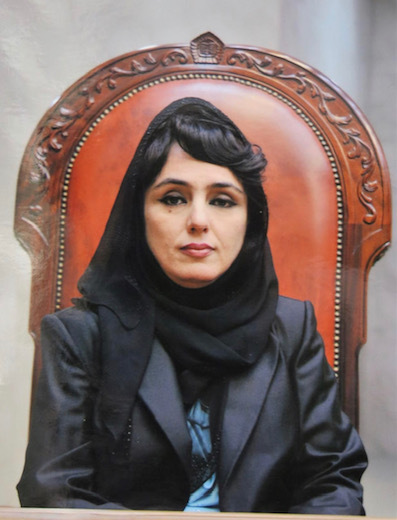
The Taliban is continuing its purge of the Afghan intelligentsia prior to the scheduled Western troop withdrawal in ten weeks from now.
Zakia Herawi, above, was shot dead in a car, along with her colleague Kadria Yasini. Both women were Supreme Court judges.
As Anthony Loyd writes: “That, two decades after the US overthrew the Taliban, these two women — part of an inspirational female elite who would have had to overcome huge obstacles to reach such positions in the male-dominated judiciary — had their car doors wrenched open by assassins and were blasted to death where they sat with no more than handbags for protection sent a chilling message to every woman who aspired to more than the dictates of Taliban conservatism allowed: submit or die”
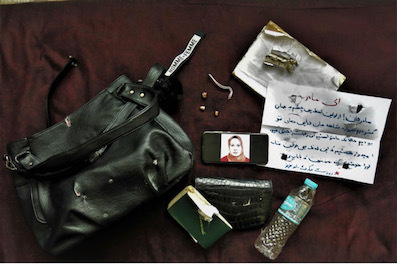
Judge Yasini’s handbag and contents, including a Mother’s Day letter written by her sons, part of a campaign to intimidate and silence the country’s middle class.
As she was shot Kadria pulled her handbag to her chest to try and protect herself; it was riddled with the bullets that killed her.
AFGHAN PURGES INTENSIFY
[Note by Tom Gross]
I attach an essay from today’s Times of London by its excellent reporter and war correspondent Anthony Loyd.
To be clear, I am not necessarily advocating keeping Western troops in Afghanistan. There is no easy solution to the conflict in Afghanistan.
The Taliban killings have escalated sharply in recent weeks, in Kabul and other towns and cities, targeting civil society leaders, human rights officials, judges, university lecturers, cultural figures and journalists.
Thousands of Afghanistan’s educated middle class are leaving the capital, fearful of what may come if the remaining 2,500 US troops, 1,000 British soldiers and 6,000 other NATO personnel withdraw from Afghanistan by May 1 as has been agreed.
Loyd writes:
News gathering in Afghanistan has been murder for some time now, so journalists making the journey home move quickly. Some reporters in the city have taken to staying in their offices for days at a time rather than risk leaving. Thirty-three Afghan journalists have been killed in the past three years and the rate of attacks on the media is worse than ever.
For Lotfullah Najafizada, the editor and director of TOLOnews, Afghanistan’s leading 24/7 news channel, the toll is personal. He has lost 11 of his reporters since the first seven TOLOnews journalists were killed in a Taliban suicide bombing in 2016. A twelfth individual, Yama Siawash, a famous former anchorman for the channel, was blown up and killed by a limpet mine placed beneath his vehicle in Kabul last November. In dead and wounded, the channel has suffered worse casualties while reporting in Kabul than many coalition units lost fighting in Helmand.
Loyd also points out:
Most Afghans detest the war. Yet they are expert enough in its nuance to know too that a badly managed attempt at peace may make the war even worse. During a previous era of civil war in the 1990s after the Soviet withdrawal, a time in which al-Qaeda established itself in Afghanistan and lay the grounds for the attacks of 9/11, the death count and ruination dwarfed the present level of casualties. A fifth of the population fled the fighting as refugees to Pakistan, and those who remained died in their thousands. In 1994 alone, 25,000 Afghans were killed in and around the capital, much of which was reduced to ruins.
He adds:
There is no doubting the necessity of ending the conflict. Tens of thousands of Afghans have died in the past 20 years, along with more than 2,400 Americans and 456 British troops. Though the involvement of Nato forces has decreased sharply in the past five years — not a single British serviceman has died in Afghanistan since 2015 and the Americans have not lost a soldier since Doha was signed — the war between Afghans is intensifying. Civilian casualties of 8,000 dead and wounded last year marked a decrease on the 2019 figures but the Taliban appear to have eschewed mass-casualty bombings in favour of a targeted campaign of killings against the educated that has caused panic.
(The second piece below, published today by the Gatestone Institute, is by Con Coughlin, my former Foreign Editor at The Telegraph in London, who is now the Telegraph’s Defence and Foreign Affairs Editor. It is titled “Biden Cannot Allow the Taliban to Destroy Trump’s Peace Legacy.”)
AMONG THE TIMES OF LONDON READERS’ COMMENTS:
Surely those commenting on the potential for a resurgent Taliban to spread to Pakistan are wrong. The Taliban is harboured in, and spreads from, Pakistan. Ask those who protected Bin Laden. We should be withdrawing all international aid and commercial contact from Pakistan until that country’s government gives clear support to a democratic Afghanistan. It will be a long wait.
***
The solution was simple. While US and British troops were in Helmand they should have destroyed the opium trade, it was and still is the Taliban’s lifeblood. They didn’t and now it’s too late.
With some pesticide and planes, it’s a job still waiting to be done. With the main cash crop eliminated, the ability to purchase weapons is hugely diminished.
***
So just like the Russians years ago. What a monumental waste of time, money and lives. The Taliban win again.
ARTICLES
WE’RE HANDING AFGHANISTAN TO THE TALIBAN
We’re handing Afghanistan to the Taliban
After decades of war and thousands of deaths, western allies are on the brink of giving away everything we fought for , says Anthony Loyd, who has covered the conflict for 25 years
By Anthony Loyd
February 20, 2021
The Times
https://www.thetimes.co.uk/article/were-handing-afghanistan-to-the-taliban-8l7x3r2gk
The editor talked about war and death as the winter’s day slipped away to the creep of shadows and the coming of the Kabul night. A couple of his journalists called their farewells as they passed his office door and took the stairs down to the reception, where rows of flak jackets and helmets were stacked in open lockers waiting to be grabbed when needed, either to survive while reporting the city streets, or in case the offices were stormed.
News gathering in Afghanistan has been murder for some time now, so journalists making the journey home move quickly. Some reporters in the city have taken to staying in their offices for days at a time rather than risk leaving. Thirty-three Afghan journalists have been killed in the past three years and the rate of attacks on the media is worse than ever.
For Lotfullah Najafizada, the editor and director of TOLOnews, Afghanistan’s leading 24/7 news channel, the toll is personal. He has lost 11 of his reporters since the first seven TOLOnews journalists were killed in a Taliban suicide bombing in 2016. A twelfth individual, Yama Siawash, a famous former anchorman for the channel, was blown up and killed by a limpet mine placed beneath his vehicle in Kabul last November. In dead and wounded, the channel has suffered worse casualties while reporting in Kabul than many coalition units lost fighting in Helmand.
“It never really stopped,” Najafizada, 33, said. “Journalists have been targeted many times before. But in the past two or three months it has become part of a much broader campaign.”
The killings have escalated sharply since November, in Kabul and other towns and cities, targeting not only journalists but civil society leaders, human rights officials, judges, university lecturers and cultural figures: a broad spectrum kill-list of men and women which loosely includes the most progressive elements of Afghan society to have evolved since the 2001 overthrow of the Taliban. Thousands of the educated middle class, many journalists among them, are leaving the capital amid this purge, fearful of what may come if the remaining 2,500 US troops, 1,000 British soldiers and 6,000 other Nato personnel follow through on an agreement made between the Trump administration and the Taliban last year in Doha to fully withdraw from Afghanistan by May 1 in the absence of any overall peace deal.
The aim behind the Taliban assassination campaign is clear but, aware of his responsibility in keeping up reporters’ morale in a time of fear, Najafizada chose his words carefully. “I am confident that the gains of the past 20 years won’t go away,” he said, leaning forward in his chair to remind me that two thirds of the country is under 25 and do not even remember the previous tenure of Taliban power. “But these attacks are very much related to the peace process. The Taliban see the world as pre-2001 and post-2001. Post-2001 the only people the Taliban see they have to negotiate with is the US, and once they have done that then all other post-2001 products in Afghanistan — music, culture, media, women’s rights — should go, along with the last American soldier.
“It is this new Afghanistan that is being attacked and the environment of debate, tolerance and discussion that are being targeted.”
War is only an event to those who have never experienced it. To those who know war, it is an entity. War is in a field; a village; a valley; a city. War is in the street. War is present on the walk home from the office. It is in the mind and memory and in feeling; in reminiscences and dreams and looking in the mirror in the morning. War is a constant presence. There is a quantum difference between reading about war, going to war, being at war and living in war. In Afghanistan, after 40 years of war, it is so deeply entrenched that it is imbued with the psyche of communities. I asked Najafizada if that preordained Afghanistan to war for eternity, like one of the innumerable great game, graveyard of empires, forever war clichés that foreigners, usually British or American, use to yoke the country to careless prediction.
“It does not mean Afghanistan will be at war for ever,” he said after a brief pause. “But it does mean that after so long exposed to conflict, people here will choose to fight very easily. One thing is for sure: the return of the Taliban is inevitable — it is just a question of what kind of Afghanistan they want to be part of.”
In the absence of an answer, that question looms like the shadow of a tombstone across Afghanistan, as the clock ticks toward the deadline for the US withdrawal. Most Afghans detest the war. Yet they are expert enough in its nuance to know too that a badly managed attempt at peace may make the war even worse. During a previous era of civil war in the 1990s after the Soviet withdrawal, a time in which al-Qaeda established itself in Afghanistan and lay the grounds for the attacks of 9/11, the death count and ruination dwarfed the present level of casualties. A fifth of the population fled the fighting as refugees to Pakistan, and those who remained died in their thousands. In 1994 alone, 25,000 Afghans were killed in and around the capital, much of which was reduced to ruins. Many now fear that the hasty Trumpian construct of the Doha accord may recreate the same horrifying scenario.
The accord, signed between the Americans and the Taliban on February 29 last year, officially titled the Agreement for Bringing Peace to Afghanistan, is not truly a “peace deal” at all, as it does not end a war. Rather, it is an accord that set the schedule for a full US withdrawal from Afghanistan by May 1 this year — and by definition the other Nato troops — dependent on three pillars of agreement between the Americans and the Taliban: the severance of the Taliban’s relationship with al-Qaeda, a reduction of Taliban violence and the start of meaningful negotiation between the Taliban and the Afghan government.
Without a single one of these pillars yet complied with, the new US administration has tried to slam the brakes on the momentum to pull out of Afghanistan by the deadline, wary of the potential consequences of a perceived US defeat, jihadist resurgence and catastrophic civil war. President Biden called for an expedited review of the Doha accord within days of assuming office. The results are expected this month and will dictate the future of all US-led Nato forces in Afghanistan and the course of the war too.
It is the overwhelming consensus among Afghan leaders, foreign diplomats and western army officers that the US will abandon the deadline to withdraw its remaining troops and stipulate that the exit from Afghanistan must be condition-based. Most agree too that the Taliban will probably test this resolve by increasing its violence and shedding more Afghan and western blood.
There is no doubting the necessity of ending the conflict. Tens of thousands of Afghans have died in the past 20 years, along with more than 2,400 Americans and 456 British troops. Though the involvement of Nato forces has decreased sharply in the past five years — not a single British serviceman has died in Afghanistan since 2015 and the Americans have not lost a soldier since Doha was signed — the war between Afghans is intensifying. Civilian casualties of 8,000 dead and wounded last year marked a decrease on the 2019 figures but the Taliban appear to have eschewed mass-casualty bombings in favour of a targeted campaign of killings against the educated that has caused panic. In the 11 months since Doha was signed a record 8,574 Afghan security force members were killed and a further 17,967 were wounded, and fighting has continued through the winter at double the intensity of the previous year.
From its inception, the structure of the Doha deal caused alarm. A bilateral arrangement between the US and the Taliban, it excluded the Afghan government altogether. Moreover, rather than initiate a choreographed set of stages in subsequent talks between the two Afghan sides, verifying and rewarding steps of agreement and implementation with a calibrated release of prisoners and drawdown of US troop numbers, the Americans gave the Taliban most of their key demands, including a set date for a full withdrawal and the release of 5,500 prisoners, before serious talks between the Taliban and Afghan government had even begun.
In both its construct and handling, the Doha deal and subsequent negotiations have caused profound resentment at the highest levels of the Afghan presidency. “Once I realised that overall the structure of the talks was flawed, cracked, I didn’t show interest in details,” the vice-president, Amrullah Saleh, told me in Kabul last month. “If this high-rise stands on false foundations why should I show interest in how they distribute the spaces within, when it is doomed anyway?”
Like many, Saleh regarded the Doha accord as a Trumpian equivalent of an emperor without clothes. “We can’t solve this by fooling ourselves,” he said, “creating a falsehood and then accepting a falsehood as truth.”
By contrast the Taliban have exulted in a narrative of victory they were handed by the Doha deal, many of the insurgents regarding the accord as a statement of American defeat rather than an opportunity for peace. “We have just defeated a superpower,” one Taliban commander, Khalid Agha, assured me when I met him and his fighters in a frontier district in Kandahar last year, a few days after the deal had been signed. “Once the Americans have gone it will be easy to sort out the Afghan government.”
Boastful and assured, scarred by shrapnel wounds and prison time, he was certain that the religious idealism for which he fought should not be compromised by any power-sharing deal with a republic. “We haven’t been shedding blood all these years with the intent of sharing power with the Kabul government,” he said. “We fight for sharia, for the Islamic emirate, not to make deals with democrats in the time of our victory.”
After Doha not even the continuing relationship between the Taliban and al-Qaeda appeared to bother the Trump administration, though it had been the principal reason for the US invading the country in the first place, and severance of the al-Qaeda–Taliban alliance was a prime pillar of the Doha agreement. In October, only seven months after the deal was signed, a senior al-Qaeda member who was on the FBI’s most-wanted list was killed by Afghan security forces in Ghazni province, deep in the Taliban heartland; and in January this year a US treasury report described how al-Qaeda continued to capitalise on its relationship with the Taliban through a network of advisers “providing advice, guidance, and financial support”.
In Trump’s hurry to find the exit from Afghanistan, it seemed that even the ghost of Bin Laden had been ignored.
With war so omnipresent and pressing I found it, too, lying in the contents of a murdered woman’s handbag. Kadria Yasini was shot multiple times in a car beside another woman, Zakia Herawi, on January 17, three days before Biden assumed the presidency and called for the Doha deal to be reviewed. As she was shot Kadria pulled her handbag to her chest; it was riddled with the bullets that killed her.
Both women were Supreme Court judges, killed in the continuing Taliban purge of the intelligentsia. That, two decades after the US overthrew the Taliban, these two women — part of an inspirational female elite who would have had to overcome huge obstacles to reach such positions in the male-dominated judiciary — had their car doors wrenched open by assassins and were blasted to death where they sat with no more than handbags for protection sent a chilling message to every woman who aspired to more than the dictates of Taliban conservatism allowed: submit or die.
Arranged on the floor of her home before me by her two sons four days after the murders, the contents of Judge Yasini’s handbag epitomised the dimensions of this assault: even the bag’s Homme+Femme label, so close to three spent bullets found inside, seemed an augur of dark reversion. Her black leather bag, purse, notebook and water bottle, and a book on law that she had written, were all bullet-punctured, her tweezers bent by the impact.
As the dead woman’s elder son, Abdulwahab, 20, examined the items in turn and leafed through bullet-torn pages of her book, he discovered a folded Mother’s Day letter tucked inside. Written by him and his brother the previous year, it too was holed by lead. “We didn’t know she kept this letter,” he said quietly, unfolding the punctured page to read once more. As Abdulwahab, born the year the Taliban had been overthrown, began to read the words around the ragged bullet holes, it seemed for a moment as if the young man was staring not at a letter to a murdered mother, but at a private manifesto of the Taliban’s reborn intent.
“BIDEN CANNOT ALLOW THE TALIBAN TO DESTROY TRUMP’S PEACE LEGACY”
Biden Cannot Allow the Taliban to Destroy Trump’s Peace Legacy
By Con Coughlin
Gatestone Institute
February 20, 2021
https://www.gatestoneinstitute.org/17080/biden-afghanistan-taliban
Under the terms of that agreement with the US, the Taliban agreed to negotiate a peaceful resolution of this benighted country’s long-running civil war in return for Washington agreeing to withdraw all its remaining forces. In addition, they agreed to cut their ties with Islamist terrorist organisations such as Al-Qaeda.
While Mr Trump kept his side of the bargain, reducing US forces from around 13,000 at the time the deal was signed last February to just 2,500 when he left office, there has been little evidence of the Taliban fulfilling their commitments under the terms of the agreement.
Consequently, Afghanistan finds itself in the midst of a major security crisis, with militants concentrating their attacks on a broad cross-section of Afghan society, with judges, activists, journalists, moderate clerics, students and other professionals all being targeted.
Afghan officials believe the Taliban never had any intention of fulfilling their side of the deal, and just drew out the negotiations with the Trump administration so that they could secure the release of the estimated 5,000 militants being held by Afghan security forces, who were eventually released by the Afghan authorities last autumn.
“The only thing the Taliban have taken out of this agreement is to get their prisoners, then launch an offensive against the Afghan forces and government. That was, it seems, their plan from the beginning.” — Hamdullah Mohib, Afghanistan’s National Security Advisor, The Times, February 17, 2021.
Of major concern is the prospect that, if the Taliban are allowed to seize control of the country they governed prior to the September 11 attacks, they will once again allow Afghanistan to become a safe haven for terrorist groups such as Al-Qaeda and ISIS, which will then use the country as a base to launch devastating attacks against the West.
Thus, in making his decision about the future of American forces in Afghanistan, Mr Biden needs to take care that he is not responsible for causing a new wave of terror attacks against the US and its allies.
***
With former US President Donald J. Trump no longer able to dictate US policy on Afghanistan, the Taliban are exploiting the opportunity to increase their efforts to seize control of the country in spite of the peace accord they signed with the Trump administration last year.
Under the terms of that agreement with the US, the Taliban agreed to negotiate a peaceful resolution of this benighted country’s long-running civil war in return for Washington agreeing to withdraw all its remaining forces. In addition, they agreed to cut their ties with Islamist terrorist organisations such as Al-Qaeda.
Yet, to judge by recent events in Afghanistan, the Taliban are showing little inclination to abide by the terms of the deal.
While Mr Trump kept his side of the bargain, reducing US forces from around 13,000 at the time the deal was signed last February to just 2,500 when he left office, there has been little evidence of the Taliban fulfilling their commitments under the terms of the agreement.
On the contrary, since the start of the year there has been a marked upsurge in violence as the Taliban, rather than seeking to achieve a peaceful solution to the Afghan conflict, have been accused of intensifying their terrorist campaign in their bid to retake control of the country. In addition, the Taliban leadership is maintaining its ties with terror groups such as Al-Qaeda.
Consequently, Afghanistan finds itself in the midst of a major security crisis, with militants concentrating their attacks on a broad cross-section of Afghan society, with judges, activists, journalists, moderate clerics, students and other professionals all being targeted.
One of the more depressing features of this upsurge in violence is that it has resulted in young educated Afghans, who have enjoyed a more liberal lifestyle in recent years and once heralded a bright future for their country, opting to abandon their country in order to escape the worsening violence.
Afghan officials believe the Taliban never had any intention of fulfilling their side of the deal, and just drew out the negotiations with the Trump administration so that they could secure the release of the estimated 5,000 militants being held by Afghan security forces, who were eventually released by the Afghan authorities last autumn.
Interviewed by The Times of London earlier this week, Hamdullah Mohib, Afghanistan’s National Security Advisor, accused the Taliban of simply exploiting the deal to secure the release of Taliban fighters from Afghan prisons:
“The only thing the Taliban have taken out of this agreement is to get their prisoners, then launch an offensive against the Afghan forces and government. That was, it seems, their plan from the beginning.”
The rapidly deteriorating security situation has now prompted NATO leaders to order a review of whether all the remaining US-led coalition troops based in Afghanistan should be withdrawn by May 1 this year, as was originally envisaged in Mr Trump’s deal.
A two-day virtual conference convened this week of NATO defence ministers -- the first time that officials from the new Biden administration have participated in a NATO summit -- discussed in detail whether the withdrawal should continue, but decided to postpone a decision while US President Joe Biden undertakes a thorough review of Mr Trump’s deal.
Even though the Biden administration has yet to decide whether to support Mr Trump’s deal, there is growing resistance within the NATO alliance to withdrawing forces while the Taliban are still maintaining their campaign of violence against the Afghan people.
Speaking at the end of the NATO meeting, Secretary General Jens Stoltenberg said the alliance remained committed to the agreement, but wanted the Taliban to demonstrate that it was serious about pursuing peace.
“The peace process is the best chance to end years of suffering and violence, and bring lasting peace,” he said. “It is important for the Afghan people, for the security of the region and for our own security.
Of major concern is the prospect that, if the Taliban are allowed to seize control of the country they governed prior to the September 11 attacks, they will once again allow Afghanistan to become a safe haven for terrorist groups such as Al-Qaeda and ISIS, which will then use the country as a base to launch devastating attacks against the West.
Thus, in making his decision about the future of American forces in Afghanistan, Mr Biden needs to take care that he is not responsible for causing a new wave of terror attacks against the US and its allies.
* You can also find other items that are not in these dispatches if you “like” this page on Facebook www.facebook.com/TomGrossMedia
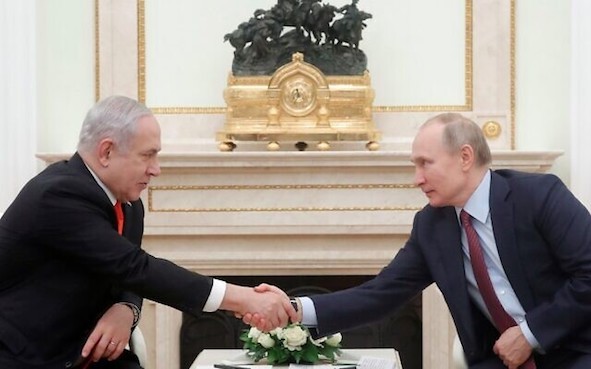
Vladimir Putin and Benjamin Netanyahu shaking hands at the Kremlin in January last year. Russia has quietly cooperated with Israel in Jerusalem’s attempts to thwart the massive Iranian rocket build up on Israel’s borders with Syria and Lebanon.
Even before Putin brokered yesterday’s Israel-Syria prisoner swap, there have been ongoing reports for some months in Arab media about Russian attempts to normalize ties between Damascus and Jerusalem.
CONTENTS
1. Israel agrees to buy Russian Covid vaccine for Syria, in exchange for captured Israeli woman
2. Did Syrian national security chief Ali Mamlouk and former Israeli chief-of-staff Gadi Eisenkot meet at the Khmeimim Russian airbase on the Syrian coast?
3. Arab media: there are ongoing Russia-brokered contacts to establish normalization ties between Syria and Israel
ASHARQ AL-AWSAT: NETANYAHU AGREED TO MORE THAN JUST A PRISONER SWAP TO GET ISRAELI WOMAN BACK FROM SYRIA
[Note by Tom Gross]
The Saudi-owned pan-Arab paper Asharq Al-Awsat* reported online this morning that in exchange for releasing a mentally disabled 25-year-old Israeli woman who had wandered into Syria on February 2, and was being held by Syria, Israel has agreed to purchase considerable stocks of Russia’s Sputnik V Covid vaccine for Syria.
The reports are correct according to unnamed sources in Israel. Israel and Syria are officially in a state of war and Israeli media outlets are barred from directly confirming these reports from named sources under Israeli military censor guidelines.
The deal was brokered in a series of phone calls between Israeli Prime Minister Benjamin Netanyahu and Russian President Vladimir Putin, who enforced the deal upon his ally President Assad.
The woman, who has not been named and is from central Israel, was flown from Syria to Moscow and then returned to Israel yesterday. She was accompanied on the flight from Moscow by a former intelligence officer, Yaron Blum, by an assistant working in Netanyahu’s office, Asher Hayun, and by a doctor who checked the woman’s health, and who has not been named.
Assad had originally demanded Israel release two captured Syrian terrorists who had been involved in attempted bomb plots against Israel, but both refused to go to Syria and said they would prefer to stay in Israeli prisons. Instead Israel release two Syrian shepherds who were in prison in Israel on lesser charges.
The Syrians who refused to leave their Israeli prisons were named as Nihal al-Maqt, in prison since 2017, and Dhiyab Qahmuz, sentenced to 16 years in 2018 for plotting a bombing in coordination with the Lebanese Hezbollah terror group.
It is believed that Israel’s purchase of the vaccine doses for Syria cost approximately one million dollars.
* Tom Gross adds: Asharq Al-Awsat is generally a reliable newspaper. In 2019 I became the first ever journalist who is understanding of Israel to be profiled by the paper in a sympathetic way.
REPORTS OF SYRIAN-ISRAELI MEETING AT RUSSIA’S KHMEIMIM AIR BASE
EXTRACTS
Memri reports:
In the recent weeks, Arab media outlets have been reporting that Russian efforts are underway to promote a normalization agreement between Syria and Israel. The reports claim that Syria and Israel have exchanged messages in this context, and some even claim that representatives of the two countries, including Syrian national security chief Ali Mamlouk and former Israeli chief-of-staff Gadi Eisenkot, met recently at the Khmeimim Russian air base on the Syrian coast. According to the reports, during this meeting the sides clarified their terms for normalization: Israel demanded the withdrawal of Hizbullah and the Iranian and pro-Iranian forces from Syria, while Syria demanded support for President Assad’s remaining in power, an end to the sanctions on his regime, and economic aid.
The Assad regime denied the reports… However, well-known Syrian actor Duraid Lahham, who is identified with the regime and is known for his firm positions against Israel, told CNN Arabic that normalization “would come” and that he does not oppose it as long as it conforms to the terms of the 2002 Arab peace initiative. His remarks may have been uttered with the approval of the regime.
According to this report, Russia means for Iran to be part of this deal as well, in light of its close relations with the Syria regime. Furthermore, Russia believes that its clout with Iran - due to its arms deals with this country and its central role in determining the fate of the Iranian nuclear deal - will enable it to pressure Iran to downscale its military presence in Syria,
Some of the reports specified that Syrian and Israeli representatives had met in secret on Syrian soil. The Al-Hadath channel, which is part of the Al-Arabiya network, reported in mid-January that Syrian and Israeli delegations had met, under Russian sponsorship, at the Khmeimim Russian air base in northern Syria. According to the report, this was preceded by meetings in Cyprus at an unspecified date…
The meeting, it claimed, took place in December and was attended by Syrian National Security Bureau head ‘Ali Mamlouk and his special advisor for security and strategic affairs, Bassam Hassan; by Israeli former chief-of-staff Gadi Eisenkot and former Mossad officer Ari Ben-Menashe, and by the commander of the Russian forces in Syria, Alexander Chayko…
FULL MEMRI REPORT
Continued Reports In Arab Media About Russia-Brokered Contacts Between Syria, Israel
By O. Peri
Middle East Media Research Institute
February 18, 2021
In the recent weeks, Arab media outlets have been reporting that Russian efforts are underway to promote a normalization agreement between Syria and Israel. The reports claim that Syria and Israel have exchanged messages in this context, and some even claim that representatives of the two countries, including Syrian national security chief Ali Mamlouk and former Israeli chief-of-staff Gadi Eisenkot, met recently at the Khmeimim Russian air base on the Syrian coast. According to the reports, during this meeting the sides clarified their terms for normalization: Israel demanded the withdrawal of Hizbullah and the Iranian and pro-Iranian forces from Syria, while Syria demanded support for President Assad’s remaining in power, an end to the sanctions on his regime, and economic aid.
The Assad regime denied the reports, calling them lies spread by countries that support normalization with Israel, aimed at discrediting his regime’s unwavering position on Israel and creating an impression that Syria too is seeking normalization.
However, well-known Syrian actor Duraid Lahham, who is identified with the regime and is known for his firm positions against Israel, told CNN Arabic that normalization “would come” and that he does not oppose it as long as it conforms to the terms of the 2002 Arab peace initiative.[1] His remarks may have been uttered with the approval of the regime.
Oppositionist Syrian writers who addressed this issue focused on whether normalization with Israel at the present time would benefit the Assad regime or harm it.
It should be noted that reports of this sort also appeared in some Arab newspapers in the fall of 2020, especially in October. Then too the Syrian regime denied the reports and reiterated its opposition to any agreement with the Israeli enemy.[2]
It should also be noted that Russia is currently mediating between Syria and Israel in some humanitarian issues, including the case of a young woman who crossed the border into Syria[3] and the search for the remains of Israeli soldiers in a cemetery in the Yarmouk refugee camp in southern Damascus.[4]
This document reviews the recent reports on the alleged diplomatic contacts between Syria and Israel, and reactions by the Syrian regime and the Syrian opposition to these reports.
ARAB MEDIA: RUSSIA SPONSORING SECRET TALKS BETWEEN SYRIA AND ISRAEL, AIMED AT NORMALIZATION AND OUSTER OF IRANIAN FORCES FROM SYRIA
As stated, reports about efforts to promote a Syria-Israel agreement first appeared in October 2020, and again in December of that year. An article published on December 12, 2020 by Lebanese-American journalist Gharida Durgham claimed that Russia had presented the Syrian regime with a proposed deal to settle its conflict with Israel. According to this report, Russia means for Iran to be part of this deal as well, in light of its close relations with the Syria regime. Furthermore, Russia believes that its clout with Iran - due to its arms deals with this country and its central role in determining the fate of the Iranian nuclear deal - will enable it to pressure Iran to downscale its military presence in Syria, especially in the Damascus area, thus paving the way to a Russia-sponsored Syrian-Israeli-Iranian understanding. Durgham assesses that Russia discussed the proposed deal with Israel before presenting it to the Syrian regime.[5]
On December 21, the liberal Saudi website Elaph reported, citing an unnamed high-ranking Israeli officer, that Syria has been relaying messages to Israel on a possible agreement. According to the report, “Assad wants to draw closer to the Sunni [Arab] axis so he can pay its debts to Iran and remove it from Syria. He understands that Israel can help him both with the U.S. and with the Gulf and the Sunni axis. He, like the Russians, now regards us [Israelis] as a bridge to the U.S. and to the Gulf and Sunni states. Assad… will not show up to make peace tomorrow. But he is now willing to talk in order to shore up his regime, rejoin the Arab League… and establish a state of non-aggression with Israel. The Golan and other issues will come later… The important point is that there is a chance he will be willing to break up the Iranian axis…”[6]
One month later, on January 21, the Saudi Al-Arabiya network likewise reported, citing a Russian diplomatic source, that contacts between Syria and Israel were underway under the auspices of Russia and with its encouragement.[7] The London-based online daily Raialyoum.com reported on a deal allegedly presented to Assad by Israel in December 2020 through a third party. According to the report, under the proposed deal the U.S. and Israel will guarantee the withdrawal of the Turkish forces from northern Syria and the withdrawal of the U.S. forces from eastern Syria, and agree to the renewal of the Syrian influence in Lebanon. In return, Syria will sign a peace agreement with Israel that will leave the Golan in Israeli hands and guarantee a withdrawal of Hizbullah and the Iranian forces from Syria. The report also states that Assad refused the deal.[8]
The London-based Qatari-owned daily Al-Arabi Al-Jadid reported that, during Syrian Foreign Minister Faisal Al-Mekdad’s visit to Moscow last December, Russia relayed an Israeli proposal under which the Iranian forces would withdraw from southern Syria, and Assad, in return, would receive financial aid to repay his debts to Iran, and a way would be found for him to remain in power with international consent.[9]
According to The Syrian Observatory for Human Rights, the issue of normalization with Israel was discussed in meetings Russian-Syrian meetings in Moscow and Damascus; representatives of the Assad regime asked what Syria’s reward would be, and whether it would include the lifting of the U.S. sanctions on the regime, given that normalization would surely lead to the withdrawal of the Iranians from Syria.[10]
REPORTS ON SYRIAN-ISRAELI MEETING IN RUSSIAN KHMEIMIM AIR BASE
Some of the reports specified that Syrian and Israeli representatives had met in secret on Syrian soil. The Al-Hadath channel, which is part of the Al-Arabiya network, reported in mid-January that Syrian and Israeli delegations had met, under Russian sponsorship, at the Khmeimim Russian air base in northern Syria. According to the report, this was preceded by meetings in Cyprus at an unspecified date.[11]
In a January 18, 2021 report, the Jusoor research center, based in Turkey and identified with the Syrian opposition, provided further details about the alleged meeting in Khmeimim. The meeting, it claimed, took place in December and was attended by Syrian National Security Bureau head ‘Ali Mamlouk and his special advisor for security and strategic affairs, Bassam Hassan; by Israeli former chief-of-staff Gadi Eisenkot and former Mossad officer Ari Ben-Menashe, and by the commander of the Russian forces in Syria, Alexander Chayko. Like the Elaph report from December 2020, this report too listed Syria’s alleged demands in return for a deal: the renewal of its relations with the Sunni Arab axis; Syria’s reinstatement in the Arab League; financial aid to repay Syria’s debt to Iran and enable it to demand Iran’s withdrawal from its territory; consent to Assad’s continued rule, and a lifting of the sanctions on his regime. The Israelis, for their part, demanded the dissolution of the “resistance axis”; a complete withdrawal of Hizbullah and the foreign militias from Syria; the establishment of a Syrian government half of whose members are from the opposition, and a reorganization of the regime’s military and security apparatuses.
The Jusoor research center assessed that this Syrian-Israeli meeting marks the beginning of “a channel that Russia is pushing to establish, and which will probably widen considerably in 2021, because Russia believes that direct relations between the Assad regime and Tel Aviv could be a life-raft for the regime and could [promote Russia’s] future efforts to enlist international support for its [proposed] political solution in Syria.” As for the Syrians’ potential profit, Jusoor speculated that that “peace with Israel is the ideal solution [for] the Assad regime, allowing it to break out of the diplomatic and economic siege it has been suffering for about a decade and to remain in power for decades more, unless a popular uprising occurs, or some other unforeseen circumstances.”[12]
SYRIAN REGIME: REPORTS ON CONTACTS WITH ISRAEL AN ATTEMPT TO OBSCURE OUR FIRM POSITION AGAINST THE ISRAELI OCCUPATION
As it did in October 2020, the Syrian foreign ministry denied that any contacts with Israel were underway. A ministry source told the official Syrian news agency SANA that “the Syrian Republic firmly denies the false reports that have been spread by some recruited media regarding Syrian-Israeli meetings in all sorts of places, and clarifies that their publication is a failed attempt by those who finance those newspapers to cast doubt on Syria’s principled and unwavering positions on the Israeli occupation… The forces behind these lies are the same forces that are rushing to normalize [their relations] with this entity and trying to drag the entire region into Zionist-Western pacts, sometimes by sowing alarm and sometimes through enticement. Having failed [to achieve this], they have now turned to publishing fake news.”[13]
In addition, the Syrian state press published articles attacking the Arab media that had published the reports about Syria-Israel contacts. Ahmed Hamada, a political editor at the Al-Thawra daily, attacked the London-based Saudi Al-Sharq Al-Awsat for quoting the abovementioned report by the Jusoor research center. He wrote: “That distorted [Al-Sharq Al-Awsat] article spread false claims that a Syrian-Israeli meeting had been hosted at Khmeimim Air Base under the auspices of Russia to discuss various issues. The most ironic claim, arousing a mixture of amusement and contempt, is that the matter of Syria’s reinstatement in the Arab League was discussed. With whom? With the Israeli entity!! How stupid are the members of that [Jusoor] ‘research’ center, and the authors of this ‘investigative’ [Al-Sharq Al-Awsat] article, whose delusions have led them to this level of cheap and reprehensible fabrication and invention, causing them to make up issues that were discussed only in their rotten minds and in their heads empty of anything but treachery!... The authors of this fake article forgot that only a few days ago the Israelis attacked in Deir Al-Zor and Al-Bukamal [the reference is to a January 31, 2021 attack on Syrian forces and pro-Iranian militias in eastern Syria, which reportedly caused some 80 casualties],[14] an attack that came only because Syria is not amenable to filthy normalization [with Israel] and because it has humiliated the leaders of the U.S. and Israel… Therefore, there isn’t a single known tactic of lying and deception, or any other filthy tactic, that the sponsors of the aggression against Syria have not used in order to realize their colonialist goals in Syria. Accordingly, their media and intellectuals have invented lies and spread rumors to distort the facts and draw attention away from the truth about the terror, its supporters and those who are behind it, so as to preoccupy public opinion with ludicrous stories…”[15]
Al-Thawra columnist ‘Abd Al-Rahim Ahmad wrote in a similar vein: “As several Arab regimes rush to normalize relations, for no reward, with the Israeli enemy that is forcefully maintaining its grip on Palestine and the occupied Syrian Golan, some media mouthpieces of these regimes have mobilized to promote normalization and to justify this collapse of moral and human [values] by fabricating reports about Syrian-Israeli meetings, so as to imply that all the Arab countries are taking this path… The forces that are normalizing their relations [with Israel] and who follow the orders of the American administration are unable to make their own decisions and cannot refuse to take this path. [So] they are not in any position to talk about Syria or instruct their media to invent false reports about it, especially considering that, when Damascus did talk with Israel, in Madrid [in 1990] and elsewhere, it did so openly and not in secret, and with one goal in mind: restoring the rights to their owners.”[16]
CONFLICTING ASSESSMENTS IN SYRIAN OPPOSITION REGARDING REGIME’S WILLINGNESS TO NORMALIZE RELATIONS WITH ISRAEL
Several Syrian writers identified with the opposition addressed the question of whether normalization with Israel could benefit the Assad regime at this time. Syrian journalist and researcher Hazem Nahar, who writes for the Lebanese daily Al-Mudun, assessed that the regime will turn to normalization with Israel only if its survival depends on it, and that the regime has not yet reached this point, because at present, normalization with Israel will only mean losing its allies. Nahar wrote: “Is it conceivable that the Syrian regime will opt for normalizing relations with Israel in order to break out of its isolation?... This regime has already taught us that it is capable of making unexpected moves when the external pressures on it increase, or, to be more precise, when it has no choice except to succumb to these pressures… In such extreme cases, Syria may use diplomacy to try and buy time. For example, the regime may express willingness to renew negotiations with Israel, or display some flexibility on the issue of restoring the Golan to Syria, by [agreeing] to a gradual [Israeli withdrawal] over a fairly long time - while leaving itself plenty of room to maneuver so it can evade every commitment. Such a tactic will enable it, as usual, to find a temporarily respite from the pressures until new developments arise.
“Hence, the Syrian regime is unlikely to change its position on Israel and on normalization with it except in the most unusual circumstances, when it is faced with the difficult but clear-cut choice between losing its power and normalizing relations with Israel in order to remain in power… I believe that the regime has not yet come to this point, and perhaps never will… Despite its desire to rebrand itself, at the moment the [Assad] regime can derive no benefit from normalizing relations with Israel; in fact, it will receive no reward and will lose much more than it gains… At present, normalization will only make it more difficult for the regime to reorganize its [power] balances and the regional and international relations that still keep it in power despite its fragility. These are relations in which it is greatly invested, especially with Iran, Hizbullah, the national Arab parties and the Arab left in general. It stands to lose in the domestic arena as well, since the basis of the continued existence of its ruling [Ba’th] party is still [this party’s] stated position on Israel and the Palestinian issue…”[17]
Conversely, Syrian writer Ghazi Dahman assessed that the Syrian regime does stand to gain from an agreement with Israel. Writing in the Al-Arabi Al-Jadid daily, he speculated that the regime wants “a deal similar to the one made by the government of Sudan, [under which Assad] will agree to normalization without preconditions, in return for the opening of doors that are [currently] closed to him. He thinks that the Western countries have trapped themselves in excessive sanctions [against him], and that that their doors are closed [to him] and cannot be opened by means of the previous methods [involving] intelligence cooperation or threats to destabilize Lebanon. Today there is need for a more powerful blow, such as normalization with Israel, in order to break down the walls of isolation around the Assad regime… Assad is betting that the countries of the world will welcome an agreement [with Israel] and open up their coffers to rescue his economy and rebuild everything he has destroyed. [He hopes that] the countries and organizations of the world will forget all the facts of his violent behavior and his madness, and give up their demands to [start] an interim phase [in Syria], [draft] a new constitution and prosecute war criminals [as per the resolutions of the Security Council]… Assad understands that entering into negotiations [will not require him to] meet terms and demands. All he needs to do is agree to normalization and remove the Iranian militias from Syria. Other than this, he is the one who will present a list of demands: for economic aid, a lifting of all the sanctions and maybe also non-interference in Syria’s affairs in the future.”[18]
FOOTNOTES
[1] Arabic.cnn.com, February 12, 2021.
[2] See Special Dispatch No. 8981 – Arab Papers Report That Efforts Are Underway To Promote Syrian Peace Agreement With Israel; Syria Denies Reports, October 21, 2020
[3] Sana.sy, February 17, 2021.
[4] Damascusv.com, February 4, 2021.
[5] Annaharar.com, December 20, 2020.
[6] Elaph.com, December 21, 2020.
[7] Alarabiya.net, January 21, 2021.
[8] Raialyoum.com, January 19, 2021.
[9] Al-Arabi Al-Jadid (London), January 28, 2021.
[10] Syriahr.com, January 19, 2021.
[11] Facebook.com/AlHadath, January 14, 2021.
[12] Jusoor.co, January 18, 2021.
[13] Sana.sy, January 18, 2021.
[14] Syriahr.com, January 13, 2021.
[15] Al-Thawra (Syria), January 18, 2021.
[16] Al-Thawra (Syria), January 19, 2021.
[17] Al-Mudun (Lebanon), January 10, 2021.
[18] Al-Arabi Al-Jadid (London), January 28, 2021.
* You can also find other items that are not in these dispatches if you “like” this page on Facebook www.facebook.com/TomGrossMedia
Here is another discussion in my series “Conversations with friends”.
Conversations with friends: Ariana Neumann (Venezuela / Prague / London)
www.youtube.com/watch?v=PfKMZlOnDVI
Growing up in a comfortable Caracas home, surrounded by joy, gaiety and the “birds of paradise” – and a father so revered that he had streets named after him in Venezuela – Ariana Neumann willed an adventure to come her way. But nothing prepared her for the true-life story which was to unfold upon her father’s death. Ariana speaks about her life growing up, and her discovery upon his death of her father’s hidden Holocaust survivor past.
The yellow stars shown at 20 minutes into my conversation with Ariana, are amazing and horrific.
OTHER VIDEOS IN THIS SERIES
* Other videos in this “Conversations with friends” series can be viewed here:
https://tomgross100.wixsite.com/chatswithtom
Tom Gross talks with friends around the world about their lives. They include musicians, historians, writers, newspaper editors and columnists, retired intelligence officers, Palestinian academics and journalists, and Oscar-nominated filmmakers.
Tom Gross interviewed about his own life here:
https://www.youtube.com/watch?v=T4Pg-IDYJYE
As part of a series of informal conservations with friends, Paul Lewis asks Tom Gross about his own life and views: growing up surrounded by cultural and literary luminaries in London and New York; Sunday brunches with Elvis Presley’s songwriter; crossing Checkpoint Charlie into East Berlin with his grandmother during communism; sitting across the breakfast room from Carlos the Jackal; visiting Prague as a student to bring Vaclav Havel materials from London in the months before Havel helped overthrow communism; Tom helping the Roma when almost no one else would; Tom’s close relationship with his godmother Sonia Orwell (the model for Julia, the heroine of her husband’s masterpiece ‘1984’); being in Manhattan on 9/11; the Mideast; the importance and legacy of the Holocaust; and other matters.
* You can also find other items that are not in these dispatches if you “like” this page on Facebook www.facebook.com/TomGrossMedia

The Israeli historian and Auschwitz survivor Otto Dov Kulka on a visit back to Prague’s Jewish town
REMEMBERING OTTO DOV KULKA; FROM PRAGUE TO VENEZUELA; WHEN GOOGLE MEETS SHTETL
[Note by Tom Gross]
I attach an obituary I wrote of Otto Dov Kulka, the Israeli historian and Auschwitz survivor. It is published today in The Daily Telegraph and is the first obituary of him to appear in English.
Otto’s 2013 memoir Landscapes of the Metropolis of Death was favorably compared in both The Guardian and Sunday Telegraph to Primo Levi’s Periodic Table.
Unlike many other scholars, Kulka shied away from using the terms “Holocaust” or “Shoah”. He told many people (including myself) that he preferred saying “the final solution” because students should understand the singular nature and aim of Nazi genocidal policies was to eradicate not just Jews but Jewish books, art, culture and history.
Telegraph obituaries are published without a byline but the text below is mine.
OTTO DOV KULKA
Otto Dov Kulka, Israeli historian who wrote an acclaimed account of surviving Nazi concentration camps
He wrote many scholarly works on the history and fate of European Jewry
Obituary
Daily Telegraph (London)
February 11, 2021
Otto Dov Kulka, who has died aged 87, was an award-winning Israeli historian and survivor of the concentration camps at Terezin (Theresienstadt) and Auschwitz.
For decades he taught at the Hebrew University of Jerusalem about the origins of Nazi ideology and the Holocaust, and wrote extensively on the subject, without telling students (or almost anyone) that he himself was a survivor.
But his highly personal 2013 book, Landscapes of the Metropolis of Death: Reflections on Memory and Imagination, translated into 17 languages within a year of its being published, brought his own experience to international attention, winning prizes in several countries, including the Jewish Quarterly-Wingate literary prize in Britain.
As Ian Thomson wrote in a review in The Sunday Telegraph Magazine “not since Primo Levi’s The Periodic Table has there been such a powerful Holocaust memoir … the writing, at times trance-like, creates an extraordinary sense of communion and intimacy with the reader … in pained but lucid prose Kulka seeks to understand how his memory processed the trauma of Auschwitz.”
Kulka's book of barely 100 pages was described by Ian Kershaw as ‘one of the most remarkable testimonies to inhumanity that I know’
It was the historian Ian Kershaw, who had read the random notes that Kulka had started scribbling in Jerusalem cafes about his childhood (he was 10 when he was deported from Terezin to Auschwitz), who helped persuade Kulka to write the book, barely 100 pages long. Kershaw called it “one of the most remarkable testimonies to inhumanity that I know”.
Kulka recalled that, as a child in the Auschwitz “family camp” (a deception effort by the Nazis), he did not experience the “acute, murderous, destructive discord and torment felt by every adult inmate”, and had no idea of the camp’s real purpose. Instead he was curious to know whether the perimeter fence was “really electrified”, and dared himself to touch it. He bore the scars until death. (Nearly everyone in the family camp was gassed to death in 1944, but some sick prisoners who by chance happened to be in the infirmary that day survived, including Kulka and his mother.)
Unlike many other scholars Kulka shied away from using the terms “Holocaust” or “Shoah”, telling friends that he preferred saying “the final solution” because students should understand the singular nature and aim of Nazi genocidal policies was to eradicate not just Jews but Jewish books, art, culture and history.
He was born Otto Deutelbaum on April 16 1933 in Nový Hrozenkov, a small town in the Czech province of Moravia, to lower-middle class Jewish parents. His family owned a small wood factory. He changed his surname after the war to Kulka, his mother’s maiden name, in her honour. She had died in Stutthof concentration camp in January 1945. His sister and other relatives were murdered in Treblinka and other camps.
He emigrated to Israel in 1949, aged 15. (His adopted father Erich, who also survived Auschwitz, joined him in Israel following the antisemitic purges in Prague that followed the 1968 Soviet-led invasion.)
Otto initially lived on a kibbutz and went on to study philosophy and history at the Hebrew University of Jerusalem, where he later became a distinguished professor, and at Goethe University, Frankfurt, publishing his first scholarly paper, Richard Wagner and the Origins of Modern anti-Semitism, in 1961.
“He was a real gentleman, retaining a pre-war mittel-European sense of decorum and culture right up to his death last week,” one of his former students, Michaela Rozov, has recalled.
Indeed at least once each year Kulka travelled back to Prague, where he often gave lectures. It was important to him to retain his central European roots and he wished to be known both by his Czech name Otto and by his Hebrew name Dov.
Among his many scholarly works on the history and fate of European Jewry and the moral and material ruins of wartime Germany, his German Jewry under the National-Socialist Regime (1997) won the Buchman Memorial Prize of Yad Vashem.
With his wife, Chaia, he had a daughter.
Otto Dov Kulka, born April 16 1933, died January 29 2021
* You can also find other items that are not in these dispatches if you “like” this page on Facebook www.facebook.com/TomGrossMedia

Above: Children in Chicago engaging in remote learning during a polio outbreak in 1937. Teachers read lessons out over the radio. By 1937, over 80 percent of American households owned at least one radio. A recent UNICEF survey found that 94% of countries have implemented some form of remote learning since COVID-19 closed schools last spring.
BIBI PLEADS NOT GUILTY
[Note by Tom Gross]
I attach three articles from today – from the New York Times, Haaretz and the Jerusalem Post.
The first is a news report on how Israeli Prime Minister Benjamin Netanyahu spoke in court today for the first time since his corruption trial began last May. (It is only the second time that he has attended in person.) This is a long awaited moment for those Israelis who dislike Netanyahu. However, many regard the trial as essentially a show trial, where allegations have been concocted or greatly exaggerated against Netanyahu by his political and societal opponents because they have repeatedly failed to oust him at the ballot box so they are trying to find other methods to drive him from office. Netanyahu pleaded not guilty.
(Netanyahu has been busy today: among other things, he met Greek Prime Minister Kyriakos Mitsotakis in Jerusalem today -- Israel and Greece signed various important agreements; and Netanyahu also held talks by phone with Russian President Putin about the increasing Iranian threat in Syria.)
The second article is long, but I think it is worth reading. Although it is about Israel, presumably these dire warnings about Covid and Covid-related problems continuing even after societies have been largely vaccinated, apply to many countries
In the third article, an Iranian regime cleric in the holy city of Qom who has hundreds of thousands of followers on social media, has told people that if they get vaccinated against Covid they will “become homosexuals”. Iran’s Islamic regime has executed thousands of gays and lesbians since it seized power in 1979.
ARTICLES
NETANYAHU ENTERS PLEA OF NOT GUILTY IN CORRUPTION TRIAL
Netanyahu Enters Plea of Not Guilty in Corruption Trial
By Patrick Kingsley
The New York Times
Monday Feb. 8, 2021
https://www.nytimes.com/2021/02/08/world/middleeast/netanyahu-trial-plea.html
JERUSALEM — Few world leaders have ever stood trial while in office, let alone while running for re-election in the middle of a pandemic.
Yet on Monday morning — with a general election just weeks away, and a fraught decision about reopening the education system due soon — Prime Minister Benjamin Netanyahu of Israel was forced to shift his attention away from matters of state and attend instead the resumption of his trial on corruption charges.
The hearing was largely administrative and Mr. Netanyahu spoke only briefly to plead his innocence.
“I confirm the response that was filed in my name,” the prime minister said, referring to a written plea that his lawyers entered several weeks ago.
Mr. Netanyahu spent less than half an hour inside the courtroom before leaving his lawyers to argue with the three judges about procedural matters. But that was the first time that Mr. Netanyahu has spoken in the court itself since the trial started last May, and only the second time that he has attended in person.
And the simple spectacle of a sitting prime minister in the dock has sparked a debate about the health of Israel’s democracy and judicial system.
For some, the fact that an Israeli prime minister can be brought to trial in an Israeli court is strong evidence of judicial independence and equality before the law. But others fear that the discourse that has surrounded the trial — which Mr. Netanyahu has himself portrayed as a plot by unelected bureaucrats to undermine the will of the people — has undermined public trust in the judicial system.
On Monday, the chief prosecutor in the case, Liat Ben-Ari, arrived in court accompanied by a security detail, following threats to her safety.
Mr. Netanyahu faces multiple charges. In one case, he is accused of granting political favors to two businessmen, in exchange for gifts worth roughly $200,000, including cigars and Champagne. In other cases, he is alleged to have sought favorable media coverage from major news outlets, in exchange for regulatory changes that benefited their owners.
If convicted, Mr. Netanyahu could face several years in prison, but a verdict is not expected for several months, if not years. The trial has already been delayed several times by coronavirus restrictions, though the process may accelerate in the coming weeks as the court begins to hear from prosecution witnesses.
In the short term, many analysts believe the trial may not have a large impact on the outcome of the election on March 23. Most voters formed their opinions long ago, since the trial and the investigation that led to it have dragged on for years, said Dahlia Scheindlin, an Israeli political analyst and pollster.
“Could the opening of the trial really change anybody’s mind?” Ms. Scheindlin said. “So far I don’t really see it.”
“None of this is new — people have had years to factor this in,” she added.
To his critics, the simple fact that Mr. Netanyahu opted against resigning from office, despite being distracted by complicated criminal proceedings, was already evidence of a dangerous selfishness.
Many government failings throughout the pandemic were “all because of the trial,” the Black Flags, an opposition movement that has led protests against Mr. Netanyahu, tweeted on Monday morning. “His personal survival is more important to him than the survival of the state.”
But to Mr. Netanyahu’s supporters, the trial is in itself proof of a deep conspiracy against him, and little that occurs during the hearings will change their mind.
“Today marks another stage in the attempted political assassination known as the Netanyahu cases,” wrote Osnat Mark, a lawmaker from Mr. Netanyahu’s party. “With incredible timing, the prosecution seeks to expedite the hearing of prosecution witnesses near the election as a political battering tool. The public did not buy it at the hearing nor at the filing of the indictments near the election and will not buy it now either.”
EXPERTS SAY COVID VACCINE WILL NOT BRING ISRAEL BACK TO NORMAL ANYTIME SOON. SO, WHAT’S NEXT?
Experts Say COVID Vaccine Will Not Bring Israel Back to Normal Anytime Soon. So, What’s Next?
Vaccines can achieve herd immunity and a gradual waning of the disease, but in the case of the coronavirus, vaccination won’t be able to immediately stop the virus
By Ronny Linder
Haaretz
Monday Feb 8, 2021
https://www.haaretz.com/israel-news/.premium.MAGAZINE-living-with-a-lingering-coronavirus-what-s-the-outlook-for-israel-s-economy-1.9519900
A man plays cello in front of a shuttered store in Jerusalem, in December 2020.
More than a year into the global coronavirus crisis, people are wondering just what it will take to bring back the life we once knew. The usual answer is a vaccine. Scientists did, in fact, develop them in the space of a few months, and Israel has the highest rate of inoculation in the world. But we now know that vaccination alone won’t end the pandemic anytime soon.
Vaccines can achieve herd immunity and a gradual waning of the disease, but in the case of the coronavirus, vaccination won’t be able to immediately stop the virus. The main reason is that children under age 16, who account for 30 percent of Israel’s population, cannot be vaccinated. There are also quite a few people that refuse the shot and even those who do may still contract COVID (since the vaccine does not provide 100% protection). In addition, evidence shows that people who have had COVID-19 can get it again. In Israel, 637 people have been infected twice after three months or more, the Health Ministry says.
All these, together with the British and other variants of coronavirus that are more contagious and perhaps more deadly, tell us that the coronavirus isn’t going away in the near future. The rate of contagion, the number of cases and the number of patients hospitalized, will continue to depend on measures, like social distancing, to contain it.
The scenarios seeing a complete lifting of restrictions on the economy look impossible in Israel so long as there are millions of people not inoculated. To do that would spell mass death and overloaded hospitals. It’s hard to imagine a government in Israel making a decision like that – and, well, it shouldn’t.
Over the next several months and even beyond, Israel will have to adapt to life with COVID and the limitations it puts on economic and social activity. That doesn’t mean that the virus will continue to win.
“The pandemics of the past haven’t gone on for years at high levels of mortality and contagion,” said Prof. Doron Gazit of the Hebrew University. “The Spanish flu, for example, was the worst pandemic and killed tens of millions of people, but it disappeared completely after two years. The same is true of the bubonic plague that broke out several times over 25 years until it disappeared.
“We may need to be vaccinated every year, but that doesn’t mean that we won’t be able to resume normal life. We may be able to target the vaccine for the right groups after we learn more about the disease.”
After a year in which Israel made nearly all the policy mistakes possible (as well as a few good decisions), we can at least hope that the lessons for the future have been learned. “After the SARS epidemic in the Far East, they were much better prepared there for the next pandemic, and we saw this in practice with the coronavirus,” said Gazit. “We should assume that after COVID, Israel and the world have a better understanding and will be a lot better prepared to deal with pandemics, too.”
How will the Israeli economy cope with a lingering coronavirus? Here is the outlook for the next few months and beyond.
SHOPS AND RESTAURANTS
Once every few days the Israel Commerce Forum, which was formed in 2020 to represent retail chains and shopping malls, announces what collective measures its members plan to take next. Usually it is a threat to reopen in violation of the rules or a plea for a return to normalcy, amid dire warnings over the impact of continued closure.
According to an executive at one of the big apparel chains, none of the retailers have any actual medium- or long-term plans for coping with the pandemic. “No one has time to think about what will happen next. There’s a lot of uncertainty, so it’s hard to make decisions,” said the manager, who spoke on condition of anonymity. “Only in the last few days have we begun to internalize the fact that the coronavirus isn’t going anywhere.”
Under the circumstances, it’s hard to blame them. But the fact is that, even before the pandemic, they were failing to respond to sweeping changes taking place in the retail sector. With a few exceptions, such as Fox Group, Azrieli Group, Golf’s Adika arm and Shufersal, Israeli retailers have failed to recognize and react to the move to online shopping and were losing out to overseas rivals. Now, they are refusing to recognize that after COVID, they will face a different Israeli consumer, one that is more discerning, who expects better prices, products and service.
The big chains will have to seriously weigh reducing the number of stores they have and how much floorspace each occupies. They will have to invest most of their resources into improving online service and “click and collect” operations. They will have to upgrade their brand images and the shipping experience.
In the case of supermarkets and pharmacies, the challenge is simpler because demand for their products is relatively inelastic (although it won’t be at the same levels we saw in 2020). Nevertheless, they will have to improve their online offerings and the placement of brick-and-mortar stores.
Restaurants at least are preparing for an extended period of coronavirus restrictions. They are adjusting menus to make them more takeout-friendly (for instance, more Asian food, hamburger and pizza) and reconfiguring their sites to be based on takeout counters in place of seating. In many, waiters are being replaced by a smaller number of delivery people.
THE LABOR MARKET
Acting on the instructions of Prime Minister Benjamin Netanyahu, the treasury had adopted the so-called “accordion strategy” of opening and closing the economy in response to rises and falls in contagion rates and other parameters. This assumed that the jobless rate would rise when the accordion was compressed but fall again when it expands, leading to a drop in the jobless rate.
That hasn’t quite worked. For example, exiting from the second lockdown at the start of December, when economic activity was almost back to normal, the broad unemployment rate remained a high 12.7%. Even if it was less than it had been at the height of the previous two lockdowns, the third lockdown at the start of January caused joblessness to soar to 16.7%.
To bring the rate back down to what it was prior to the pandemic, about 3.5% to 4%, the government will have to sponsor massive retraining that includes paying trainees unemployment benefits. The state will cover the cost and most of the programs will be conducted in-house by employers, with courses tied to the needs of the economy. In addition, the government will have to encourage academic and short-term professional study that is geared toward the future needs of the economy, including robotics, cybersecurity and data mining.
Even though the coronavirus broke out nearly a year ago and extended jobless benefits run out in June, the treasury’s budget division is still grappling with a great deal of uncertainty over what the post-pandemic labor market will look like. The full employment that Israel enjoyed before COVID won’t be coming back very soon.
Many workers, especially those in low-paying service and sales jobs, will struggle to find work because of changing work patterns. Much work will move online and will require fewer staff. For that reason, the treasury is dedicating 13 billion shekels ($400 million) to enable workers like these to move into higher-productivity, technology-oriented jobs. For others, the state is offering grants of thousands of shekels each for employers to take back low-wage employees.
Beyond professional retraining and targeted incentives, however, the Finance Ministry refuses to talk about a wider-ranging job-market program. As officials see it, the level of uncertainty makes more ambitious planning impossible; that will have to wait till the accordion opens in June.
Labor market experts believe that remote work will remain widespread for the foreseeable future. Assuming that we have to continue living with COVID, or perhaps other pandemics, the labor market will become more flexible. Employers and employees will follow a hybrid model of working part-time in the office that will enable all workers to work at home when the need arises. Employers will have to invest in technology and equipment to make that happen efficiently and securely.
Social distancing and work-at-home has made the office market one of the main casualties of the coronavirus pandemic. The property companies that own and operate office space saw their share prices collapse amid predictions that the office was going the way of the dinosaur.
But as it turned out, work patterns are evolving to a flexible model of home and office work. Companies are now talking about reducing the amount of floorspace they rent, but not abandoning their offices altogether, In response, shares of property companies have been climbing and in many cases are trading at their pre-COVID levels. The most dire predictions aren’t likely to play out.
Still, demand for office space is expected to decline and planners are thinking about how to adapt.
In the Budget Arrangements Law that never passed the Knesset, the Finance Ministry had sought to give local authorities permission to convert up to half of all office buildings in their jurisdictions to apartments or public uses. But the law may never be approved, or at least be implemented, because local authorities are loathe to give up on the municipal taxes that offices pay, which is a much higher rate than residential buildings.
AIR TRAVEL
The number of people flying globally dropped by two thirds last year, according to the International Air Transport Association. That is actually better than expected because passenger flights came to an almost complete halt. But the fact is that in many places they continued and the summer months even saw a small revival.
That doesn’t mean that the global aviation industry has suffered anything less than a disaster. Close to 45 airlines have gone under during the coronavirus (and the number would have been higher, if governments hadn’t bailed out so many of them). Then, in December, air travel suffered another blow with the onset of the more contagious British strain. The IATA says this year will be no less challenging for the industry.
Last Wednesday, American Airlines said it was putting 13,000 employees on furlough because the aid program the airlines had gotten from the U.S. government will end in March. On Friday, its rival, United, sent furlough letters to 14,000 staff. U.S. airlines have received $15 billion in aid on condition they would bring employees back from unpaid leave by next month. Unions are now asking for another $15 billion in aid to last the aviation industry until September.
Many airlines are telling travellers that they expect to return to something like a full schedule this spring or summer; others, such as Lufthansa, are aiming for October. Others are planning on a gradual return to a full schedule of international flights.
But all these plans assume that the pandemic will have faded and that the airlines can survive until then. If 2021 sees a repeat of what happened in 2020, and COVID revives, the airlines have no Plan B. In any case, long-haul flights are unlikely to resume ordinary service until 2023 or 2024, according to Singapore’s Alton Aviation Consultancy. The IATA now says that in the worst case scenario growth in passenger loads will be just 13% a year, down from 50% it predicted in December.
GOVERNMENT AID
The expansionary fiscal policies of the Israeli government have so far been characterized by massive infusions of cash going to the public. The coronavirus budgets for 2020 and 2021 will reach 137.1 billion shekels, an amount never spent by any government in Israel’s history and has left the government with an unprecedented budget deficit of 160 billion just for 2020.
However, a small item hidden inside the Law for Expanding Grants to Business, which was approved at the end of December, reveals that the government still understands the concept of fiscal restraint: Unlike previous aid programs, this one cuts by half the money to be allocated to businesses in May and June in order to cover the costs of a grant paid at the end of 2020.
The decision was made before the government fell.
Since then Netanyahu and Finance Minister Yisrael Katz have changed course and have been engaged in election economics. At a cost of 15 billion shekels, they want to give grants to all Israelis in the seventh income decile and below.
The fiscal warning lights are starting to flash. Today, government aid programs are due to expire in June, but it’s clear to everyone that the Israeli economy won’t have recovered by then from the coronavirus crisis.
The Bank of Israel and the International Monetary Fund, among others, have warned that without government support, many businesses that have been kept on life support until now will go bankrupt and leave behind mountains of debt. Any of those that survive will adopt new business models that require fewer workers. The result is likely to be an unemployment rate far higher than before COVID. Many employers and former employees will need government assistance.
This scenario, which assumes continued high rates of contagion and restrictions on economic activity, is contained in the Bank of Israel’s latest Financial Stability report issued last week. The bank warned that in its most catastrophic scenario public debt could climb to 90% of gross domestic product, a level that would lead financial markets to have doubts about Israel’s ability to repay debt. If so, the fiscal ventilator the economy has relied on to keep it alive may not be able to operate much longer.
IN A CHANGE TO THE USUAL CHANT OF “DEATH TO ISRAEL”…
Iran cleric: People who are vaccinated for COVID have ‘become homosexuals
By Benjamin Weinthal
Jerusalem Post
Monday, Feb 8, 2021
https://jpost.com/middle-east/iran-news/iran-cleric-people-who-are-vaccinated-for-covid-have-become-homosexuals-658173
An Iranian regime cleric in the holy city of Qom has issued a homophobic rant against people vaccinated for COVID-19, claiming that they become gay after receiving the vaccine.
Ayatollah Abbas Tabrizian wrote on his Telegram social media platform: “Don’t go near those who have had the COVID vaccine. They have become homosexuals.”
The radical Islamist has nearly 210,000 followers on his Telegram account.
Tabrizian has a history of anti-Western medicine views. Last year, a video showed him burning Harrison’s Manual of Medicine, in which he argued that “Islamic medicine” has made such books “irrelevant,” according to an article on the US government Radio Farda website.
Sheina Vojoudi, an Iranian dissident who fled the Islamic Republic of Iran due to repression, told The Jerusalem Post on Sunday that “Like other clerics in the regime, also
Tabrizian relates all the shortages to sexuality. The clerics in Iran are suffering from lack of knowledge and humanity. Actually, his goal of spreading nonsense is to try to scare people [out] of getting vaccinated while the leader of the regime and other officials got Pfizer and they don’t provide it for the people with the excuse that they don’t trust the West.”
Peter Tatchell, the LGBTQ+ and human rights campaigner, told the Post that “Ayatollah Tabrizian combines scientific ignorance with a crude appeal to homophobia. He’s demonising both the vaccination programme and LGBT+ people, without a shred of evidence. By seeking to scare the public into not getting vaccinated against Covid-19 he is fueling the pandemic and putting lives at risk. Typical of many Iranian religious and political leaders, his bizarre, irrational claims scapegoat LGBTs and put theological prejudice before scientific knowledge.”
Iran’s regime has executed 4,000-6,000 gays and lesbians since its 1979 Islamic revolution, according to a 2008 British WikiLeaks cable.
The foreign minister of the Islamic Republic, Mohammed Javid Zarif, justified his regime’s executions of gays in 2019. When questioned why Iran’s regime executes homosexuals, Zarif said, “Our society has moral principles, and according to these principles we live,” adding, “These are moral principles regarding the behavior of people in general. And that’s because the law is upheld and you abide by laws.”
In 2019, the Post reported that Iran’s rulers publicly hanged a 31-year-old after being found guilty of violating the country’s anti-gay laws.
* You can also find other items that are not in these dispatches if you “like” this page on Facebook www.facebook.com/TomGrossMedia
Here is another discussion in my series “Conversations with friends”.
Novelist Max Gross: When Google meets shtetl
https://www.youtube.com/watch?v=xMkpZZZt0Ts
Deep in the forests of eastern Poland, the Yiddish-speaking orthodox Jewish shtetl of Kreskol lies forgotten, cut off from the world and undiscovered by both the Nazis and the modern Polish state – Europe’s last shtetl. Such is the seemingly absurd premise of Max Gross’s new novel.
And yet somehow Max concocts a storyline that is just about plausible in a book that is both amusing and also raises serious questions about what it means for the modern world to meet a world where there is still no electricity, running water, or paved roads, let alone cars, computers or phones. As Tom says, “it’s Google meets shtetl”.
Tom and Max discuss how these shtetls, which were relatively backward places of the kind depicted in “Fiddler on the Roof,” nevertheless had such deep reverence for study and the importance of books, that the children and grandchildren of those who left the shtetl changed the world – winning Nobel prizes, revolutionizing science, medicine and commerce, as well as helping create Hollywood and the modern entertainment industry.
(Discussion by zoom, February 3, 2021.)
OTHER VIDEOS IN THIS SERIES
* Other videos in this “Conversations with friends” series can be viewed here:
https://tomgross100.wixsite.com/chatswithtom
Tom Gross talks with friends around the world about their lives. They include musicians, historians, writers, newspaper editors and columnists, retired intelligence officers, Palestinian academics and journalists, and Oscar-nominated filmmakers.
Tom Gross interviewed about his own life here:
https://www.youtube.com/watch?v=T4Pg-IDYJYE
As part of a series of informal conservations with friends, Paul Lewis asks Tom Gross about his own life and views: growing up surrounded by cultural and literary luminaries in London and New York; Sunday brunches with Elvis Presley’s songwriter; crossing Checkpoint Charlie into East Berlin with his grandmother during communism; sitting across the breakfast room from Carlos the Jackal; visiting Prague as a student to bring Vaclav Havel materials from London in the months before Havel helped overthrow communism; Tom helping the Roma when almost no one else would; Tom’s close relationship with his godmother Sonia Orwell (the model for Julia, the heroine of her husband’s masterpiece ‘1984’); being in Manhattan on 9/11; the Mideast; the importance and legacy of the Holocaust; and other matters.
* You can also find other items that are not in these dispatches if you “like” this page on Facebook www.facebook.com/TomGrossMedia
IRANIAN DIPLOMATS YET AGAIN ENGAGED IN BOMB PLOTS TO KILL CIVILIANS
[Note by Tom Gross]
I attached several pieces below from today and yesterday.
Just to make it more explicitly clear than most of the US press does today: the rally in France which the Iranian government attempted to bomb, was not some small gathering. It was attended by about 25,000 people, including several prominent Americans.
Also not made clear in US media, but reported for example in Germany in Deutsche Welle yesterday: “Iranian diplomat Assadolah Assadi transported the explosives for the plot on a commercial flight from Iran to Austria. Belgian prosecution lawyer Georges-Henri Beauthier said, ‘Today’s ruling shows two things: A diplomat doesn’t have immunity for criminal acts... and the responsibility of the Iranian state in what could have been carnage.’”
In addition to the Iranian government’s role in the killing and attempted killing of Jews in countries as far afield as Argentina and India, European countries have in recent years blamed Iranian diplomats for murders in the Netherlands in 2015 and 2017, and for a foiled assassination in Denmark in 2018. Albania in 2019 said it had averted several planned attacks by Iranian agents.
LOKMAN SLIM, ASSASSINATED YESTERDAY BY HEZBOLLAH
I would like to pay tribute to the fearless filmmaker Lokman Slim, 58, an outspoken Shia critic of Hezbollah and Iran, who was murdered yesterday in his car in south Lebanon. (I had lunch with Lokman Slim at a conference in Europe a few years ago.)
A Twitter account belonging to the son of Hezbollah leader Hassan Nasrallah appeared to celebrate the news of the assassination yesterday, saying, “The loss of some is in fact a gain and unexpected mercy #No_Sorrow.” The tweet has now been deleted.
Slim not only documented the murderous campaign of Iranian forces and their proxy militias in Syria and Lebanon, he also highlighted the suffering of prisoners in the Assad regime’s dungeons, particularly in the award-winning film he co-directed with his wife about Syria’s notorious Tadmor prison.
Last month, Slim said he had evidence that the hazardous chemicals that caused a massive explosion in the Beirut port last year had been brought to Lebanon for use by the Syrian government, with the complicity of Russia, Iran and Hezbollah.
In the New York Times article today on Slim’s assassination (third piece below), it is very misleading of the Times to simply write “Few of Lebanon’s political killings are ever solved, and it is widely believed that the authorities are hamstrung in their ability to investigate by fears of angering powerful political forces” without the Times making clear that the single most powerful faction of the government is Iranian-controlled Hezbollah and it is the one carrying out most of the killings.
ARABS AND ISRAELIS UNITE IN PLEA TO BIDEN NOT TO REPEAT THE MISTAKES OF OBAMA
Meanwhile, there is growing despair across the Middle East and beyond at the initial indications by the Biden foreign policy team that they intend to repeat the Obama era appeasement of the Iranian regime.
For example, Bahraini analysis Amjad Taha writes (February 2):
“The Biden administration should understand that the situation is no longer the same as it was during Obama’s presidency… America should not stand against its interests in the Gulf in order to favor Iran. The Iranians have occupied three of UAE’s islands. Iran has [since1979 when the Islamic regime seized power] murdered millions of Arabs by inflicting and supporting multiple wars such as the ones located within Iraq, Syria, and Yemen and they’ve supported every terrorist attack in Bahrain, Saudi Arabia, and Kuwait.
“The Arab citizens of the Gulf know that Israel was not responsible for the blast explosions near the Kaaba, and they did not target Makkah with its missiles. Israel did not manufacture militias that kill the people of Iraq and Yemen, nor did they swing pictures of Netanyahu in southern Lebanon, or occupy Syria, Ahwaz, and the Emirates Islands. Israel did not kill 4,000,000 people and make 7,000,000 migrate. Rather, Iran is responsible for all of the aforementioned situations.”
CONTENTS
1. “In the Mideast, Biden Returns to Abnormal: He revives the Obama policy of strengthening America’s enemies and harming its friends” (By Michael Doran,
Wall St Journal, Feb. 5, 2021)
2. “The U.N. Refugee Agency With Few Actual Refugees: Less than 5% of five million people deemed ‘Palestinian refugees’ meet the criteria for this status” (By Richard Goldberg and Jonathan Schanzer, Wall St Journal, Feb. 4, 2021)
3. “Prominent Lebanese Critic of Hezbollah Is Killed” (By Ben Hubbard, New York Times, Feb. 5, 2021)
4. “Iranian Diplomat Is Convicted In Plot to Bomb Opposition Rally in France” (By Steven Erlanger, New York Times, Feb. 5, 2021)
5. “Iranian Diplomat Sentenced to 20 Years for Foiled Bomb Plot in France” (By Sue Engel Rasmussen, Wall St Journal, Feb. 5, 2021)
ARTICLES
IN THE MIDEAST, BIDEN RETURNS TO ABNORMAL
In the Mideast, Biden Returns to Abnormal
He revives the Obama policy of strengthening America’s enemies and harming its friends.
By Michael Doran
Wall Street Journal
Feb. 5, 2021
https://www.wsj.com/articles/in-the-mideast-biden-returns-to-abnormal-11612481108
Joe Biden implicitly campaigned on Warren G. Harding’s 1920 promise of “a return to normalcy.” But his administration is returning to Barack Obama’s abnormal Middle East strategy. A normal policy would respect the fundamental commandment of sound statecraft: Strengthen friends and punish enemies. It would distinguish between them by asking two simple questions: Which states have tended to shelter comfortably under the American power umbrella? And which have instead sought to destroy the American order? Israel, Turkey and the Gulf states, led by Saudi Arabia, have functioned as pillars of the postwar American order. By contrast, for the past 40 years Iran has tirelessly opposed the American security system.
Three details of Iran’s strategic position could make it more dangerous in the near future. First, the Persian Gulf contains five of the world’s 10 largest proven oil reserves, and Iran threatens to dominate the region. Second, Tehran is increasingly allied with both Russia and China. Third, outreach to Iran by the U.S. has deeply angered most of America’s Middle Eastern allies.
A normal policy would seek to contain Iran. Every president since Jimmy Carter regarded Iran as a threat – except Mr. Obama. His flagship policy was the Joint Cooperative Plan of Action, to which Mr. Biden is dedicated to return. The JCPOA won’t contain Iran. Its sunset clauses create a clear path for Iran to obtain nuclear weapons. By lifting sanctions, it supplies the Islamic Revolutionary Guard Corps with cash.
Mr. Obama also dispensed with traditional military deterrence. Tehran saw a green light to expand and arm its militia networks. By the time Mr. Obama left office, Tehran held substantial sway over four Arab capitals: Baghdad, Beirut, Damascus and Sana’a. Donald Trump returned to containment. While revitalizing deterrence and imposing sanctions, he also supported military and intelligence operations by allies, especially Israel, against Iran and its proxies. A new coalition of regional states developed and was formalized in the Abraham Accords.
Mr. Trump established significant leverage over Tehran. Mr. Biden appears intent on squandering it. Consider his Yemen policy. One of his first moves was to announce a review of the Trump administration’s designation of the Houthi movement as a terrorist organization. Iran is building up the Houthis as a Yemeni counterpart to Hezbollah. As Hezbollah threatens Israel with precision-guided rockets and missiles, so the Houthis are threatening Saudi Arabia. At the same time, the Houthis provide Iran with a perch on the Red Sea, which guards the approach to the Suez Canal from the Indian Ocean.
Instead of forcing Iran to retreat, the Biden administration is working to drive out Saudi Arabia, a U.S. ally, which intervened in Yemen to stop Iran’s advance. In his first major foreign policy speech, delivered yesterday, Mr. Biden announced an end to all support for operations in the Saudi-led war, including arms sales. Following on the review of the Houthi terrorism designation, this will embolden Iran and demoralize Saudi Arabia and all American allies who are threatened by Iranian aggression.
The arms ban comes after a previously announced review of arms sales to the United Arab Emirates and Saudi Arabia. The administration bills the review as “pro forma,” but in reality, it is a threat. If Riyadh and Abu Dhabi work with the Israelis against America’s return to the JCPOA, Washington will cut off their arms supply.
In returning to a policy of containment, Mr. Trump was at least partly motivated by a desire to erase Mr. Obama’s legacy. It is only natural that Mr. Biden’s national-security team, which with few exceptions was also Mr. Obama’s team, would feel a reciprocal urge to erase the Trump legacy. But that’s no basis for a superpower’s foreign policy.
Abandoning containment, gutting deterrence, squandering leverage, downgrading allies and enriching enemies – these are the essential components of the Obama-Biden strategy. For a superpower to embrace such an approach isn’t only abnormal; it is alarming.
THE U.N. REFUGEE AGENCY WITH FEW ACTUAL REFUGEES
The U.N. Refugee Agency With Few Actual Refugees
Less than 5% of five million people deemed ‘Palestinian refugees’ meet the criteria for this status.
By Richard Goldberg and Jonathan Schanzer
Wall Street Journal
Feb. 4, 2021
https://www.wsj.com/articles/the-u-n-refugee-agency-with-few-actual-refugees-11612378415
Lost amid President Trump’s unceremonious send-off were a pair of Jan. 14 tweets from Secretary of State Mike Pompeo : Of the more than five million people identified as “Palestinian refugees” by the United Nations Relief and Works Agency, fewer than 200,000 meet the criteria for refugee status.
This is a breach of trust by a U.N. agency, but Unrwa is not the only one to blame. One administration after another, Democrat and Republican, enabled Unrwa to perpetuate its fiction. It’s time for a new U.S. policy that promotes regional peace, advances Palestinian human rights and defends the U.S. taxpayer.
History can explain, in part, how this mess was created. In 1948, five Arab armies invaded the fledgling state of Israel but lost. Unrwa was established to care for Arab residents displaced by that conflict. The organization was dedicated solely to Palestinian Arabs – independent of the U.N. High Commissioner for Refugees, which took responsibility for all other world refugee populations.
Unrwa became part of a new Arab narrative: Millions of Palestinians were trapped as refugees, living in destitution and yearning for home. Until these people achieved their “right of return,” the Arab world insisted, the Middle East would never see peace. Meanwhile, Israel absorbed 800,000 Jewish refugees who were exiled from Arab states.
Over time, America somehow allowed itself to become Unrwa’s leading donor. From 1950 to 2018, American taxpayers contributed more than $6 billion, even as legislators from both parties raised concerns about the agency. Employees moonlighted as terrorists. Schools were used to store weapons and launch rockets against Israel. Concerns in Congress mounted over waste, fraud and abuse.
For years, Unrwa stymied congressional investigations into its distribution of textbooks that promote hatred and incitement against Israel and Jews. When the Trump administration suspended funding to Unrwa in 2018, it cited the agency’s textbooks as justification. After repeated denials, the agency’s chief acknowledged recently that Unrwa’s curricula refers to Israel as the “enemy,” teaches math by counting “martyred” terrorists, and includes the phrase “Jihad is one of the doors to Paradise” in grammar lessons.
But Unrwa’s corruption runs deeper. The agency today claims 5.6 million people as refugees. That is simply false. There were 800,000 refugees in 1948. How could that number have grown to such an extent while the population in question aged and died?
In 2012, then- Sen. Mark Kirk of Illinois tried to answer this question. His amendment to an annual spending bill demanded an estimate of people receiving Unrwa services who were actually displaced by the 1948 war. The Obama administration delivered a classified answer in 2015. The State Department guarded the secret, even during the Trump years – until Mr. Pompeo’s tweets.
“Unrwa is not a refugee agency; it’s estimated <200,000 Arabs displaced in 1948 are still alive and most others are not refugees by any rational criteria,” Mr. Pompeo tweeted. “Taxpayers deserve basic truths: most Palestinians under UNRWA’s jurisdiction aren’t refugees, and UNRWA is a hurdle to peace. America supports peace and Palestinian human rights; UNRWA supports neither. It’s time to end UNRWA’s mandate.”
President Biden reportedly intends to restore funding to the agency. Some questions he needs to answer: Should America support more than five million people through a refugee agency if fewer than 200,000 of them are refugees? Why should the State Department’s refugee bureau oversee Unrwa if the majority of its registry are not refugees?
Since most people registered with Unrwa are citizens or permanent residents of another country – such as Jordan – or currently reside within the borders of a future Palestinian state, Congress should work with the administration to find bilateral solutions. America can still assist the remaining 200,000 refugees while supporting others outside the Unrwa framework.
Remarkably, there are no technical teams from the U.S. Agency for International Development or other federal agencies designing programs, projects, or budgets to help Palestinians registered with Unrwa achieve economic independence. In other words, there are no plans to improve their lives. That needs to change.
American oversight of the U.N. must also change. When the U.S. contributes to U.N. agencies, it often takes a seat on the board to exercise basic oversight. Unrwa, however, has no board of governors and no oversight.
It took more than eight years, but we finally got the truth: Less than 5% of those on Unrwa’s registry are refugees. This means Unrwa is not a refugee agency, but something else entirely. That demands a bipartisan policy to halt the abuse of taxpayer funding.
PROMINENT LEBANESE CRITIC OF HEZBOLLAH IS KILLED
Prominent Lebanese Critic of Hezbollah Is Killed
Lokman Slim was a rare Shiite Muslim who openly criticized the extremist group for its militancy in Lebanon and the Middle East. He was found dead in a car with multiple bullet wounds.
By Ben Hubbard
Feb. 5, 2021
https://www.nytimes.com/2021/02/04/world/middleeast/lokman-slim-killed-hezbollah.html
BEIRUT, Lebanon – A prominent Lebanese critic of the militant group Hezbollah was found dead on Thursday after being shot multiple times in what his friends called a political assassination.
Lokman Slim, 58, was a publisher and filmmaker who was among a small group of political activists from the country’s Shiite Muslim minority who openly criticized Hezbollah, a Shiite extremist group, for violent role in the country and the wider Middle East.
Mr. Slim’s killing came at a time of multiple crises that have pushed Lebanon to the brink of collapse. Its political system is nearly paralyzed, its economy is in free-fall, and many of its people are still suffering the aftereffects of a huge explosion in the Beirut port in August that killed more than 200 people.
For weeks, Lebanon has been under total lockdown, with a 24-hour curfew aimed at slowing the rapid spread of the coronavirus.
The killing of Mr. Slim, which the Lebanese authorities said they were investigating, raised fears among his supporters that the country could slide into a new period of political killings similar to those it had suffered through in the past. Assassinations have been rare in recent years, but multiple killings of politicians, journalists and security officials mar the country’s history.
“It is dangerous that there could be a return to assassinations,” said Ali al-Amine, a Shiite journalist and Hezbollah critic who considered Mr. Slim a friend.
Few of Lebanon’s political killings are ever solved, and it is widely believed that the authorities are hamstrung in their ability to investigate by fears of angering powerful political forces.
Mr. Slim hailed from a prominent Shiite family; his father had been a member of Lebanon’s Parliament. He studied philosophy and ancient languages at the Sorbonne in Paris before returning to Lebanon in the late 80s.
Over the next decades, he launched projects aimed at documenting Lebanon’s violent history and paving the way for what he hoped would be a more peaceful future, based on secular values and respect for religious diversity.
He opened a publishing house called Dar al-Jadeed, and in partnership with his wife, Monika Borgmann, created an organization, UMAM Documentation and Research, to compile information about the history of Lebanon and its 15-year civil war, which ended in 1990.
He and Ms. Borgmann made films, including Massaker, which featured interviews with participants in the Sabra and Shatila massacre of 1982, and Tadmor, which recreated the traumatic detentions of Lebanese men in a notorious desert prison in Syria.
All along, Mr. Slim remained in his family’s historic, book-filled villa in the southern suburbs of Beirut, an area that has come to be dominated by Hezbollah.
While many of the group’s critics refrain from criticizing it openly, Mr. Slim accused it of imposing its view of eternal war against Israel and the United States on Lebanon’s Shiites, and criticized it for sending fighters to back President Bashar al-Assad of Syria in the civil war there.
That stance won Mr. Slim friends among Hezbollah’s foes in Lebanon, as well as among diplomats from the United States, which considers Hezbollah a terrorist organization.
Diplomatic cables released in 2010 and 2011 by WikiLeaks show that United States diplomats often sought out Mr. Slim for his views on developments in the Shiite community, provided funding for some of his initiatives and arranged high-level meetings for him during visits to Washington.
Those initiatives, which included supporting independent Shiite candidates in parliamentary elections and forming a Shiite clerical body to serve as an alternative to that seen as beholden to Hezbollah, earned him harsh criticism from Hezbollah and its political allies.
They dismissed him and his colleagues as “the Shiites of the embassies,” an insult meant to suggest that their support came from Western governments and not from the communities they lived in.
Mr. Slim often received personal threats. Last year, rioters attacked his home and covered the walls with insults, prompting him to live elsewhere for a while.
“Lokman Slim publicly and privately acknowledged that there were threats being made against his life, and yet he bravely continued to push for justice, accountability, and the rule of law in Lebanon,” Dorothy C. Shea, the U.S. ambassador to Lebanon, said in a statement. “This assassination was not just a brutal assault on an individual, but a cowardly attack on the principles of democracy, freedom of expression, and civic participation.”
In January, in an interview on an Arabic satellite station, Mr. Slim suggested that the hazardous chemicals that had blown up in the Beirut port had been brought to Lebanon for the Syrian government, with the complicity of Russia and Hezbollah.
“We have before us a war crime whose parties are Moscow, Beirut and Damascus,” Mr. Slim said, although there is no clear evidence that Hezbollah or any government played a direct role in bringing the chemicals to Beirut.
In a statement from its media office, Hezbollah condemned Mr. Slim’s killing and called on the Lebanese authorities “to work quickly to uncover the perpetrators and punish them.”
On Wednesday, Mr. Slim drove to southern Lebanon to visit a friend and never returned home. His relatives posted frantic messages on social media that he was not answering his cellphone.
The security forces found his body on Thursday in a car he had rented for the trip, on an isolated road near the southern village of Addoussieh. A coroner said he had been shot six times, including three times in the head.
Mr. al-Amine, Mr. Slim’s friend, said that Mr. Slim’s public positions and the area where his body was found made it likely that Hezbollah had killed him.
“Everyone knows that that area is completely controlled by Hezbollah,” he said.
Mr. Slim’s relatives worried that his would become the latest in Lebanon’s string of unsolved killings.
“I want an investigation and I want his killers to be punished,” said Ms. Borgmann, his wife, emphasizing that she wanted an international investigation because she did not trust the Lebanese authorities to find the truth.
Ms. Slim’s sister, Rasha al Ameer, said he had told her that if he was ever assassinated to consider it “a work accident.” She had been at a police station on Thursday morning to report him as missing when someone had called to give her the news.
Ms. al Ameer, like Ms. Borgmann, said she had little hope that the Lebanese authorities would identify the killers.
“Why should they waste their time going around in the same closed circle?” she said, seeing her brother in the long line of such killings in Lebanon.
“He was not the first, and he will not be the last,” she said.
IRANIAN DIPLOMAT IS CONVICTED IN PLOT TO BOMB OPPOSITION RALLY IN FRANCE
Iranian Diplomat Is Convicted In Plot to Bomb Opposition Rally in France
A court in Belgium sentenced Assadollah Assadi, an envoy based in Vienna, to 20 years in prison for his role in a thwarted attack on a group that seeks to overthrow the Iranian leadership.
By Steven Erlanger
New York Times
Feb. 5, 2021
https://www.nytimes.com/2021/02/04/world/europe/iranian-diplomat-convicted-bomb-plot.html
BRUSSELS – A Belgian court on Thursday stripped a senior Iranian official of his diplomatic immunity, convicted him of organizing a thwarted bomb attack aimed at an Iranian opposition rally in France in 2018 and sentenced him to 20 years in prison.
The Iranian official, Assadollah Assadi, a Vienna-based diplomat detained in Belgium, invoked his diplomatic status in refusing to testify during his trial, which began in November. Mr. Assadi, now 49, received the maximum sentence on charges of attempted terrorist murder and participation in the activities of a terrorist group. He did not attend the hearing on Thursday at the courthouse in Antwerp.
The conviction is a blow to the Iranian government as it tries to persuade the United States to re-enter the 2015 Iranian nuclear deal before Iranians vote in presidential elections in June.
Mohammad Javad Zarif, the Iranian foreign minister, claimed in 2018 that the bomb plot allegations were a “false flag” operation designed to embarrass Iran as President Hassan Rouhani prepared to travel to Europe to rally support for the nuclear deal that President Donald J. Trump had recently abandoned.
The target of the bomb plot was an annual convention in Villepinte, outside Paris, of the National Council of Resistance of Iran, the political wing of the Mujahedeen Khalq, or M.E.K. The leader of the council, Maryam Rajavi, is a controversial figure who has been compared to the leader of a cult, as has her husband, Massoud Rajavi, who disappeared during the Iraq war in 2003 and is believed to be dead.
Ms. Rajavi has long argued for a revolution in Iran and says she would act as interim president of a new government. Prosecutors say the bomb plot was aimed at killing her and well-known international figures who also attended the 2018 convention.
Those included Rudolph W. Giuliani, the former mayor of New York; Newt Gingrich, the former House speaker; Louis J. Freeh, the former F.B.I. director; Bill Richardson, the former governor of New Mexico; Stephen Harper, the former prime minister of Canada; and Ingrid Betancourt, a Colombian politician. In the past, such figures have been paid large sums of money for their appearances and lobbying activities.
The M.E.K., which Ms. Rajavi also leads, has a complicated history. The group began in opposition to the shah of Iran and later was considered a terrorist organization by the European Union until 2009 and by the United States until 2012.
The Belgian court also convicted three accomplices of Mr. Assadi, all dual citizens of Iran and Belgium, who were given jail terms of 15 to 18 years and stripped of their Belgian citizenship. All three are believed to be agents of the Iranian intelligence ministry, prosecutors said.
The head of Belgium’s State Security Service, Jaak Raes, said in a letter to the prosecutors that intelligence officials had determined the planned bombing was a state-sanctioned operation, approved by Tehran.
A spokesman for the Iranian Ministry of Foreign Affairs condemned the verdict, calling Mr. Assadi’s detention and sentence illegal under international law. “Iran reserves the right to resort to legal and diplomatic means to realize the rights of Assadollah Assadi and hold governments accountable for violating their international obligations,” said the spokesman, Saeed Khatibzadeh, according to the semi-official Fars News Agency.
Mr. Assadi was attached to the Iranian mission in Austria when he supplied explosives for the planned attack. Prosecutors said that he brought about a pound of the explosive triacetone triperoxide, or TATP, and a detonator from Iran to Vienna in his luggage and then drove it to Luxembourg. There, he handed it over on June 30, 2018, to an Iranian-Belgian couple at a Pizza Hut. Mr. Assadi was arrested at a service station in Germany, where he did not have diplomatic immunity, as he drove back to Austria.
The couple, Amir Saadouni, 40, and his wife, Nassimeh Naami, 36, had been granted political asylum and later citizenship in Belgium. They were arrested as they drove to Paris from Antwerp on the day of the rally. The fourth defendant, Mehrdad Arefani, 57, was an associate of Mr. Assadi who was supposed to guide the couple at the rally.
Iran has been accused in the past of trying to eliminate opponents abroad. Denmark called for sanctions against Iran for planning another assassination there in 2018.
Mr. Assadi was in contact with Iranian agents all over Europe, according to documents provided to Belgian prosecutors by the police in Germany and the Netherlands, according to Belgium’s Flemish broadcaster, VRT. The documents include a notebook found in his car containing numerous receipts for payments to people identified only by aliases.
A note from Belgium’s intelligence and security agency identified Mr. Assadi as an officer of Iran’s intelligence and security ministry who operated undercover at the Iranian Embassy in Vienna, according to The Associated Press. Belgium’s state security officers said he worked for the ministry’s so-called Department 312, the directorate for internal security, which is on the European Union’s list of terrorist organizations.
IRANIAN DIPLOMAT SENTENCED TO 20 YEARS FOR FOILED BOMB PLOT IN FRANCE
Iranian Diplomat Sentenced to 20 Years for Foiled Bomb Plot in France
Assadollah Assadi is the first Iranian diplomat convicted for terrorism in Europe in a case that has soured Iranian relations with a key partner
By Sue Engel Rasmussen
Wall Street Journal
Feb. 5, 2021
https://www.wsj.com/articles/iranian-diplomat-sentenced-to-20-years-for-foiled-bomb-plot-in-france-11612439873
A Belgian court sentenced an Iranian diplomat to 20 years in prison for plotting a bomb attack against a gathering of Iranian dissidents outside Paris in 2018, in a case that has strained Tehran’s ties with Europe.
Assadollah Assadi, a counselor at Iran’s embassy in Vienna, was Thursday convicted of organizing the foiled attack that targeted a rally held by the National Council of Resistance of Iran, an umbrella opposition group dominated by the People’s Mujahedeen Organization of Iran, or MEK.
The court in Antwerp sentenced three other Iranians to 15, 17 and 18 years respectively in prison for collusion, concluding that Iranian state intelligence had ordered the plot.
“The attack plan was conceived in the name of Iran and under its leadership,” the Belgian state security service VSSE said to the public prosecutor last year.
Mr. Assadi, in prison in Antwerp since 2018, claimed protection by diplomatic immunity and refused to appear at the court hearings. The three others maintained their innocence.
Mr. Assadi’s lawyer said before the verdict that he would appeal a guilty sentence.
A spokesman for Iran’s Foreign Ministry condemned the verdict, saying that Iran didn’t recognize it and that all stages of the judicial process were illegal and violated international law.
The MEK heralded the verdict as a victory against the Islamic Republic, whose leadership it has worked for nearly 40 years to overthrow.
The group’s leader Maryam Rajavi said the trial had “confirmed the regime’s widespread planning for espionage and terrorism in Europe.” She called on the European Union to recall ambassadors from Tehran and close down Iranian embassies.
The case shows Iran’s willingness to conduct operations and exert political influence in Europe, which has helped keep alive the 2015 nuclear deal and provides a key link for Iran to the West. The verdict marks the first time an Iranian diplomat has been sentenced in Europe for terrorism activities.
Iran denies involvement in the plot, which Foreign Minister Javad Zarif has called a “false flag ploy” meant to tarnish Iranian-European relations.
The foiled plot strained Iran’s ties with Europe as both sides worked to salvage the nuclear deal, which former President Trump withdrew from in 2018. In retaliation to the terror plot, France and the EU froze assets of Iran’s intelligence agency, Mr. Assadi and another agent.
European officials are now concerned that Iran will retaliate by executing Ahmedreza Djalali, a Swedish-Iranian scientist working in Brussels, who has been sentenced to death for alleged espionage in Iran.
Ahead of the verdict, Iran worked behind the scenes to exchange Mr. Assadi for Mr. Djalali, the officials said.
Iran sees the MEK as a terrorist organization and accuses the group of fomenting public uprisings inside the country, including in late 2017, months before the Paris gathering. The U.S. considered the MEK a terrorist group until 2012, when the Obama administration delisted it after a lawsuit from the group that was backed by its American supporters.
According to the prosecutor, Mr. Assadi, an operative of Iran’s Ministry of Intelligence, on June 28, 2018, delivered a detonator and a pound of explosive, transferred from Iran in a diplomatic pouch, to an Iranian couple in Luxembourg.
The couple, Nasimeh Naami and Amir Saadouni, who lived in Antwerp, were arrested two days later en route to Villepinte outside Paris, where the MEK gathering took place. A fourth suspect, Mehrdad Arefani, an alleged Iranian mole in the MEK, was arrested at the site. Mr. Assadi was arrested on July 1 at a reststop in Germany, and extradited to Belgium.
European countries have in recent years blamed Iran for other suspected plots against dissidents, including two killings in the Netherlands in 2015 and 2017, and a foiled assassination in Denmark in 2018. Albania in 2019 said it had averted several planned attacks by Iranian agents against the MEK, which runs a large camp in the Balkan nation.
A spokesman for Iran’s mission to the United Nations didn’t reply this week to requests for comment on Mr. Assadi’s trial. Iran has denied involvement in the plots in Europe. Mr. Zarif has accused European nations of “harboring terrorists.”
Mr. Assadi’s case shows how Iran uses its presence in Europe and the continent’s open borders for intelligence work, particularly through cultural and religious institutions.
His notebook, submitted as evidence, suggested that the diplomat visited locations in 11 different European countries, including Shiite mosques and institutes in Germany, Austria, the Netherlands and France. His visits notably included the Islamic Center Hamburg, a hub for pro-Iranian activities in Europe, supervised by a foundation set up by Supreme Leader Ali Khamenei.
The German Ministry of Interior has called the Hamburg mosque “one of the most active centers of Iranian propaganda in Europe” whose actual task is “the subtle propagation of an Islamic theocratic state after Iranian example.”
“Iran uses cultural networks for intelligence purposes,” said Mehdi Khalaji, a senior fellow at the Washington Institute who studied for 14 years at seminaries in Iran’s holy city of Qom. “They want to have a foothold in Europe.”
Norwegian intelligence in November asked the country’s Ministry of Justice to consider expelling a cleric at the Iran-backed Imam Ali Center in Oslo who threatened national security, according to state broadcaster NRK.
British authorities last year investigated the Islamic Centre of England, a charity run by a representative of Mr. Khamenei, after it hosted a vigil attended by 2,000 people for Iranian Gen. Qassem Soleimani who had been killed by the U.S.
* You can also find other items that are not in these dispatches if you “like” this page on Facebook www.facebook.com/TomGrossMedia