

[Note by Tom Gross]
The above cartoon is a sign of the times. Happy Passover to my Jewish readers.
I continue to suffer from various health problems and there will be fewer dispatches than usual for the time being.
There are two more cartoons below. Dr Seuss has yet to be completely "cancelled".
An increasing number of international leaders are issuing annual Passover greetings. Here is one put out yesterday by British Prime Minister Boris Johnson, complete with a couple of lines of his customary humor. You may have to unmute the sound on the twitter link.)
https://twitter.com/10DowningStreet/status/1375458282823880708


* You can also find other items that are not in these dispatches if you ?like? this page on Facebook www.facebook.com/TomGrossMedia
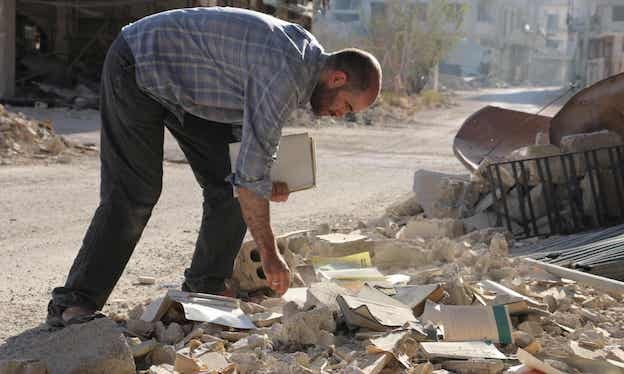
English teacher Muhammad Shihadeh salvages books from the rubble in Darayya
HOW REBELS BUILT A LIBRARY FROM BOOKS RESCUED FROM THE RUBBLE
[Note by Tom Gross]
The dreadful Syrian conflict, now over 10 years old, one of the worst in the world in recent decades, continues on. There been many dispatches over the years on this list about the human toll. Here is an interesting piece concerning books. (It is an edited extract from The Book Collectors of Darayya published by Picador.)
BOOK EXTRACT
Hunting for books in the ruins: how Syria's rebel librarians found hope
In a town under siege from Assad?s regime, a small group of revolutionaries found a new mission: to build a library from books rescued from the rubble. For those stranded in the city, books offered an imaginative escape from the horrors of war
By Delphine Minoui
The Guardian
March 16, 2021
https://www.theguardian.com/news/2021/mar/16/words-have-the-power-to-heal-syrias-rebel-librarians
At first, Ahmad Muaddamani was a distant voice coming through my computer speakers: a fragile whisper from a hidden basement. When I made contact with him on Skype, on 15 October 2015, he hadn?t left Darayya in nearly three years. Located less than five miles from Damascus, his town was a sarcophagus, surrounded and starved by the regime. He was one of 12,000 survivors.
They had been under fire from Bashar al-Assad?s rockets, barrel bombs and even a chemical weapon attack for many months. Syria?s president had besieged the town since November 2012. Like many others, Muaddamani?s family had packed their suitcases and escaped to a neighbouring town. They begged him to follow. He refused ? this was his revolution, his generation?s revolution.
He had joined one of the first demonstrations in Darayya calling for change, in 2011. He remembered everything about his ?first time?: his heart on fire. Losing his voice from shouting slogans. The joy of being there. It was his first sensation of freedom.
Muaddamani and other young rebels had stayed, not to defend their city, but to keep something in it alive. In the city under siege, he got hold of a video camera and finally realised his childhood dream: he would expose the truth. He joined the media centre run by the new local council. In the daytime, he roamed the devastated streets of Darayya. He filmed houses ripped apart, hospitals overflowing with the injured, burials for the victims, traces of a war invisible and inaccessible to foreign media. At night, he uploaded his videos to the internet.
One day in late 2013, Muaddamani?s friends called him ? they needed some help. They had found books that they wanted to rescue in the ruins of an obliterated house.
?Books?? he repeated in surprise.
The idea struck him as ludicrous. It was the middle of a war. What?s the point of saving books when you can?t even save lives? He?d never been a big reader. For him, books smacked of lies and propaganda. After a moment of hesitation, he followed his friends through a gouged-out wall. An explosion had ripped off the house?s front door. The disfigured building belonged to a school director who had fled the city and left everything behind.
Muaddamani cautiously felt his way to the living room, illuminated by a single sliver of sunlight. The wood floor was carpeted with books, scattered amid the debris. With one slow movement, he knelt on the ground and picked one at random. His nails flicked against the dust-blackened cover, as if against the strings of a musical instrument. The title was in English, something about self-awareness, a psychology book. He turned to the first page, deciphered the few words he recognised. It turned out the subject didn?t matter. He was trembling. His insides turned to jelly. An unsettling sensation that comes with opening the door to knowledge. With escaping, for a second, the routine of war. With saving a little piece, however tiny, of the town?s archives. Slipping through these pages as if fleeing into the unknown.
Muaddamani took his time standing up, the book against his chest. His entire body was shaking. ?The same sensation of freedom I felt at my first protest,? he remembered.
A detonation interrupted the internet connection. I stared at the screen. After a moment, he continued his story, giving an inventory of the other books found in the rubble that day: Arabic and international literature, philosophy, theology, science. A sea of information.
?But we had to hurry,? he continued. ?Planes were rumbling outside. We moved fast, dug up the books, and filled the bed of a pickup to the brim.?
In subsequent days, the collection effort continued in the ruins of abandoned houses, destroyed offices, and disintegrating mosques. Muaddamani developed a taste for it. With each new hunt for books, he savoured the immense pleasure of unearthing abandoned pages, bringing back to the world life buried in wreckage. They excavated with their bare hands, sometimes with shovels. In all, they were 40 or so volunteers ? activists, students, rebels ? always at the ready, waiting for the planes to go silent so they could dig in the rubble. They salvaged 6,000 books in one week. One month later, the collection reached 15,000. The books were short, long, dented, dog-eared, damaged; some were rare and highly sought-after.
They had to find somewhere to store them. Protect them. Preserve this small crumb of knowledge before it all went up in smoke. By general agreement, a plan for a public library took shape. Darayya never had one under Assad, so this would be the first. ?The symbol of a city that won?t bow down ? a place where we?re constructing something even as everything else collapses around us,? added Muaddamani. He stopped, pensive, before uttering a sentence I will never forget: ?Our revolution was meant to build, not destroy.?
Fearing reprisals from the regime, the organisers decided this library would be kept in the greatest of secrecy. It would have neither name nor sign. It would be an underground space, protected from radar and shells, where avid and novice readers alike could gather. Reading as refuge. A page opening to the world when every door is locked. After scouring the city, Muaddamani and his friends uncovered the basement of an abandoned building at the border of the frontline, not far from the snipers, but largely spared rocket fire. Its inhabitants were gone. The volunteers hurriedly constructed wooden shelves. They found paint to freshen the dusty walls. They reassembled two or three couches. Outside, they piled a few sandbags in front of the windows, and they brought a generator to provide electricity. For days, the book collectors busily dusted, glued, sorted, indexed and organised all these volumes. Now arranged by theme and in alphabetical order on overstuffed shelves, the books found a new, harmonious order.
These young Syrians cohabited with death night and day. Most of them had already lost everything ? their homes, their friends, their parents. Amid the chaos, they clung to books as if to life, hoping for a better tomorrow, for a better political system. Driven by their thirst for culture, they were quietly developing an idea of what democracy should be. An idea that challenged the regime?s tyranny and Islamic State?s book burners. Muaddamani and his friends were true soldiers for peace.
Before the revolution, Muaddamani studied civil engineering at Damascus University. When Syria rose up against the Assad regime in March 2011, he was 19. His father, who had spent 12 months in prison in 2003 for a simple comment he had whispered to a friend, forbade him to go into the streets. Muaddamani missed the first protest held in Darayya. During the second one, he sneaked out and joined the crowd, chanting at the top of his lungs: ?One, one, one, the Syrian people are one.?
Weeks, then months went by, and the protests continued. Assad?s voice shouted menacingly from transistor radios. ?We will win. We will not yield. We will eliminate the dissenters.? Regime forces fired into the crowd. Muaddamani and his friends chanted even louder ? ?Freedom! Freedom!? ? as other resisters took up weapons to protect themselves.
SALVAGING BOOKS IN DARAYYA
?Ustez? (?Professor?) Muhammad Shihadeh, a teacher of English and nonviolent resistance techniques, salvaging books in Darayya. Photograph: Mohammad al-Eman
He explained why the regime was so focused on Darayya. ?Darayya is not like other cities. Its civic resistance stretches way back before the revolution.?
Darayya?s resistance had begun in the late 90s, in one of the mosques, where activists would study the Qur?an and read banned works by religious dissidents. In particular, they spent hours dissecting the writings of Jawdat Said, one of the first Muslim thinkers to engage with the notion of nonviolence. Contrary to the ?terrorist? label they would inherit much later, these men were advocating a form of Sunnism favouring dialogue and tolerance. Their only weapons were a few secretly gathered books. That tradition of nonviolent rebellion through knowledge was picked up almost by accident, in the creation of the underground library.
By 2002, the Darayya group had begun to translate its new knowledge into activism, with environmental and civic initiatives. After the US invasion of Iraq, it demonstrated against the occupation. The Assad government was also opposed to the US operation, so the dissenters of Darayya felt safe in their protest. But the government began to worry about this popular momentum, which was growing too large. A month later, 24 activists involved in planning the demonstration were arrested and imprisoned.
At the beginning of the Arab spring, in March 2011, a new event stirred up the inhabitants of Darayya. Inspired by the fall of Zine al-Abidine Ben Ali in Tunisia and Hosni Mubarak in Egypt, some teenagers in Deraa, another Syrian city, more than 50 miles from Damascus, had scrawled ?Your turn will come, Doctor? on their school?s wall. The message was aimed at Assad. The youths were arrested and tortured. Anger quickly poured into the streets throughout Syria. Fed by the fervour spreading through the Arab world, other cities joined the movement.
Darayya was one of the first to rise. On Friday 25 March, Darayya Shebab, the movement formed in the 90s, regrouped for a new struggle. ?From Darayya to Deraa, a dignified people,? the protesters repeated in chorus. The crowd swelled. In the space of an hour, thousands braved the ban on demonstrating. When the first bullets were fired, the young protesters got creative: they offered the soldiers roses and bottles of water with notes attached: ?We are your brothers, don?t kill us.?
The message irritated the regime. It contradicted the official propaganda that there were hate-filled religious fanatics among the demonstrators. In September 2011, the leader of those peaceful protests was arrested and tortured. His mutilated body was returned to his family. After that, pockets of armed resistance began to form, but the peaceful movement persisted.
On 25 August 2012, Assad sent in the tanks. After three days of intense bombing, regime soldiers attacked Darayya. Street by street. House by house. The inhabitants who resisted were lined up in front of a wall and shot, one by one. Men, women, children. A collective punishment for the demonstrators. For the flowers and bottles of water. For this peace odyssey that stretches back to the 90s, far before the revolution.
Shut up in a makeshift shelter, Muaddamani didn?t discover the scale of the massacre until the troops left three days later. The bodies of dozens of victims had been gathered in the courtyard of a mosque. A cemetery was hastily created for approximately 500 dead, but he believed there were at least 200 more, hastily buried where they were executed.
On 8 November 2012, the government imposed a blockade on Darayya. As soon as this sanction was announced, a new wave of departures began. It included Muaddamani?s parents. The young activist made the choice to stay. ?You don?t abandon a revolution halfway through,? he said. He had no way of knowing what would come next.
The library very quickly became one of the cornerstones of this isolated town. Open from 9am to 5pm, except on Friday, the day of rest, it welcomed an average of 25 readers a day, mainly men. In Darayya, Muaddamani said, women and children were not very visible and rarely ventured outside. In general, they made do with reading the books their fathers or husbands brought home, rather than risk the barrel bombs raining from the sky.
?Last month, around 600 fell on the town,? said Muaddamani. His friend Abu el-Ezz, co-director of the library, was a near fatality. In September 2015, he was on his way to the book cellar when one of the many barrel bombs being tossed from regime helicopters landed in front of him.
These containers full of explosives and scrap metal fell randomly and were particularly destructive. Abu el-Ezz was hit in the neck by pieces of shrapnel that affected his nervous system; after that, he suffered from cramps that stabbed down to the small of his back.
After weeks of convalescence, Abu el-Ezz was able to leave his hospital bed and joined Muaddamani at the media centre run by the local council, which spoke for the opposition to the regime. ?Books are our way to make up for lost time, to wipe out ignorance,? he said.
Abu el-Ezz was 23 years old, just like Muaddamani. And his engineering studies also had been interrupted. Like Muaddamani, he?d never been a bookworm. At college, he said, the required reading verged on caricature. Countless sheets of paper wasted to honour the memory of the former Syrian president Hafez al-Assad, who died in 2000.
?Before the revolution,? he continued, ?we were fed lies. There was no room for debate. We were living in a coffin. Censorship was the glue of our daily lives. Assad was the master of the country, of time, of thought.?
Abu el-Ezz was still in terrible pain from his wounds, but he wanted to talk about his new passion, books. He dared to believe in the good they can do. Words have the power to soothe mental wounds. The simple act of reading had become a huge comfort to him. He liked to wander through pages. Lose himself in words. His reading choices were eclectic, varying from analyses of political Islam to Arabic poetry to psychology.
?Books don?t set limits; they set us free. They don?t mutilate; they restore. Reading helps me think positively, chase away negative ideas. And that?s what we need most right now.?
What about the other library regulars? What did they read? What subjects captured their interest? At first, said Abu el-Ezz, everyone was getting their bearings, dipping their toes in. A book is like a precious relic that you?re examining for the first time ? it can overwhelm. The most curious ones picked a text at random without much hesitation. The shyest visitors, those unused to reading, were nervous, intimidated by the idea of even touching a book cover. But certain books started to gain popularity by word of mouth. ?That?s how most of our borrowers ended up reading The Alchemist,? he said.
?By Paulo Coelho??
?Yeah, it?s one of our most popular books. People pass it around. Some have read it a couple of times.?
Maybe this international bestseller appealed to the library?s patrons because it describes a notion familiar to them: self-discovery. A Spanish shepherd?s journey from Andaluc?a to the Egyptian pyramids spoke to them. Darayya?s young revolutionaries heard in this book an echo of their own perilous odyssey. It contained a treasure particularly precious in their eyes: the idea of limitless freedom.
Among Abu el-Ezz?s generation, which has only ever known the rigid dictatorship of the Ba?ath party (in power since the early 60s), the thirst for change is striking. ?Most of the readers are like me. They never liked books before the war. Today, the young people of Darayya have everything to learn. It?s like all of us are starting over at zero. At the library, people ask me for books about ?democracy? all the time.?
Another book, placed prominently on the shelf, has proved particularly popular: Kitab al-Ibar (The Book of Lessons), by Ibn Khaldun. ?Our readers have all skimmed this massive book at one point or another. In it, a 14th-century Tunisian historian uses his own experiences to try to determine the causes for the rise and decline of the Arab dynasties.? In the midst of revolutionary uncertainty, this forerunner of modern sociology offered, if not solutions, at least ways to think about issues as fundamental as governance, power struggles and economic development ?essential fodder at a time when the shape of the future Syria was endlessly questioned.
Books were helping transport these young Syrians somewhere else. The residents of Darayya were inspired by these narratives. They were a source of intellectual sustenance too long withheld.
Abu el-Ezz was impatient to get well enough to return to the library. For him, it was not only a place of healing but also somewhere he could breathe ? a hopeful page in Syria?s dark history.
At the end of October 2015, I opened my inbox to find a message from Muaddamani, with the subject line ?Library rules?. I read:
1. No book can be borrowed without the librarians? permission.
2. Do not forget to return your books on the indicated date.
3. Any reader who returns a book overdue will be barred from borrowing others.
4. Respect the peace and quiet of others and abstain from making noise.
5. Be mindful of keeping the library clean.
6. Please return books to their original place after reading them.
In a postscript, he explained that these instructions were printed on an A4 piece of paper and prominently placed at the basement entrance, glued to a pole, so everyone could see them.
He and his friends had created something extraordinary in the midst of a war zone, their library a land without borders. A secret hideaway where books circulated with no need for a safe-conduct pass or bulletproof vest. In this protected place, they had managed to establish an atmosphere of collective intimacy, as well as a sense of ethics, discipline and, oddly enough, normality. There was no doubt that this helped them hang on. Even the fighters of the Free Syrian Army were regulars at the library.
?Our most faithful reader is an armed rebel. He can?t get enough. He reads everything he finds. He spends so much time plunged in books by Ibn Khaldun that my friends and I call him by that name now,? said Muaddamani.
The next day, he introduced me to Omar Abu Anas, AKA Ibn Khaldun. He talked in a highly polished Syrian dialect, close to literary Arabic, as if reading great scholars had rubbed off on his vocabulary.
Like Muaddamani, Abu Anas had planned on an engineering career before the revolution, before the conflict turned his life upside down. ?When the regime forces started to shoot at us, we had no choice but to protect the demonstrators. So I gave up my studies and volunteered to fight. It was the first time I took up arms.?
Twenty-four years old, Abu Anas belonged to the Liwa Shuhada al-Islam rebels. Along with Ajnad al-Sham, it was one of two brigades of the Free Syrian Army?s southern front. This young accidental fighter was one of the countless young men of Darayya, aged 18 to 28, who were propelled overnight to the frontlines of the war. Unlike their leaders, deserters from the official army, they had no combat experience. Former college classmates and nextdoor neighbours, they sometimes found themselves fighting the bombs and tanks with one weapon shared among three people.
OMAR ABU ANAS READING ON THE FRONTLINE
I asked if he considered himself a jihadist. He paused for a long time before replying. ?If I chose to fight against the regime, it was to defend my land,? he said. ?My country. My right to freedom,? he said. ?Fighting wasn?t a choice. It was a necessity. When your friends are shot before your eyes for brandishing a piece of cardboard calling for change, what?s left, except the desire to protect other protesters? Sadly, that?s how it all started. And then, with the regime?s bombs, the vicious spiral of violence began.?
Abu Anas?s words reflected the same candour as the revolutionary slogans of 2011 ? the thirst for freedom, and recourse to weapons as the sole means to protect oneself. ?As for jihad ? To those who seek to tarnish our image by painting us as religious fanatics, my response is simple: we are Muslims. We refuse any usurpation of our religion. Whether it be by the al-Nusra Front, the Syrian branch of al-Qaida; or by Islamic State ? Those people don?t represent our ideas. They warp them. Don?t forget that the revolt began with calls for justice and respect for human rights, not for Islam.?
I was curious to know at what exact moment books began to have a critical importance in his life. Was it when the library opened? When he read a particular passage? ?It was when I understood that the war could go on for years. When I realised that we could only count on ourselves.?
From that point onward, books would replace the university he no longer attended. He would have to educate himself. Fill the void that could be taken over by fanatics imposing their backward ideas. ?Books had a crucial impact very quickly ? they helped me not to lose myself.?
He had been leading a double life, between war and literature. He even created a mini-library on the frontline: a dozen works organised and protected behind the sandbags. When the bombs quietened down, the combatants exchanged books and shared reading recommendations. ?War is destructive. It transforms men, kills emotions and fears. When you?re at war, you see the world differently. Reading is a diversion, it keeps us alive. Reading reminds us that we?re human.?
I asked if he had a favourite. ?Al-Qawqa?a,? he answered immediately. Al-Qawqa?a! The Shell. I know this book. I read it before the revolution. It?s chilling. Terrifying, in fact. The Syrian writer Mustafa Khalifa wrote it after 13 years of detention in Palmyra, the terrible ?desert prison?. This semi-autobiographical account is full of atrocious descriptions inspired by his jailers? barbarism, torture and the nightmare of his incarceration under the rule of Hafez al-Assad.
?Under Assad, the father and then the son, the book was banned. There was so much censorship that we had very little information about the extent of the regime?s brutality. Most of us really became aware of it at the beginning of the revolution, when pro-Assad forces began to brutally crack down on us. Today, it?s important to open people?s eyes to our past, which, in moments of doubt and despair, can remind us why we are resisting.?
Despite the cruelty laid out in The Shell, Abu Anas developed a special connection to the book. It opened a door to his country?s buried history. Reading versus the memory-erasers, the chiefs of single-minded thought. I would later learn that this once-banned book was one of the most read in Darayya. Abu Anas was particularly attached to The Shell because it reminded him of his own situation. How to survive behind bars? How to endure forced confinement?
?The Shell is a mirror in which I can project myself,? Abu Anas said. ?A protective bubble I create to be able to endure the worst.?
His unwavering faith in books brought to mind all the letters and accounts left behind by the soldiers of the first world war. Like Marcel ?t?v?, a graduate of France?s prestigious ?cole Normale Sup?rieure, who devoured 80 books in two years on the frontline. Or Robert Dubarle, the captain of France?s legendary mountain infantry, whose wife constantly sent him reading material for the trenches. Then there?s the famous Soci?t? Franklin, which bankrolled the creation of 350 barrack libraries. Reading to escape. Reading to find oneself. Reading to feel alive. Among the young people of Darayya, reading had even more meaning than that. Here, reading was an act of transgression. It was an affirmation of the freedom they had been deprived of for too long.
In August 2016, news spread that an envoy from the Fourth Division had issued an ultimatum to the city?s inhabitants: leave Darayya immediately or end up buried alive there. The situation in Darayya had become desperate. ?There was nothing left to eat, nothing to protect ourselves with. The regime had burned all our farmland. It was leave or die,? Muaddamani wrote in a series of texts. The young rebels who had survived the horror of war by losing themselves in books had to leave their treasures under the rubble.
He was evacuated to Idlib. A few weeks later, he sent me a photo of what remains of the secret library. The shot was taken by one of the rare reporters granted access to Darayya, under the regime?s close surveillance. I recognised the enclosed space with its perfectly lined-up aisles and wooden shelves along the walls. They were half-empty. The remaining books were thrown on the floor, abandoned to dust and darkness. Ripped-out drawers littered the ground, mixed with scattered volumes. In the background, a soldier wearing fatigues trampled the paper wreckage. The books didn?t end up in a bonfire, as Muaddamani had feared. After unearthing the secret library, regime soldiers had pillaged it to sell the books for cheap on the sidewalk of a flea market in Damascus.
A year later, some of the librarians had left Syria for Turkey. Muaddamani stayed in Idlib, where, even after the ceasefire declared in May 2017, life was difficult. Anxiety over an uncertain future settled over the relief brought by the semblance of a truce. Initially welcomed as heroes, Darayya?s activists grew disenchanted. ?We wanted to embody a third path, to show that an alternative to the regime and Islamic State was possible,? he said.
It felt to him as if there was no longer a precise goal in the resistance, a defined objective. Dozens of factions and local councils were competing for control. There was also the fear that the regime would make this the site of its final sweep. That the sole remaining bastion of the rebellion would be the theatre for the last battle against the insurgents.
Yet Muaddamani wanted to remain hopeful. He wanted to believe that the long night of the Syrian people would be followed by a rebirth. In what form? He didn?t know. In the meantime, he had launched a mobile library for the children of Idlib.
* You can also find other items that are not in these dispatches if you ?like? this page on Facebook www.facebook.com/TomGrossMedia

WHY AN ISLAMIST COULD KEEP BIBI IN POWER; OR IS A FIFTH ELECTION NOW A SELF-FULFILLING PROPHECY?
[Note by Tom Gross]
Pictured above: Mansour Abbas, voting in the village of Maghar in this week's general elections in "Apartheid (Not) Israel". Abbas heads the Raam party, one of several Arab parties represented in the Israeli Knesset.
Raam has the same Islamist roots as Hamas, the extremist group that runs the Gaza Strip. And yet Raam may agree to back Benjamin Netanyahu to continue as Israeli prime minister thus allowing him to stay in power following this weeks inconclusive Israeli elections, the fourth in two years.
Israeli politics, which was already overly complicated, is becoming even more so. I also think that it has less international significance, not only because global issues such as covid and climate change continue to dominate much of the world?s attention, but because the Middle East as a whole is becoming less important relative to other regions such as China and the Far East.
And despite serious continuing threats, Israel has never been more secure as it continues to increase both its public and covert good relations with more and more states both in the region and beyond, in large part thanks to Netanyahu?s policies.
There are also many fewer ideological differences than there used to be between mainstream Israeli parties of left, center and right. However, unfortunately because of Israel's overly democratic electoral system some extremists of both right and left have entered the Knesset.
I attach four articles below analyzing the election results, for those interested in the intricacies of Israeli politics. Among the authors are Haviv Rettig Gur and Jonathan Tobin, both longtime subscribers to this list.
ARTICLES
IS A FIFTH ELECTION NOW A SELF-FULFILLING PROPHECY?
Is a fifth election now a self-fulfilling prophecy?
Israel's leaders can form a government and end the deadlock. All they need is a bit of trust and a willingness to compromise. Or: Why another snap election is inevitable
By Haviv Rettig Gur
The Times of Israel
March 26, 2021
https://www.timesofisrael.com/is-a-fifth-election-now-a-self-fulfilling-prophecy
March 2020, just one year ago, seems an eon away. A pandemic separates that time from ours, with its social distancing and shuttered schools and waves of contagion and lockdown. A strategic realignment and four peace treaties took place over this year, as did a dramatic changing of the guard in Washington. A mental chasm formed by the tribulations of these strange times seems to place that period far in the past.
In Israeli politics, too, everything seemed to have changed. The 33-seat behemoth called ?Blue and White? that once challenged Israel?s longest-serving prime minister has shattered into its constituent parts.
As a new election drew close over the past month, Netanyahu seemed to hold all the cards. He was headed into election day with a well-oiled campaign (four elections in two years is good practice) and an extraordinary vaccination campaign and four peace treaties under his belt.
Election day itself also seemed to suggest a dramatic shift. Benny Gantz of Blue and White now leads a list of just eight MKs. The Arab parties were divided and Arab turnout was down. Yair Lapid's Yesh Atid party, the largest opposition faction, grew by just one seat while Netanyahu?s right-wing challengers Gideon Sa?ar and Naftali Bennett crashed from polling in the low twenties and high teens in Knesset seats down to six and seven respectively.
Everything had changed. Yet everything seemed to remain exactly the same.
BLOCS
Step back from the individual parties and consider them by their overlapping electorates, and all that Brownian motion averages out to very nearly zero.
Consider: Likud and Yamina together won 42 seats last year. Likud, Yamina and its offshoot Religious Zionism won 43 this time.
Blue and White won 33 seats last time. Yesh Atid and Gantz?s shrunken Blue and White, together with Sa?ar?s New Hope party whose voters mostly identified as centrists, now drew 31.
Haredi parties Shas and United Torah Judaism won 16 seats between them in 2020; they won the same 16 on Tuesday.
The Arab parties and the left won 22 seats between them last time, 24 this time. Avigdor Liberman?s Russian-speaking hawkish-but-secularist party won seven then and seven now.
It?s as if someone had thrown half the parliament into the air in exasperation, only to watch them land in the exact same pattern. The parties may have changed, but the fundamental contours of the standoff did not. Voters seem unmoved by the passage of time and intervening events. Fresh out of a fourth election, the country seems to be plunging headlong into a fifth.
A SELF-FULFILLING PROPHECY
Based on the near-final results announced Thursday, it?s fair to say that no candidate has a clear path to a coalition. Or, more accurately, no one has a clear path to a coalition they?d want to be seen joining just before yet another election.
That?s the terrible secret of Tuesday?s election: There are many paths out of the deadlock and toward stability and good governance. But no one can take them.
As the anti-Netanyahu camp keeps noting, Netanyahu could resign. That would free Sa?ar to join the right-wing camp and help establish a stable and internally coherent government large enough to be free of the extremist wing of the Religious Zionism slate.
Alternatively, as the pro-Netanyahu camp keeps insisting, Gideon Sa?ar could swallow his pride - and his central promise to his voters - and join the Netanyahu government in order to avert the fresh pain and continued instability of yet another election.
There are also those in the pro-Netanyahu camp, including some of Netanyahu?s most ardent supporters over the years, like right-wing pundit Shimon Riklin and pollster Shlomo Filber, who are urging that Likud accept the support of the Islamist Ra?am party, pushing the Netanyahu coalition above the 61-seat mark and ushering in a narrow but, they hope, viable coalition - whose mere founding, they add, will convince other members of the opposition to defect, quickly swelling its ranks and releasing it from its reliance on Ra'am.
There are many such paths for those seeking stability, but all are beset by the same thorny problem: No politician can afford such compromises without a guarantee that it won't avert a new election.
SA'AR'S DILEMMA
Assume for a moment that Sa?ar is open to Likud?s demand that he return to the Likud fold. He might hypothetically be willing to consider the move if it promised to grant him a few quiet years in the cabinet to rehabilitate his position in the ruling party and try his luck in the succession contest that will follow Netanyahu?s retirement.
But even if he were willing to contemplate that path in theory, at the moment he can?t even afford to hear out a Likud offer. A fifth election is imminent. Negotiating with a Netanyahu-led Likud after promising not to do so would simply hand Likud campaign ammunition it could use to bury him in the next round.
The fear of a fifth election drives the distrust that in turn is pushing the country toward a fifth election.
BENNETT?S PREDICAMENT
The same holds true for every other player in this drama.
Media outlets have taken to counting Naftali Bennett?s Yamina party as part of the automatic Netanyahu bloc. But should they? True, Netanyahu has no viable path to a coalition without Bennett, but Bennett has nevertheless refused to say that he will join Netanyahu?s government.
Bennett is undoubtedly seeking to maximize his negotiating position with Netanyahu. It never hurts to let the other side sweat.
But Bennett?s reluctance goes deeper. He ran in Tuesday?s election as a critic of Netanyahu, his campaign message focused on Netanyahu?s management failures during the pandemic. While he never ruled out sitting in a Netanyahu government, he won his seven seats for his criticism of the prime minister.
As long as a fifth election appears imminent, Bennett cannot seem to suddenly transform into a Netanyahu cheerleader like Shas or Religious Zionism. The campaign is still underway. He must distinguish himself from Smotrich, demonstrate that his demands from Netanyahu are significant and connected to the issues he campaigned on, and still assume the negotiations will fail, taking every step along the way to ensure the public sees him earnestly holding his ground when they inevitably do.
THE RA'AM CONUNDRUM
Betzalel Smotrich, head of Religious Zionism, publicly nixed any right-wing coalition that relies on Ra?am, even if Ra'am doesn't actually join but merely abstains from voting against the coalition, thereby denying the opposition the ability to topple the government in a budget or no-confidence vote.
Smotrich?s refusal to consider cooperation, like Sa'ar's to contemplate sitting under Netanyahu, is surely rooted in principle. But Smotrich is no political fledgling. He understands the need for political compromise and knows how desperate Netanyahu is for a government ? which, as Netanyahu?s backers keep explaining, will likely have an easier time pulling in defectors once it is established.
But, again, the next election looms. Smotrich won?t win far-right votes if he is seen to compromise over Ra?am. If the next election were a long way off, if the compromise with Ra?am was a momentary thing, a single vote followed by four years of stable governance, it?s reasonable to think he might have risked it. But right before an election? How could he?
And while Smotrich can?t embrace Ra?am, Netanyahu can?t let it go.
Consider the dilemma from Netanyahu?s perspective. Ra?am isn?t just the potential deciding vote (or deciding abstention) that would form his next coalition. It holds the deciding vote on the bill set to be proposed in the new Knesset that would forbid an MK under indictment from standing for prime minister ? a bill demanded by Avigdor Liberman and other Netanyahu adversaries that would summarily remove him from the running in the next election.
Netanyahu cannot embrace Ra'am without hurting Likud at the ballot box or undermining his alliance with Religious Zionism and other right-wing forces. But he also cannot entirely rebuff Ra'am's calls for a constructive relationship, at least not without running the risk that the Muslim party will head across the aisle to more compliant partners, who will happily pay a political dividend in exchange for the votes to legislate Netanyahu out of politics.
Here again, the threat of another election becomes the cause of another election. An anti-Netanyahu bill would only enter into force in the 25th Knesset; it wouldn?t apply retroactively to the current one. If Netanyahu believed he had three or four years before he?d need to worry about the next Knesset, he could risk Smotrich?s ire to obtain the momentary help he needs to found his coalition. He could take chances.
It?s the same with Lapid, who must piece together a coalition with Bennett after the latter promised his voters not to sit under him. Or he could try to pull Bennett and Sa?ar into a coalition with Meretz and Labor ? a not impossible task in ordinary times, an extremely difficult one on the eve of an election.
It must be said: The point stands even if a government is somehow formed from the impossible arithmetic handed down by the voters. The fifth-election problem won't go away. No government formed out of this parliament is likely to have a stable, broad-based coalition propping it up. It would try to hobble along under the polarizing influence of an ever-looming snap election; it would almost certainly fail.
After Tuesday's election, Israelis are asking themselves if there?s any path forward to a viable and stable government. The answer, at least for now, appears to be no. Not because it?s hard to see what compromises are required to produce such a government, but because none of the relevant leaders trust each other enough to risk those compromises.
And, indeed, if the extraordinary shifts of the past year have failed to move the needle, why should we assume that a fifth election would do the trick? It may be time to contemplate the strange possibility that Benny Gantz, with the enthusiastic backing of his party?s seven lawmakers, may yet find himself replacing Netanyahu as prime minister when the outgoing government?s rotation deal comes due in November.
ISRAEL STILL CAN?T MAKE UP ITS MIND ABOUT NETANYAHU
Israel still can't make up its mind about Netanyahu
Despite his accomplishments, half the country is determined to oust the prime minister. But a possible way out is both a societal breakthrough, as well as a source of potential trouble.
By Jonathan Tobin
Jewish News Syndicate
March 24, 2021
When the first exit polls were published, it seemed as if the long stalemate had been ended. Within a couple of hours, however, the polls had been revised, and by the end of a long night and morning of counting, it turned out that the deadlock between those who wish to keep Benjamin Netanyahu as prime minister and those who want to get rid of him hadn?t been broken.
With 88.5 percent of the vote counted (and with approximately half a million absentee votes that could alter the electoral math still left to be tabulated), the parties supporting Netanyahu, plus one likely coalition partner, had fallen two seats short of the 61 Knesset seats needed to form a new government. By the same token, the disparate group of parties that agree on very little, but which are all pledged to oust the prime minister, were similarly short of a clear path to an alternative government.
This fourth consecutive election stalemate in two years is a discouraging outcome for the Jewish state. It?s not just an annoying waste of time. More than that, it has been estimated that the cost of holding these four votes amounted to $4.24 billion?a staggering sum for a small country that, like the rest of the world, is dealing with the economic catastrophe caused by the ongoing coronavirus pandemic. Aside from the not-inconsiderable expenses involved in staging the contest, election days are legal holidays in Israel. That costs company holiday pay, as well as a loss of productivity and sales, even though some businesses, like restaurants, benefit from people having the day off.
Then there is the plain fact that the lack of a national budget for 2020?let alone 2021?is also a blow to stability and the country?s economic well-being.
There is a national consensus that the standoff has been something of a disgrace since, among other things, the frequency of elections means that Israel has now surpassed Italy as the home of the most unstable democracy in the world. And yet, the one person who hasn?t been hurt by it is Netanyahu. The failure to form a stable government has served him fairly well since it enables him to govern without actually winning an election. Even the lack of a budget has made it easier for him since he hasn?t been hampered by the financial negotiations that would have undermined his agenda.
Indeed, in the course of the last year, Netanyahu hasn?t just managed to stay afloat. Since Israel was last forced to the polls, the prime minister had what historians may ultimately say were his two greatest accomplishments: the signing of the Abraham Accords and the successful effort to get Israelis vaccinated against COVID-19, enabling it to be the first of nations to essentially emerge from the yearlong pandemic crisis.
Any leader with two such impressive achievements to his credit might have expected to be easily re-elected. But the election results speak volumes about both his strengths and his weaknesses. That?s because it could also be said that no prime minister who was facing trial for three corruption charges and who had worn out his welcome with both the public and political colleagues after 12 consecutive years in office could reasonably presume to emerge from an election as the head of the largest party and as the only person with a chance to form a government, as is also the case with Netanyahu.
His able statesmanship and skillful governance?not to mention a national consensus behind his core positions on issues that used to divide Israel over policy towards the Palestinians, territory and settlements?have made him something of an institution. It?s no wonder that polls show that most Israelis (including many who don?t vote for him) think that he?s the most qualified person to hold the top job.
Still, his constant scheming, untrustworthiness in political negotiations and the sense of entitlement that go with having stayed in office so long with no thought of grooming a successor, let alone stepping aside for the next generation, has also fueled a rage at Netanyahu on the part of a broad cross-section of the Israeli public. It may be created by a mix of partisanship and ideology (many in the ?anybody but Bibi? camp would be similarly determined to oppose any Likud leader or non-leftist), but it is nonetheless real. His followers cannot imagine Israel being led by anyone else. And yet the fact that so many Israelis seem focused on nothing but the quest to topple him has further embittered the country?s political discourse.
Can Netanyahu find a way out of the corner into which the Israeli public has painted itself?
Talk of defectors from other parties is, as was the case last year, mooted by his supporters, but that seems even less likely this time around. Another possibility of a solution is both a laudable development as well as a potential case of staggering hypocrisy.
When the four disparate Arab factions ran together as a single party last year, they won 15 seats as the Joint Arab List. When Blue and White leader Benny Gantz spoke of his willingness to deal with that coalition of anti-Zionists?many of whom sympathize with terrorists?the Likud and others blasted the idea as something that would compromise the nation?s security.
The Joint List split when Mansour Abbas, leader of the Ra?am Party that advocates the conversion of Israel into an Islamist Palestinian state, pointed out something that was quite true. Israeli Arabs have been badly served by their politicians. Many of them are corrupt and have spent their time working harder to support Palestinian efforts to undermine Israel than on trying to assist their constituents. Abbas (no relation to the Palestinian Authority leader Mahmoud Abbas) suggested that it was time for them to stop grandstanding in order to help allies in Ramallah and Gaza, and start doing deals with the Zionist parties in order to serve their people better.
Assuming that the current results stand up after all the votes are counted, that led to a loss of four seats for the Arabs after the Joint List won six seats and Ra?am five.
As he promised during the campaign, however, Abbas says that he is open to supporting either side of the Israeli political divide in order to advance the interests of Israeli Arabs. That opens up the possibility that one of the non-Jewish parties would become part of a government, even if it meant supporting it from outside the coalition.
If Ra?am enables Netanyahu and the Likud to govern in this fashion, the prime minister and his supporters would be open to charges of staggering hypocrisy. Then again, it would also give the lie to the canard that Israel is an ?apartheid state.?
It would also illustrate just how far the Abraham Accords and the other normalization deals between Israel, and Arab and Muslim states, have helped erode support for the century-long war on Zionism. Friendly relations with the United Arab Emirates and Bahrain are a signal to Arab voters that it?s in their interests to stop acting like auxiliaries of Palestinian terror groups.
This scenario may not happen?not the least because many of Netanyahu?s supporters won?t tolerate sitting in a government whose existence depends on the votes of those who don?t really want it to exist. It also doesn?t alter the fact that half of the country will never rest until he is finally defeated. Nor does it erase the way the prime minister?s sense of indispensability and double-dealing has fatally divided an Israeli right that might otherwise be firmly in control under almost any other leader. The mere fact that the option of a deal with an Arab party can be realistically discussed is also a tribute to how much Netanyahu has changed Israel and the Middle East.
ISRAEL?S ELECTION ENDED IN ANOTHER MESS. COULD AN ARAB PARTY BREAK THE DEADLOCK?
Israel?s Election Ended in Another Mess. Could an Arab Party Break the Deadlock?
In the fourth attempt, neither Prime Minister Benjamin Netanyahu nor his opponents have a clear path to power. An Islamist party has emerged as a possible kingmaker.
By Patrick Kingsley
New York Times
March 25, 2021
JERUSALEM ? After a fourth Israeli election in two years appears to have ended in another stalemate, leaving many Israelis feeling trapped in an endless loop, there was at least one surprising result on Wednesday: An Arab political party has emerged as a potential kingmaker.
Even more surprising, the party was Raam, an Islamist group with roots in the same religious movement as Hamas, the militant group that runs the Gaza Strip. For years, Raam was rarely interested in working with the Israeli leadership and, like most Arab parties, was ostracized by its Jewish counterparts.
But according to the latest vote count, Raam?s five seats hold the balance of power between Prime Minister Benjamin Netanyahu?s right-wing bloc and the motley alliance of parties that seeks to end his 12 years in power. The vote tally is not yet final, and Raam has previously suggested it would only support a government from the outside.
Still, even the possibility of Raam playing a deciding role in the formation of a coalition government is making waves in Israel. An independent Arab party has never been part of an Israeli government before, although some Arab lawmakers supported Yitzhak Rabin?s government from the outside in the 1990s.
Suddenly in a position of influence, Raam has promised to back any group that offers something suitable in return to Israel?s Arab minority, who are descended from the Palestinians who stayed after Israel?s creation in 1948 and who today form about 20 percent of the population.
?I hope to become a key man,? Mansour Abbas, the party?s leader, said in a television interview on Wednesday. In the past, he added, mainstream parties ?were excluding us and we were excluding ourselves. Today, Raam is at least challenging the political system. It is saying, ?Friends, we exist here.??
The party is not in ?anyone?s pocket,? he added. ?I am not ruling out anyone but if someone rules us out, then we will of course rule him out.?
Either way would make for a strange partnership.
If Raam backed Mr. Netanyahu?s opponents, it would likely need to work with a right-wing opposition leader, Avigdor Liberman, who has described some Arab citizens as traitors and called for them to leave the country.
If it supported the Netanyahu-led bloc, Raam would be working with a prime minister who enacted legislation that downgraded the status of the Arabic language and said that only Jews had the right to determine the nature of the Israeli state. In a previous election, Mr. Netanyahu warned of high Arab turnout as a threat to encourage his own supporters to vote.
Raam would also be cooperating with an alliance that includes far-right politicians who want to expel Arab citizens of Israel they deem ?disloyal? to the Israeli state. One of those politicians, Itamar Ben Gvir, until recently hung in his home a picture of a Jewish extremist who murdered 29 Palestinian Muslims in a West Bank mosque in 1994.
But Mr. Abbas is prepared to consider these possible associations because he believes it is the only way for Arab citizens to secure government support in the fight against the central problems assailing the Arab community ? gang violence, poverty and restrictions on their access to housing, land and planning permission.
In the past, ?Arab politicians have been onlookers in the political process in Israel,? he said in an interview with The New York Times in February. Today, he added, ?Arabs are looking for a real role in Israeli politics.?
The move would mark the culmination of a gradual process in which Arab parties and voters have grown incrementally more involved in the electoral process.
Raam, a Hebrew acronym that stands for the United Arab List, is affiliated with a branch of an Islamist movement that for years did not participate in Israeli elections. Raam was founded in 1996 after some members of that movement voted by a narrow margin to run for Parliament, an event that split the movement in two. The other branch, which Israel has outlawed and whose leader it has jailed, does not participate in elections.
Raam later joined the Joint List, a larger Arab political alliance that emerged as the third-largest party in three recent Israeli elections, in a sign of the Arab minority?s growing political sway.
Recognizing this increased importance of Arab voters, Mr. Netanyahu canvassed hard for their support during the recent election campaign.
Analysts had long predicted that an Arab party would eventually end up working in or alongside the government. But few thought that an Arab party would countenance working with the Israeli right. Fewer still imagined that party would be a conservative Islamist group like Raam.
The party separated from the Joint List in March, frustrated at how its parliamentary presence meant little without executive power, and declared itself ready to join a government of any color that promised political rewards to Arab citizens.
On Wednesday, that gamble appeared to have been rewarded. Asked whether Mr. Netanyahu would consider a government supported by Mr. Abbas, Tzachi Hanegbi, a government minister, said if a right-wing government of Zionist parties was impossible to assemble, his party would consider ?options that are currently undesirable but perhaps better than a fifth election.?
Raam?s newfound relevance constitutes ?a historical moment,? said Basha?er Fahoum-Jayoussi, the co-chairwoman of the board of the Abraham Initiatives, a nongovernmental group that promotes equality between Arabs and Jews. ?The Arab vote is not only being legitimized but the Palestinian-Arab community in Israel is being recognized as a political power with the ability to play an active and influential part in the political arena.?
The news was also greeted happily in the Negev desert, where dozens of Arab villages are threatened with demolition because they were built without authorization.
?The possibility that Abbas can pressure the government to recognize our villages stirs up emotions of optimism,? said Khalil Alamour, 55, a lawyer whose village lacks basic infrastructure like power lines and sewerage because it was built without Israeli planning permission.
Within Mr. Netanyahu?s party, there is considerable dissent to the idea of relying on Mr. Abbas. Some members fear working with ? and being held to ransom by ? a group that is ideologically opposed, for instance, to military operations in the occupied territories.
The government should not be ?dependent on a radical Muslim party,? said Danny Danon, chairman of the World Likud, the international branch of Mr. Netanyahu?s party. ?We should not be in that position.?
Among the opposition bloc, there is also disquiet at the prospect of an alliance. Some of its right-wing members already vetoed working with Arab lawmakers during an earlier round of negotiations last year. And Raam?s social stances ? it voted against a law that bans gay conversion therapy ? are at odds with the vision of left-wing opposition parties like Meretz.
?It?s going to be very challenging no matter how you look at it,? said Ms. Fahoum-Jayoussi. ?When push comes to shove, it?s still hard to see whether Mansour Abbas?s approach is a real one that he can push through.?
And some Palestinian citizens of Israel are highly skeptical of Raam?s approach. Ayman Odeh, the leader of the Joint List, has accused Mr. Abbas of assenting to a relationship with the Israeli state that frames Arabs as subjects who can be bought off, rather than as citizens with equal rights.
?Mansour Abbas is capable of accepting this,? Mr. Odeh said in an interview before the election. ?But I will not.?
ENOUGH WITH THE HYPOCRISY OVER KNESSET OUTLIERS
Enough with the hypocrisy over Knesset outliers
A Kahane disciple won a seat, but so did a Reform rabbi and Islamists. Like America?s Congress, the Jewish state?s parliament is more diverse than most of us would like.
By Jonathan Tobin
Jewish News Syndicate
March 25, 2021
Is Israel?s reputation indelibly tainted by the presence of two new members of the Knesset with hateful views? That?s the fear that many American Jewish liberal groups are expressing in the wake of round four of the ongoing Israeli election stalemate. But those Americans who are quick to condemn Israeli Prime Minister Benjamin Netanyahu for his role in smoothing the path of that pair should think about the indirect connections between their own political heroes and some of their unsavory political associates.
American Jews are also cheering the fact that Rabbi Gilad Kariv was elected to the Knesset this week on the Labor Party slate. Kariv, a member of the Reform movement, is the first non-Orthodox rabbi to sit in the Knesset, a singular victory for those who rightly lament the non-recognition of any but Orthodox clergy in a country where there is no formal separation between religion and state. While he won?t be able to do much about that problem?or implement his left-wing views about security issues?his is nonetheless a symbolic victory for the majority of American Jews who regard the pluralism issue as one that alienates them from Israel.
Most of the commentary from American groups, however, is about their horror at the strength of the old Religious Zionist Party and the fact that the 24th Knesset will have two members whose beliefs are particularly repugnant to American Jewish sensibilities.
Though its name conjures memories of the National Religious Party or Mafdal?a generally moderate group that represented Modern Orthodox Jews in the Knesset for the first few decades of Israel?s history?this group is an amalgam of several hard-right parties. It?s also interesting that it appealed to ultra-Orthodox Jews and seems to have drained support worth a seat or two away from the haredi United Torah Judaism Party.
Its success is due in no small measure to the support it got from Israeli Prime Minister Benjamin Netanyahu, who it pledged to support. He did his best to ensure that some of its disparate elements didn?t run on their own and wind up ?wasting? votes for parties that couldn?t pass the 3.25 percentage of the vote threshold needed to gain entry to the Knesset.
That was good for Netanyahu?s right wing-religious alliance, but it also generated anger since the occupants of the seats the party won can be attributed to the prime minister?s help. And that means that the presence of both Itamar Ben-Gvir and Avi Moaz in the new Knesset are seen as Netanyahu?s doing.
Ben-Gvir is the head of the Otzma Yehudit Party that merged with Religious Zionist for this election. An advocate for expelling Arab citizens from Israel, his group has also been labeled, with good reason, as successor to the late Rabbi Meir Kahane?s openly racist Kach movement. Indeed, Ben-Gvir was excoriated for having a picture in his home of Dr. Baruch Goldstein, the Kahane follower who murdered 29 Arabs in 1994 at Hebron?s Cave of the Patriarchs.
Alongside Ben-Gvir will be Avi Maoz, the head of the Noam faction, an avowedly homophobic group. Maoz has made a name for himself with incendiary rhetoric in which he has attacked Israeli gays, as well as the Reform movement?at one point likening them to the Nazis and Palestinian suicide bombers for wanting to ?destroy? Jews.
Netanyahu made it clear that neither man would be considered for any responsible post or cabinet position in his next government (assuming he is able to somehow form one after the country?s fourth consecutive electoral stalemate). While he stands fairly accused of an act of staggering cynicism in being willing to use the votes of their supporters in order to stay in power, he shrugs off such criticism as having no significance since all?s fair in love, war and politics.
Ben-Gvir?s beliefs are at odds with those of most Israelis, and that of the founding fathers of Zionism, including Ze?ev Jabotinsky, from whom Netanyahu?s Likud Party still supposedly draws inspiration. Jabotinsky was a hardliner about the territorial dimensions of the Jewish state and the author of the influential essay ?The Iron Wall.? In it, he wrote that in contrast to the foolish optimism of his Labor Zionist opponents, the Arabs would never accept the permanence of a Jewish state until they had been completely defeated. But he also advocated for full and equal rights for non-Jews, even to the point of believing it would be desirable if the deputy prime minister of a Jewish state were an Arab.
Maoz?s hostility to gays is equally out of touch with the beliefs of the overwhelming majority of Israelis. Israel is the sole Middle East country where the LGBTQ community has equal rights and is a tourism destination for gay men and women. Indeed, leading Netanyahu loyalist and current Minister of Public Security Amir Ohana is the first openly gay member of the Israeli cabinet.
Once sworn into the Knesset, both Ben-Gvir and Maoz will be nuisances that Netanyahu will do his best to ignore. Still, as long as they are there, their antics will be blamed on him.
This prospect has led to angry press releases from groups like the Reform movement, the Democratic Majority for Israel and the American Jewish Committee. The left-wing rabbinic group T?ruah called for the pair to be banned from the Knesset as Kahane was after he won election to it in the 1980s.
A couple of Jewish members of Congress, Rep. Steve Cohen (D-Tenn.) and Jan Schakowsky (D-Ill.) also denounced Ben-Gvir and Maoz.
While both Israeli extremists are fair game for condemnation, it?s equally fair to ask liberal Jews about their own comfort in making common cause with extremists. After all, Cohen and Schakowsky sit in Congress alongside Reps. Ilhan Omar (D-Minn.) and Rashida Tlaib (D-Mich.), who are not only supporters of the anti-Semitic BDS movement but who have trafficked in anti-Semitic tropes. Both have continued to run interference for them, and liberal Jewish groups like the Reform movement are equally guilty of either winking at or turning a blind eye to the open anti-Semitism of some their ideological allies in the Black Lives Matter movement and other advocates of critical race theory and intersectionalism.
Does their hypocrisy excuse Netanyahu?s cynical attitude towards Ben-Gvir and Maoz? Not at all.
Netanyahu was dead-wrong for his role in allowing their entry into the Knesset, and all the excuses in the world about politics making strange bedfellows won?t excuse it.
Nevertheless, it is not ?whataboutism? to point out that he isn?t the only one guilty of such cynicism or for being willing to profit from connections to indefensible political allies. After all, President Joe Biden doesn?t repudiate Omar and Tlaib, and treats race-baiters on the left with the sort of deference that Netanyahu pays to his unsavory allies.
Israel?s proportional electoral system rewards extremism of all kinds, including from the ultra-Orthodox sector and the Arab community. It is to the American Jewish Committee?s credit that while condemning Ben-Gvir and Maoz, they also noted that it was equally concerning that there are members of the Knesset who don?t recognize Israel?s right to exist and support terrorist groups like Hamas, as is the case with members of the two Arab parties who are in the Knesset.
Just like American democracy, which sometimes elevates extremists from both the left and the right into the corridors of power, Israel?s system also produces electoral outliers that are an embarrassment to the country along with those worthy of respect. But it?s equally true that they are a tiny minority, and that their views will have no impact on the nation?s policies. This is a time when BDS supporters oppose the existence of a Jewish state in any borders. That?s why those who exaggerate the significance of these radicals and treat their presence in the Knesset as uniquely awful and delegitimizing Israel?s government are doing the Jewish state, its democratic system and its people a profound disservice.
* You can also find other items that are not in these dispatches if you ?like? this page on Facebook www.facebook.com/TomGrossMedia