

TALIBAN 2.0: HOW THE RETURN OF "THE ISLAMIC EMIRATE OF AFGHANISTAN" AFFECTS EVERYWHERE FROM CHINA TO CHECHNYA
[Note by Tom Gross]
Above: A woman lies in a pool of blood in Afghanistan's Takhar province this week after being shot by the Taliban for not wearing a burqa. A Taliban spokesman claimed that his government would "honor women's rights, within Islamic law."
Questions are being asked why western social media platforms such as twitter are continuing to allow the Taliban to spread propaganda while banning former US president Donald Trump. Various comedians have made light of the discrepancy. For example, the image below.

I attach six articles below about how the NATO withdrawal from Afghanistan is viewed by and may affect, or threaten, or be exploited by others ? including al-Qaeda, China, Russia, Chechen separatists, Iran, Iraq, Pakistan, India and Uzbekistan.
These potentially seismic events were made possible by the withdrawal of the less than 2,500 troops that America had been stationing in Afghanistan recently (with no American fatalities there in the past 1? years); by contrast America has more troops stationed in many other places, such as Kuwait (13,000), Djibouti (3,000) and Bahrain (5,000).
CONTENTS
1. "The Taliban is back, and the world's jihadis are coming" (By Roy Gutman, Daily Beast)
2. "How Russia stands to gain thanks to Biden's Afghanistan disaster" (By Anna Borshchevskaya, 19FortyFive)
3. "Iraqis fear they could be next" (By Bilal Wahab, Foreign Policy magazine)
4. "Iran Poised to Exploit the Afghan Collapse" (By Farzin Nadimi, The Washington Institute)
5. "Opportunities for al-Qaeda, ISIS and Hayat Tahrir al-Sham" (By Aaron Zelin, Washington Institute)
6. "This Betrayal of Afghanistan Is Beyond Belief" (By Tarek Fatah, The Toronto Sun)
ARTICLES
THE TALIBAN IS BACK, AND THE WORLD'S JIHADIS ARE COMING
The Taliban is back, and the world's jihadis are coming
By Roy Gutman
Daily Beast
August 18, 2021
The Taliban triumph in Afghanistan has given a new lease on life to the world's Islamic extremists, and neighbors far and near including Russia and China had better watch out. Osama bin Laden wasn't the only jihadist to find sanctuary in Afghanistan and use it as a base for attacks when the Taliban last held power from 1996 to 2001. From China to Chechnya and throughout the Arab world, jihadists came for military training and combat as the Taliban fought its internal rivals.
The risk of terror attacks could now rise across the board. Despite their pledges to the contrary in U.S.-led peace talks, the Taliban have continued to maintain relations with Al Qaeda, the Pentagon says. The local affiliate of the Islamic State of Iraq and Syria also continues to operate in Taliban-controlled areas. It took a battering from the U.S. and Afghan militaries two years ago, but now, in a far friendlier environment, it can spring back into activity and draw supporters who have gone to ground in Syria and Iraq.
To judge their last stint in power, the Taliban are inclined to bold and dangerous behavior. We've seen this movie before, and it doesn't end well.
When they captured Kabul in 1996, one of their first actions was to recognize the independence of Chechnya (which was then and remains part of the Russian Federation). Later they opened a Chechen embassy in Kabul and sent troops to fight in Chechnya.
Another target of opportunity was neighboring Uzbekistan. In 1997, the Taliban and an Uzbek separatist leader jointly announced the formation of the Islamic Movement of Uzbekistan (IMU) as well as a holy war to overthrow the then-president of Uzbekistan. A year later, the IMU provided the Taliban with some 600 fighters from Uzbekistan and other Central Asian states. The Taliban authorized an Uzbek Islamist leader to command all volunteers from Central Asia, even Uighurs from China's Sinkiang region.
Uighurs, now under severe repression and the threat of genocide in China, were offered refuge under the Taliban, and clusters took up residence in Kabul. They, too, were deployed in the foreigners' brigade fighting against internal foes of the Taliban.
Then there's Pakistan, which provided sanctuary to the Taliban leadership following the U.S. intervention in 2003 and is reported to have trained Taliban forces. Nine years ago, the Afghan Taliban offered sanctuary in the areas they controlled to the Pakistani Taliban, an umbrella group known as the Tehreek-i-Taliban Pakistan (TTP) seeking the overthrow of the government of Pakistan. In response, the Obama administration slowed what had been an announced withdrawal of U.S. troops from Afghanistan and added the TTP to its list of Islamist foes to be bombed.
Iran is likely to face a different threat. There are some three million Shia from western Iraq and Bamiyan province who fled Afghanistan under the Taliban, and a lot more may be heading west to Iran ? for the Taliban views the Shia of Bamiyan as heathens. Iran was close to war with the Sunni radicals in late 1998 after a Taliban-allied militia invaded the Iran consulate in Mazar-i-Sharif and killed nine diplomats.
These relationships will evolve in the months ahead, but it seems likely that the first order of business for the Taliban will be to crack down on the rights of women that were established as a matter of national policy after their defeat in 2001, and to take control over the education system. The Taliban, who are Pashtuns, also could go on the offensive against other ethnic groups, such as the Hazaras of Bamiyan province or the ethnic Uzbeks and Tajiks, who reside mostly in the north of the country. The Taliban are known to bear deep grudges from previous battles with these groups, and their human rights record is abysmal.
In 2001, about six months before the Taliban were overthrown, the United Nations issued a summary of the massacres from the internal wars that began when they took power five years earlier. Of the 14 worst massacres that occurred in that period, 13 were caused by the Taliban ? ordered by senior officials who appeared bent on collective punishment.
The Taliban had a "seemingly pathological desire for revenge" and "an apparent inability to compromise on anything," a U.N. investigator in the High Commission for Human Rights said in a report that year. They view their enemies "as beneath contempt," wrote Andreas Schiess. "To murder or torture enemy soldiers or civilians who do not profess the same religious belief is not only condoned but encouraged."
In the face of the likely consequences, how could the Taliban be allowed to reclaim the country 20 years after the U.S. intervened following the 9/11 attacks? A lot has been written about the failure of Afghan governance and the pervasive corruption of the pro-western regime that came to power under American coaching and protection. A lot has been written about the long-running problems with training Afghans, particularly local police forces, who have had an unacceptably high illiteracy rate. Yet the underlying problem lies elsewhere ? in the modest goal the Bush administration set for Afghanistan following the attacks of 9/11 of stopping Al Qaeda, not defeating the Taliban. The regime and its militia were allowed to escape into the countryside and into Pakistan without ever surrendering or conceding defeat.
Rather than launching a counter-insurgency campaign to win over hearts and minds of Pashtuns who may have sympathized with the Taliban or succumbed to their pressures, the U.S. military fought Al Qaeda with counter-terror methods, mostly by bombing from a high altitude and drone attacks. Many Afghans viewed the U.S. engagement more as a revenge strike than as a policy to stabilize the country. Then Defense-Secretary Donald Rumsfeld insisted on the smallest possible military footprint and avoiding "nation-building."
At the heart of the policy was an over-reliance on advanced weaponry and an aversion to risk. "There had been no stomach in Washington for sustained face-to-face combat in this remote, primitive, landlocked country halfway around the world," wrote Tommy Franks, the commander of the U.S. Central Command, located in Tampa, Florida.
Even the fight against Al Qaeda fell to second place in Bush administration priorities to the plan to invade Iraq and oust the Saddam Hussein regime. When bin Laden escaped to the Tora Bora mountain complex in eastern Afghanistan, CIA officials pleaded in vain for a battalion of U.S. Army Rangers to block his escape. The CIA had to make do with its own team of eight, who were able to call in airstrikes.
But even as Franks was working on plans to provide air support for American and Afghan fighters at Tora Bora, Rumsfeld interrupted him. "General Franks. The President wants us to look at options for Iraq. What is the status of your planning?" Franks said the current plan was out of date and needed revision. "Okay, Tom," Rumsfeld replied. "Please dust it off and get back to me next week."
As planning moved ahead for the Iraq invasion, U.S. military forces on the ground in Afghanistan remained unaware of the most basic facts of Afghan politics and power. Instead they followed Rumsfeld's lead, dealt with regional warlords as their prime contacts, strengthening them at the expense of the central government.
Journalist Sarah Chayes, who covered the U.S. invasion for NPR, discovered this when she was asked to brief the U.S. military commander in Kandahar in April 1993. Chayes, who stayed on in Kandahar to set up an organization for Afghan women, told the commander that the U.S. decision to empower local warlord Gul Agha Shirzai was undermining the central government of Hamid Karzai as well as the goals of the U.S. government in southern Afghanistan. "How did we let this happen?" Col. John Campbell asked. She drew a chart showing the main tribes in the region and learned in the process that no such chart was available to the American military. Chayes suggested he sit down with tribal leaders to hear their complaints. "What you're telling me is that because U.S. forces are working so closely with one tribe, the rest of the Afghans are losing faith in them. Is that it?" he asked.
The U.S. military would adjust to Afghanistan's political culture, but in fact the conversation in Kandahar took place just as the Bush administration had begun its far more risky operation ? the invasion of Iraq. For one brief shining moment, the Bush administration showed signs of a serious approach to Afghanistan, sending in Zalmay Khalilzad, the Afghan American foreign policy specialist, as ambassador to Kabul. But after nine months on the job and registering genuine progress in stabilizing the country, he was reassigned as ambassador to Iraq. There a complex insurgency had broken out involving a local Al Qaeda affiliate, Saddam Hussein's security forces and Shiite militias supported by Iran. Afghanistan was on a downward slope.
Possibly the biggest threat that developed from the U.S. failure to defeat the Afghan Taliban was the rise in 2007 of the TTP, the Pakistani Taliban movement that had a close relationship with both Al Qaeda and the Afghan Taliban. Its stated aims were to enforce Sharia law, to fight NATO in Afghanistan, and to conduct a "defensive jihad" against the Pakistani army.
In a statement to Reuters on Monday, the TTP said 780 of its members had been freed from Afghan prisons and made their way to the group's strongholds in Kunar, Paktika and Khost provinces. The TTP renewed its pledge of loyalty to the Taliban and its commitment to fight the Pakistani state. It's pretty clear where this is heading.
HOW RUSSIA STANDS TO GAIN THANKS TO BIDEN'S AFGHANISTAN DISASTER
How Russia stands to gain thanks to Biden's Afghanistan disaster
By Anna Borshchevskaya
19FortyFive website
August 18, 2021
President Joe Biden's withdrawal from Afghanistan is a catastrophic moral and strategic mistake that will define his legacy. It will also complicate his focus on great power competition with China and Russia. "You can't blame Russia for feeling a little smug about what is happening in Kabul," said Fyodor Lukyanov, Putin's foreign policy advisor and editor of influential Russia in Global Affairs. Indeed, Russian state-run media reactions show open glee. "America no longer matters," declared one Russian political scientist on Russian-state TV show 60 Minutes, adding that Russia should continue to "quietly strangle the United States."
To be sure, the American withdrawal presents challenges for Russia. But also opportunities for Putin. More than fighting terrorism, he seeks to weaken the US-led liberal post-World War II security architecture in favor of his vision of a multipolar world. The American withdrawal from Afghanistan weakens this structure for Putin, and leaves a vacuum he has little choice but to fill. Putin's Russia has many problems, but it is not the Soviet Union that withdrew from Afghanistan in defeat in 1989, only to collapse and lose the Cold War soon after. Indeed, Putin, for whom these years were formative, always wanted payback.
While the collapse of the USSR was a tragedy for Putin insofar as it meant the loss of power and status, he also extracted a number of key lessons. Unlike his Soviet predecessors, Putin has focused on pragmatism over ideology to pursue his goals. Since taking the reins of power over twenty years ago, he has consistently built contacts with everyone in the Middle East, both governments and major opposition movements to them. He applied a similar template to Afghanistan, where Moscow for years played a double game. I wrote about it in 2017 after visiting Afghanistan, a country where I worked in previous years with a US military contractor.
True, Putin supported the US-led Afghanistan invasion from the beginning, but his support was ultimately conditional. Thus in 2009, Moscow pressured Kyrgyzstan to close the Manas airbase that the country was leasing to the United States. The American presence in Central Asia worried Moscow at least as much as the threat from the Taliban; Putin did not want American bases in this region, Russia's historic vulnerable "soft underbelly." Over the years, Moscow worked to build influence in Afghanistan not simply out of security considerations but also with the aim to weaken the West and NATO.
By at least as late as 2007, Moscow opened a line of communication with the Taliban and engaged the Taliban diplomatically ? which in and of itself lent it greater legitimacy. Senior US military and Afghan officials suggested support later went beyond diplomacy, to arms provision. In most recent years, public diplomatic engagement only intensified. The Taliban is officially a terrorist organization in Russia but since 2018, Moscow hosted Taliban officials for several rounds of peace talks, which produced little tangible progress but gave Moscow an opportunity to come out as a convener of a major diplomatic initiative where the US did not play a key role. Russian officials also routinely met with the Taliban in Qatar over the years.
Moscow's current attitude towards Afghanistan remains complex but ultimately highlights anti-American priorities. Indeed, this attitude reflects a long history of simultaneously coveting Western assistance and resenting Western primacy. As late as October 2020 Putin said, "I to this day believe that the presence of Americans in Afghanistan does not contradict our national interests," adding that an American withdrawal raises many risks for Russia. But last month, Russian foreign minister Sergei Lavrov described the Taliban as "sane" people who said they have no plans to create problems in Central Asia and who will "uncompromisingly" fight ISIS. And Konstantin Kosachev, deputy speaker of Russia's Federation Council (upper parliament house), saw only one piece of good news from Afghanistan ? that the US has "no grounds to claim leadership" with regard to the Afghan settlement.
Lavrov also suggested that a new American presence in Central Asia outside Afghanistan will make Russian allies "hostage to American politics." Indeed, Russia's deputy foreign minister, Sergei Ryabkov, warned the US about deploying American troops to Central Asia after withdrawing from Afghanistan. Putin for his part has yet to speak publicly since Biden announced the US withdrawal. Instead, he met with Central Asian leaders and the Russian Security Council and held military drills on the Afghan border.
Whether Russian officials genuinely believe that the Taliban will turn into a responsible stakeholder is a separate matter. "In their hearts, they [the Russians] know the futility of their wish, but they have their anti-American design," Davood Moradian, founder and first director-general of the Afghan Institute for Strategic Studies (AISS), told me. Ultimately, however, Moscow is nothing if not cynical. Beyond savoring American defeat, Putin will focus on making sure whatever happens does not affect Kremlin interests ? and makes him look good. Russia's special envoy to Afghanistan Zamir Kabulov said last month that thanks to Russia's multi-year dialogue with the Taliban, Moscow can now "talk with any of the forces in Afghanistan" unlike the "failed Westerners." The Kremlin will thus likely put a renewed emphasis on diplomacy and projecting military power in the region.
Although many analysts expected Russia to get stuck in a quagmire in Syria when Putin intervened militarily in September 2015, Putin aimed to keep it limited ? indeed to precisely avoid the Afghanistan experience of the Soviet Union. Certainly, Afghanistan is not Syria, but Moscow is now in a better position to play peacemaker here too, and as desperate Afghans cling to sides of American airplanes leaving Kabul while Biden told the American public he does not regret his decision, Moscow's (like Beijing's) clout can simply grow by default. What a world that will be.
AFTER AFGHANISTAN COLLAPSE, IRAQIS FEAR THEY COULD BE NEXT
After Afghanistan collapse, Iraqis fear they could be next
By Bilal Wahab
Foreign Policy magazine
August 19, 2021
Perhaps no one is more shocked by the debacle in Afghanistan than the people of Iraq. More than anyone else, they worry their country could face a similar fate.
Even before the U.S. withdrawal morphed into the Afghan state's total collapse and complete Taliban takeover, many Iraqis I talked to during a visit there in July and August were deeply wary of what the impending U.S. pullout would mean for Iraq. Would the United States end its 2,500-troop presence in Iraq too? If it did, would it lead to an Iranian militia takeover, a resurgence of the Islamic State, or a possible civil war?
The desperate scenes at the Kabul airport on Sunday stirred feelings of d?j? vu and premonition among Iraqis. It reminded them of how, in 2014, the U.S.-trained and equipped Iraqi military and police melted down and lost three provinces to the Islamic State. The United States had withdrawn in 2011 but had to return to Iraq to stop the Islamic State's onslaught and slaughter of Iraqis. Iraqis also fear renewed discussions in Washington and Baghdad over a complete U.S. withdrawal from Iraq. As in 2011, Iran is pressuring the Iraqi government to ask U.S. forces to leave. Just as it was then, Washington may be more than willing to comply.
The parallels between Iraq and Afghanistan are easy to list. Like Afghanistan, Iraq has a divided government that prioritizes patronage politics over competent security force governance and other government services. If anything, the Iraqi government and the collapsed Afghan one competed over which was more corrupt. Like in Afghanistan, the Iraqi government and military are unwilling to stand up to unruly militias threatening Iraq's sovereignty and stability and attacking Iraqis. As in Afghanistan, it's not a matter of ability but of political will ? U.S. officials complain Baghdad commands the region's premier counterterrorism service but deploys it only against the Islamic State, not the militias. Like the Taliban, these thuggish militias, despite public and international pressure, are more than willing to patiently strive for power. They're playing the long game with Iran at their backs ? while Iraqis doubt the United States will be as steadfast.
Many also fear the withdrawal debate in Baghdad ? egged on by Iran ? will find an open door in Washington, not least because the team that withdrew from Iraq in 2011 is back in the White House. Iraqis worry the Biden administration could live with an Iraqi government led by militias if they cease attacks on U.S. interests. Many Iraqis fear the implications of the administration's deadline to withdraw U.S. combat forces from Iraq by the end of 2021. To be sure, Washington's shifting priorities and fatigue with Iraq are not just a Democratic position. It was the Trump administration that threatened to shutter the U.S. Embassy in Baghdad after militia attacks on U.S. military and diplomatic personnel increased. Further, the sharp political and policy swings in Washington confuse its friends and partners in Iraq, many of whom have begun looking for alternative foreign patrons ? say, Ankara or Abu Dhabi ? to counter Tehran's influence.
Despite such real and perceived similarities, Iraq is, of course, a very different country, which gives it a chance to avoid Afghanistan's fate. Unlike Afghanistan, Iraq has a history of robust national institutions. There is U.S. bipartisan support for staying the course in Iraq, leading the anti?Islamic State coalition to keep the terrorist group from resurging and advancing economic relations. Moreover, the United States cannot afford to ignore the threat to the region posed by Iran's expansionist agenda in Iraq. And U.S. interests aside, Iraq has a better chance at curbing militia rule given local antidotes to Iranian influence ? including a popular protest movement; outspoken Iraqi Shiite leadership in Najaf wary of losing religious authority to the clerics in the Iranian religious capital, Qom; and Kurdistan leaders who fear they are the militias' next target after the Sunni provinces. Unlike the Taliban, Iraq's diverse militias lack unified leadership and nationwide acceptance. Moreover, the success of the U.S. mission against the Islamic State and al Qaeda in Syria depends on the United States' presence in Iraq.
Still, Iraq could go Afghanistan's way unless both Iraq and the United States recalibrate their relationship. The first order of business is to maintain but also diversify the counterterrorism profile of U.S. commitments in Iraq. As long as U.S.-Iraqi ties hinge on the number of U.S. military personnel, Iran and its proxies will aspire to end the relationship by forcing those troops out. The militias have demonstrated their wherewithal and will maintain their attacks on the U.S. presence, knowing the United States lacks both patience and deterrence.
For the U.S.-Iraqi relationship to endure, it needs to shift its focus toward investing in building Iraqi security forces' military and institutional capacity for counterterrorism and other purposes. Capacity rather than a timeline should be the benchmark for progress. To sustain such a mission, moreover, the U.S. presence in Iraq needs to be depoliticized. Washington needs to clearly communicate that redesignating its military presence in Iraq as an advise-and-assist mission will not mean abandoning Iraq. Crucially, the Iraqi people need to feel the benefits of the relationship in areas like trade, health care, and education. A series of U.S.-Iraqi strategic dialogues have attempted to arrive at such a goal.
Moreover, Washington must not let the Iraqi government off the hook. Iraqis may find solace that Biden seems unwilling to risk images from Baghdad International Airport similar to those we've seen from Kabul. However, U.S. priorities are indeed shifting away from the greater Middle East, and the onus lies first and foremost with the Iraqi government to take responsibility and invest in a robust relationship with the United States. Counterterrorism alone won't sustain the relationship. U.S. messaging should be clear: The transition of its mission from a combat role to an advising one does not mean the withdrawal of U.S. commitments to Iraq or abandoning the anti?Islamic State campaign. The 2,500 military advisors will anchor the U.S.-Iraqi relationship and signal continued international and NATO support for Iraq. But they must not be the entire relationship.
After Afghanistan, Iraqi leaders may complain that the United States has become an unreliable partner. However, seeking to replace it with other patrons ? be it Iran, Turkey, or another country ? would only deepen Iraqi dependencies on even more unreliable partners. Instead, Iraqis must look to Baghdad for fixes to the government. Finally, the debacle in Afghanistan is a reminder that Washington, Baghdad, and Erbil should recognize pervasive Iraqi corruption as a true national security challenge ? and not just some negative side effect of a democratic transition. Washington must therefore demand accountability for the funds and equipment it provides to Iraqi security and Kurdish Peshmerga forces.
IRAN POISED TO EXPLOIT THE AFGHAN COLLAPSE
Iran Poised to Exploit the Afghan Collapse
By Farzin Nadimi
PolicyWatch, The Washington Institute
August 18, 2021
Based on official statements and media coverage so far, the Iranian regime seems pleasantly surprised by the sudden collapse of nascent liberal democracy in Afghanistan, with commentators expressing cautious satisfaction at the Taliban takeover and the chaotic final days of the Western-supported government. In 1998, Iran almost went to war with the Taliban after years of arming and financing the group's local opponent, the Northern Alliance. And as late as 2015, Supreme Leader Ali Khamenei was still referring to the Taliban as a "bunch of cruel, fanatical mercenaries who know nothing about Islam or international norms."
Today, however, senior Iranian figures such as Foreign Ministry official Rasoul Mousavi are readily calling the group the "Islamic Emirate," the Taliban's preferred name, and state media are portraying it as a revamped movement. Meanwhile, new president Ebrahim Raisi shed no tears for the ousted government, instead calling the U.S. "military defeat and withdrawal" an opportunity for all Afghans to achieve lasting peace. What is behind this shift, and what implications does it hold for Iran's near-term policy in Afghanistan and beyond?
DAMAGING U.S. INTERESTS WHILE SAFEGUARDING IRAN'S
Well before the recent public rebranding, Iran was apparently working behind the scenes for months to reap benefits from the final episode of the long war, including assurances about the safety of Shia Muslim co-religionists in Afghanistan. For example, Tehran did not express concern when Herat and its sizable Shia community fell to radical Sunni Taliban fighters on August 15, perhaps indicating that a deal had been struck with the group beforehand. According to Iran's state-affiliated Tasnim News Agency, Taliban officials recently reassured Tehran that Afghan Shia could pursue their religious activities freely and safely, including the ongoing Muharram ceremonies that culminate in the holy day of Ashura. Yet new social media videos from Herat showed Taliban fighters disrupting such proceedings.
Iran's tilt toward the Taliban and away from the pro-Western Afghan government is nothing new. For the past two decades, Khamenei has been careful to dismiss America's role in the group's original 2001 defeat while calling for the country to establish an independent and deeply Islamist regime ? which the Taliban once again seems bent on doing today. Then, after years of dismissing the Taliban's legitimacy, he suddenly stopped excoriating the group in 2015. Whatever his reasons, he has since focused on promoting resistance against American "evildoing" in Afghanistan, repeatedly making analogies between the Afghan, Syrian, Iraqi, and Yemeni "resistance."
At the regional level, the emerging situation in Afghanistan is adding a huge element of uncertainty for U.S. policy in the Middle East, and Iran will likely exploit that by encouraging its numerous local proxies to increase their activity in the coming weeks and months. It may even attempt to recruit the Taliban into its "axis of resistance," which in practical terms could entitle the group to fuel shipments, money, and advanced Iranian-made arms. Tehran has already provided some arms ? when Supreme National Security Council secretary Ali Shamkhani visited Kabul in December 2018, he reportedly told the Afghan government that Iran was supplying the Taliban with light arms.
Throughout its cross-country offensive, the group has also been seizing large caches of advanced U.S. weapons worth billions of dollars. Some of those weapons may now end up in the hands of Iranian forces, proxy militias, or terrorist groups. In return, Tehran might offer to help the Taliban maintain its seized arsenal in operational condition.
WHAT ROLE FOR IRAN'S AFGHAN MILITIA?
Before the latest dramatic developments, the Iranian proxy militia Liwa Fatemiyoun ? comprising thousands of seasoned Afghan fighters who have helped prop up Syria's Assad regime since 2012 ? was expected to take an active part in countering a potential Taliban takeover, at least in the Shia regions of Afghanistan. On August 12, however, the militia denied rumors that any of its forces had been or would be deployed to Afghanistan; the statement also cheered the U.S. withdrawal and derided Afghan liberal democrats.
Yet this denial need not be taken as the gospel truth. Fatemiyoun members would hold immense intelligence collection value for Iran's Qods Force if Tehran deployed them to Afghanistan, so it seems highly plausible that some of them are operating there amid the current chaos. Notably, though, such activities would still constitute significant restraint compared to the major opposition that Iran organized in Iraq several years ago to counter the Islamic State ? a Sunni jihadist group that shares many ideological similarities with the Taliban. Withholding a large-scale Fatemiyoun deployment might also be Iran's way of preserving the unit as a valued military and political asset for use in future Afghanistan plans.
CONCLUSION
As the dust settles and the situation on the ground becomes clearer, Iran can be expected to reconfigure its approach to Afghanistan in whatever manner it believes will make the most out of the collapse. In addition to pursuing relations with the Taliban, this will likely mean pressuring the United States and its partners with increased determination and confidence, particularly in Iraq, Syria, and Yemen.
Tehran will also presumably reexamine its old plans for cross-border military action in Afghanistan, mainly to ensure that its forces are prepared to fight the Taliban if existing arrangements or future accords with the group falter. Iranians will never see the Taliban as a natural ally ? anti-American affinities aside, they remain ideological competitors with historical resentments toward each other. Relatedly, Iran will keep a closer eye on its own Sunni population in provinces bordering Pakistan and Afghanistan, especially after top Iranian Sunni cleric Molavi Abdolhamid Ismailzahi openly congratulated the Taliban on August 17. The regime may also be worried about a surge in drug trafficking from Afghanistan given the Taliban's heavy involvement in such activity in the past.
At the same time, there are logical reasons to expect an Iranian-Taliban alliance, even one limited to the tactical level. After all, Shia-Sunni differences have not stopped Iran from forming close relations with similar groups (e.g., Hamas and Palestinian Islamic Jihad), so long as they share common enemies. Partnering with the Taliban could meet several Iranian interests: keeping even more extreme groups at bay (e.g., the Islamic State); establishing closer economic and political relations with those who run Afghanistan; and, perhaps, enabling Iran to access Shia-majority regions as far away as Gilgit-Baltistan, a strategic portion of Kashmir that connects with Afghanistan and China.
As for al-Qaeda, it remains to be seen whether the regime will allow senior members of the group currently residing in Iran to relocate to Afghanistan. In light of that possibility and other security risks, the United States needs to ensure that sufficient intelligence, surveillance, and reconnaissance capabilities are focusing on Afghanistan and its border with Iran and Pakistan around the clock ? a requirement that will place even more importance on existing U.S. bases in the Middle East.
RETURN OF THE ISLAMIC EMIRATE OF AFGHANISTAN: OPPORTUNITIES FOR AL-QAEDA, ISLAMIC STATE AND HAYAT TAHRIR AL-SHAM
Return of the Islamic emirate of Afghanistan: the jihadist state of play
By Aaron Y. Zelin
PolicyWatch, The Washington Institute
August 18, 2021
The fall of Kabul raises a number of questions about the future of the jihadist movement, from the plans being pondered by global organizations like al-Qaeda (AQ) and the Islamic State (IS), to the reaction of local actors such as Hayat Tahrir al-Sham (HTS), the Syrian group that views the Taliban as a model. Answering these questions can help policymakers better understand where the current situation stands and how the environment could change going forward.
STATUS OF FOREIGN FIGHTERS IN AFGHANISTAN
In December 2018, a senior Taliban commander told NBC News that the group had around 2,000-3,000 foreign fighters. Most of these individuals came from Pakistan, Xinjiang, Tajikistan, Uzbekistan, the Caucasus, Tunisia, Yemen, Saudi Arabia, or Iraq.
IS has likewise had a stream of foreign recruits join its ranks in Afghanistan. A specific number is hard to pin down, but a good portion of its local leadership is Pakistani, and members have also come from Uzbekistan, Tajikistan, Kyrgyzstan, Russia, Xinjiang, Jordan, Iran, Turkey, Indonesia, Bangladesh, India, Maldives, Algeria, or France.
Other foreign-run groups continue to operate in Afghanistan as well, including AQ, the Islamic Movement of Uzbekistan, Katibat Imam al-Bukhari, and the Turkestan Islamic Party. The latter group is a major concern to China given its roots in the country's Xinjiang province. In that sense, events in Afghanistan may give Washington and Beijing mutual motivation to concertedly address the threat of external jihadist operations. Afghanistan has a history of foreign fighter mobilizations, extant jihadist networks, and at least a few thousand fighters already on the scene, so the Taliban victory will likely inspire another mobilization.
JIHADIST REACTIONS: JUBILATION, SILENCE, ENVY
Many elements of the jihadist movement ? especially individuals affiliated with AQ networks or HTS ? have expressed joy over the Taliban's swift takeover, viewing it as confirmation that their patience and ideological steadfastness will bring them favor in God's eyes. At the same time, neither AQ central nor its branches have officially commented yet, which would seem shocking if not for their pattern of slow media responses in recent years ? one of several reasons why IS and HTS have eclipsed AQ in some ways. Yet the online reactions seen thus far by AQ's individual supporters and its auxiliary Thabat News Agency indicate that the organization will formally celebrate the victory at some point.
In contrast, HTS ideologues were immediately jubilant over the news from Kabul, since they hope to achieve the same thing in Damascus someday. One senior member wrote a poem for the occasion: "Oh lord of men, we want victory / By which you may bless noble al-Sham / Just as you have ennobled them, ennoble a land / That yearns to break Bashar the collaborator." Another ideologue, Abu al-Fatah al-Farghali, exclaimed: "Oh God, bless the men of the Taliban, who were true to their covenant with God and did not change. The victory of the Taliban is a lesson for the Islamic nation in steadfastness on the truth until victory is achieved." Likewise, HTS leader Abu Mariyah al-Qahtani declared, "The Taliban's victory is a victory for Muslims, a victory for the Sunnis, a victory for all the oppressed." In another post, he urged followers to seize this opportunity to build an Islamic axis between HTS, the Taliban, Turkey, and Pakistan ? in his view, they are the only actors who are returning Islamic politics and jihad to their rightful place, in contrast to the many Arab regimes that have "deviated."
In the coming days or weeks, HTS officials will probably commemorate the victory with a local exhibition or series of forums extolling the importance of what the Taliban did and explaining how it relates to Syria's situation. They have already demonstrated their joy in the streets, for instance by giving baklava away to drivers and passersby in Salqin, Maarat Misrin, Harem, al-Dana, and Idlib.
For their part, IS leaders are likely unhappy to see the Taliban revamp itself as the so-called Islamic Emirate of Afghanistan. The victory takes the shine away from the IS caliphate project in Iraq and Syria, especially since the Taliban now controls an entire country, which IS never achieved. Moreover, Taliban and IS forces have been actively fighting each other since 2015, when IS first announced its presence in Afghanistan. These hostilities seem destined to persist ? the Taliban will no doubt continue its efforts to suppress IS operations in Afghanistan, while IS still detests what it sees as deficiencies in the Taliban's ideology. For example, IS leaders accuse the Taliban of being too lenient on instances of bida (heretical religious innovations). The Taliban has also purportedly instructed supporters not to attack Shia mosques or shrines, and even sent members to attend a Shia ceremony related to the holy day of Ashura. IS will likely flagellate the group for such actions in its next al-Naba newsletter.
KNOWN UNKNOWNS
Although no one can predict the trajectory of events in Afghanistan with any uncertainty, several developments merit further attention. The Taliban takeover has led to prison breaks that freed AQ operatives (and likely members of other groups too). The fall of Bagram Air Base was particularly relevant in this regard, since it held the most important AQ prisoners. This outflow of jihadist veterans will likely jumpstart AQ's efforts to rebuild its local infrastructure. Yet without information on who exactly escaped, it is difficult to determine whether historically significant figures remain within AQ's AfPak network, or if it is mainly composed of newer figures these days, whether local or regional foreign fighters. To close this gap and enable better assessments of AQ's future in Afghanistan, the U.S. government should declassify the names of those key figures imprisoned at Bagram and other facilities.
A related question is how many AQ operatives outside Afghanistan will try to return now that the Taliban is in power. Of particular interest is Saif al-Adel, who has been based in Iran since the post-9/11 invasion and is regarded as a potential heir to AQ leader Ayman al-Zawahiri. Tehran may see Adel as a bargaining chip with Taliban officials, both to secure its interests in Afghanistan and ensure the well-being of local Hazara Shia.
Other potential returnees include AQ members who transferred from Afghanistan to Syria over the past decade to assist with the organization's local branches ? first Jabhat al-Nusra, and later Huras al-Din after former affiliate HTS decided to forsake its parent and concentrate on becoming an independent local power. HTS essentially declawed Huras al-Din in June 2020, so those in the latter group who have historical ties to AQ's Afghan network are rumored to be seeking a return there.
In thinking about how the United States and its allies might prevent a jihadist resurgence in Afghanistan, it is important to remember that the counterterrorism infrastructure built since 9/11 will give them far more robust options than they had beforehand. Even so, the potent on-the-ground intelligence infrastructure that Washington relied on for the past twenty years is now changing or disappearing altogether, so it may be more difficult to interdict future external operations by AQ and other groups. Accordingly, the U.S. government must continue pushing the Taliban to live up to its claims that Afghanistan will not be used for planning terrorist attacks abroad ? while also preparing measures to counter that threat if the group proves unwilling or unable to fulfill its pledge. Either way, the return of the Islamic Emirate of Afghanistan has reinvigorated AQ cadres and given HTS a model to follow in Syria.
This Betrayal of Afghanistan Is Beyond Belief
By Tarek Fatah
The Toronto Sun
August 18, 2021
(Tarek Fatah is the founder of the Muslim Canadian Congress.)
Just one day after Kabul fell, Taliban 2.0 along with their American and Pakistani sponsors reassured us that the fresh version of the Islamist terrorist group was 'new and improved.' Then we witnessed the work of the barbarians.
After Taliban spokesman Zabihullah Mujahid claimed that his government would "honour women's rights, within Islamic law," Taliban fighters shot and killed a woman for not wearing a burqa.
A photo emerged of a woman in Takhar province lying in a pool of blood, with loved ones crouched around her, after she was killed by insurgents for being in public without a head covering.
For the Biden and Kamala Harris types of this world, beholden to the hijab-promoting 'Squad' in the U.S. Congress and among the guilt-ridden Feminists of the #MeToo world, this "Islamic Sharia 101" lesson may yet escape their attention.
Behind the cause of the calamity in Afghanistan, one name stands out as one gambled the lives of tens of million while locked inside expensive conference halls of Doha in Qatar (Iran's closest ally in the region).
Experts on Afghan affairs in India believe that the biggest 'credit' for this plight of Afghanistan and the loss of the country to the Taliban goes to the shadowy American Afghan diplomat, Zalmay Khalilzad, better known for his pro-Pakistan policies.
As early as March 2019, the American news outlet Politico ran a story with the sub-heading: "Under peace envoy Zalmay Khalilzad, the U.S. Administration seems poised to give away everything America has fought for in Afghanistan since 9/11."
An example of this was recently seen in April 2021. At a time when the Taliban were rampaging in Afghanistan through Pakistan's support, Khalilzad defended Pakistan during a hearing at the US Senate's Committee on International Relations, denying Pakistan's role in supporting the Taliban.
Khalilzad assured the Senate committee that the Pakistani leadership has given assurances that it does not support the Taliban and stressed, "I think Pakistan understands the implications of the civil war in Afghanistan."
Much has been written on the 'Fall of Kabul' and the 'Victory of Islam' over 'non-believers' such as the West and India, and celebrations have broken out among India's Muslim community as well as Pakistan's. However, these celebrations of Islam's victory over the 'kufaar' is not restricted to jihadis and their admirers in South Asia.
Sam Westrop of the Middle East Forum has listed major Muslim figures in the West who have expressed their joy at the Taliban victory in Kabul.
Among them is Yasir Nadeem Al Wajidi, Islamic cleric in the U.S., director of Darul Uloom Online, and lead teacher of the Institute of Islamic Education Elgin IL. He tweeted: "Congratulations to #Taliban and the people of Afghanistan on the rebirth of the Islamic Emirate! Allah has once again given you the opportunity to present to the world the Islamic system based on justice and fairness. Your blessed entry into #Kabul is reminiscent of the Prophetic era."
Kamil Ahmad, a Canadian Islamic cleric who lectures at TV channels Peace TV and Huda TV, and teaches at the Islamic Online University, said: "Whether you like the #IslamicEmirateOfAfghanistan (aka #Taliban) or not, they are now in power. As long as their mandate is to rule by Islam and not man-made ideologies and systems of governance, they should be supported."
I asked the National Council of Canadian Muslims (NCCM) for its statement on the Taliban takeover of Kabul, since the Canadian Muslim community has a large Afghan population, but I received no response. There were other Canadian Islamic groups that did not release with their position on the Taliban takeover of Afghanistan.
On Tuesday, I sat on numerous Indian TV networks discussing Afghanistan and was shocked to see the glee and joy of Pakistanis and Indian Muslims celebrating the Taliban victory.
On the approaching 20th anniversary of 9/11 ? while Joe Biden may not realize ? the forces of Islamism will be celebrating the deaths in the United States, wherever proponents of Islamism reside, be it in Kabul, Karachi or Kashmir.
* You can also find other items that are not in these dispatches if you "like" this page on Facebook www.facebook.com/TomGrossMedia

Above: Time magazine's cover from 20 years ago, as a humanitarian disaster unfolds today in Afghanistan, particularly for the girls, women and minority groups such as homosexuals at the mercy of the Taliban Islamic radicals.
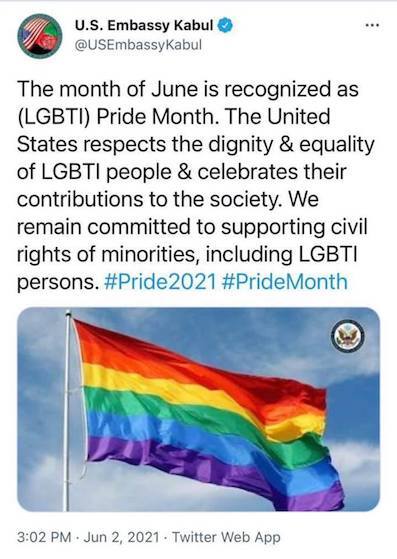
It doesn't look like Kabul will be holding a pride parade next year.
[Note by Tom Gross]
I attach four articles on the fall of Kabul (from Haaretz, the NY Times and Wall St Journal). All went online yesterday evening and are published in today's print newspapers.
For short videos of the desperate scenes at Kabul airport as people try and flee, see:
https://twitter.com/i/status/1427122053212098560
https://twitter.com/i/status/1427000691407654914
https://twitter.com/i/status/1427019469755404291
*
(Among recent other dispatches on Afghanistan, see the dispatch of Feb. 20, 2021, titled: "We're handing Afghanistan to the Taliban; middle class Afghans being assassinated in the run-up to US withdrawal".)
CONTENTS
1. "What America's Middle Eastern allies can learn from the collapse of Afghanistan" (By Anshel Pfeffer, Haaretz)
2. "Disaster in Afghanistan Will Follow Us home. Biden owns the moment. He'll also own the consequences" (By Bret Stephens, New York Times)
3. "Biden's Afghanistan Surrender. The President tries to duck responsibility for a calamitous withdrawal" (Wall Street Journal editorial)
4. "Nancy Pelosi on Afghan Women" (Wall Street Journal editorial)
(EXTRACTS from articles below)
UNFAIR TO THE SOUTH VIETNAMESE
(Haaretz) The comparisons being made between the fall of Kabul to Taliban fighters and the fall of Saigon, with its iconic photographs of U.S. helicopters evacuating American personnel from city rooftops, are unfair to the South Vietnamese. They persevered for over two years after the U.S. military departed in early 1973, until Saigon fell in April 1975. The Afghan National Army has melted away before U.S. troops even departed.
*
The United States can't fix a failed state. For Israel, which is surrounded by two failed states in Lebanon and Syria, and two others that could rapidly be on the brink of failure in Egypt and Jordan, this is a sobering conclusion.
Ironically, in the last two decades of U.S. campaigns in the Middle East and Afghanistan, the only foreign military intervention that actually achieved its objectives was that of Russia in Syria. Saving and propping up a dictator by bombing hospitals and bakeries in rebel-held areas, as the Russian Air Force did on behalf of the Assad regime, is much easier than establishing democracy and equality for women.
*
"WOMEN WILL BECOME CHATTEL"
(New York Times) The killing in Afghanistan won't stop. Watch -- if you have the stomach -- videos of the aftermath of an attack in May on Afghan schoolgirls, which left 90 dead, or the massacre of 22 Afghan commandos in June, gunned down as they were surrendering, or Taliban fighters taunting an Afghan police officer, shortly before they kill him for the crime of making comic videos.
Women will become chattel. There are roughly 18 million women and girls in Afghanistan. They will now be subject to laws from the seventh century. They will not be able to walk about with uncovered faces or be seen in public without a male relative. They will not be able to hold the kinds of jobs they've fought so hard to get over the last 20 years: journalists, teachers, parliamentarians, entrepreneurs. Their daughters will not be allowed to go to school or play sports or consent to the choice of a husband.
Afghanistan will become a magnet to jihadists everywhere. Sirajuddin Haqqani, the Taliban's deputy leader, is one of the F.B.I.'s most wanted terrorists. Don't expect him to change his spots, even if he claimed otherwise last year in a New York Times guest essay.
"WHAT HAPPENS IN AFGHANISTAN WON'T STAY THERE"
What happens in Afghanistan won't stay there. The country most immediately at risk from an ascendant Taliban is neighboring Pakistan. After years of Islamabad giving sanctuary and support for the Afghan Taliban (as long as they attacked coalition forces), Pakistan must now fear that the next regime in Kabul will give sanctuary and support for the Pakistani Taliban. There may be poetic justice in this, but the prospect of fundamentalist forces destabilizing a regime with an estimated 160 nuclear warheads is an unparalleled global nightmare.
20 VIKTOR ORBANS
Short of this, the calamity in Afghanistan is a recipe for another wave of migrants, one that will wash over Europe's shores and provoke a populist backlash. "We're going to see 20 Viktor Orbans emerge," warned Mohseni, referring to the Hungarian strongman.
THE SOUTH KOREAN WAY
In the last several years, the United States has maintained a relatively small force in Afghanistan, largely devoted to providing surveillance, logistics and air cover for Afghan forces while taking minimal casualties. Any American president could have maintained this position almost indefinitely -- with no prospect of defeating the Taliban but none of being routed by them, either.
In other words, we had achieved a good-enough solution for a nation we could afford to neither save nor lose. We squandered it anyway.
We've been in Korea for 71 years, at far higher cost, and the world is better off for it.
ARTICLES
WHAT AMERICA'S MIDDLE EASTERN ALLIES CAN LEARN FROM THE COLLAPSE OF AFGHANISTAN
What America's Middle Eastern allies can learn from the collapse of Afghanistan
By Anshel Pfeffer
Haaretz (Israel)
Aug. 15, 2021
https://www.haaretz.com/us-news/.premium-what-america-s-middle-eastern-allies-can-learn-from-afghanistan-1.10120495
The comparisons being made between the fall of Kabul to Taliban fighters and the fall of Saigon, with its iconic photographs of U.S. helicopters evacuating American personnel from city rooftops, are unfair to the South Vietnamese. They persevered for over two years after the U.S. military departed in early 1973, until Saigon fell in April 1975. The Afghan National Army has melted away before U.S. troops even departed.
This is a personal humiliation for President Joe Biden, who said only last month that "the Taliban is not the North Vietnamese army. They're not remotely comparable in terms of capability. There's going to be no circumstances where you see people being lifted off the roof of the embassy of the United States from Afghanistan."
Few U.S. presidents assumed office with foreign policy experience comparable to that of Biden -- accumulated over his decades in the relevant Senate committees (he was in his first term as senator when Saigon fell) and his eight years as Barack Obama's vice president. Unlike his immediate predecessor Donald Trump, whom Biden has been trying to blame in recent days for the failed deal with the Taliban, Biden reads his daily intelligence briefing papers.
Biden's blithe assurances will have been based on the assessments of the U.S. intelligence community. They will continue to haunt him personally, just as Obama was haunted by his "red line" promise to retaliate if the Assad regime used chemical weapons against Syrian civilians and his original assertion that ISIS was merely "a J.V. team."
Whether or not this will harm the Biden administration's domestic political standing or international credibility remains to be seen. Any potential domestic damage will probably be short-lived. America's "longest war" is far from popular at home. Leaving Afghanistan, even in these humiliating circumstances, is what the overwhelming majority of Americans wanted Biden to do.
What this means for America's traditional allies is another matter.
For many of those allies, his election last year was reason for a massive sigh of relief. Trump's fondness for dictators -- including many of America's rivals, from Vladimir Putin to Kim Jong Un -- alongside his unconcealed contempt for NATO, did more than any rushed evacuation to erode the U.S.' standing.
Biden has restored that trust. Even those American allies whom Trump favored -- chiefly Israel, Saudi Arabia and the United Arab Emirates -- have been relieved by Biden's policies so far. He hasn't pressured Israel to make any major concessions to the Palestinians. Nor has he rushed to go back to the Iranian nuclear agreement or acted on his pre-election threats to make the Saudis pay for their human rights record.
But Biden is not the problem. The Kabul debacle is on his watch, but the failure can be shared by all four administrations since the United States first launched its Afghan campaign in the wake of 9/11, some 20 years ago.
The real effect on America's allies, especially Israel and the pro-Western Arab regimes, is that America, now and for the foreseeable future, has a heightened awareness of its limitations.
That's not entirely new. It was already clear from the later years of George W. Bush's presidency that once the Afghan and Iraqi campaigns began to bog down, there was no longer much appetite for foreign adventures. Bush stood aside in 2008 as Russia invaded Georgia, a pro-Western nation. Obama publicly abandoned America's oldest ally in the Middle East, Hosni Mubarak; reneged on his promises to protect Syrians from chemical weapons; and did nothing to help Ukraine when Russia invaded and annexed Crimea in 2014.
Obama at least paid lip service. Trump quite obviously couldn't care less. For all the talk of his striking Iran, with the exception of the assassination of Gen. Qassem Soleimani, he only ever seriously considered it once he had lost the election and his hold over the Pentagon.
Both Obama and Trump were prepared in some cases to use air power, though Obama was dragged by the Europeans to help the Libyan rebels, while it took the executions of Western prisoners to get him to sign off on airstrikes against ISIS. It was clear that the era of "boots on the ground" was long over.
The realization that the Americans are no longer prepared to squander the lives of their own soldiers is not the only lasting effect of its military failures of the past two decades. It goes deeper than that. As Biden said on Saturday, a U.S. military presence "would not have made a difference if the Afghan military cannot or will not hold its own country."
Whether you call it nation-building or regime-change, America has learned, at least for now, that it doesn't work unless there's a nation that wants to change its regime.
America hasn't abandoned its allies. It would be grossly unfair to characterize a 20-year investment of some 2,400 U.S. lives and nearly a trillion dollars in that way. It simply can't help them if they are incapable of helping themselves.
The United States can't fix a failed state. For Israel, which is surrounded by two failed states in Lebanon and Syria, and two others that could rapidly be on the brink of failure in Egypt and Jordan, this is a sobering conclusion.
Ironically, in the last two decades of U.S. campaigns in the Middle East and Afghanistan, the only foreign military intervention that actually achieved its objectives was that of Russia in Syria. Saving and propping up a dictator by bombing hospitals and bakeries in rebel-held areas, as the Russian Air Force did on behalf of the Assad regime, is much easier than establishing democracy and equality for women in a deeply tribal and religious society.
That's especially true when there is a deeply entrenched enemy like the Taliban, which can lose control of territory for nearly 20 years but never go away, waiting patiently until the Americans leave.
The only way, perhaps, to destroy the Taliban would have been to wipe out the villages and communities that sheltered it, and that isn't the way America fights its wars in the 21st century. That's a good thing. America, for all its faults, isn't Russia. But its limitations mean that its allies sometimes have to fend for themselves.
The most immediate conclusion for Israel is that if Lebanon is engulfed by chaos, which could be imminent, it will not be able to rely on the United States or anyone else to help prevent Hezbollah taking control of the country. It will take years, if not decades, for the memory of Kabul to fade.
DISASTER IN AFGHANISTAN WILL FOLLOW US HOME
Disaster in Afghanistan Will Follow Us Home
Biden owns the moment. He'll also own the consequences.
By Bret Stephens
The New York Times
Aug. 15, 2021
https://www.nytimes.com/2021/08/15/opinion/afghanistan-taliban-biden.html
What on earth was Joe Biden thinking -- if, that is, he was thinking?
On July 8 (video here), the president defended his decision to withdraw all remaining U.S. forces from Afghanistan. After assuring Americans that "the drawdown is proceeding in a secure and orderly way" and that "U.S. support for the people of Afghanistan will endure," he took some questions. Here are excerpts from the White House transcript.
Q: Is a Taliban takeover of Afghanistan now inevitable?
The president: No, it is not.
Q: Why?
The president: Because you -- the Afghan troops have 300,000 well-equipped -- as well equipped as any army in the world -- and an air force against something like 75,000 Taliban. It is not inevitable. ?
Q: Do you see any parallels between this withdrawal and what happened in Vietnam, with some people feeling ---
The president: None whatsoever. Zero ? The Taliban is not the South -- the North Vietnamese Army. They're not -- they're not remotely comparable in terms of capability. There's going to be no circumstance where you see people being lifted off the roof of an embassy. ?
Q: Mr. President, how serious was the corruption among the Afghanistan government to this mission failing there?
The president: Well, first of all, the mission hasn't failed, yet. There is in Afghanistan -- in all parties, there's been corruption. The question is, can there be an agreement on unity of purpose? ? That -- the jury is still out. But the likelihood there's going to be the Taliban overrunning everything and owning the whole country is highly unlikely.
*
Biden's heedlessness, on the cusp of a sweeping Taliban blitzkrieg that on Sunday saw them enter Kabul, will define his administration's first great fiasco. It won't matter that he is carrying through on the shambolic withdrawal agreement negotiated last year by the Trump administration, with the eager support of Trump's isolationist base, and through the diplomatic efforts of Trump's lickspittle secretary of state, Mike Pompeo.
This is happening on Biden's watch, at Biden's insistence, against the advice of his senior military advisers and with Biden's firm assurance to the American people that what has just come to pass wouldn't come to pass. Past presidents might have had a senior adviser resign in the wake of such a debacle, as Les Aspin, then the secretary of defense, did after the 1993 Black Hawk Down episode in Somalia.
This time, Biden owns the moment. He also owns the consequences. We should begin to anticipate them now.
The killing won't stop. Watch -- if you have the stomach -- videos of the aftermath of an attack in May on Afghan schoolgirls, which left 90 dead, or the massacre of 22 Afghan commandos in June, gunned down as they were surrendering, or Taliban fighters taunting an Afghan police officer, shortly before they kill him for the crime of making comic videos.
One Taliban official declared that their jihad was directed not against ordinary Afghans but only "against the occupiers and those who defend the occupiers." Yet the list of Afghans who fill that bill reaches into the thousands, if not higher.
Women will become chattel. There are roughly 18 million women and girls in Afghanistan. They will now be subject to laws from the seventh century. They will not be able to walk about with uncovered faces or be seen in public without a male relative. They will not be able to hold the kinds of jobs they've fought so hard to get over the last 20 years: journalists, teachers, parliamentarians, entrepreneurs. Their daughters will not be allowed to go to school or play sports or consent to the choice of a husband.
Afghanistan will become a magnet to jihadists everywhere. Sirajuddin Haqqani, the Taliban's deputy leader, is one of the F.B.I.'s most wanted terrorists. Don't expect him to change his spots, even if he claimed otherwise last year in a Times guest essay.
"The relationship between the Taliban and Al Qaeda will get stronger," Saad Mohseni, the head of the Afghan news and media company Moby, told me on Saturday. "Why should the Taliban fear the Americans anymore? What's the worst that could happen? Another invasion?
"These guys are going to be the most belligerent, arrogant Islamist movement on the planet," Mohseni added. "They are going to be the Mecca for any young radical of Islamic heritage or convert. It's going to inspire people. It's a godsend for any radical, violent group."
What happens in Afghanistan won't stay there. The country most immediately at risk from an ascendant Taliban is neighboring Pakistan. After years of Islamabad giving sanctuary and support for the Afghan Taliban (as long as they attacked coalition forces), Pakistan must now fear that the next regime in Kabul will give sanctuary and support for the Pakistani Taliban. There may be poetic justice in this, but the prospect of fundamentalist forces destabilizing a regime with an estimated 160 nuclear warheads is an unparalleled global nightmare.
Short of this, the calamity in Afghanistan is a recipe for another wave of migrants, one that will wash over Europe's shores and provoke a populist backlash. "We're going to see 20 Viktor Orbans emerge," warned Mohseni, referring to the Hungarian strongman and Tucker Carlson B.F.F.
America's geopolitical position will be gravely damaged. What kind of ally is the United States? In the last several years, the United States has maintained a relatively small force in Afghanistan, largely devoted to providing surveillance, logistics and air cover for Afghan forces while taking minimal casualties. Any American president could have maintained this position almost indefinitely -- with no prospect of defeating the Taliban but none of being routed by them, either.
In other words, we had achieved a good-enough solution for a nation we could afford to neither save nor lose. We squandered it anyway. Now, in the aftermath of Saigon redux, every enemy will draw the lesson that the United States is a feckless power, with no lasting appetite for defending the Pax Americana that is still the basis for world order. And every ally -- Taiwan, Ukraine, the Baltic states, Israel, Japan -- will draw the lesson that it is on its own in the face of its enemies. The Biden Doctrine means the burial of the Truman Doctrine.
*
But didn't we have to leave Afghanistan sometime? So goes a counterargument. Yes, though we've been in Korea for 71 years, at far higher cost, and the world is better off for it.
But wasn't the Afghan government corrupt and inept? Yes, but at least that government wasn't massacring its own citizens or raising the banner of jihad.
But aren't American casualties unacceptable? They are surely tragic. But so is squandering the sacrifice of so many Americans who fought the Taliban bravely and nobly -- and, as it turns out, for nothing.
But is there any reason we should care more about the fate of Afghans than we do of desperate people elsewhere? Yes, because our inability to help everyone, everywhere doesn't relieve us of the obligation to help someone, somewhere -- and because America's power and reputation in the world is also a function of being a beacon of confidence and hope.
Now these arguments belong to the past. The war in Afghanistan isn't just over. It's lost. A few Americans may cheer this humiliation, and many more will shrug at it. But the consequences of defeat are rarely benign for nations, no matter how powerful they otherwise appear to be. America's enemies, great and small, will draw conclusions from our needless surrender, just as they will about the frighteningly oblivious president who brought it about.
***
You can watch my conversation with Bret Stephens from a few months ago here:
http://www.tomgrossmedia.com/mideastdispatches/archives/001958.html
BIDEN'S AFGHANISTAN SURRENDER
Biden's Afghanistan Surrender
The President tries to duck responsibility for a calamitous withdrawal.
Wall Street Journal
Editorial board
Aug. 15, 2021
https://www.wsj.com/articles/biden-afghanistan-surrender-withdrawal-ashraf-ghani-kabul-saigon-jihadist-9-11-11629054041?mod=opinion_lead_pos1
President Biden's statement on Saturday washing his hands of Afghanistan deserves to go down as one of the most shameful in history by a Commander in Chief at such a moment of American retreat. As the Taliban closed in on Kabul, Mr. Biden sent a confirmation of U.S. abandonment that absolved himself of responsibility, deflected blame to his predecessor, and more or less invited the Taliban to take over the country.
With that statement of capitulation, the Afghan military's last resistance collapsed. Taliban fighters captured Kabul, and President Ashraf Ghani fled the country while the U.S. frantically tried to evacuate Americans. The jihadists the U.S. toppled 20 years ago for sheltering Osama bin Laden will now fly their flag over the U.S. Embassy building on the 20th anniversary of 9/11.
*
Our goal all along has been to offer constructive advice to avoid this outcome. We criticized Donald Trump's deal with the Taliban and warned about the risks of his urge to withdraw in a rush, and we did the same for Mr. Biden. The President's advisers offered an alternative, as did the Afghanistan Study Group. Mr. Biden, as always too assured of his own foreign-policy acumen, refused to listen.
Mr. Biden's Saturday self-justification exemplifies his righteous dishonesty. "One more year, or five more years, of U.S. military presence would not have made a difference if the Afghan military cannot or will not hold its own country," Mr. Biden said. But the Afghans were willing to fight and take casualties with the support of the U.S. and its NATO allies, especially air power. A few thousand troops and contractors could have done the job and prevented this rout.
Worse is his attempt to blame his decisions on Mr. Trump: "When I came to office, I inherited a deal cut by my predecessor -- which he invited the Taliban to discuss at Camp David on the eve of 9/11 of 2019 -- that left the Taliban in the strongest position militarily since 2001 and imposed a May 1, 2021 deadline on U.S. forces. Shortly before he left office, he also drew U.S. forces down to a bare minimum of 2,500. Therefore, when I became President, I faced a choice -- follow through on the deal, with a brief extension to get our forces and our allies' forces out safely, or ramp up our presence and send more American troops to fight once again in another country's civil conflict."
Note that Mr. Biden is more critical of his predecessor than he is of the Taliban. The President has spent seven months ostentatiously overturning one Trump policy after another on foreign and domestic policy. Yet he now claims Afghanistan policy is the one he could do nothing about.
This is a pathetic denial of his own agency, and it's also a false choice. It's as if Winston Churchill, with his troops surrounded at Dunkirk, had declared that Neville Chamberlain got him into this mess and the British had already fought too many wars on the Continent.
Mr. Trump's withdrawal deadline was a mistake, but Mr. Biden could have maneuvered around it. He knows this because his Administration conducted an internal policy review that provided him with options. The Taliban had already violated its pledges under the deal. Mr. Biden could have maintained the modest presence his military and foreign-policy advisers suggested. He could have decided to withdraw but done so based on conditions on the ground while preparing the Afghans with a plan for transition and air support.
Instead he ordered a rapid and total withdrawal at the onset of the annual fighting season in time for the symbolic target date of 9/11. Most of the American press at the time hailed his decision as courageous.
*
The result a mere four months later is the worst U.S. humiliation since the fall of Saigon in 1975. The Taliban is saying it wants a "peaceful transfer of power" in Kabul, but the scenes are still redolent of U.S. defeat. The scramble to destroy classified documents. The helicopters evacuating U.S. diplomats. The abandonment into Taliban hands of valuable U.S. military equipment.
Worst of all is the plight of the Afghans who assisted the U.S. over two decades. Mr. Biden said Saturday that the 5,000 U.S. troops he is sending will help in evacuating Afghans and Americans. But there are thousands of translators, their families, and other officials who are in peril from Taliban rule and didn't get out in time. (See nearby.) The Biden Administration was far too slow to get them out of the country despite urgent warnings. The murder of these innocents will compound the stain on the Biden Presidency.
The consequences of all this will play out over many months and years, and none will be good. The illusion, indulged on the left and right, that the U.S. can avoid the world's horrors while gardening its entitlement state, is sure to come home to haunt. Adversaries are taking Mr. Biden's measure, and there will be more trouble ahead. The costs will be all the more painful because the ugliness of this surrender was so unnecessary.
NANCY PELOSI ON AFGHAN WOMEN
Nancy Pelosi on Afghan Women
The House Speaker has a stern feminist warning for the Taliban.
Wall Street Journal
Editorial board
Aug. 15, 2021
https://www.wsj.com/articles/pelosi-afghan-women-biden-withdrawal-taliban-forced-marriages-misogyny-feminism-11629058703
Politics often requires blind loyalty, and on Afghanistan the word blind clearly applies to Nancy Pelosi. On Sunday the House Speaker issued a statement that began, "The President is to be commended for the clarity of purpose of his statement on Afghanistan and the actions he has taken."
Then she got rolling. "We are deeply concerned about reports regarding the Taliban's brutal treatment of all Afghans, especially women and girls. The U.S., the international community and the Afghan government must do everything we can to protect women and girls from inhumane treatment by the Taliban," Mrs. Pelosi said.
But the "international community" was doing precisely that by maintaining a modest allied force and air power in Afghanistan. Now they're gone, and we can see what will happen to the women and girls of that country.
"Any political settlement that the Afghans pursue to avert bloodshed must include having women at the table," the Speaker added. Gotta love that "must." That should impress the Taliban as it closes schools for girls, forces marriages to Taliban fighters, and bars women from public or prominent commercial life.
Mrs. Pelosi is so used to giving political lectures she doesn't seem to realize she is detached from reality.
* You can also find other items that are not in these dispatches if you ?like? this page on Facebook www.facebook.com/TomGrossMedia