
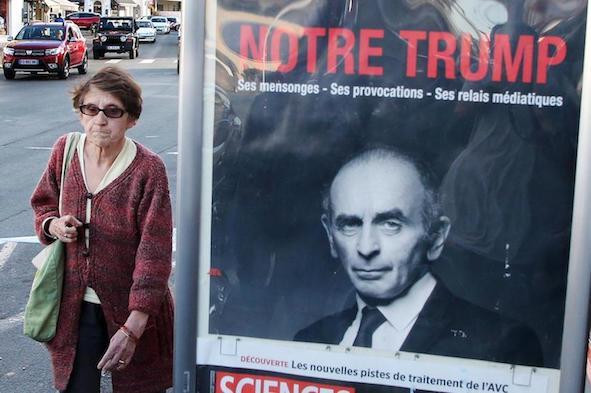
Above: Eric Zemmour, a controversial far right TV pundit and former journalist for Le Figaro, is now running second in opinion polls behind incumbent President Emmanuel Macron in the run up to France's 2022 elections. Zemmour has said France doesn't want to become an Islamic Republic or "a second Lebanon," meaning a country fragmented between sectarian communities that hate and fear one another. A French journalist friend of mine said he was like "Donald Trump with a touch of Tucker Carlson."

Above: Eric Zemmour, 63, and Sarah Knafo, 28. Suggestions of an affair between the would-be president and his aide led to the dismissal earlier this month of the editor of 'Paris Match', which published pictures of them embracing on a Mediterranean beach. (Zemmour accused the magazine of taking orders from President Macron to damage him and the magazine's editor was sacked.)
Knafo, who like Zemmour is a Sephardic Jew, is said to be influencing Zemmour's as yet to be announced campaign for the presidency, urging him to run. (Some have also questioned their age difference. Others say it is irrelevant and point out that President Macron's wife is 25 years older than him.) Zemmour remains married to Mylene Chichportich, a prominent Paris lawyer, who has not been visible so far in his virtual campaign. The couple have three adult children.
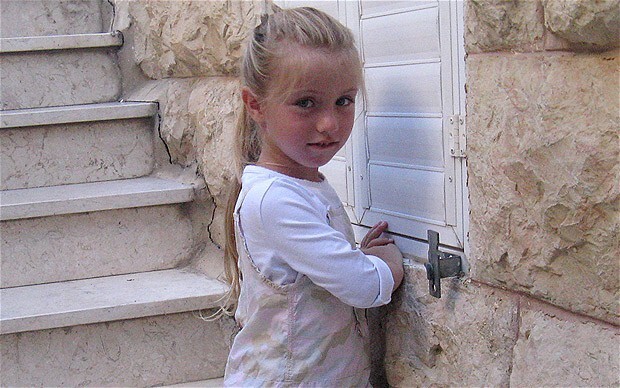
Above: Seven-year-old Miriam MonsonEgo, one of several Jewish children murdered in a French Islamist attack on a French Jewish school in Toulouse in 2012. Zemmour said the Jewish victims of this attack were "not properly French". Miriam was pulled by the hair and then shot through the head in Toulouse because she was Jewish (I wrote about that attack here.)
THE FRENCH-JEWISH "USEFUL IDIOT" ENDORSED BY JEAN-MARIE LE PEN
[Note by Tom Gross]
I attach several articles published in recent weeks (including one from today's London Sunday Times) about Eric Zemmour, the rabble-rousing far right French journalist who is fast rising in the polls and is expected to make a serious challenge for the French presidency next year.
Anne-Elisabeth Moutet, a French journalist and commentator who has appeared on TV debates with Zemmour, told me yesterday that she thought he has a 25 percent chance of defeating Emmanuel Macron in a run-off second round and becoming French president.
Another well-known French journalist friend of mine, who has also known Zemmour for many years, tells me he gives him a one third chance of winning.
A book published by Zemmour on September 16 titled "La France n'a pas dit son dernier mot" (France Has Not Yet Said Her Last Word) sold 100,000 copies in its first week.
"DONALD TRUMP -- WITH A TOUCH OF TUCKER CARLSON"
Anne-Elisabeth Moutet describes Zemmour as "Donald Trump with a touch of Tucker Carlson."
A longtime journalist for leading newspaper Le Figaro, Zemmour came to national prominence when he was given his own daily debating show two years ago by Cnews, a French TV cable station which has re-invented itself as the French Fox News. "CNEWS's ratings shot up, overtaking its CNN-like rival BFMTV," Moutet says.
"Le Z," as many call him, has several wealthy backers including French financier Charles Gave who was previously based in Hong Kong. Zemmour is believed likely to declare he is officially running and to launch a political party on November 9, the anniversary of the death of Charles de Gaulle in 1970.
The party may be called Vox populi (voice of the people) similar in name to the rightwing Spanish political party.
Jean-Marie Le Pen, the elderly founder of the neo-fascist National Front (FN) has said he will vote for Zemmour over his own daughter Marine Le Pen, leader of the far-right National Rally (RN), from whom he is estranged.
The elder Le Pen, 93, said of Zemmour: "He says what I think, but to a larger audience ... The only difference between Eric and me is that he is Jewish. It is difficult to call him a Nazi or a fascist. This gives him more freedom."
A JEWISH "USEFUL IDIOT"
Francis Kalifat -- president of Crif, the umbrella organization representing French Jews -- called Zemmour "the useful idiot of French antisemites" and added that "not a single Jewish vote" should be cast for him.
Serge Klarsfeld, 86, the historian who helped bring countless Nazis to justice, has said Zemmour's ideas "revolt" him.
Among Zemmour's highly provocative remarks:
Last year, Zemmour questioned whether Alfred Dreyfus -- the French-Jewish army captain falsely convicted as a traitor and tortured in 1894 during a wave of violent antisemitism in France -- was innocent.
Zemmour, who is a Jew of Algerian origin, sometimes attends synagogue and largely keeps kosher though he says he doesn't believe in God, also outraged French Jews by claiming last month that the Jewish victims of the massacre by an Islamist gunman at a Jewish school in Toulouse in 2012 -- Rabbi Jonathan Sandler, his two sons, six-year-old Arieh and three-year-old Gabriel, and another little girl, seven-year-old Miriam MonsonEgo -- were "not properly French".
Earlier this month Zemmour attacked the philosopher Bernard-Henri LEvy, one of the country's most prominent Jewish intellectuals as a "cosmopolitan" and a "traitor par excellence" -- remarks denounced by former French prime minister Manuel Valls and others as reminiscent of pre-World War II French anti-Semitism.
Zemmour has expressed nostalgia for some aspects of the Vichy collaborationist regime set up after the Nazi invasion of France in 1940, that sent 72,500 Jews to their deaths.
SOME JEWISH SUPPORT
Yet Zemmour has won support among some French Jews who see him as their best hope in stemming the wave of violent antisemitic attacks (including many murders) by Muslims that continue to be targeted at largely working-class or lower-middle class Sephardic French Jews. French conservative commentator Elizabeth Levy said Zemmour "represented the last chance before exile for many North African Jews in France who regularly suffer antisemitic attacks by Muslims". Already thousands of French Jews have left the country in recent years.
Describing himself as "a French Jew of Berber origin", Zemmour has contrasted his own community's success in integrating into French life with the reluctance of many Muslim immigrants to follow suit. Zemmour himself was born in Montreuil in eastern Paris in what was then a working-class suburb.
He is said to believe in the so-called "Great Replacement" theory, writing there are areas in Paris where "one feels best, physically, the disappearance of the French population ? an Arab-Muslim people has replaced the former inhabitants."
INSISTING ON "FRENCH" NAMES
Yves Mamou, who worked for two decades as a journalist for Le Monde, writes in the article below:
"Zemmour is the man who broke through the glass ceiling to insert into the media discussion topics such as "immigration" and "jihad" -- which no one had ever dared to talk about publicly. He is a man who embodies the fear of seeing traditional France -- the one of church steeples and the 'baguette' -- disappear under the blows of jihad and political correctness" ?
Zemmour appears to be shocking because he states that France ceased to be France the day it allowed parents from foreign origin to give African or Muslim first names to their children (Mohammed is the most prevalent name in the Parisian suburbs). Zemmour says he would like to restore a law from the 19th century that obligated all French citizens "to give French first names" to their children?
He is also uncompromising on societal issues: against assisted reproduction ("I want children to have a father and a mother"), transgender propaganda in schools, same-sex marriage, and LGBT militancy at school. Zemmour is not anti-homosexual, he is just saying that "LGBT lobbies" and "minorities" are at war with France just as Islamists are at war with all Western countries?.
Zemmour is popular not because he makes provocative remarks about immigration or LGBT rights. He is popular because he brings to the media concerns that were previously expressed only in the family or among friends. Zemmour's popularity is growing in the polls today because he is now exporting the debate from the media sphere to the political sphere
***
I attach six pieces below, including some by friends of mine and subscribers to this list including Ben Cohen and Anne-Elisabeth Moutet.
-- Tom Gross
CONTENTS
1. 'Traitor!': French Pundit Tipped as Far-Right Presidential Candidate in Visceral Attack Against Leading Jewish Intellectual (By Ben Cohen, The Algemeiner, Oct 15, 2021)
2. Is Eric Zemmour the new Bruno Kreisky? (By Ben Cohen, JNS, Oct 15, 2021)
3. Eric Zemmour, the rabble-rouser dividing France's Jewish population (By Peter Conradi, London Sunday Times, Oct 31, 2021)
4. Young aide Sarah Knafo 'has would-be French president Eric Zemmour in her grip' (By Charles Bremner, The Times of London, Oct 30, 2021)
5. Is Eric Zemmour the French Trump? The populist provocateur speaks to Les DEplorables (By Anne-Elisabeth Moutet, Unherd, Oct 5, 2021)
6. France: Can Eric Zemmour Be the Next President? The Journalist Who Is Reshuffling the Cards in French Politics (By Yves Mamou, Gatestone Institute, Oct 25, 2021)
ARTICLES
'TRAITOR!': FRENCH PUNDIT TIPPED AS FAR-RIGHT PRESIDENTIAL CANDIDATE IN VISCERAL ATTACK AGAINST LEADING JEWISH INTELLECTUAL
'Traitor!': French Pundit Tipped as Far-Right Presidential Candidate in Visceral Attack Against Leading Jewish Intellectual
By Ben Cohen
The Algemeiner
October 15, 2021
The television pundit widely tipped to be the far right's candidate in next year's presidential election in France on Thursday attacked one of the country's most prominent Jewish intellectuals as a "traitor."
Eric Zemmour, a 63-year-old outspoken commentator and TV presenter, has yet to declare his candidacy, but the possibility of a presidential run has electrified France in recent weeks.
A household name for his hardline anti-immigrant and anti-feminist views, laced with nostalgia for the Vichy collaborationist regime set up after the German invasion of France in 1940, Zemmour has attracted plenty of trenchant criticism, including an article in this week's edition of the magazine Le Point by the philosopher Bernard-Henri LEvy -- the target of Zemmour's ire on Thursday.
In his article, LEvy highlighted Zemmour's Jewish origins, charging him with the "renunciation of Jewish generosity, vulnerability, humanism, and sense of otherness."
Zemmour was born in a Paris suburb to a Jewish family from Algeria that arrived in France during the 1954-62 Algerian War. His father Roger was a paramedic, while his mother Lucette was a home-maker.
Zemmour's positions were "an insult to the Jewish name that all Jews carry within them, unless and until they explicitly throw it overboard," LEvy argued.
Asked for his response to LEvy during a Thursday morning interview on the CNEWS network, Zemmour called the philosopher a "cosmopolitan" and a "traitor par excellence" -- provoking outrage among those who accused him of dredging up the language of pre-World War II antisemitism in France.
Manuel Valls, a former prime minister of France, tweeted that "according to Zemmour on CNEWS, BHL (LEvy) is a 'traitor' and a 'cosmopolitan' -- a fine example of the rhetoric of the far right, as has always been the case."
LEvy told The Algemeiner on Thursday that Zemmour's verbal assault had exposed his anti-democratic instincts.
"Honestly, I have more questions than replies," LEvy said. "What is a 'traitor par excellence?' What might a candidate for the presidency mean when he describes one of his fellow citizens as a 'traitor par excellence?' And if he were to be elected, how would he treat someone he considers as a 'traitor par excellence'?"
LEvy added: "A democrat is someone who debates, who expresses disagreement, but who does not exclude his adversary from the nation by calling him a 'traitor par excellence.'"
Over the last decade, Zemmour has written several bestsellers bemoaning the immigration of Muslims from the Middle East and Africa to France, pushing the far right's "great replacement" conspiracy theory that immigrants of color are displacing native white people in Europe and the US.
On Jewish issues, Zemmour has frequently been at odds with the Jewish community. He has claimed with scant evidence that the Vichy regime of Marshal Philippe PEtain acted to save French-born Jews from the clutches of the Nazis by prioritizing Jews holding foreign citizenship for deportation. While foreign Jews were the initial targets of the antisemitic campaign, by 1942, most historians agree, the entire Jewish population in France was in the frame. During the infamous Vel D'Hiv round-up in Paris in 1942, 80 percent of the 4,000 Jewish children deported to the Nazi-built Auschwitz concentration camp in Poland were French-born.
Last year, Zemmour questioned whether Alfred Dreyfus -- the French-Jewish army captain falsely convicted of espionage in 1894 during a wave of violent antisemitism in France -- was truly innocent, opining that "we will never know." He also outraged French Jews by claiming in September of this year that the burial in Israel of the victims of the massacre by an Islamist gunman at a Jewish school in Toulouse in 2012 proved that they were not properly French.
The victims -- Rabbi Jonathan Sandler, his two sons, six-year-old Arieh and three-year-old Gabriel, and another little girl, eight-year-old Miriam MonsonEgo -- were buried in Israel because "they were foreigners above all and wanted to stay that way even beyond death," Zemmour said.
This week, Zemmour was also in open conflict with the head of the French Jewish community, accusing him of feeding antisemitic conspiracy theories about a Jewish takeover of France.
In response, Francis Kalifat -- president of Crif, the umbrella organization representing French Jews -- called Zemmour "the useful idiot of the last remaining antisemites in France."
Speculation over whether Zemmour will run for president in April 2022 has reached new heights in the wake of a poll of French voters last week that showed him in second place.
A Zemmour run would put him in direct competition with Marine Le Pen, leader of the far-right National Rally (RN) -- a successor party to the neo-fascist National Front (FN) founded by her now estranged father, Jean-Marie Le Pen -- who was roundly defeated by current incumbent Emmanuel Macron in the second round of the 2017 presidential election.
On Thursday, Marine Le Pen told the newspaper Le Figaro, "I can and will win this presidential election." Asked about a Zemmour candidacy, she responded that "he would make a good prime minister, but it seems obvious to me that he wouldn't want to be."
IS ERIC ZEMMOUR THE NEW BRUNO KREISKY?
Is Eric Zemmour the new Bruno Kreisky?
When it comes to anti-Semitic barbs and dog whistles, the overlaps between the two men who denounced their Jewish identity are again all too apparent.
By Ben Cohen
October 15, 2021
JNS
Could a politician who positively identifies as Jewish and expresses pro-Israel sympathies ever be elected as head of state in a European country?
The question is still a hypothetical one. In spite of the large number of proudly Jewish politicians elected to legislatures in Europe in the post-World War II period, along with those who have served as cabinet ministers and prominent judges, none of them seriously entertained the possibility of winning the post of president or prime minister in an election.
But that's not been the case with Jewish politicians whose families left Judaism for another religion -- like Laurent Fabius, a French prime minister in the 1980s who was raised as a Catholic -- or, far more disturbingly, those Jews who denounced Jewish identity and the State of Israel as they ascended the ladder of power.
An obvious example of the latter was the late, longest-serving Chancellor of Austria, Bruno Kreisky, who was in office between 1970 and 1983. A scourge of Jewish organizations and the Israeli government at the time for his anti-Semitic utterances and his ostentatious friendship with PLO leader Yasser Arafat, Kreisky, who died in 1990, isn't spoken of much these days. Nonetheless, he remains the model of a European politician who comes from a Jewish family and yet scorns his community, its history and its aspirations to ingratiate himself with the voters at large.
Kreisky's legacy is relevant once again because of developments in France, where a TV pundit named Eric Zemmour, who also comes from a Jewish family, is being widely tipped as the far-right's candidate in the French presidential election in April 2022. True, Kreisky was a proud Socialist, whereas Zemmour, a household name in France for his strident anti-immigrant stance, is an outspoken representative of the ultra-nationalist right; in other important respects, however, the political similarities between the two are uncanny.
Take the attitudes of both to the Holocaust -- a defining event in Europe's history that remains the subject of emotive, politically charged disputes even today. Kreisky himself lived through this period, spending most of the war in Sweden, where he escaped following the incorporation of Austria into the Nazi Third Reich in 1934. Yet for reasons that have puzzled psychologists and historians alike, the Holocaust appeared to make Kreisky even more hostile to his fellow Jews.
In 1970, he formed a coalition government with the right-wing Freedom Party, whose leader, Friedrich Peter, had served as a senior officer in an SS unit responsible for the mass shootings of Jews, Roma and others under Nazi occupation. An additional four cabinet members also had Nazi backgrounds. When the Nazi provenance of Kreisky's government was exposed by Simon Wiesenthal, the famed investigator who actively pursued Nazi war criminals, Kreisky responded viciously. He falsely accused Wiesenthal, a Holocaust survivor, of having been a Gestapo agent and charged him with stirring up anti-Semitism in Austria. At one point in the row, Kreisky clarified that he was "no longer a Jew" -- a clue, perhaps, as to why the constant talk of his Nazi colleagues left him so enraged.
If Kreisky was willing to burnish the reputations of still-living Nazis, Eric Zemmour has done the same with dead ones -- specifically, the collaborators of the Vichy regime who ruled France following the Nazi invasion in 1940. In his several bestsellers published in France, Zemmour has depicted the Vichy authorities as doing their utmost to save French-born Jews while sacrificing the foreign-born to the Germans. This assertion fits neatly with Zemmour's nationalist revisionism, but it's patently false, as the bald facts show. For example, of the 4,000 children among the more than 13,000 Jews deported to Auschwitz during the notorious Vel d'Hiv roundup of July 1942, 80 percent were born in France. Moreover, the anti-Jewish laws and regulations introduced by the Vichy regime from late 1940 onwards applied to all Jews, not just the foreign-born, who at their peak composed no more than 13 percent of France's pre-war Jewish population of 340,000.
Not content with distorting the Holocaust in France, Zemmour has also assailed the reputation of Capt. Alfred Dreyfus, the French army officer falsely convicted of espionage in 1894, amid a wave of anti-Semitism that convinced Theodor Herzl, among others, of the need for a sovereign Jewish state. According to Zemmour, we will never know whether Dreyfus was a spy, but the army at the time had good reason to suspect him because of his alleged German connections.
When it comes to anti-Semitic barbs and dog whistles, the overlaps between Kreisky and Zemmour are again all too apparent. "If the Jews are a people, then they are an ugly people," Kreisky once remarked, while frequently denouncing Israel as a "semi-fascist," "clerical," and, of course, "apartheid" state.
Zemmour, a veteran TV commentator and newspaper columnist, is not quite so blatant, but he draws from the same well. Last week, he denounced the prominent French Jewish intellectual Bernard-Henri LEvy as a "traitor" and a "cosmopolitan" -- language that, as the former French Prime Minister Manuel Valls pointed out, echoed the rhetoric of French anti-Semites before the war. And in September, Zemmour opined that the victims of the gun massacre carried out by an Islamist at a Jewish school in Toulouse in 2012 -- Rabbi Jonathan Sandler; his two young sons, 6-year-old Arieh and 3-year-old Gabriel; and a little girl, 8-year-old Miriam MonsonEgo -- had been buried in Israel because they were not truly French. "They were foreigners above all and wanted to stay that way even beyond death," he said.
Zemmour has not yet announced his intention to run, but the talk of his candidacy has been bolstered by a recent poll showed him coming second in the election. Marine Le Pen, the other far-right candidate who was roundly defeated by Emmanuel Macron in the second round of the 2017 election, is eyeing Zemmour nervously. Certainly, Zemmour's message extolling traditional French and Christian values increasingly resonate in a country sharply divided on immigration, on the government's response to the COVID-19 pandemic, on Europe and much else besides.
From a Jewish perspective, though, the question persists as to why European Jews who shun their own communities can entertain hope of the highest political offices -- with Kreisky setting the precedent -- while those who embrace them have to calibrate their expectations accordingly. Should Eric Zemmour decide that he wants to be the president of France, he will doubtless provide us with some answers along the way, as unpalatable as those are likely be.
ERIC ZEMMOUR, THE RABBLE-ROUSER DIVIDING FRANCE'S JEWISH POPULATION
Eric Zemmour, the rabble-rouser dividing France's Jewish population
By Peter Conradi, Paris
The Sunday Times (of London)
October 31, 2021
It is more than eight decades since they came for her father, but EugEnie Cayet, 84, vividly remembers the moment in the summer of 1941 when German officers, accompanied by French police, burst into the flat in southeast Paris in which she lived with her family.
"I was only four at the time, but it made a deep impression on me," she said. "There were four of them: French police and German soldiers. My father had been told they were coming and my mother urged him to hide somewhere in the building. But my father refused. He said that if they didn't find the men they would take the women and children."
Israel Fisse, her father, had arrived from Turkey in the 1920s, working as an accountant for Renault at its car plant west of Paris. He had briefly served with his brother in the French army. But for the authorities of Nazi-occupied France, all that mattered was that he was Jewish.
He was sent first to a vast internment camp at Drancy, on the northeast outskirts of the capital, where Cayet's mother would take her and her two siblings to catch a glimpse of him through a distant window. Occasionally he smuggled out letters.
After just over a year, Fisse wrote to say he was being sent off in a convoy the next day. He was put on a train to the concentration camp at Auschwitz and his family never saw him again. They never knew when or how he died.
"At first I was always waiting for him to come back. If a man ever came to our flat, I asked my mother if it was my father. I was so young," Cayet recalled, sitting in her flat in a tower block and showing me photographs of a man she barely had the chance to know.
Cayet was not just separated from her father during that first round-up of Jewish men living in Paris's 11th arrondissement on August 20, 1941; she also lost three uncles and her elder sister's husband. They were among more than 70,000 Jews deported from France and murdered by the Nazis.
Her mother survived a later raid on Jewish women thanks to the concierge of their building, who hid her in an empty flat. By that time, Cayet had been sent to a boarding school whose headmaster pretended she was not Jewish.
The complicity in such crimes of the collaborationist government based in the southern town of Vichy and headed by Marshal Philippe PEtain is historical fact. To the dismay of Cayet and her fellow French Jews, however, it is being challenged by Eric Zemmour, a right-wing polemicist who has galvanised the battle for next April's presidential election.
Their horror is all the greater because Zemmour, 63, is himself the son of Algerian Jews who emigrated to France in the early 1950s, and he has been a frequent visitor to a synagogue in the north of Paris.
"It is shameful," Cayet said of Zemmour's claim that the Vichy regime had "protected French Jews" while giving up foreign ones to the Nazis. "How can he say such nonsense? Having a man like that as our head of state would be terrible."
France's presidential battles, which end in a head-to-head contest between the two leading candidates, are inevitably polarising. The upcoming contest is proving especially divisive, however, thanks to Zemmour, a best-selling author and television pundit whose pursuit of controversy has seen him achieve blanket coverage in the media. Although he is still to declare his candidacy, polls show him vying with Marine Le Pen for second place behind President Emmanuel Macron, who remains comfortably ahead of both.
Nowhere is this division more pronounced than in France's Jewish community, which, at an estimated 500,000, is Europe's largest. Its leading figures have expressed outrage at Zemmour's revisionist take on history, which he has reiterated during a series of events at venues across the country that, although ostensibly intended to promote his latest book, have more of the feel of election rallies.
Serge Klarsfeld, 86, a historian who helped bring countless Nazis to justice after the war, has said Zemmour's ideas "revolt" him. Francis Kalifat, head of Crif, a leading Jewish group, said "not a single Jewish vote" should be cast for the polemicist.
Yet Zemmour has also won support among some Jews through his barely concealed hostility to Muslims, who are blamed for a surge in antisemitism in recent years that has seen Jewish cemeteries desecrated and verbal and physical attacks on those displaying religious symbols. Calling himself "a French Jew of Berber origin", he has contrasted his own community's success in integrating into French life with the reluctance of Muslim immigrants to follow suit.
His appeal appears strongest among working-class Jews -- especially those, like Zemmour, whose families have emigrated from north Africa since the war, and so did not suffer the same degree of persecution by the Nazis as those who arrived in France from eastern Europe and beyond in the late 19th and early 20th centuries.
"Many of them are extremely fearful of Muslim immigration and of the antisemitism the Islamists have created," said Cayet's grandson, Julien Bensimhom, a lawyer, who has handled a number of cases involving antisemitic attacks. "For that reason they agree entirely with what he says about Muslims."
Often, though, families are split. To Cayet's alarm, a few months ago her own cousin began urging her to watch Zemmour on his regular slot on CNews, a right-wing French news channel. "He is awful," she said. "He is sowing hatred against Arabs, against everyone." She makes a point of avoiding politics whenever the two women talk.
Zemmour also has his fans at the synagogue in the north of Paris that he began to visit regularly following the death of his father, Roger, in 2012.
Jeremy Benhaim, 28, a student who also worships there, said: "He is very popular." Benhaim agrees "with 80 per cent of what Zemmour says" -- especially when he talks about the decline of France and the failure of its Muslim population to integrate -- but cannot quite bring himself to vote for him because of his whitewashing of PEtain.
Zemmour's praise for PEtain is part of a broader nationalist (and often revisionist) view of French history that places the wartime leader among a panoply of national heroes, summed up in the phrase: "Napoleon is our father, Louis IX our grandfather and Joan of Arc our great-grandmother." In the same spirit, the English, he declared recently, had been France's "greatest enemies for a thousand years".
Such views go down well with those who support Le Pen and, before her, her father, Jean-Marie, 93, who was fined several times for describing the gas chambers used to kill Jews in the Holocaust as a "detail of history". The elder Le Pen recently said of Zemmour: "He says what I think, but to a larger audience ... The only difference between Eric and me is that he is Jewish. It is difficult to call him a Nazi or a fascist. This gives him more freedom."
Historians are almost unanimous in their disavowal of Zemmour's views on Vichy, pointing out that the government worked with the Nazis to round up Jews regardless of their nationality.
This has not deterred Zemmour, who, like Donald Trump, with whom he is often compared, thrives on controversy. He has also grabbed headlines by challenging a 1990 law punishing Holocaust denial and has questioned the innocence of Alfred Dreyfus, the Jewish officer in the French army who was convicted in 1894 of spying for the Germans. Later exonerated, his case has been one of the most polarising in French history.
Most shocking of all have been comments in Zemmour's latest book, which has sold 200,000 copies since it was published last month, about Jonathan Sandler, a rabbi who was shot dead with his two young sons and a third child at a Jewish school in Toulouse in 2012 by Mohammed Merah, an Algerian-French jihadist. Zemmour questioned whether either the victims or the perpetrator could be considered really French because their families decided to bury them abroad.
During a recent appearance in Nice he tried to defuse the controversy, only to twice get the victims' names wrong -- prompting a frantic aide to push a piece of paper across the table pointing out his error, a scene that was captured in a TV documentary to be screened next month.
Although Zemmour himself was born in Montreuil in eastern Paris in what was then a working-class suburb, his views appear to have been shaped in part by his family's heritage and the history of tensions between Arabs and Jews in north Africa. Although Jews began to emigrate to what is now Algeria as early as the Roman period, they were in effect separated from the Arab majority in 1870 under the terms of the so-called CrEmieux decree passed by France, the colonial power, that granted them French citizenship. This created animosity not just with the Arab majority, who resented their superior status, but also with right-wing French settlers who, by the 1930s, had become increasingly antisemitic.
The decree was abolished in October 1940 as part of the promotion of anti-Jewish laws in France, paving the way for their persecution in Algeria too. But it was reinstated less than three years later following the Allied landings in north Africa.
Zemmour's parents had left for France before the start of Algeria's war of independence in 1954. Other Jews followed. By 1962, when the war ended in victory for the Algerians, almost all of them had departed, either for Israel or to France -- often bringing their old grievances with them.
YOUNG AIDE SARAH KNAFO "HAS WOULD-BE FRENCH PRESIDENT ERIC ZEMMOUR IN HER GRIP"
Young aide Sarah Knafo 'has would-be French president Eric Zemmour in her grip'
Charles Bremner, Paris
The Times (of London)
Saturday October 30, 2021
Eric Zemmour, the far-right pundit who has burst into the French presidential campaign, was persuaded to enter the race by a protegEe 35 years his junior who now exerts a strong influence on him as his manager, according to a new book.
Sarah Knafo, 28, a senior civil servant with an intellectual background, became the power behind Zemmour, 63, after he had mentored her for years, Etienne Girard writes in le RadicalisE, an account of the rise of the new figurehead of hard nationalism.
Knafo was the daughter of a friend when Zemmour met her when she was 13. A member of the elite Cour des Comptes, the state auditors body, she made the news last month when Paris Match published a cover picture of her locked in an embrace with Zemmour on a Mediterranean beach.
Zemmour accused the magazine of taking orders from President Macron to damage him and the magazine's editor was sacked this month.
Le Monde newspaper and other media have since reported that Knafo is in a romantic relationship with Zemmour, who has been married since 1982 to Myl?ne Chichportich, a prominent Paris business lawyer, who has not been visible so far in his virtual campaign. The couple have three adult children.
Paul-Marie Cocteaux, an MEP, has said: "Eric listens to Sarah and Sarah listens to Eric. They form a perfect duo".
Knafo's constant presence at Zemmour's side is worrying supporters of his insurgent's push to steal the mantle of Marine Le Pen as champion of the anti-immigrant nationalist vote, according to insiders.
Philippe de Villiers, 72, a former cabinet minister and figurehead of the nationalist right, said: "They fascinate each other. It will end badly".
Zemmour, who is polling in second or third place and is expected to make his candidacy formal next month, was warned earlier this year by political veterans that his private life would be subject to deep scrutiny.
He has drawn feminist fire for his antique views on virility and women's supposed place as subordinates and helpers of men. "Sexual hanky panky have entertained all presidential campaigns," he has written. "They are usually the setting for great displays and small pleasures. Women are drawn like magnets to these political beasts."
The television commentator and essayist found an affinity with the young Knafo, who "had the same Sephardic Jewish origins, the same childhood in Seine-Saint-Denis," writes Girard. Zemmour grew up in the rough northern Paris suburbs with his Algerian-French parents.
Her ideas shaped by Zemmour, Knafo blazed a trail through Sciences Po, the elite Paris university, as a rightwing student activist and graduated in 2018 from the Ecole Nationale d'Administration, the high civil service college that had twice rejected Zemmour's candidacy.
After she graduated, Zemmour was overcome by the success of his protegEe, writes Girard, whose account appeared in L'Express news magazine. "Her godfather was dazzled." Knafo described the reversal of roles, saying: "There had been something filial, then our relationship balanced," Girard writes.
Knafo, who had for a time dated Louis Sarkozy, former president Nicolas Sarkozy's youngest son, set out last year to convince a reluctant Zemmour that he should put his nationalist, anti-Muslim ideas into action with a bid for the presidency.
She organised evenings for Zemmour, whom she calls "Z", with politicians and establishment figures at her flat in Saint Germain des Pres on the Left Bank. When Zemmour wavered, Knafo goaded him, saying Natacha Polony, a rival pundit on the left, would make a better candidate, says the book.
In April, at a gathering in Knafo's flat, Zemmour announced his bid, saying: "I have undergone a conversion. It's thanks to you", writes Girardin. In July, Zemmour, who has never confirmed that he wants to be president, told followers at a Paris dinner: "The intellectual elite have lost the spirit of resistance. You must prepare to become this patriotic elite."
As a shy and physically slight man who was always ill at least with women, Zemmour is savouring his celebrity and potential power in a world that had looked down on him, says Girard, echoing a widespread view in Paris.
"The moment is climactic for him. The young frail boy from the due Doudeauville who has spent 40 years reading, writing, crossing-out, arguing, raging to get there," he writes.
IS ERIC ZEMMOUR THE FRENCH TRUMP?
Is Eric Zemmour the French Trump?
The populist provocateur speaks to Les Deplorables
By Anne-Elisabeth Moutet
Unherd
October 5, 2021
A 59-second viral video has captured the growing dismay of the French political class at the swift rise of Eric Zemmour in the presidential race. In it, a cyclist wearing a Tour de France yellow jersey overtakes a succession of fellow competitors without even pedalling -- he is not sitting on the saddle, but balanced across it, poised, horizontally, like a superhero. He is tagged "Le Z", while each racer he flies past is briefly labelled after one of the other candidates.
Any professional Instagrammer would shudder at the amateurish unsophistication of the video. But that is the point: Zemmour, 63, a bestselling author fired by his publishers this summer and a TV polemicist regularly sued for hate speech by advocacy groups (so far he's won more often than he's lost), reaches the parts of the electorate others don't.
Although he still hasn't formally declared his candidacy, his ramped-up media presence in recent months finally prompted polling institutes to include him in their first round voting intentions surveys. In three weeks, Zemmour jumped from 6% to 15%, ahead of Hard Left three-time candidate Jean-Luc MElenchon (9%), Green primary winner Yannick Jadot (9%) and Socialist Paris Mayor Anne Hidalgo, who in the same period dropped from 7% to 5%.
But Le Z's chief victims are all on the Right. He has all but killed off Marine Le Pen, who has dropped from 28% this summer to 17%. The two main Centre-Right candidates, Paris Region president ValErie PEcresse and Xavier Bertrand, both former Sarkozy Cabinet members, are lagging at 12% and 14% respectively, with Michel Barnier, the former Ogre of Brexit unexpectedly turned sovereignty champion, battling them for the REpublicain nomination at 11%.
All are uninspiring: le Pen has been left seeming incompetent since her defeat by Macron in 2017; PEcresse and Bertrand are spouting the same things France has heard a hundred times before; and Barnier is baffling because the French, unlike the British, mostly don't know who he is.
Zemmour, much like other disruptive populist figures, appeals to those voters (and many no-longer voters) who had despaired of ever finding a candidate expressing their concerns. He speaks to their fears: the loss of French identity and rising insecurity caused, he believes, by unchecked immigration. His books, which have sold in the hundreds of thousands, compare a rose-tinted past Republic, where teachers were respected, fathers held solid jobs, families stayed together and classical culture wasn't derided as pale and stale.
So far, so Trump -- with a touch of Tucker Carlson. A Le Figaro journalist, Zemmour came to national pre-eminence when he was given his own daily debating show two years ago by CNEWS, a rolling news TV cable station which was re-inventing itself as the French Fox News. CNEWS's ratings shot up, overtaking its CNN-like rival BFMTV. Le Z's style, however, couldn't be further from Trump's. "Unlike my rivals, I write all my own books," he jokes. He is highly cultured, even if one might argue that his erudition is preserved in aspic: he quotes 18th-century philosophers and 19th-century historians, with nary a concession to popular topics. (He does like football and the Rolling Stones.)
This fits French particularism: Les DEplorables here rarely object to cultural literacy, as long as they don't feel it's used to belittle them, Enarque-style. (Emmanuel Macron specialises in such putdowns.)
"Je comprends rien ? ce qu'il raconte, mais il parle dr?lement bien," is a typical reaction to a Jacques Bainville- and Charles Maurras-quoting tirade by Le Z. His style and accent are demotic, his sentences are clear and his opinions trenchant. In a country where columnists, even in tabloids, prefer weighty circumlocutions to punchlines, this singles Zemmour out.
In common with Donald Trump, he relishes dropping live grenades in any debate. His first polemical essay (he'd already written a number of political biographies, including one of Jacques Chirac), published in 2006, was called Le Premier Sexe, in clear reference to Simone de Beauvoir's 1949 The Second Sex. It bemoaned the "feminisation" of values, and whenever talking about it Zemmour never shied from adding fuel to the fire. "How did women enter the National Assembly and the Senate? Through parity laws that forced parties to select them. And I need not tell you how they were picked? They put in friends, wives, mistresses, etc."
He believes in the "Great Replacement" theory: he described in his Le Figaro column those areas in Paris where "one feels best, physically, the disappearance of the French population [?] while, coming from the suburbs, at the end of a long journey from the depths of Africa, an Arab-Muslim people has replaced the former inhabitants." He has continually hammered home his idea that foreign immigrants to France should give at least one "traditional" French first name to their children, drawn from the saints' calendar, helping them to assimilate better into French society. "Your parents should have called you Corinne," he told the television personality Hapsatou Sy, born near Paris of Senegalese parents.
In this, the Paris-born Eric Justin LEon Zemmour, son of French-Algerian Jews who had to leave Algeria in the Fifties during the independence war, harks back to the old French REpublicain model of "assimilation" rather than of "integration". "I'm a Frenchman of Berber origin," he says. His peculiar brand of nostalgia dovetails with the long-standing history of France as a country of immigration, that, until recently, seamlessly crafted Frenchmen and women from anyone who wanted to become French.
This approach proved successful for centuries. So much so that the character who most defines, fondly, the French foibles, AstErix the Gaul, was created by the sons of immigrants: RenE Goscinny, a Polish-Argentinian Jew, and Albert Uderzo, an Italian builder's son. (Another Italian builder's son, Fran?ois Cavanna, founded Charlie Hebdo.) This resonates with Zemmour's audiences, who smart from being hectored by New York Times journalists shrieking that France is a country riven by structural racism.
Zemmour has used his personal story as a shield while positing particularly contentious theories, such as his idea that Marshall PEtain, the President of the puppet Vichy rEgime under German Occupation, "made a pact with the Devil, allowing the Nazis to deport foreign Jews in France in order to save French Jews". This is a known far-Right trope in a country that carries the complicated trauma of the Collaboration.
It's hard not to see here the influence of the old Jean-Marie Le Pen, Marine's father and founder of the National Front, now 93, whom Zemmour used to regularly visit in his Chateau de Montretout lair just outside Paris for long, lively discussions. Le Pen, who was fired from his own party by his daughter, himself joined the Resistance for a few weeks in 1944, aged 18. But he's specialised in obsessive remarks about the Holocaust ever since. He is more of a provocateur than a dyed in the wool anti-Semite (which is not the case of a fringe he emboldened within his party) and probably helped cultivate Zemmour's own taste for scandalous statements.
Le Pen was never forgiven in France for his provocations; hence his own daughter's symbolic parricide. But what is interesting about Zemmour is that, like Donald Trump, his mounting crowd of partisans discount his verbal excesses as just "Le Z being le Z". In a country where, for centuries, strong opinions have had to be coated in supercilious obfuscation (there's a reason why, for decades before the advent of the Internet, the French press was losing money), Zemmour is largely seen as an unscary shock jock, not a threatening fascist -- except among the chattering classes, whom he enrages. This, of course, serves him.
What he has achieved, though, is in putting the three-I concerns of his potential voters -- immigration, identity and insecurity -- at the centre of the political discourse. Even a character as cautious and grey as Michel Barnier, in an effort to gain traction for the Centre-Right nomination, has now demanded a five-year moratorium on immigration to France, and attacked ECJ rulings as harmful to French sovereignty.
"The debate on immigration only exists in the [Paris] media now, no longer in public opinion," says the shrewd social geographer Christophe Guilluy, the man who theorised "La France PEriphErique", the French version of David Goodhart's Somewheres vs. Anywheres. This is an area where the rest of the political class, especially on the Right, usually runs scared. Their every new statement now pushes for "chosen immigration", more means for the police, stricter criminal sentencing. Yet as former members of previous governments, however, none of the REpublicain candidates seems credible on the subject.
Zemmour seems keen. He has hired a campaign team and rented a 4,000 sq ft campaign HQ less than a kilometre from the ElysEe, funded by a sympathiser financier, Charles Gave. But he's no professional politician. This an obvious asset now, that could turn into a flaw in the heat of a long campaign. If current trends hold, though, and it's a big "if"; Zemmour might well get to the second round next year.
While all polls give a clear victory to Emmanuel Macron in the run-off today, against any candidate, the President's reasonably high ratings of 40% last week have now slid to 34%. He is also facing a winter of discontent, with energy costs skyrocketing. His prime minister Jean Castex has just announced that the hikes would be deferred until next May, which utterly coincidentally happens to be after the April election. Added to which, 2017's fresh young man in a hurry has now become the incumbent in a fractious country.
This is all to the disruptor's favour. Zemmour has suddenly made France's tired political race risky again. What if Macron didn't even manage to clear the bar of the first round?
THE JOURNALIST WHO IS RESHUFFLING THE CARDS IN FRENCH POLITICS
France: Can Eric Zemmour Be the Next President?
The Journalist Who Is Reshuffling the Cards in French Politics
By Yves Mamou
Gatestone Institute
October 25, 2021
EXTRACTS:
Zemmour represents the France of yesteryear: the France of Napoleon, Notre Dame de Paris and General Charles de Gaulle, a France that does not want to become an Islamic Republic. "The danger for France is to become a second Lebanon," Zemmour often says, meaning a country fragmented between sectarian communities that hate and fear one another.
He is the man who broke through the glass ceiling to insert into the media discussion topics such as "immigration" and "jihad" -- which no one had ever dared to talk about publicly. He is a man who embodies the fear of seeing traditional France -- the one of church steeples and the "baguette" -- disappear under the blows of jihad and political correctness.
The meteoric rise of Zemmour has had a second effect: he has broken a degrading electoral trap in which the French people are stuck.... dividing the right to prevent them from returning to power.
From the middle of the eighties until now, the media and the left, together, manufactured an industrial-strength shame-machine to stigmatize as "racist" and "Nazi" anyone who dared to raise his voice on issues of immigration...
The Zemmour fight is just beginning. One thing, however, is certain: Zemmour is restoring an authentic democratic debate about topics -- security, immigration, Islam -- that really matter to the French. For many, Zemmour is the last chance for France not to become an Islamic nation or a "Lebanon in Europe."
**
PIECE
The Financial Times calls him "the extreme right-winger". For the New York Times he is the "right wing pundit". For Die Zeit, he is "the man who divides France"... Eric Zemmour, journalist and essayist, is not (yet) an official candidate for the French presidency, but because of his popularity, France is already living at election time.
The presidential elections will take place in about 200 days, but not a week goes by without a poll propelling Eric Zemmour higher and higher in the voter projections for 2022. A Harris Interactive poll published by Challenges magazine on October 6 puts him at 17%, ahead of Marine Le Pen, the candidate of the National Rally party (at 15%, having slipped by 13 points since the summer). Zemmour still remains behind incumbent President Emmanuel Macron, projected at 24%. But for how long?
Seen from abroad, a projected vote tally of 17% for Zemmour may seem low. But in France, the presidential election is a two round competition. The polls quoted here concern the first round only, where there may be 25 candidates in the race. Consequently, first round voting intentions are necessarily fragmented. If the elections were held next week, the only two candidates at the second round would be Marcon and Zemmour.
"Never before have we seen such a meteoric rise in such a short time, insists Jean-Daniel LEvy, deputy director of the poll company Harris Interactive. "We are witnessing the collapse of the very heart of the electorate" of Marine Le Pen.
Who is Eric Zemmour? He is the man who broke through the glass ceiling to insert into the media discussion topics such as "immigration" and "jihad" -- which no one had ever dared to talk about publicly. He is a man who embodies the fear of seeing traditional France -- the one of church steeples and the "baguette" -- disappear under the blows of jihad and political correctness.
A book published by Zemmour on September 16 and entitled La France n'a pas dit son dernier mot (France Has Not Yet Said Her Last Word) is about national identity; 100,000 copies were sold the first week. Zemmour represents the France of yesteryear: the France of Napoleon, Notre Dame de Paris and General Charles de Gaulle, a France that does not want to become an Islamic Republic. "The danger for France is to become a second Lebanon," Zemmour often says, meaning a country fragmented between sectarian communities that hate and fear one another.
Zemmour is not a professional politician. He started as a political reporter at the daily newspaper Le Figaro in the 1990s, but because he was brilliant and had sweeping judgments about French politicians, and deeply understood political and historical culture, he began to be invited on radio and television. Le Figaro gave him a regular column, and in 2006 he became an authentic television star. His participation for five years on "On n'est pas couchE," ("We Are Not Asleep"), a Saturday night talk show, made him known to all of France. In 2015, the host of the show, Laurent Ruquier, regretted having teamed up with Zemmour. "We didn't think a monster was going to appear" Ruquier said.
Why is Zemmour "a monster"? Because he claims that "French people from immigrant backgrounds are more controlled than others because most of the traffickers are Black and Arabs.... That is a fact." Zemmour was convicted in court for saying that, not because it was a lie, but because such an assertion is impossible to prove. French law has refused to use the ethnic statistics as they exist in Great Britain or the United States.
Zemmour appears to be shocking because he states that France ceased to be France the day it allowed parents from foreign origin to give African or Muslim first names to their children (Mohammed is the most prevalent name in the Parisian suburbs). Zemmour says he would like to restore a law from the 19th century that obligated all French citizens "to give French first names" to their children. Zemmour also demands that France cease to be subject to the authority of the judges of the European Court of Justice and the European Court of Human Rights. They are the ones, Zemmour says, who prevent foreign criminals from being deported.
He is also uncompromising on societal issues: against assisted reproduction ("I want children to have a father and a mother"), transgender propaganda in schools, same-sex marriage, and LGBT militancy at school. Zemmour is not anti-homosexual, he is just saying that "LGBT lobbies" and "minorities" are at war with France just as Islamists are at war with all Western countries.
Zemmour is popular not because he makes provocative remarks about immigration or LGBT rights. He is popular because he brings to the media concerns that were previously expressed only in the family or among friends. Zemmour's popularity is growing in the polls today because he is now exporting the debate from the media sphere to the political sphere.
Does Zemmour actually have a chance of becoming president? Zemmour is not yet even an official candidate for the presidential election. He is also the man who said that he would "disappoint many people if he did not run".
For many reasons, yes, Zemmour has a chance to be the next president. First, because Macron has proven that an individual who does not belong to any political party can win. The irregularity is therefore reproducible.
Also, the Constitution of the Fifth Republic in France is entirely built to organize an exceptional personality meeting with the French people. This system was carved out for General de Gaulle and directly voted for by the French people. From that vantage point, the meeting between Zemmour and French people is already a reality. When Zemmour organized the promotion of his latest book, thousands of people rushed to shake his hand.
There are other reasons as well that explain Zemmour's exceptional popularity. First, the French population nowadays is segmented into different "audiences" or centers of interest. In France, in the political field, the main characteristic of all of these "audiences" is a feeling of "anguish" and "anger" against the elites who promoted mass immigration without consulting the native population. The Confidence Barometer, a poll published every year in France by Cevipof, the research center of the Paris Institute of Political Studies, is a good indicator of the "lassitude, moroseness, distrust" that the majority of the French population apparently feel toward the political class.
GETTING OUT OF THE CURRENT ELECTORAL TRAP
The meteoric rise of Zemmour has had a second effect: he has broken a degrading electoral trap in which the French people are stuck. This electoral trap was thought up in the mid-1980s by France's socialist President Fran?ois Mitterrand: dividing the right to prevent them from returning to power. Mitterrand promoted in the state-owned radio and television a microscopic far-right party, the National Front, the first that dared to speak out against immigration.
From the middle of the 80s until now, the media and the left together manufactured an industrial-strength shame machine to stigmatize as "racist" and "Nazi" anyone who dared to raise his voice on issues of immigration.
This policy of shame was so strong that recently even Marine Le Pen, leader of the National Rally (as the National Front is now branded), tried to escape the stigma of being called a "Nazi" by saying positive things about Muslim immigration and not excluding the use of immigration to fill an alleged labor shortage.
With Zemmour, however, the anti-racist media are now working in a vacuum. The more the media try to stigmatize Zemmour as a "Nazi", the greater his popularity with voters has grown.
Moreover, the leaders of the right-wing party Les REpublicains, who did not dare to utter the word "immigration", are now proposing to "put an end to migration laxity" and to stop "uncontrolled immigration". Even Macron has privately acknowledged that Zemmour "was right" about immigration.
The Zemmour fight is just beginning. One thing, however, is certain: Zemmour is restoring an authentic democratic debate about topics -- security, Islam, immigration -- that really matter to the French. For many, Zemmour is the last chance for France not to become an Islamic nation or a "Lebanon in Europe."
(Yves Mamou, author and journalist, based in France, worked for two decades as a journalist for Le Monde.)
* You can also find other items that are not in these dispatches if you "like" this page on Facebook www.facebook.com/TomGrossMedia

Amess was chairman of the parliamentary British-Qatari friendship group and had returned from his latest visit to the Gulf state two days before his death. Above: Amess inspects one of stadiums for next year's Qatari World Cup.
POLICE EXAMINE QATAR-SOMALI LINK OVER KILLING OF MP DAVID AMESS
[Note by Tom Gross]
I attach follow-up articles from today's UK and US papers regarding the murder near London on Friday afternoon of Sir David Amess, a veteran British MP from the governing Conservative party. A Somali-British man has been arrested and police are investigating his links to Islamist extremism.
Amess's murder came less than two days after five people were killed and several injured in a Norwegian town in a medieval-style bow and arrow attack by a Danish convert to radical Islam, and exactly a year after the horrific beheading of French school teacher Samuel Paty by an 18-year-old Islamist.
The man being questioned over the frenzied British stabbing, Ali Harbi Ali, 25, is the son of a former prime ministerial adviser in Somalia and comes from a well-off family that is prominent in Somalia politics. The Qatari regime backs the incumbent rival Somali president.
Amess returned from Qatar (his third visit in as many years) last Wednesday, where he met the emir, Tamim bin Hamad al-Thani.
The current Somali President Mohamed has vowed to eliminate the jihadist group al-Shabaab, which continues to carry out a wave of suicide bombings and other murderous attacks.
ALLEGED MURDERER TRAINED TO BE A DOCTOR
Ali Harbi Ali was born in south London and educated at a local Church of England primary school. During his high (secondary) school he appears to have become radicalized. After school, he worked for the British National Health Service. The Sun newspaper reports today that he also studied for four years at the prestigious University College London to become a doctor.
Ali's father has himself previously been targeted by Islamist radicals and received death threats from al-Shabaab. He is cooperating with British police in an effort to understand his son's movements and behavior prior to the attack.
His father made regular trips back to east Africa, especially during the British winter, but it is not clear whether Ali went with him on these trips, and whether he might have become increasingly radicalized there.
AMESS WAS CAMPAIGNER FOR HOLOCAUST EDUCATION
In addition to Qatari connections, the 69-year-old Amess was a long-standing supporter of Britain's Jewish community and a campaigner for increased Holocaust education.
Speaking during this year's parliamentary debate for Holocaust Memorial Day in January, Amess told fellow MPs: "Although I myself am not a Jew but a Catholic, there is Jewish blood in each and every one of us. I would certainly have been proud to have been born a Jew, and I stand shoulder to shoulder with our local Jewish community".
In the past, Amess led the eventually successful campaign to have a statue erected in London in honor of Raoul Wallenberg, the Swedish diplomat who saved thousands of Jews in Nazi-occupied Hungary, an endeavor for which Wallenberg lost his life. Amess was also a leading campaigner for animal rights, and also outspoken on behalf of the Chinese Uighurs.
ARTICLES
POLICE EXAMINE QATAR LINK OVER KILLING OF SIR DAVID AMESS
Police examine Qatar link over killing of Sir David Amess
Amess had ties to Gulf state involved in Somalia
By Dominic Kennedy, Fiona Hamilton, Jane Flanagan
The Times (of London)
October 18, 2021
The close ties between Sir David Amess and the Gulf state of Qatar are being investigated by police after his murder.
The Conservative MP was chairman of the all-party parliamentary group on Qatar and returned from his latest visit there on Wednesday last week.
Security sources emphasised that all avenues were being explored as they examined the killing. The man being questioned over the stabbing, Ali Harbi Ali, 25, is the son of a former prime ministerial adviser in Somalia. Qatar backs the present Somali president.
Amess, 69, was stabbed to death during a constituency surgery in a Methodist church in Leigh-on-Sea, in his Southend West seat in Essex, on Friday.
His family called for peace, tolerance, kindness and love saying: "Our hearts are shattered." In a statement they added: "We are trying to understand why this awful thing has occurred. Nobody should die in that way. Nobody. Please let some good come from this tragedy. We are absolutely broken, but we will survive and carry on for the sake of a wonderful and inspiring man."
Ali's father, Harbi Ali Kullane, who lives in north London, told The Sunday Times: "I'm feeling very traumatised. It's not something that I expected or even dreamt of."
A neighbour at Ali's childhood home in Croydon, south London, reacted to his arrest with disbelief, saying: "No it can't be him. Ali is a good boy. I knew him when he was young."
But a former friend told the Sun that Ali was "radicalised after watching online videos by convicted hate preacher Anjem Choudary. The friend said: "He became radicalised through the internet and now he's a suspect in something as evil as this. It's horrendous."
The Qatar group at Westminster seeks to foster good relations between Britain and the kingdom. Amess registered trips to Qatar in 2018 and 2020 funded by Qatar's Ministry of Foreign Affairs worth a total of ?8,700.
In July this year he accepted ?700 of hospitality and accommodation to attend the Goodwood horseracing festival, which Qatar sponsors.
The veteran Tory MP invited the then ambassador, Yousef Al-Khater, to Southend in 2019. Amess held talks with him again in March this year, seeking Qatari investment for a ?60 million marina development in the resort.
Ali was arrested inside the church and has been co-operating with detectives at a London police station where he is being held under the Terrorism Act.
Scotland Yard said early investigations revealed a potential motivation linked to Islamist extremism. Sources said they were continuing to pursue that line and keeping an open mind.
Ali, who was born in Britain, was referred to the Prevent programme, which seeks to help those considered vulnerable to extremism, when he was in his late teens but was unknown to the security services. The Home Office is drawing up plans for a new minimum package of security measures that all police forces must offer MPs.
The killing has brought renewed fear to MPs following the murder of Jo Cox during the Brexit referendum campaign in 2016 and the stabbing of Stephen Timms by an Islamist when he was holding a surgery in 2010.
Police are examining whether the work Amess did to foster friendship between Britain and the Gulf kingdom of Qatar might have contributed to his death on Friday.
Amess is the British politician closest to Qatar and the all party parliamentary group of MPs makes regular visits to the Gulf. The highlight of the MPs' visit to Qatar last week was an audience with the emir Tamim bin Hamad al-Thani, when Amess raised Southend's bid for city status.
Ali Harbi Ali is from a family that is prominent in Somalian politics. Qatar backs President Mohamed who was elected in February 2017 and has remained in post since his mandate ran out. It was when Ali's father, was advising Omar Sharmarke, who twice served as Somalia's prime minister, that the country began to court Qatar for investment.
After losing power in 2017, Sharmarke went into exile in Kenya where he lives in comfort. He remains unpopular at home.
Somalia's president, popularly known as Farmaajo, is at loggerheads with his prime minister ahead of delayed elections. In April, Mohamed tried to seek a two-year extension to his term, sparking armed clashes.
The stabbing suspect's wealthy family remain connected to Somalia's elite. Awale Kullane, Ali's uncle, is Somalia's ambassador to China, and his aunt is Samira Gaid, head of a security think tank in Mogadishu who has also advised the government. His father lives in Bounds Green, north London.
Amess told BBC Radio Essex of his visit last week: "I'm hoping to get Qatar behind it. I know that the majority of residents in Southend would welcome Qatari investment in Southend.
"If the House of Commons want to shut me up as the city bore they need to grant it to us because I've spent all my time mentioning it at every conceivable opportunity.
"It's a no-brainer, the benefits are enormous. We're engaging local residents with the situation, we've got some great events planned, and we've got a wonderful team of people who are putting our bid together so I'm really excited about the prospect. It could absolutely transform things in Southend and raise civic pride."
The emir reacted to the killing by saying that Amess "played an appreciable role in strengthening the historical relations between our two friendly countries. My sincere condolences to his family and the British people."
Amess brought Yousef al-Khater, then Qatari ambassador to the UK, to his Southend West constituency and was urging the Qataris to invest in the town. Amess later congratulated al-Khater on winning a seat on Qatar's shura council, the legislative body. The MP tweeted about his latest trip to the Gulf kingdom last week.
A security source said police were investigating whether the MP's leadership of the parliamentary group and relationship with Qatar were a credible line of inquiry. "It was the last issue that Amess tweeted about. Police are looking at it."
The source emphasised that it was one of several lines of inquiry and that nothing clear had yet emerged on why Amess was targeted.
As for Kullane, "there's no suggestion that the father was in any way extreme", the source said.
A Whitehall source said: "A specific, clear reason on why he was targeted has not been established."
The attack had probably been planned for the best part of a week. The suspected attacker booked a meeting at the MP's constituency surgery when it was advertised on social media.
Ali was referred to the government's Prevent programme, which helps protect people feared to be vulnerable to extremism, more than five years ago. A teacher at his school is understood to have made the referral. Whitehall sources said there was no apparent connection with al-Shabaab, the Somali-based jihadi fighters, nor any clear terrorist affiliation.
**
ANALYSIS
Somalia's strategic location in the Horn of Africa and potential offshore oil reserves make it an appealing target for foreign powers (David Rose writes in The Times).
Its leader, President Mohamed, has been accused by his critics of breaching electoral law to retain power with the backing of Qatar, the oil-rich state whose petro-dollars are claimed to have helped him to secure an election victory in 2017.
Mohamed was elected with promises to fight corruption and eliminate the jihadist group al-Shabaab, but Somalia's problems only got worse during his administration. Terrorism, suicide bombings and murderous attacks increased. The president's four-year term was due to end in February but he has clung on to power, triggering the worst political violence for years in April. He has reneged on repeated promises to hold new presidential elections.
According to some observers, Somalia's woes largely stem from the alliance Mohamed made with Doha. The president appointed Fahad Yasin, a former journalist with Al Jazeera, Qatar's state-funded broadcaster, to head Somalia's National Intelligence and Security Agency (Nisa), despite his apparent lack of qualifications.
Abdullahi Mohamed Ali, a former director of Nisa and former Somali ambassador to Turkey and the United Kingdom, wrote last year: "Nisa operations no longer focus on the battle against al-Shabaab, and instead are geared to silence political opposition and critical voices in civil society."
Rashid Abdi, a Horn of Africa specialist, said there was a "deep and malign" influence in Somalia including contacts of the al-Shabaab group now having positions within the intelligence services.
"Radicalised elements are not external to the Somali state, they are very much part and parcel of it," Abdi said. "There is definitely a jihadi network close to power in Somalia which is wealthy and either self-radicalising or being radicalised."
Fears of Qatar's increasing hold over their leaders and state structures has provoked a backlash from young Somalis, who express their anger on social media, too afraid to take to the streets.
FATHER OF ALLEGED JIHADI SUSPECTED OF KILLING SIR DAVID AMESS HAD HIMSELF FACED ISLAMIST THREATS
Father of alleged jihadi suspected of killing Sir David Amess had himself faced Islamist threats
Former official in Somali government, who was targeted by al-Shabaab, said to be devastated at son's arrest in relation to attack on MP
By Martin Evans, Colin Freeman and Izzy Lyons, crime correspondents
Daily Telegraph (London)
October 18, 2021
The father of the alleged jihadist being held on suspicion of murdering Sir David Amess had himself received death threats from Islamist terrorists, The Telegraph can reveal.
Ali Harbi Ali, 25, was continuing to be questioned on Sunday night in connection with the frenzied knife attack on the Tory MP, which is being treated as an alleged terrorist incident.
But his own father, Harbi Ali Kullane, a former director of communications for the prime minister's office in Somalia's Western-backed government, had previously been targeted by Islamist radicals.
Somali government sources said that during his time as an official in the country's administration, Mr Kullane received numerous death threats from al-Shabaab, the terror movement, which still controls parts of the country.
Mr Kullane, who moved to the UK from Mogadishu in the Nineties, is understood to have been targeted by the jihadists because of the hard line he took against terrorism in east Africa.
"He was quite involved in countering al-Shabaab's message in his role as comms director, and he received death threats from them for doing so, which is common for anyone involved in a high-profile position in the government," one source told The Telegraph.
"He himself despises terrorists, so it would be hard to imagine how his son has become radicalised as a result."
Mr Kullane, who now lives in the Bounds Green area of north London, was said to be "devastated" at the news that his son had been arrested in connection with the fatal attack on Sir David.
Counter-terrorism detectives are understood to have spoken to Mr Kullane at length and have also been examining his mobile phone in an effort to understand his son's movements and behaviour prior to the attack.
Ali Harbi Ali was born in 1996 in Southwark, south London, after his parents left war-torn Somalia and moved to the UK. The eldest of four children, he grew up in Croydon and was educated at a local Church of England primary school.
FAMILY WERE 'PEOPLE JUST LIKE US'
Neighbours in the quiet street where his mother and siblings still live described the family as ordinary and not particularly religious.
The parents separated when Mr Ali was still quite young and his father then began to split his time between London and east Africa, where he is thought to have homes in Mogadishu and Nairobi in Kenya.
One neighbour in Croydon said: "The dad was here when we moved in but we haven't seen him for a long time."
The mother, who locals described as a housewife, was said to be quiet and very respectable and wore a hijab only occasionally.
Another neighbour expressed their shock at the news that Ali Harbi Ali had been arrested in connection with the murder. "They were not extremists at all. They were not that sort of people. I would say they were just like us."
But while still at school, Ali Harbi Ali was referred to the Government's counter-extremism programme, Prevent, after concerns were raised about his increasingly radical behaviour. However, he did not remain in the programme for long and the issues were never thought serious enough to be flagged to MI5.
After leaving school, locals claimed he had got a job in the NHS, but it was not clear whether it was a clinical, administrative or support role.
Relatives claimed on Sunday night he had studied for four years at University College London to become a doctor, according to The Sun newspaper.
Despite moving away from the Croydon area, Mr Ali was a regular visitor to the family home, but according to locals had not shown any obvious signs of radicalisation. One said: "He dressed normally, just jeans and normal clothes."
During his late teens or early 20s, Mr Ali is thought to have moved in with his father and aunt in north London.
His father would regularly travel back to east Africa, especially during the British winter, but it is not clear whether Mr Ali went with him on these trips.
At the start of the pandemic, neighbours claim the family suffered a bereavement due to Covid, which hit them hard.
Most recently, Mr Ali had been living in a top floor flat in the Kentish Town area of north London, close to where Sir Keir Starmer, the Labour leader, lives with his family.
The property is understood to be rented from the local authority and the main tenant is thought to be a female relative of Mr Ali. Police have spent the weekend searching the premises and on Sunday a blue tent remained in the front garden of the three-storey property.
The counter terror-investigation has continued to move at pace, but detectives so far believe Mr Ali was acting alone. However, specialists will be scouring his devices and media accounts in an attempt to establish any potential links with outside influences or other groups.
Another focus of the investigation will be to explore whether there is any evidence that he may have been radicalised online during lockdown.
THE AMESS ASSASSINATION
The Amess Assassination
Was the killer of a Tory Member of Parliament motivated by radical Islamic sympathies?
Wall Street Journal Editorial
Oct. 18, 2021
The murder on Friday of Member of Parliament David Amess as he met with constituents has shocked Britain, and it ought to concern other Western democracies too. It's the first assassination of a British political figure by an apparent Islamist that we can recall, and it raises troubling questions about assimilation and democratic norms.
Amess, a 69-year-old Tory MP for Essex east of London, was among the most well-liked and respected backbenchers. His service extended to the Thatcher era and he had assisted refugees from the world's many despotisms. He was attacked in a church during his regular Friday constituent meeting. He was killed, in other words, doing the normal open business of representative democracy.
Media reports identify his killer as Ali Harbi Ali, a 25-year-old British citizen of Somali heritage. He was waiting in a line of constituents when he stabbed Amess multiple times with a knife. Police are calling the assassination an act of domestic terrorism and are investigating Mr. Ali for radical Islamic sympathies or links.
The BBC reports that Mr. Ali, who is under arrest, was not on the MI5 "subjects of interest" list, but he had been referred to the counterterror Prevent program that aims to stop radicalization.
There have been other attacks on politicians in the U.K. and U.S. that are unrelated to Islamists. A far-right assailant killed Labour MP Jo Cox in a knife and gun assault in 2016. A Bernie Sanders sympathizer opened fire on Republican House Members practicing for their annual baseball game in 2017 and nearly killed Rep. Steve Scalise.
But if Mr. Ali's attack was motivated by extremist Islamic ideology, it will revive concerns about radicalization. Is he an immigrant himself, or a second-generation immigrant who became radicalized in the U.K.? Was Mr. Ali associated with an Islamist mosque or preacher? Radical Islam is at war with Western values, views jihad as a sacred cause, and exploits the openness of democratic societies to spread terror and kill the innocent.
British political figures were split over the weekend on what kind of security to provide MPs going forward. At least one Tory recommended suspending the in-person constituent meetings known as "surgeries." Others, including Home secretary Priti Patel, said such acts of terror shouldn't be allowed to end the accessibility and openness that are hallmarks of British democracy.
Our instincts lean to Ms. Patel's view, but then the country's security services and political culture will have to do a better job of addressing the spread of Islamic radicalism.
* You can also find other items that are not in these dispatches if you "like" this page on Facebook www.facebook.com/TomGrossMedia
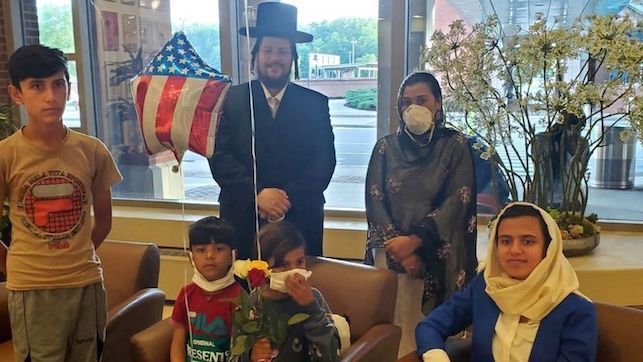
Rabbi Moshe Margaretten with the Afghan children he helped rescue and reunite with their mother. He has also helped hundreds of other Afghan Muslims.
BOTH BBC AND CNN RUN STORIES ON JEWISH AND ISRAELI HELP FOR AFGHAN MUSLIMS
[Note by Tom Gross]
It is rare for the BBC or CNN to run positive reports on Israelis or on orthodox Jews. Yesterday both did so, in the context of the ongoing efforts to rescue threatened Afghans.
First CNN:
CNN reported yesterday about how Israeli activists, donors and aid workers from IsrAid have helped rescued 125 Afghans at risk from Taliban retribution in two complex and highly secretive operations in recent weeks.
The Afghans, which included female athletes, judges, human rights activists, journalists, TV presenters, scientists, artists, and even diplomats, arrived in Albania on October 2nd, after being evacuated by Israeli-trained special forces from Afghanistan to a neighboring country.
CNN video clip here:
Tom Gross adds:
Not mentioned in the CNN report, but I know from people involved in the operation:
The first group of refugees comprising 42 women, girls and family members were taken on September 6 to the United Arab Emirates, with which Israel enjoys increasingly close relations following last year's peace deal, and these rescued Afghan liberals currently in the UAE and Albania, have been offered long-term resettlement in Canada, France, and Switzerland.
I noted in this dispatch in 2014 how the Israeli charity IsraAid delivered urgent humanitarian aid (including mattresses, blankets, food and clothes) to tens of thousands of Christian and Yazidi refugees in northern Iraq fleeing Islamic State jihadists.
In this dispatch in 2015, I noted how Israeli aid workers risked their lives to rescue Syrian refugees, including children and babies, drowning off the Greek coast.
In this dispatch in 2013, I noted how Israeli activists and doctors (with Israeli government help) assisted disabled children in Gaza and also Syrian Muslim refugees:
Canada's national newspaper The National Post was kind enough to mention my dispatch .
BBC "THE RABBI FROM BROOKLYN SAVED OUR LIVES"
The BBC reports, October 14, 2021:
https://www.bbc.com/news/world-us-canada-58729508
It was the story of four children hiding from the Taliban in an apartment in Afghanistan's capital Kabul that made a rabbi thousands of miles away in Brooklyn, New York, pick up his phone and make a crucial call.
Days earlier, Afghans gathered in large crowds at the gates to Kabul airport desperate to leave the country after the takeover by the Taliban on 15 August.
"I thought about those four kids, all younger than 18, I thought 'who knows if they are still alive, I have to try to reach them'," Rabbi Moshe Margaretten, 41, tells the BBC.
After learning that their mother had left Afghanistan for the US years earlier following her husband's sudden disappearance - leaving the children behind with relatives - he tracked down the attorney representing the family.
"I told her, believe it or not, I think I can help those children get to the airport."
Rabbi Margaretten's mission to reunite the four children with their mother in the US was something he says he was desperate to achieve quickly.
Through his organisation - the Tzedek Association - and a network of people based in the region, he set about putting the wheels in motion.
"We got our people on the ground to take care of the children and an hour later they were inside the airport," he says, adding that within a few hours they were in the air on their way to Qatar, before finally reaching their destination of Albany in the US state of New York.
He says he became very emotional when he met the family as they were reunited.
The rabbi's association says it has now assisted dozens of activists, judges, and others who either worked with the former Afghan government or as interpreters for British and US forces in the country.
"MY PARENTS AND GRANDPARENTS ARE HOLOCAUST SURVIVORS"
"Why is an Orthodox Jewish rabbi from Brooklyn helping Muslims in Afghanistan? The answer is very simple," he says, "my parents and grandparents are all Holocaust survivors".
The rabbi, whose grandparents are from Hungary, says the horror his family faced when the Nazis swept across Europe during World War Two - and witnessing how events were unfolding in Afghanistan - meant that doing nothing was not an option.
"Our parents were forced to run for their lives and they went through very similar pain," he says.
Rabbi Margaretten had no real connection to Afghanistan before he was contacted by a Jewish Afghan carpet trader named Zablon Simintov in August.
Mr Simintov, whose story has been widely told as Afghanistan's last Jew, had become desperate to leave, saying the country was even more dangerous than when the Taliban were in control two decades ago.
"Since I got Zablon out, I started speaking with people on the ground and they said 'there are so many people in danger, maybe you should get involved'."
The rabbi began fundraising within the Jewish community in Brooklyn and Chicago with the aim of getting as many people to safety as possible.
His association helped to secure safe passages for female members of the country's junior national soccer team, enabling them and their families to cross the border.
Many of the players - aged 13 to 19 - later received permits to resettle in the UK after spending weeks in Pakistan.
THE RABBI HELPED GET WOMEN FOOTBALLERS OUT TOO
The more involved Rabbi Margaretten became, the more calls he received, and the response quickly became overwhelming.
"More and more groups reached out - people were calling me in the middle of the night, crying and saying 'rabbi help me, my life is in danger'."
He says trying to establish who was most at risk or who should be prioritised was very difficult.
"On the one hand I'm very happy for those I've been able to help, but on the other it's very sad - there's a limit to how much I can do."
Rabbi Margaretten set up a team he says works day and night to process paperwork and visa applications for Afghan nationals at risk. "They know what they're doing," he says.
The biggest expense, he adds, is getting people out of the country, but his association also pays for their stay at safe houses and hotels, and for food, clothing and medical bills.
WOMEN ACTIVIST - 'THEY GOT ME OUT WITHIN 24 HOURS'
One of those helped by Rabbi Margaretten is Fareeda (not her real name), an activist who fights for women's and children's rights.
"When the Taliban took control I lost everything," the 25-year-old says, "my hopes, my dreams, my freedom; I couldn't go out, I couldn't go to work or to university - I lost my personality".
She says she "fought and struggled" for her rights over the years and found the Taliban's return to power devastating.
"I organised protests urging the Taliban to let us keep our rights," she says. Fareeda used social media to share images of the demonstrations, which were at times violent with the Taliban using live ammunition, batons and whips.
The photos were later used to identify her.
"They came to my district," she says, describing how the Taliban were knocking on doors, forcing her into hiding.
Fearful of what might happen, Fareeda asked for help, and was quickly connected with Rabbi Margaretten's team on the ground.
"They got me and my whole family out of Afghanistan within 24 hours," she says, adding: "I'm very happy."
HELPING GET THE THREATENED INTERPRETERS OUT OF AFGHANISTAN
As Taliban forces rapidly advanced across Afghanistan in August, the UN warned that the group was stepping up its search for people who worked for foreign forces and former government employees.
Aalem (not his real name), is an Afghan former interpreter who got in touch with the rabbi through his international connections.
He says he was just a teenager in 2003 when he volunteered to interpret for the late Donald Rumsfeld, then serving as secretary of defence for US President George W Bush.
Now 36, Aalem says he fears for the future of his country and is relieved to have escaped. "I was one of those activists who had to flee," he says. "The regime change made me feel very vulnerable, it is very risky for former interpreters - Afghanistan is no longer an option as a place to live."
He says the Tzedek Association is very effective at identifying vulnerable people, but adds: "There are thousands more who still need that support."
In the days after the Taliban took control of Kabul, US and coalition aircraft evacuated more than 123,000 civilians - although it is unclear how many of those were Afghan nationals.
Thousands are still trying to leave the country every day. Rabbi Margaretten says he will continue his efforts to help them for "as long as it takes".
(Names of evacuees have been changed because at the time of writing some were in third countries awaiting travel to new destinations.)
* You can also find other items that are not in these dispatches if you "like" this page on Facebook www.facebook.com/TomGrossMedia

A MIDDLE EAST WORLD CUP TO HELP CALM TENSIONS AND BRING ABOUT COOPERATION
[Note by Tom Gross]
Earlier this week I met FIFA president Gianni Infantino (photo above). Infantino took over from the allegedly corrupt former FIFA president Sepp Blatter and is trying to clean up the sport.
We discussed next year's football (soccer) World Cup in Qatar. He told me (and others) that in future it would be good if Israel could jointly host the World Cup with the UAE and other countries in the region as part of the Abraham Accords, the normalization deals brokered by the Trump administration which Israel signed last year at the White House with the United Arab Emirates, Bahrain, Sudan and Morocco.
I mentioned to Mr. Infantino that some years prior to the Abraham Accords I had written a piece for The Guardian suggesting that Israel, Gaza, the West Bank and Egypt should jointly host the World Cup as a means to advance peace.
Infantino seemed very interested in the idea and positive about a future World Cup - the planet's biggest sporting or cultural event - being co-hosted by Israel.
For those interested, below is my 2014 Guardian piece. (It was also translated into Hebrew and published in Haaretz's weekend supplement.)
Of course, Qatar's hosting of next year's World Cup now seems a fait accompli. But giving the opportunity for the Palestinians to host some future world cup matches with Israel, the UAE and others - while seeming far-fetched - is not an impossibility if approached imaginatively.
A MIDDLE EAST WORLD CUP TO HELP CALM TENSIONS AND BRING ABOUT COOPERATION
A modest proposal: Qatar could win by letting Gaza host the World Cup
* Handing over the tournament voluntarily would allow the emirate to save face and play a lead role in bringing the Middle East together
By Tom Gross
The Guardian
December 1, 2014
http://www.theguardian.com/commentisfree/2014/nov/30/qatar-let-gaza-host-world-cup
The controversy surrounding the decision to allow Qatar to host the 2022 World Cup, seems only to keep growing. Sunday brought revelations of a dossier of new allegations. There's the allegedly corrupt means by which Qatar is rumoured to have "bought" the tournament, the deaths of more than 2,000 migrant workers who have toiled in slave-like conditions and, of course, Qatar's weather. The tournament is to be held in summer when temperatures routinely soar above 40 degrees centigrade, posing risks to the players as well as to millions of visiting fans.
Many people feel Qatar should not host the tournament. But how to bring this about with Qatar's consent, without the emirate losing face - such an important consideration in the Arab world - and bringing multiple legal challenges?
Here's one idea: Qatar should take the high ground by announcing that it will heed calls by an outgoing Fifa official for the tournament to be moved to other Arab lands. It should give the World Cup to Gaza. And Qatar should pay for it too.
The idea is not as far-fetched as it may seem. Gaza's key problem is not money, but rule by militant Islamism, combined with hopelessness. Indeed, Gaza has received billions in aid over the years - but its corrupt Hamas rulers have never shared this properly with the population. The Hamas prime minister, Ismail Haniyeh, among others, flies around in a Qatari-provided private jet. Recently Forbes rated Hamas "the second richest terrorist group in the world" - poorer than Isis but considerably richer than the Taliban and other groups.
As long as Hamas maintains its grip on the territory Israel will respond with force. So how to prevent the next Gaza war? For the first time in history almost the entire Arab world backed Israel - albeit tacitly - in last summer's campaign against Hamas. The one exception was Qatar (as well as non-Arab regimes in Turkey and Iran).
And consider this. Football is almost a secular religion for millions of people throughout the world. I know from my own visits there that Gaza is no exception. (Readers may have noticed from photos during the recent conflict how many Gazans were wearing the shirts of leading European teams.)
What other force is great enough to pull Gazans from the lure of Hamas, restore a sense of pride and purpose, create thousands of jobs, and direct billions of dollars into the territory - to be used to transform the strip into a prime Mediterranean tourist hub? Hamas would, of course, object but football is such a powerful force in Gazan society that it would be hard even for its leadership to justify to its own people its continued focus on jihadi activities.
Such an idea may sound implausible at first, but only if you disregard other historical examples of the healing power of football. For example, the "Miracle of Berne" in 1954 when West Germany won the World Cup, a victory that played a role in reviving the country and accelerating its economic recovery. "In the days after the game," Uli Hesse, the respected German journalist, wrote, "the country celebrated like seldom before and never since."
Gaza is a small territory, but so is Qatar, whose population is smaller than Gaza's. And if Gaza is too small to host all the matches, why not also allow Ramallah, Cairo and even Tel Aviv to host a few. The 2022 final should be played in Gaza, of course, and Gazans could rejoice in this, after decades of perceived humiliation. I suspect Israelis - so long as security was not an issue - would welcome the idea with great enthusiasm. It would, one hopes, buy eight years of quiet, economic development and reconstruction in which the focus in Gaza could be taken off conflict with Israel and radical Islamism. An unusual idea? Perhaps. But can anyone think of a better one?
* You can also find other items that are not in these dispatches if you "like" this page on Facebook www.facebook.com/TomGrossMedia

Tom Gross writes: Researchers at Tel Aviv University have said that the Covid-19 pandemic has spurred antisemitic sentiment globally. "Prejudice, superstition, primordial emotions, and bizarre theories surfaced and dominated the scene, and manifestations of antisemitism, both verbal and visual, were vicious and outrageous," a new report says.
Israel's advanced Covid-19 strategy is being closely watched by many experts in the rest of the world.
Several people asked me for updates so, for those interested, below are some articles from the last couple of days.
Later this month Israel will begin enforcing new rules requiring people to have had a booster (third) shot to keep their 'Green Pass' Covid passports valid.
An Israeli study found booster shots caused fewer side effects than the initial vaccinations, and studies in Israel and elsewhere have shown that initial COVID-19 immunity protection for most people diminishes after a few months.
CONTENTS
1. "Covid-19 Booster Shots Are Available for All in Israel. Younger People Aren't Convinced"(Wall St Journal, Oct. 10, 2021)
2. "Israelis march in Tel Aviv in protest of Covid Green Pass rules"(JNS, Oct. 10, 2021)
3. "The new frontier: Israeli hospitals contend with 'long COVID' in children"(Haaretz, Oct. 10, 2021)
4. "Moderna, Racing for Profits, Keeps Covid Vaccine Out of Reach of Some Poorer Countries"(NY Times, Oct. 9, 2021)
5. "Life-saving COVID drug comes to Israel - but most patients won't take it"(Haaretz, Oct. 11, 2021)
6. "Pfizer's COVID-19 immunity protection diminishes after 2 months, and it can reach as low as 20% after 4 months"(Insider, Oct. 8, 2021)
7. "Could playing music under 120 bpm slow spread of COVID-19?"(Jerusalem Post, Oct. 9, 2021)
ARTICLES
COVID-19 BOOSTER SHOTS ARE AVAILABLE FOR ALL IN ISRAEL. YOUNGER PEOPLE AREN'T CONVINCED
Covid-19 Booster Shots Are Available for All in Israel. Younger People Aren't Convinced.
Take-up rates for boosters are especially low among younger Arab and ultraorthodox Israelis
By Dov Lieber
The Wall Street Journal
Oct. 10, 2021
https://www.wsj.com/articles/covid-19-booster-shots-are-available-for-all-in-israel-younger-people-arent-convinced-11633858202
TEL AVIV?Israel is among the most aggressive countries in the world in pushing boosters for the Covid-19 vaccine. Many younger people here are asking why.
Later this month the government will begin enforcing new rules requiring people to get a booster shot of the Covid-19 vaccine or present a negative test if they want to go to restaurants, bars or other indoor entertainment spots. The boosters are needed to keep "Green Pass"Covid passports valid, which authorities view as an effective way of nudging as many people as possible to get a third shot of the vaccine to boost immunity and reduce the virus's spread through the population.
Yet while many younger Israelis were happy to get their initial doses of the Pfizer Inc. - BioNTech SE vaccine, this time they aren't so willing. Some say they feel they are being pushed toward a third shot before enforcement of the program begins on Oct. 17, and would prefer to wait, saying they believe they are still protected from severe cases of Covid despite health officials' efforts to convince them they can prevent long Covid cases.
Just over a quarter of 16-to-19-year-olds have received a booster along with 40% of 20-to-29-year-olds and 47% of 30-to-39-year-olds, according to Israel's health ministry. This is compared with older groups, such as 65% for 50-to-59-year-olds and 75% for 60-to-69-year-olds. The numbers are weighed down in part by wider hesitancy among younger Arab and ultraorthodox Israelis.
Experts say doubts by younger people over boosters could be a harbinger for what other countries might expect as they begin to roll out third shots, and raises the prospect that transmission of the virus could continue.
"Younger people are less afraid of the coronavirus,"said Tamar Hermann, who has been conducting opinion polls on vaccine policy at the Jerusalem-based Israel Democracy Institute. "Some are confused and bewildered whether they are really at such a risk or it's part of the government propaganda."
On Monday, Europe's top health regulator recommended boosters for anyone 18 and over who had received their second shot of the vaccine developed by Pfizer and BioNTech. The U.K. has begun providing boosters to anyone over 50, while the U.S. is offering them to over 65s and people in high-risk groups.
But in Israel, which began vaccinating widely before many other countries, some younger people this time say they feel they are being coerced into having the third shot.
"Everyone is saying they are just getting the third vaccine just to keep their rights,"said Dan Rushansky, 33, who owns a bar and separate cafe in the young and hip neighborhood of Florentine in Tel Aviv.
Mr. Rushansky said that he and 10 of his 20 employees haven't yet gotten a third shot, and the same is true of much of his clientele. He said he closed his cafe on Tuesday believing it would no longer be profitable under the new Covid-19 pass regime.
Aliza Petrack, 32, a philosophy student at Tel Aviv University, said she felt frustrated by the rigidity of the new regulations. Rather than rushing to get a third shot and risk the side effects, even if they are mild, she said she got an antibody test and learned she was still well protected from her previous shots.
Now Ms. Petrack said she feels she's being forced into getting a third shot earlier than she would have because otherwise she won't be able to attend classes on campus.
"It's frustrating that there's no kind of common-sense policy,"she said. When she got her first two shots, she said she felt Israel was "in line with the global medical community. Now Israel is kind of doing it's own thing."
Israel's Covid-19 passes were initially to be linked to the third shot beginning on Oct. 7, but that was pushed back because of technical problems. Meanwhile, pickup rates for the booster shots are accelerating as the enforcement date nears, but it isn't necessarily because young people want to get them or believe they will improve their protection against Covid-19. It's to keep their passes.
"Everyone wants to have a normal life, so people are getting their third shot,"said Shon Weizman, 27, who works at a wine bar in Tel Aviv.
Last week, Dr. Anthony Fauci, President Biden's chief medical adviser and director of the National Institute of Allergy and Infectious Diseases, said in an interview with Israel's Army Radio that U.S. regulators are waiting for data from Israel's military to understand the risk-benefit analysis of giving boosters for younger adults.
Dr. Fauci said the regulators were particularly interested in understanding the risk for young people developing a rare side effect of heart muscle inflammation called myocarditis after receiving a third shot of the Pfizer vaccine, and that he believed the U.S. would ultimately follow Israel's lead on boosters.
Israel's health ministry has published data indicating that the booster shots cause fewer side effects than the initial vaccinations and provide a significant increase in resistance to the virus compared with people who received their second five months or more previously. Officials and medical professionals credit the booster campaign for tamping down a wave of infections and severe illness from the contagious Delta variant.
But some suggested the government should be more flexible in enforcing the new Covid-19 pass rules, and focus more on communicating the benefits of the third shot instead.
Nadav Davidovitch, head of the Israeli Association of Public Health Physicians and director of the School of Public Health at Ben Gurion University in Be'er Sheva, thinks this is particularly true among Arab and ultraorthodox youngsters who have been slower to take up boosters, because infection rates have been higher in the latter group and many are still recovering from the virus.
"I think maybe we need to give some more time and invest more in health promotion to be targeted to specific groups,"Dr. Davidovitch said.
THOUSANDS OF ISRAELIS MARCH IN TEL AVIV IN PROTEST OF COVID GREEN PASS RULES
Israelis march in Tel Aviv in protest of Covid Green Pass rules
"We were thousands again tonight in the streets protesting against the Green passport ... and for our civil rights and our sovereignty,"says Israeli activist.
JNS
October 10, 2021
https://www.jns.org/israelis-march-in-tel-aviv-in-protest-of-covid-green-pass-rules/
Israelis once again took to the streets in Tel Aviv on Saturday night in protest against the government's Oct. 3 decision to restrict the country's COVID "Green Pass"to only those who have received a vaccine booster shot or those who have recently recovered from the disease.
"We were thousands again tonight in the streets protesting against the Green Pass ? and for our civil rights and our sovereignty,"tweeted Israeli activist Efrat Fenigson.
On Oct. 3, Israel became the first country in the world to require a third vaccine dose as a requirement for its vaccination passport, without which indoor venues cannot be entered and access to certain public venues is restricted. The move meant that some 2 million Israelis' Green Passes were rendered invalid.
"More than 2 million people who have already been vaccinated twice have not taken the booster [shot] ? and will be deprived of their basic human rights,"tweeted Fenigson.
Under the new criteria, those who have received two vaccine doses, and those who have recovered from coronavirus, were issued passes valid for six months from the date of their vaccination or recovery.
After the new rules went into effect, there were protest demonstrations at several locations across the country. Opponents of the new, stricter criteria claim that they amount to a forced vaccination program.
Israel began an aggressive campaign on Aug. 29 to encourage Israelis to get a vaccine booster shot, announcing all citizens age 12 and above would be eligible. More than 3.7 million have since received the booster, according to Israel's Health Ministry.
THE NEW FRONTIER: ISRAELI HOSPITALS CONTEND WITH 'LONG COVID' IN CHILDREN
The new frontier: Israeli hospitals contend with 'long COVID' in children
By Ido Efrati
Haaretz
Oct. 10, 2021
https://www.haaretz.com/israel-news/the-new-frontier-israeli-hopsitals-contend-with-long-covid-in-children-1.10280661
At the "long COVID"clinic at Schneider Children's Medical Center in Petah Tikva, about 150 children are being treated, but several hundred more or on a waiting list. "Demand is high and the wait is more than half a year, because we monitor and test everything for each patient,"says Dr. Liat Ashkenazi-Hoffnung, an infectious-disease specialist.
The clinic began operating in November, several months after similar clinics were opened for adults. The symptoms the doctors see are varied, from shortness of breath (the most common complaint), muscle pain, headaches, fatigue, disordered sleep, chest pain, hair loss, and digestive disorders, to the loss of taste and smell, weight loss, difficulty concentrating, memory loss and the exacerbation of tics in children who suffered from them previously. About 60 percent report reduced daily functioning because of the symptoms.
"What's interesting, is that in some of the children, it really appears as a direct continuation of severe illness but in very many of the children, there is a severe illness, followed by a lull of several months and only then do the symptoms of long COVID begin,"says Ashkenazi-Hoffnung.
According to her, the persistence of the symptoms varies. "There are children for whom it takes half a year or more. For example, we had a boy here who was a competitive swimmer and came down with long COVID and was very anxious and in pain. After half a year he went back to swimming and even broke a personal record."
However, she also says that there are "a few children here who, a year after the illness, haven't recovered, and they have symptoms that are affecting their day-to-day functioning. There are cases in which it lasts for more than a year."
She adds that about 15 percent of the children treated at the clinic have been found to have no antibodies, even though they tested positive on a PCR test.
UNDERESTIMATED
Coronavirus infection in children has been considered to be mild since the start of the pandemic. Less than 1 percent of children who have been tested have required hospitalization, and cases of severe illness are rare and appear mainly in those with pre-existing conditions. The assumption that children are protected has been part of the medical and public discourse concerning vaccinations.
However, the illness has long-term effects, known as "long COVID,"the extent, severity and persistence of which are not yet completely clear.
A recently published Health Ministry survey of 13,000 children who contracted COVID has found that 11.2 percent of them suffered from at least one symptom after recovering and 1.85-4.6 percent still had symptoms after six months.
One of the limitations of the ministry survey is that the answers were based on asking the children's parents and their recall of how their children's symptoms were first noticed or perceived. Experts believe that there is under diagnosis of the phenomenon both on the part of parents as well as doctors.
"I think there is an underestimation,"says Ashkenazi Hoffnung, "even in the research studies, because of their methods, and the numbers are higher. That said, not all symptoms have the same significance. The essential question is whether it affects functioning. If, for example, a child loses the sense of taste and smell for eight months and that leads to picky eating, this is not necessarily clinically significant compared to symptoms that damage functioning and prevent the child from doing the things he loves."
For example, there are children for whom physical activity was an important part of their lives. "Fifteen percent of the children who come to us trained in various sports for three or four hours a day six days a week, and after the coronavirus they can't even walk for five minutes. Their parents and sometimes the doctors don't always connect this to the coronavirus."
"These children aren't spoiled or depressed - they are dealing with physical damage that is part of long COVID and they want to go back to their activities. I am sure there are other children who suffer from the same phenomenon, but it isn't noticed because it doesn't affect their routine. Some of them are sitting at home playing Fortnite and don't know they are incapable of walking for five minutes, that they have these symptoms."
NO CLINICAL DEFINITION
The process of researching and understanding the phenomena of long COVID is only in its earliest stages and even the World Health Organization does not yet have a final diagnostic definition.
According to Ashkenazi-Hoffnung, the lack of recognition and awareness of the syndrome among doctors in the community is leading to two phenomena.
On one hand, "doctors are telling parents it's psychological, or the child is spoiled, or they should wait and it will pass and they aren't diagnosing the symptoms,"she notes. But on the other hand "it is leading to children being tested extensively and unnecessarily. For example, a child who was experiencing dizziness came to us after a series of tests and was diagnosed as suffering from vertigo and was sent to an ear, nose and throat doctor. The doctors aren't managing to put their finger on the correct diagnosis and the parents tend to interpret it as being spoiled or something psychological. I have children coming in with chest pains and shortness of breath and their mother is whispering 'I think it's psychological, he's having a panic attack.'"
Because of lack of familiarity with the symptoms, children often come to the clinic due to one of the symptoms, but then it turns out they are suffering from additional ones. "A teenager comes in and says he is suffering from shortness of breath and pains in his chest. And only after I ask,"she says, "it turns out he has difficulty falling asleep and has tingling in his extremities."
Another phenomenon, which was first reported in April of 2020 is multisystem inflammatory syndrome in children, of which about 100 cases have been reported in Israel. The syndrome usually appears eight to ten weeks after the illness, even among children who had light cases. It starts out as stomach aches, a rash and a fever and can develop into life-threatening damage to the heart. It requires hospitalization, and in most cases cardiac damage remains after recovery.
There is also treatment for long COVID in children available at Ichilov Hospital in Tel Aviv (Sourasky Medical Center) and at Shaare Zedek Medical Center in Jerusalem, where Prof. Yechiel Schlesinger is head of pediatrics.
"A year ago we opened a clinic that treated the continuing symptoms in children. With the waning of the third wave, it hardly operated at all, but in the fourth wave with the extensive infection rate among children, it is back in action,"he says.
While all of the cases "ended well,"Prof. Schlesinger says that they now have cases of children coming "long after they had fallen ill, with the most prevalent symptom being severe difficulty in breathing, damage to the nervous system and the brain, very severe pains and neurological phenomena, alongside dermatological problems like rashes and problems with the digestive system."
IRON, PHYSIOTHERAPY AND AN INHALER
"We are seeing children coming in with very significant nutritional deficits because of the loss of the sense of taste or its incomplete return,"says Ashkenazi-Hoffnung at Schneider. "There are children who smell the smell of burning or for whom the tastes of foods that had been familiar to them have completely changed. This is a common phenomenon, and it leads to very picky eating and weight loss. In the wake of that, we are seeing, among other things, iron deficiency, which exacerbates exhaustion and hair loss."
"We have found that many of the children, at least a third of them, suffer from shortness of breath and giving them an inhaler, even if they don't have asthma, helps some of them."
The clinics also provide physiotherapy for pain and for improving breathing techniques, as well as psychological support for children with post-trauma and anxiety and medicinal treatments for damage to the peripheral nervous system, along with therapies for sleep disturbances by means of medications or at sleep clinics if needed.
MODERNA, RACING FOR PROFITS, KEEPS COVID VACCINE OUT OF REACH OF POOR
Moderna, Racing for Profits, Keeps Covid Vaccine Out of Reach of Poor
Some poorer countries are paying more and waiting longer for the company's vaccine than the wealthy ? if they have access at all.
The New York Times
Oct. 9, 2021
https://www.nytimes.com/2021/10/09/business/moderna-covid-vaccine.html
Moderna, whose coronavirus vaccine appears to be the world's best defense against Covid-19, has been supplying its shots almost exclusively to wealthy nations, keeping poorer countries waiting and earning billions in profit.
After developing a breakthrough vaccine with the financial and scientific support of the U.S. government, Moderna has shipped a greater share of its doses to wealthy countries than any other vaccine manufacturer, according to Airfinity, a data firm that tracks vaccine shipments.
About one million doses of Moderna's vaccine have gone to countries that the World Bank classifies as low income. By contrast, 8.4 million Pfizer doses and about 25 million single-shot Johnson & Johnson doses have gone to those countries.
Of the handful of middle-income countries that have reached deals to buy Moderna's shots, most have not yet received any doses, and at least three have had to pay more than the United States or European Union did, according to government officials in those countries.
Thailand and Colombia are paying a premium. Botswana's doses are late. Tunisia couldn't get in touch with Moderna.
Unlike Pfizer, Johnson & Johnson and AstraZeneca, which have diverse rosters of drugs and other products, Moderna sells only the Covid vaccine. The Massachusetts company's future hinges on the commercial success of its vaccine.
"They are behaving as if they have absolutely no responsibility beyond maximizing the return on investment,"said Dr. Tom Frieden, a former head of the Centers for Disease Control and Prevention.
Moderna executives have said that they are doing all they can to make as many doses as possible as quickly as possible but that their production capacity remains limited. All of the doses they produce this year are filling existing orders from governments like the European Union.
Even so, the Biden administration has grown increasingly frustrated with Moderna for not making its vaccine more available to poorer countries, two senior administration officials said. The administration has been pressing Moderna executives to increase production at U.S. plants and to license the company's technology to overseas manufacturers that could make doses for foreign markets.
Moderna is now scrambling to defend itself against accusations that it is putting a priority on the rich.
On Friday, after The New York Times sent detailed questions about how few poor countries had been given access to Moderna's vaccine, the company announced that it was "currently investing"to increase its output so it could deliver one billion doses to poorer countries in 2022. The company also said this past week that it would open a factory in Africa, without specifying when.
Moderna executives have been talking with the Biden administration about selling low-cost doses to the federal government, which would donate them to poorer countries, as Pfizer has agreed to do, the two senior officials said. The negotiations are continuing.
In an interview on Friday, Moderna's chief executive, St?phane Bancel, said "it is sad"that his company's vaccine had not reached more people in poorer countries but that the situation was out of his control.
He said that Moderna tried and failed last year to get governments to kick in money to expand the company's scant production capacity and that the company decides how much to charge based on factors including how many doses are ordered and how wealthy a country is. (A Moderna spokeswoman disputed Airfinity's calculation that the company had provided 900,000 doses to low-income countries, but she didn't provide an alternate figure.)
Nearly a year after Western countries began sprinting to vaccinate their populations, the focus in recent months has shifted to the severe vaccine shortages in many parts of the world. Dozens of poorer countries, mostly in Africa and the Middle East, had vaccinated less than 10 percent of their populations as of Sept. 30.
In August, for example, Johnson & Johnson faced rebukes from the director general of the World Health Organization and public health activists after The Times reported that doses of that shot produced in South Africa were being exported to wealthier countries.
Biden administration officials are especially frustrated with what they see as Moderna's lack of cooperation, because the U.S. government has provided the company with critical assistance.
Scientists at the National Institutes of Health worked with the company to develop the vaccine. The United States kicked in $1.3 billion for clinical trials and other research. And in August 2020, the government agreed to preorder $1.5 billion of the vaccine, guaranteeing that Moderna would have a market for what was an unproven product.
While clinical trials last year found that the Moderna and Pfizer vaccines were similarly effective, more recent studies suggest that Moderna's shot is superior. It offers longer-lasting protection and is easier to transport and store.
Moderna's shot is "essentially the premium vaccine,"said Karen Andersen, an industry analyst at Morningstar. "They're in a position where they probably don't need to sacrifice too much on pricing in a lot of these deals."
There is limited public information about the deals that Moderna has struck with individual governments. Of the 22 countries, plus the European Union, to which Moderna and its distributors have reported selling the shots, none are low income, and only the Philippines is classified as lower middle income. (Six are upper middle income.)
Pfizer, by comparison, said it had agreed to sell its vaccine at discounted prices to 12 upper-middle-income countries, five lower-middle-income governments and one poor country, Rwanda. (Tunisia, for example, is paying about $7 per dose.)
Only a handful of governments have disclosed how much they're paying for Moderna doses. The United States paid $15 to $16.50 for each shot, on top of the $1.3 billion the government gave Moderna to develop its vaccine. The European Union has paid $22.60 to $25.50 for its Moderna doses.
Botswana, Thailand and Colombia, which the World Bank classifies as upper-middle-income countries, have said they are paying $27 to $30 per Moderna dose.
The lack of transparency about how much other governments are paying has put relatively poor countries in a weak bargaining position. They are "negotiating totally in the dark,"said Kate Elder, who advises Doctors Without Borders on vaccine policy.
In some cases, Moderna has offered to provide poorer countries the vaccine at relatively low prices, but only after it has fulfilled other countries' orders.
In May, Moderna offered the African Union doses for about $10 each, according to a bloc official involved in the discussions. But the doses wouldn't be available until next year, causing the talks to fall apart, according to two African Union officials.
Dr. Ayoade Alakija, who helps run the African Union's vaccine delivery program but was not involved in the procurement discussions, said Moderna's attitude amounted to: "We're here to make money. We've stumbled upon a good thing, and we're not even trying to pretend that we're trying to save the world."
Moderna's Covid vaccine has been transformative for the company and its leaders. The company has said it expects its vaccine to generate at least $20 billion in revenue this year, which would make it one of the most lucrative medical products in history. Ms. Andersen, the Morningstar analyst, projected that the company's profits on the vaccine could be as high as $14 billion. In 2019, Moderna reported total revenue of $60 million.
Moderna's market value has nearly tripled this year to more than $120 billion. Two of its founders, as well as an early investor, this month made Forbes magazine's list of the 400 richest people in the United States.
As the coronavirus spread in early 2020, Moderna raced to design its vaccine ? which uses a new technology known as messenger RNA ? and to plan a safety study. To manufacture the doses for that trial, the company received $900,000 from the nonprofit Coalition for Epidemic Preparedness Innovations.
The nonprofit group said Moderna had agreed to its "equitable access principles."That meant, according to the coalition, that the vaccine would be "first available to populations when and where they are needed and at prices that are affordable to the populations at risk, especially low- and middle-income countries or to public sector entities that procure on their behalf."
Moderna agreed in May to provide up to 34 million vaccine doses this year, plus up to 466 million doses in 2022, to Covax, the struggling United Nations-backed program to vaccinate the world's poor. The company has not yet shipped any of those doses, according to a Covax spokesman, although Covax has distributed tens of millions of Moderna doses donated by the United States.
Mr. Bancel said that many more doses would have gone to Covax this year had the two parties reached a supply deal in 2020. Aur?lia Nguyen, a Covax official, denied that, saying, "It became clear early on that the best we could expect was minimal doses in 2021."
Late last year, the Tunisian government was hoping to order Moderna doses. Dr. Hechmi Louzir, who led Tunisia's vaccine procurement efforts, didn't know how to contact Moderna to begin talks and asked the U.S. Embassy in Tunisia for help, he said. Officials there contacted Moderna, he said, but nothing came of it.
"We were very interested in Moderna,"Dr. Louzir said. "We tried."
In Thailand, where about 32 percent of people are fully vaccinated, a government spokeswoman said the government was paying Moderna about $28 per dose for one million shots that are designated for vulnerable people. Deliveries from that order will start next year.
In Botswana, the health minister told Parliament in July that the government had ordered 500,000 shots from Moderna, at nearly $29 per dose ? enough to fully vaccinate about 10 percent of the population. (That would roughly double the number of Botswanans who are fully vaccinated.) A spokesman for the Health Ministry said that the doses were expected to start arriving in August, but that none had yet arrived.
Colombia ordered 10 million shots from Moderna. The government budgeted about $30 per dose, a price that may include the cost of transportation and other logistics, according to Finance Ministry documents. The country's health minister, Dr. Fernando Ruiz, said Moderna's vaccine was the most expensive among the Covid shots that Colombia had ordered.
There were some initial delays, Dr. Ruiz said: The first deliveries, expected in early June, came in August. About 2.3 million had arrived as of Friday.
LIFE-SAVING COVID DRUG COMES TO ISRAEL - BUT MOST PATIENTS WON'T TAKE IT
Life-saving COVID drug comes to Israel - but most patients won't take it
By Ido Efrati
Haaretz
Oct. 11, 2021
https://www.haaretz.com/israel-news/life-saving-covid-wonder-drug-comes-to-israel-but-most-patients-won-t-take-it-1.10282942
Nobody in Israel's healthcare system anticipated this scenario: Many at-risk COVID patients who are candidates to receive the drug Regeneron have refused to take it since the health maintenance organizations began offering it on September 23. It's been administered to only 256 patients so far, with 291 declining it.
The medication, which costs $1,500 dollars per patient, is given intravenously, and according to studies it reduces the risk of severe illness substantially if it's given within 72 hours of infection. The drug made headlines last year when it was given to former U.S. President Donald Trump, who was diagnosed with COVID-19. About a month later it was
Until recently the drug was administered in Israel mainly to inpatients at hospitals and geriatric facilities. But since September 23 its use was expanded through the HMOs.
The Health Ministry designated the expensive medication as a limited national asset and feared excessive demand by patients, particularly ones who don't meet the criteria. A letter by ministry director general Nachman Ash to the HMOs requested that clearly defined criteria be drawn up as to who is eligible for the drug, and that professional committees be formed in each fund to consider exceptional requests by patients who do not meet all the clinical criteria. Noting the shortage of the drug which he called "a national asset,"Ash wrote that "all steps must be taken to prevent waste and destruction of doses or administering doses to those who do not meet the criteria."
Accordingly, the HMOs set criteria based on the patient's age, number of hospitalizations in the past three years, vaccination status, and whether they had chronic conditions such as kidney disease, diabetes and coronary disease, among others, or were heavy smokers or suffering from immunosuppression. Each criterion is worth so many points, and if the patients "scores"seven points - they are eligible for the drug. Non-vaccination is worth five points and is the heaviest-weighted criterion. The HMOs prepared for rapid deployment of the drug. In addition, IDF Medical Corps teams were called up to help the HMOs deliver the drugs to home-bound patients, and the very day the Health Ministry announced expansion of the drug's use, the HMOs began approaching prospective patients.
But it turns out that demand is very low and the HMOs find themselves urging patients to take a drug meant to protect them from severe illness.
"We've administered the drug to over 140 patients so far, mostly in patients' homes all over the country, with Medical Corps aid,"says Dr. Doron Netzer, head of medicine in the community division of Clalit Health Services. Netzer tells Haaretz that the entire process at the patient's home, including the infusion (which takes about 20 minutes) and observation afterwards, lasts 90 minutes to two hours. Netzer's teams contact COVID-19 patients who have risk factors for serious disease and explain the importance of taking the medication. But to his surprise, a substantial number refuse. This includes many who are not vaccinated and are therefore at greater risk for serious illness and are also eligible for the costly drug.
"Another group of 'Regeneron refusers' are those whose condition is mild and who feel well and do not sense the danger. It's human and understandable, but they have a 20-25 percent risk of developing severe illness, and we can't persuade them [to take the drug],"he says. Others express willingness, make an appointment, and then renege at the last moment - often due to consultation with friends and family. "It's their right. It's a novel treatment that is undoubtedly the best available right now, but there's still distrust among some patients,"says Netzer.
CRITERIA BEING EASED
A senior figure at another HMO tells Haaretz, "We're investing a lot in Regeneron, but we have four times as many refusals as takers. On one hand we were surprised. On the other - why would someone who declined the vaccination take a drug? If at first we thought we'd have to ration it, now we're easing criteria and giving it to willing patients even if they don't fully meet criteria."
The drug is manufactured by U.S. firm Regeneron under the trademark REGEN-COV. It made headlines last year, when it was given to former U.S. President Donald Trump, who was diagnosed with COVID-19. About a month later it was FDA-approved for emergency use.
Since approval, a study published in The New England Journal of Medicine showed efficacy of 81 percent in preventing symptomatic illness, and 66 percent in preventing contagion among those living with confirmed patients. In addition, duration of symptoms among those who were infected was shorter by half compared to those who did not receive the drug.
Regeneron contains two antibodies - Casirivimab and Imdevimab - which adhere to the viral envelope of the coronavirus and disrupt its ability to penetrate the cell and replicate itself.
Company studies showed it to be 70 percent effective in preventing severe illness among non-admitted patients when given within 72 hours of infection - as long as it is given close to the appearance of symptoms, and not after deterioration has begun. Studies have found next to no side effects except for an allergic reaction or local bleeding and swelling related to the injection itself.
PFIZER'S COVID-19 IMMUNITY PROTECTION DIMINISHES AFTER 2 MONTHS, AND IT CAN REACH AS LOW AS 20% AFTER 4 MONTHS: STUDIES
Pfizer's COVID-19 immunity protection diminishes after 2 months, and it can reach as low as 20% after 4 months: studies
By Matthew Loh
Insider news
October 8, 2021
https://news.yahoo.com/pfizers-covid-19-immunity-protection-032404881.html
Two recent studies found that Pfizer's immunity protection diminishes rapidly a few months after a person has their second dose.
However, one study noted that the vaccine's protection against death and hospitalization still remained as high as 96%.
The studies affirm Pfizer's earlier comments that its vaccines may not defend against COVID-19 infection as effectively over time.
COVID-19 immunity protection from two doses of the Pfizer vaccine starts dwindling after about two month, still, the shots remain effective in guarding against hospitalization and death, according to a pair of studies published in the New England Journal of Medicine on Wednesday.
The new findings affirm what Pfizer, Moderna, and the Centers for Disease Control and Prevention have indicated in recent weeks - that the vaccines' ability to protect the body from coronavirus infection may wane over time. Last month, the Food and Drug Administration authorized Pfizer booster shots for older or more vulnerable people.
In the first study, researchers from Qatar found that Pfizer's immunity protection drops to as low as 20% just four months after a person receives their second dose. They based their report on observations of infections among Qatar's over 900,000 vaccinated people.
The researchers found that Pfizer's protection against infection was "negligible"shortly after the first dose, but jumps to 36.8% three weeks later. When people receive their second dose, immunity protection increases to 77.5% after about a month.
But once that month is over, Pfizer's immunity effectiveness declines steadily, hovering at around 20% after the four-month mark, per the researchers.
"These findings suggest that a large proportion of the vaccinated population could lose its protection against infection in the coming months, perhaps increasing the potential for new epidemic waves,"wrote the report.
Still, Pfizer's protection against hospitalization and death remained "robust"at 90% or higher for six months after the second dose, it said. The report also noted that its findings may not apply well to countries with older populations, since Qatar's population is relatively young with only 9% of its people being 50 or older.
The other study, conducted in Israel, looked at 4,868 healthcare workers. It reported that people have substantially decreased COVID-19 antibodies just six months after receiving their second dose of Pfizer's vaccine.
The drop is especially prominent among men, the elderly above 65, and those with weakened immune systems.
In comparison, vaccines for other conditions such as mumps, measles, and rubella only show small decreases of about 5% to 10% each year in neutralizing antibody levels, wrote the researchers.
They also noted that they observed higher antibody counts in obese participants who have a body mass index of 30 or above.
"Yet, it is still unclear whether vaccinated obese persons are at higher or lower risk for breakthrough infection and whether the relatively high humoral response to the vaccine is protective,"the report stated.
COULD PLAYING MUSIC UNDER 120 BPM SLOW SPREAD OF COVID-19?
Could playing music under 120 bpm slow spread of COVID-19?
South Korea has decided to restrict gyms from playing music at over 120 beats per minute (bpm) during group activities like aerobics and spinning.
Jerusalem Post
October 9, 2021
https://www.jpost.com/health-and-wellness/exercise/could-playing-music-under-120-bpm-slow-spread-of-covid-19-681489
In South Korea, they're struggling with another coronavirus wave. Instead of closing the gyms the government stated that it's forbidden to play rhythmic music at over 120 beats per minute. The speed of the treadmills will be limited and other restrictions implemented. These laws caused a great deal of opposition and many questions: "How can one control the music that people hear?"
The vast majority of people who regularly work out in gyms probably love music that puts them into a rhythm and motivates them during exercise. But, South Korea has decided to significantly reduce this musical option under the new coronavirus restrictions.
In addition to social distancing and various similar rules, this Asian country has also decided to restrict gyms from playing music at over 120 beats per minute (bpm) during group activities like aerobics and spinning.
The state health authorities explained that the purpose of these guidelines is to prevent exercisers from breathing too fast or sweating near other people, in order to reduce their chances of getting infected, which could lead to the business closures that happened in previous corona waves.
But this law, as you must have guessed, has caused a great deal of opposition on the part of exercisers and also lawmakers who have called it "nonsensical,"along with gym owners who oppose this law and claim that it's ineffective and impossible to implement.
Hang Yun-Koo, owner of a gym in north Seoul, commented on this restriction, by asking if playing classical music or quiet songs has been proven to prevent the virus spreading? He added that many people use headphones to listen to music they choose, so you can't control what they hear.
South Korea, which is dealing with a big corona wave, added additional restrictions and even decided to limit the speed of treadmills to only 6 km/h and a ban on using showers in gyms. The government also decreed that no more than two people would participate in table tennis games at once, among another rules.
Will it help them? It remains to be seen.
* You can also find other items that are not in these dispatches if you "like" this page on Facebook www.facebook.com/TomGrossMedia

A girl on the way to school this week near Paradise Square in Raqqa, where Isis used to crucify and behead its victims
THE SPOT WHERE ISIS DISPLAYED THE HEADS OF ITS WESTERN VICTIMS NOW HOUSES A NUTELLA CAFE?
[Note by Tom Gross]
I attach two articles below about Syria.
In the first, The Times of London reports today from Raqqa, previously the capital of the Isis caliphate, where western and other hostages were beheaded prior to 2017. Then in 2016-17 the city was pummeled to the ground by American, British and French warplanes in one of the fiercest military campaigns in modern history. The almost total destruction of 80 percent of the city included schools and hospitals.
Today, reports The Times, "Raqqa's streets are packed, lined with new restaurants, and officials say its population has grown beyond its prewar numbers as Syrians flee violence and poverty elsewhere in the country to its relative security."
ASSAD'S KEY SUPPORT FOR ISIS
The second piece below discusses the way in which Assad supported and helped Isis throughout the war. It is a subject I have discussed several times before on this list and mentioned during TV appearances. This new article sums up this crucial tactic used by the sadistic Assad regime to help it survive.
As the piece points out: "One key tactic of the regime's strategy was to focus its military efforts against the moderate Syrian rebel groups opposing the Assad dictatorship, in particular the Free Syrian Army (FSA), and not the Islamic State group. The Syrian regime made this strategic decision to enable and facilitate the continued survival of the Islamic State in Syria in an effort to paint all of the Syrian opposition as 'terrorists'."
REMEMBERING STEPHEN SOTLOFF, JIM FOLEY AND OTHERS
Among other related dispatches:
The abandoned freelance journalists trying to report the world's worst war, Syria (2014)
http://www.tomgrossmedia.com/mideastdispatches/archives/001482.html
"Good to meet you, bro": A poetic tribute to James Foley (2014)
http://www.tomgrossmedia.com/mideastdispatches/archives/001483.html
"MY TEN MONTHS WITH ISIS" ? LIFE AS A HOSTAGE OF JIHADI JOHN'S BRUTAL TERROR GANG
Among related articles:
In an exclusive first interview, a freed French Isis hostage who was held in Raqqa, tells Tom Gross that the British and American prisoners he was held with (who were then beheaded) remained as cheerful as possible but that their governments could have done more to save them.
Daily Mail, February 27, 2015
Video here:
https://www.youtube.com/watch?v=tzlmnSVrqGs
Among related short TV clips:
"As UK government demands Israel investigation, why not first investigate 2017 UK bombing in Mosul & Raqqa?" (2018)
https://www.youtube.com/watch?v=3qTsPW29xhk
https://www.facebook.com/TomGrossMedia/videos/1690569737647205
NEAR SILENCE FROM THE BBC, NY TIMES AND GUARDIAN
I wrote the following note, for example, in a dispatch in 2018:
On multiple occasions I have asked why western governments, human rights groups and media have all but ignored the American-British-French bombing of Raqqa in Syria and before that of Mosul in Iraq during the last three years.
The bombing of Raqqa, which concluded in October 2017, and in which over 30,000 munitions were fired by the US, UK and France, is believed to be the heaviest western bombing since the Vietnam War. More civilians are estimated to have been killed by western bombing in Raqqa than by Islamic State.
Finally, today [2018], Amnesty International has issued a report accusing America, Britain and France of "indiscriminate bombing" and "possible war crimes" in Raqqa in 2016-17.
But the coverage this morning on the BBC and other media is very different from the often hysterical and greatly exaggerated coverage of Israel's recent defensive actions as Hamas tried to breach Israel's border.
The BBC barely scratches the surface of what went on in Raqqa in its reports so far this morning, and the very same news presenters who have been bashing Israel day in, day out, sometimes eagerly lapping up (without even attempting to fact check) what turned out to be fake news slurs, are very dismissive of the overwhelming evidence of what happed in Raqqa and Mosul. Other media, by contrast, report on it:
https://www.nbcnews.com/storyline/isis-terror/liberating-mosul-isis-left-more-9-000-civilians-dead-report-n831431
https://www.theatlantic.com/international/archive/2018/04/counting-the-dead-in-mosul/556466/
https://www.telegraph.co.uk/news/0/coalition-forces-killed-civilians-islamic-state-study-finds/
http://www.newsweek.com/mosul-battle-us-coalition-killed-ten-times-more-civilians-it-claims-753349
I am not seeking to pre-judge western military tactics, only commenting on the very different approaches by media and others towards Israel and towards every other country, an approach that has done so much to whip up hatred of Israel and stir up anti-Semitism.
At the present time (7.30 am UK time), both The Guardian and New York Times websites ? despite each having over 30 stories and headlines on their home pages ? don't mention the Amnesty accusations against the US and Britain even though other British media are running the story as their second most prominent headline. (President Obama ordered the military action. Perhaps if it had been initiated by President Trump, the New York Times would cover it.)
TODAY'S ARTICLES
RAQQA, THE ISIS CALIPHATE CAPITAL, IS NOW SYRIA'S BOOM TOWN
Raqqa, the Isis caliphate capital, is now Syria's boom town
By Richard Spencer, Raqqa, Syria
The Times (of London)
October 2, 2021
Paradise Square was once famous as the roundabout where Islamic State crucified and displayed the heads of its victims. Now it has a Nutella House caf?.
The caf?, newly built next to one of the bombsites that filled Raqqa four years ago, is just one symptom of the city's stark change in fortunes.
Isis's former capital, on the fringes of the desert where Mohammed Emwazi, known as Jihadi John, paraded his captives, was pummeled into submission by British and American missiles in 2017.
Today, its streets are packed, lined with new restaurants, and officials say its population has grown beyond its prewar numbers as Syrians flee violence and poverty elsewhere in the country to its relative security.
"The economic situation at home is terrible," said Juneya Sayyan, who has moved to Raqqa with her children from a village near Damascus, which is firmly under the control of the Assad regime. "My house was destroyed in the war. There is no work there, and prices are sky-high. So we came here."
She lives in a block of flats that, like 80 per cent of the city's buildings, was partially destroyed in a coalition airstrike when the West's Kurdish-led allies on the ground drove out Isis fighters.
Holes gape in the walls pockmarked by bullet holes, offering a glimpse of children playing in the ruined landscape. It is hardly ideal but it is safe, and here her family's only son at least has a job to support them.
Working at a chicken restaurant earns him about $90 a month ? hardly a fortune but almost double the equivalent job in Damascus. The capital is suffering from western sanctions and has experienced a collapse in its currency similar to that in neighbouring Lebanon, in whose failed banks many Syrians kept their money.
When Isis was driven out of Raqqa, it was after one of the fiercest military campaigns in modern history. The attacking army, the Kurdish-dominated Syrian Democratic Forces (SDF), had to fight from building to building to dislodge the Isis fighters, who were down to a hardened, fanatical rump after three years of war.
The SDF developed an extraordinary tactic with their British and American allies. As they advanced, they marked Isis outposts on computer pads linked to a central database. The co-ordinates would then be transmitted by allied headquarters directly to the jets' missile guidance systems.
As a tactic, it saved many SDF lives. How many civilians died on the ground, trapped in basements under the Isis positions, remains hotly disputed.
What is not disputed is that the city was physically levelled in a way rarely seen even in modern warfare. The almost total destruction included schools, hospitals and basic services.
"When we arrived here there was no one," Asma Habal, 36, who came from Aleppo, said. Her extended family was partly motivated by fear ? some were wanted by the regime and other men would at least be called up for military service.
Her cousin, Ahmed Hamido, 26, came to join the conversation. He had been a journalist in rebel-held Aleppo when it was surrounded and barrel-bombed by the Assad regime, and would be an immediate target for retribution.
Much of Raqqa's wreckage remains. There is still insecurity, with regular arrests of what the authorities say are Isis sleeper cells. But compared with the fighting going on in northwest and southern Syria, and the economic devastation in regime-held territory, Raqqa is starting to look good.
A report by Save the Children said it was possible the population was now higher than before the war. Mustafa Hamshu, a local tribal elder, said that the number of people in Raqqa province was several times larger.
The charity said that conditions were still poor, with more than a third of the city's buildings in a state of ruin and families camping in the wreckage afraid of roofs literally falling in on them.
In addition, drought and a fall in the level of the nearby Euphrates is leading to disease, while schools have still not been rehabilitated. "Children are still living among ruins, with limited water, electricity, and access to education," it found.
However, everything is relative. The families seeking refuge often have no homes to go back to; here the local authorities have granted them permission to stay in old council accommodation, even if damaged.
While the main Syrian Kurdish party, the PYD, has a reputation for authoritarian behaviour, it allows a greater degree of freedom than either the regime or the Islamist militia Hayat Tahrir al-Sham, which runs Idlib province in the northwest.
Safety also is understandably uppermost in the minds of the families here. Juneya Sayyan's husband was killed in crossfire in a gun battle between rebels and the regime, and her eldest son disappeared into a regime prison nine years ago, never to be seen again. Asma Habal's husband was killed by an Isis car bomb.
Even in SDF-run territory further north, Turkish forces shell positions occupied by Kurdish soldiers, many of whom are in effect the local affiliate of the Turkey-based guerrilla organisation, the PKK. Raqqa, though, is protected by the US presence and is anyway no longer fought over, perhaps not really wanted, by any of the other powers that have contributed to Syria's destruction.
Another woman, Jihad Azo, said she had lost two grandsons, aged 10 and 11, during the siege of Aleppo, when the family home was bombed. As she cradled a baby granddaughter sitting in Sayyan's first floor flat, the wall behind her lay open to the elements.
"Our homes here may be destroyed and open to the sky, but at least there's shelter," she said. "And we have our children in our laps."
ASSAD'S BUSINESS MODEL FOR SUPPORTING ISIS
Assad's Business Model for Supporting ISIS
By Matthew Levitt
Lawfare
September 26, 2021
The international community stepped up to the ISIS challenge but has failed miserably to address the multifaceted problems presented by Assad, whose regime has worked with the terrorist group on and off for years.
*
The regime of Bashar al-Assad consistently supported the Islamic State (ISIS) when the group controlled significant amounts of territory, even as the regime struggled to retake control of Syrian territory from the various rebel groups engaged in the Syrian civil war, including ISIS. One key tactic of the regime's strategy was to focus its military efforts against the moderate Syrian rebel groups opposing the Assad dictatorship, in particular the Free Syrian Army (FSA), and not the Islamic State group. Assad typically would be involved in any major decisions, and government officials would be wary of the consequences of making sensitive decisions or taking sensitive actions without Assad's prior approval. It is therefore inconceivable that Syrian intelligence could have assisted, facilitated or tolerated ISIS operatives without prior decision-making at the highest levels of the Syrian government. The Syrian regime made this strategic decision to enable and facilitate the continued survival of the Islamic State in Syria in an effort to paint all of the Syrian opposition as "terrorists."
In May 2011, in the wake of some of the early Arab Spring protests in Syria, the Syrian government began to release hardline Islamist terrorists in the first of a series of official government amnesties. Decree No. 61, for example, issued in May 2011 covered "all members of the Muslim Brotherhood and other detainees belonging to political movements." Several of the terrorists released in these first amnesties went on to head Islamist extremist groups in Syria, including Hassan Abboud, a founder of Ahrar al-Sham; Zahran Alloush, the commander of Jaysh al-Islam; and Ahmad `Aisa al-Shaykh, the commander of Suqour al-Sham, as well as senior figures in ISIS such as Ali Musa al-Hawikh (aka Abu Luqman). Bassam Barabandi, a former Syrian diplomat with Syria's foreign ministry who later defected to the opposition, told the Wall Street Journal in 2014 that "the fear of a continued, peaceful revolution is why these Islamists were released. The reasoning behind the jihadists, for Assad and the regime, is that they are the alternative to the peaceful revolution. They are organized with the doctrine of jihad and the West is afraid of them."
By housing the jihadists together in the notorious Sednaya prison before the rebellion, the regime effectively networked together formerly disparate and unconnected jihadists, who came to refer to themselves as Sednaya graduates. According to one released Sednaya jihadist, "when I was detained, I knew four or five or six, but when I was released I knew a hundred, or two or three hundred. I now had brothers in Hama and Homs and Daraa and many other places, and they knew me. It took only a few short weeks?weeks, not a month?for us, in groups of two or three, in complete secrecy, to start."
Beyond strategically and intentionally releasing jihadists from Syrian prisons, the Assad regime also frequently refrained from attacking ISIS positions. At times, the Assad regime and ISIS agreed to several evacuation deals, and sometimes the regime appeared to collude with ISIS in an effort to encourage the group to attack moderate rebels rather than the regime. In other cases, ISIS appeared to take actions favorable to Syrian government interests. For example, in July 2014, ISIS forces withdrew from the northern suburbs of Aleppo just as the Syrian regime was trying to outflank FSA forces in the city. The ISIS withdrawal enabled regime forces to take the city's northern suburbs without firing a shot and then outflank FSA forces in the city from three sides.
One reason the Assad regime may have elected not to target ISIS positions in Eastern Syria was the regime's business dealings with the organization. The U.S. State Department has stated unequivocally that "the Syrian regime has purchased oil from ISIS through various intermediaries, adding to the terrorist group's revenue." This started around 2014, when ISIS seized control of the Deir al-Zour region of Eastern Syria, and gained control of more than 60 percent of the country's oil fields, including Syria's largest, the al-Omar oil field. By September 2014, ISIS's daily income from oil from Iraqi and Syrian oil fields was estimated to total some $3 million a day, with sales of around 50,000 barrels a day in Syria alone.
Reports emerged in 2015 that the Islamic State was selling at least some of its oil to the Syrian government. According to the U.S. Treasury Department, in 2014 "ISIL may have earned as much as several million dollars per week, or $100 million in total, from the sale of oil and oil products to local smugglers who, in turn, sell them to regional actors, notably the Asad regime." In March 2015, the European Union blacklisted prominent Syrian businessperson George Haswani, explaining that "Haswani provides support and benefits from the regime through his role as a middleman in deals for the purchase of oil from ISIL by the Syrian regime." Meanwhile, according to a Financial Times investigation, there were reports that Haswani's company, HESCO, "sends ISIS 15m Syrian lira (about $50,000) every month to protect its equipment, which is worth several million dollars." Haswani's son denied this but confirmed that ISIS did, in fact, "partly" run the company's Tuweinan gas plant.
The Assad regime's business dealings with ISIS did not end with oil and gas, however. The regime also purchased and sold grain from areas under ISIS control. Samer Foz, a Syrian businessman blacklisted by the European Union in 2019 for providing financing and other support to the Assad regime, reportedly transported grain from Syrian government-controlled areas to territory controlled by ISIS. According to other reports, he also moved wheat from ISIS-controlled areas through Turkey into Syrian regime-controlled territory.
The Syrian regime also supported the financing of ISIS by allowing Syrian banks to continue to function and provide financial services within ISIS-held territory. In a report on ISIS financing issued in February 2015, the Financial Action Task Force?the multinational body that develops and promotes policies to counter illicit financial activities?found that "more than 20 Syrian financial institutions with operations in ISIS-held territory" continued to do business there. Moreover, these bank branches remained "connected to their headquarters in Damascus; and some of them may maintain links to the international financial system."
The Assad regime also looked the other way and allowed ISIS to conduct financial transactions through informal financial networks, even once these illicit terror-financing channels were publicly exposed. For example, in April, September and November 2019, the U.S. Treasury Department designated a series of ISIS financial facilitators and money service businesses that had been enabling ISIS activities in Syria and beyond. But the Syrian government took no action against these publicly outed ISIS financial intermediaries, which continued to function unmolested.
The ISIS financial networks in question were not insignificant, making the Syrian government's decision not to act against them, even once their activities became public, all the more galling. They included, for example, the ISIS "general financial manager" Abd-al-Rahman Ali Husayn al-Ahmad al-Rawi, who according to information released in the Treasury Department press release announcing his designation in April 2019, "was one of a few individuals who provided ISIS significant financial facilitation into and out of Syria." Moreover, "Abd-al-Rahman had a hard-currency liquidity of several million dollars in Syria. He served as ISIS's general financial manager, and prior to his relocation to Turkey, he traveled around Syria on behalf of the group."
The territorial defeat of ISIS, coupled with the relative increase of the Syrian regime's strength, means the group's utility to Damascus has largely run its course. ISIS cells primarily attacked regime-aligned forces in the Badia (the Syrian desert) in 2020, regime forces have carried out operations targeting ISIS forces rather than letting them relocate as before, and the group has become even more reliant on illicit money service businesses in the region to transfer funds internationally.
While ISIS remains an insurgent threat in Iraq and Syria and a global threat as a terrorist network, it no longer controls significant territory and the risk it poses is a fraction of what it once was. But there is no clear global coalition?political or military?to address the threat posed by the Assad regime, which has killed exponentially more people than ISIS, facilitated the group's terrorist activities, and caused population displacement, migration flows, and tremendous regional instability. The international community stepped up to the challenge of ISIS, but it has failed miserably to address the multifaceted challenges presented by the Assad regime, let alone address the calamity that is the Assad regime itself.
* You can also find other items that are not in these dispatches if you "like" this page on Facebook www.facebook.com/TomGrossMedia
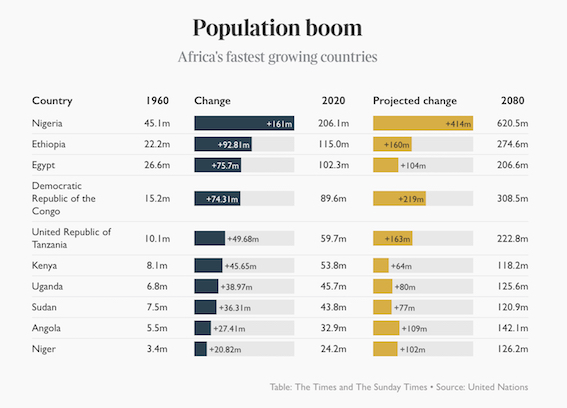
THE AFRICAN TREK TO THE WEST HAS JUST BEGUN
[Note by Tom Gross]
I attach an essay from today's Times (of London) by the interesting Roger Boyes.
The developments he points to are likely to have considerable implications beyond Africa, as many Africans flee to Europe, the Middle East and some to America, in search of a better (or safer) life.
There are a few extracts first for those who don't have time to read the article in full.
EXTRACTS
Two thirds of Africans are under 25. In 1950 Lagos had 325,000 inhabitants. The 1960 street map of Lagos shows a comfortable coastal city of under a million that a savvy traveller could cross in less than an hour. By 1990 it had swollen to four million and is now 14 million. If you count outer Lagos, it's 20 million and rising fast. This is the youthquake turning not just Lagos but dozens of African capitals into megacities.
"The average age in Senegal is 19. We are a country of teenagers," says Nzinga Biegung Mboup, a 32-year-old who works as an architect in the capital, Dakar. She says she can understand the anger of the younger Senegalese. "There is a huge shortage of housing. People want access to schools and healthcare."
"The cost of living is very high," says Hawa Yokie, a 21-year-old who moved from the provinces of Sierra Leone to its capital, Freetown, in search of a better education. "People are living on below $1 a day."
Sub-Saharan states such as Mali and Niger are viewed as fruitful recruiting grounds by Islamist radicals. The Sahel ? the poorest part of the poorest continent, which also includes parts of Chad, Sudan and Mauritania ? is set to register the largest population growth in the world between now and 2050, doubling to 2.4 billion. That's because of high fertility rates ? women in the Sahel give birth on average to 5.2 children compared to 1.6 in Europe and 1.9 in North America ? and declining infant mortality. In Niger, women are giving birth to 7.6 children on average.
Europe, then, has become the spillover zone for African cities that are bursting at the seams. The pandemic has further depressed western birth rates. The US fertility rate fell by 4 per cent in 2020, a record low. Italy's birth rate is the lowest since unification. In China, Xi Jinping has relaxed the one-child policy and is permitting a three-child family. Not many seem to be taking up the offer.
The brutalisation of refugees during their journey to Europe (and often once they are in Europe) won't be any easier to shake off than the experiences that drove them to flee in the first place.
FULL ARTICLE
YOUTHQUAKE WILL DRIVE MILLIONS OF AFRICANS ON TREK TOWARDS EUROPE
Youthquake will drive millions of Africans on trek towards Europe
In just 60 years there will be more Nigerians than Europeans and, as climate change takes its toll, our continent is set to become the spillover zone for African cities bursting at the seams.
By Roger Boyes
October 2 2021
The Times (of London)
Weekend Essay
https://www.thetimes.co.uk/article/youthquake-will-drive-millions-of-africans-on-trek-towards-europe-kp2vv33s6
They're called invisible shipwrecks: migrant boats that sink without a trace as they make their way from west Africa to the Canaries. So far this year 9,386 Africans have made it alive. Close to 800 died in the Atlantic. Most could not be identified from the body parts washed into the nets of fishermen. One woman survivor, interviewed by the UN's Institute of Migration, described the scene on the smugglers' boat before it capsized last month off the Mauritanian coast. "After three days at sea the engine broke down and we ran out of food and water. People were already starting to die."
Bodies were thrown overboard to lighten the load and reduce the stench. "There were people who looked like they had gone mad," she said. "Some bit each other. They shouted and threw themselves into the sea."
The flight from Africa isn't just an Atlantic or Mediterranean event, and what we see every day on the Channel is a mere sideshow. It's part of an epic journey that began, perhaps, in a trek from the scorched earth of a village that can no longer produce a crop to the outer suburbs of Lagos, Kinshasa and Accra. There, young men try, from the noisy sleepless shanty towns, to find a job that pays enough to send money home to the villages they left. When they fail they are gripped by guilt. The cities of Africa are growing so quickly and so chaotically that there is no time to build the basic infrastructure and so, in the end, they are failing Africa's youth.
Sodjah Evans, 22, left school with dreams of studying business administration in the Ghanaian capital. "Everyone comes to Accra because they think there will be job opportunities," he said. "They think they will be valued." The reality is different. He scrapes a hand-to-mouth existence tutoring children in his commune. His sister, a mother of five, is the breadwinner, selling rice and beans at the side of one of the main roads into the city.
There are plenty like them. Two thirds of Africans are under 25. In 1950 Lagos had 325,000 inhabitants. The 1960 street map of Lagos shows a comfortable coastal city of under a million that a savvy traveller could cross in less than an hour. By 1990 it had swollen to four million and is now 14 million. If you count outer Lagos, it's 20 million. It's growing at more than 3 per cent a year and by the end of this century will be as populous as Britain is now. In 60 years there will be more Nigerians than Europeans.
This is the youthquake turning not just Lagos but dozens of African capitals into megacities. It should be a good thing. It's what created the brand of "Africa Rising". The West's boomer generation is associated with prosperity, the Tiger states of Asia became flush with cash. And just as Europe started to labour under falling birth rates, as even China began to flounder under its unsustainable one-child policy, Africa's megacities ? Luanda, Dar es Salaam, Abidjan and Kinshasa among them ? were bursting with hormones, becoming mini-states full of youthful energy.
The Nigerian government boasted of its start-ups, of a film industry, Nollywood. Now fretting leaders seem to think they have created a Frankenstein monster, a force they can't control. "In the past year," says Emmanuel Adegboye of the Mo Ibrahim Foundation, "Nigerians have woken up to bans on motorcycle taxis in Lagos, cryptocurrency transactions involving banks and, most recently, Twitter."
All these obstacles are regarded by the urban young as hostile acts by the state. Motorcycle taxis summoned by hailing apps are often the only way of making appointments in the turgid compression of rush hour, or the "go slow" as the start-up generation calls it. As for the Twitter ban, imposed because it had become a protest tool to demand an end to police brutality and extortion, it's part of the democratic fabric for the Nigerian young. The International Finance Corporation estimates that the internet economy has the potential to reach $180 billion by 2025 and $700 billion by 2050.
But that won't happen if it's blocked by governments nervous about a young generation wanting to put an end to the old patterns of corruption and bureaucratic obstruction. Young Africans smell a rat. That's part of a global trend. Parag Khanna, author of Move, notes that "youth know rotten governance when they see it". When gas and electricity subsidies are cut, mass protests ensue. That's true of deferential Asian states such as Thailand, of European countries with high living standards, but above all in youth-heavy Africa.
"The average age in Senegal is 19. We are a country of teenagers," says Nzinga Biegung Mboup, a 32-year-old who works as an architect in the capital, Dakar. She says she can understand the anger of the younger Senegalese. "There is a huge shortage of housing. Across the country the government is trying to provide 100,000 houses in the next five years, but demand is about triple that. The government builds houses just outside the city but this creates its own problems. People want access to schools and healthcare." Planning and public transport are key, she says.
The density of Africa's emerging mega-cities focuses demands on better governance. The would-be entrepreneurs are feeling it. Even the powerful mobile phone operators reckon they are being blocked, but so are those who have arrived from the rural hinterland and who have failed to find a foothold. "The cost of living is very high," says Hawa Yokie, a 21-year-old environmental activist who moved from the provinces of Sierra Leone to its capital, Freetown, in search of a better education.
"People are living on below $1 a day. There's no access to good education. No access to jobs. And everything is getting expensive. There's no easy way to survive." She was shocked by the slums, with many living next to the expanding rubbish dump in the city centre. She has already been robbed in daylight, as has her mother. The city, she says, has become a violent place. "We see gangs, moto-taxi drivers and the police fighting each other, huge fights in which people are killed."
The innate violence, the sense of turmoil of the African megacity is beginning to outweigh the sense of opportunity. And the result: migration to Europe, to neighbouring states or, when the frustration has become particularly intense, recruitment in Islamist groups that promise a better world-beyond-the-world.
Sub-Saharan states such as Mali and Niger are viewed as fruitful recruiting grounds by Islamist radicals. The Sahel ? the poorest part of the poorest continent, which also includes parts of Chad, Sudan and Mauritania ? is set to register the largest population growth in the world between now and 2050, doubling to 2.4 billion. That's because of high fertility rates ? women in the Sahel give birth on average to 5.2 children compared to 1.6 in Europe and 1.9 in North America ? and declining infant mortality. In Niger, women are giving birth to 7.6 children on average.
Europe, then, has become the spillover zone for African cities that are bursting at the seams. The British demographer Paul Morland talks of the Europeans becoming both greyer, because of declining birth rates, and blacker, because of the inevitability of migrant birth rates filling the gap.
Right-wing populist governments such as Poland and Hungary paint this as a threat. Viktor Orban, the Hungarian prime minister, declares: "We want Hungarian children; migration is a surrender." About 5 per cent of GDP is earmarked towards pushing up the domestic birth rate. Poland has rolled out a near-total ban on abortion.
The pandemic has further depressed western birth rates. The monthly fertility rate in England and Wales in December 2020 and January 2021 ? that is about nine months after the first lockdown ? fell by 8.1 per cent and 10.2 per cent year-on-year. The US fertility rate fell by 4 per cent in 2020, a record low. Italy's birth rate is the lowest since unification. In China, Xi Jinping has relaxed the one-child policy and is permitting a three-child family. Not many seem to be taking up the offer.
In 1972 the Club of Rome ? financial, political and academic brains set on saving the world ? presented a manifesto, The Limits to Growth. It developed the kind of dystopian future envisaged by the scholar Thomas Malthus during the Industrial Revolution: populations would grow at such a pace the planet wouldn't be able to feed itself. The Limits to Growth still underpins some of the arguments used by climate change activists: natural resources are finite, competition for them could lead to famine and war.
They're not wrong, yet the global population is about to top eight billion and the world hasn't collapsed. Agriculture has become smarter; as the African middle class grows so the birth rate will fall naturally. There are already a few, admittedly rare, parts of Africa with European fertility rates. And migration to Europe, the careful integration of new arrivals, could eventually be seen as a demographic boon. That was one of the supporting arguments in Germany in 2015 when Angela Merkel opened her doors to Syrians. After all, said her fan club, someone has to pay the pensions of the boomer generation.
But just around the corner is a mass movement even greater than the 2015 influx. Climate migration is likely to exceed anything in history. The World Bank estimates that 30 million to 70 million people in sub-Saharan Africa will be displaced from their homes at least in part because of the rising temperatures.
Where will they go? The shift to cities on the coast, meanwhile, suggests that up to 36 million could be living precariously on the floodplains of megacities. Nigerians, for example, are living in the Lagos slums of Makoko, which is built on swampland. How will they survive the rising waters of the Atlantic?
Africa is larger than the territorial space of the US, Europe, China and India combined. But internal displacement in overstretched states, or on the land of neighbouring countries, is no real solution. The most likely scenario is a trek north towards Europe, a dramatic escalation of what is already happening. Hawa Yokie in Freetown compares it with Temple Run, a smartphone game. The player is forced to jump, duck and swerve around obstacles in the hunt for gold, pursued by demonic monkeys. That's how the exodus through the Sahara and across the Med is described by Sierra Leoners. "A lot of young people I know have died along the way." Every border brings danger.
The migrants stress that the journey is the worst part. But even when they reach the apparent safety of Europe, it's dog eat dog. In the encampments on the French coastline that have sprung up to replace the "Jungle" there are fights between Eritreans and Afghans, feuds between people fleeing never-ending military conscription or the random cruelty of the Taliban. The brutalisation of refugees during their odyssey won't be any easier to shake off than the experiences that drove them to flee in the first place.
Now imagine this flow ? one million Syrians at its peak in 2015-2016 ? multiplied by a factor of five or ten: the extraordinary despair, the relentless march, and the cracks that will be quickly exposed in western societies and our stitch-in-time immigration system.
Perhaps the estimates are wrong. Perhaps the impact of the coming climate upheaval will be more piecemeal. Perhaps ? and this is the least probable scenario ? African governments will inspire heroic acts of resilience. I'm with the Nigerian playwright Wole Soyinka on this: states are already buckling under the pressure of long decades of corrupt governance. "Even during the [1967-70] civil war, I do not believe that we devalued humanity as much as we do today," the Nobel laureate said in a recent interview. "It's like something has broken in society."
He's 87 but his analysis is as clear-eyed as any of those in the vanguard of the youthquake. The challenge then is what can be done by westerners. Immigration policy has to function not so much as a Maginot Line but rather as a series of nudges that have to be framed by the social upheaval that we expect across the globe. If aid policy is to make sense in Africa it has to be less geared to the generalised alleviation of poverty and more towards persuading this vast group of young people that it's worth trying to realise their dreams in their own countries.
Critics of educational projects in Africa argue that they end up making the beneficiaries into more savvy economic migrants. But there is one priority that will always bring both fast and lasting rewards, and that is education for girls. Their contribution to the workforce, the sense of independence the schooling brings, modernises society, increases household income, reduces the birth rate and provides the most powerful riposte to the likes of the Islamist terror gangs of Boko Haram, who after a decade of activity believe they are invincible. Family-planning clinics are springing up across the continent but not fast enough. Even small doses of aid give encouragement.
Then there is the way that urbanisation, which should be a tool for modernising society, is becoming dysfunctional. British help can make the cities more liveable. We have waste-disposal experts who can put an end to the stinking piles of landfill that make life so unhealthy. We have driving school instructors who can set up training centres for HGV drivers, and offer the best a chance of residence in Britain. If we have surplus Covid-19 vaccine we can strike partnerships with hospitals. Traffic engineers can advise on congestion. Mayors have to become go-to partners. British business has to pepper them with questions: what are you doing to build sea defences? Can we help? We can work together to digitalise African economies, find ways of gathering and deploying data to improve productivity.
Schadrack Bwata Ongwe, 34, a videographer from Kinshasa, says Africans would not think of moving if there were opportunities at home. "If you have a job, if you have a business, you wouldn't dream of living in Europe. There is youth coming up and we need to find more opportunities for them."
All this doesn't cost a fortune. And it's not crass mercantilism. Nor is it just a polite way of saying: stay where you are, don't come to us in droves. It establishes the bonds we need if Global Britain is to become more than a slogan. But we need to get on with it.
* You can also find other items that are not in these dispatches if you "like" this page on Facebook www.facebook.com/TomGrossMedia
Above: The Turkish government-supporting press didn't regard Angela Merkel as sufficiently anti-Kurdish
MERKEL'S 16-YEAR TERM OF OFFICE DRAWS TO A CLOSE
[Note by Tom Gross]
I attach four pieces in relation to this week's German elections which may be of interest to readers.
CONTENTS
1. "Angela Merkel deserves the Nobel Prize for Peace: The departing German leader was no rebel, orator, or original thinker, but morally she was a giant" (By Amotz Asa-El, Jerusalem Post, Oct. 1, 2021)
2. "Making sense of German electorate's shift to the Left: Israel should not be under any delusion that the Social Democratic Party has its back" (By Benjamin Weinthal, Israel Hayom, Sept. 30, 2021)
3. "German election: Olaf Scholz would turn his back on America as chancellor, warns the head of the Bundestag's foreign affairs committee" (The Times of London, Oct. 1, 2021)
A friend of TG adds: If so, the ex-KGB staff running Russia must be amazed how easy it all was?
4. "German-Jewish leader welcomes downward trend of far-right party in Sunday's election" (European Jewish Press, Sept. 30, 2021)
PIECES
"ANGELA MERKEL DESERVES THE NOBEL PRIZE FOR PEACE"
Angela Merkel deserves the Nobel Prize for Peace
The departing German leader was no rebel, orator, or original thinker, but morally she was a giant.
By Amotz Asa-El
The Jerusalem Post
October 1, 2021
The assistant professorship that is any doctoral student's wish was one nod away from her when the future Angela Merkel (Kasner, at the time) was asked to double as an informant for the Stasi, East Germany's secret police.
The 24-year-old physicist, whose disdain for melodrama would later become legend, said no, but instead of adding a provocative statement just said: "I can't keep secrets."
It was 1978 and the Stasi's spooks could not imagine the real secret, that they were facing a united Germany's future matriarch and a post-communist Europe's undeclared queen.
Now, as her 16-year chancellorship draws to a close, Merkel is set to be remembered as a vestige of an era of optimism that was as brave and inspiring as it was brief and na?ve.
IRONICALLY, the East German revolution's poster girl was no revolutionary.
Yes, she told the Stasi no that day, but she joined no underground, made no active protest and never claimed to have braved Soviet repression the way Lech Walesa, Vaclav Havel, Natan Sharansky, Aleksandr Solzhenitsyn or Andrei Sakharov did.
Merkel was no rebel. Boring and uncharismatic, the East German lawmaker who became West German leader Helmut Kohl's briefcase holder was no firebrand or orator. She swept no audience off its feet and was no trigger-happy warrior, in any sense and on any front. She was no Margaret Thatcher.
She was also no exhibitionist. Merkel was no Willy Brandt, who fell on his knees in front of the Warsaw Ghetto Memorial, and she was no Ronald Reagan, who located his loud cry "Mr. Gorbachev, tear down this wall" at the foothills of the monstrosity that Merkel knew all too well.
Merkel was also no originator of ideas.
Unlike Otto von Bismarck, who created the modern social safety net; unlike Konrad Adenauer, who led the rise of New Germany and the emergence of the European Community and unlike Helmut Kohl, who spearheaded Germany's reunification, Merkel created little, focusing instead on the preservation of other people's legacies.
Yes, she was a great crisis manager. Faced with the Greek economic crisis, Merkel produced a deal that balanced economic prudence with European solidarity.
The result, enormous pain for the Greeks and a loss of billions for its creditors, was no idyll, but it kept the union alive, left its cracking currency intact, and consolidated Germany's position as Europe's center of gravity. At the same time, faced with the 2008 meltdown's shock she led the German economy to quick recovery at a minimal cost.
Meanwhile, faced with a newly assertive Russia's invasions of Georgia and Ukraine, Merkel led with the US a vast international effort to sanction Moscow while keeping intact Nord Stream 2, a mega-project aimed at feeding Europe with Russian gas.
However, crisis management is one thing and shaping history is another.
IT WILL take decades to gauge her historic imprint, but right now it seems that the future's growing pressures were too heavy for Merkel's stubborn efforts to preserve the past.
At home, the political center steadily eroded under Merkel's watch.
The two major parties, which in the last election before her chancellorship won a combined 76% of the vote, shrank during her tenure to a combined 49.8%. The growth of radical parties was underscored by the emergence of the far-right Alternative for Germany, which did not exist before Merkel's arrival and has since come to grip a solid one-tenth of the electorate.
Abroad, the European Union, which under her predecessors gradually grew from six members to 28 shrank for the first time in its history, following Britain' departure. Meanwhile, the euro that she inherited from her predecessors was exposed during her chancellorship as a vulnerable currency of a disjointed polity.
Merkel's titanic effort to keep the EU and its currency intact was challenged not only by the imbalances between its richer north and poorer south, but also by the deepening chasm between its liberal West and conservative East.
The common denominator between these setbacks is not that they happened because of Merkel's mistakes, but that they happened despite her resistance.
Now, chances that the trends she defied will accelerate are higher than the chances that they will be offset. In fact, chances are Merkel will eventually loom not only as no Reagan, Adenauer or De Gaulle, but as a version of Franz Josef, the Hapsburg monarch whose 68-year reign of prosperity and seeming stability actually concealed a decaying empire's approaching demise.
Like the Austro-Hungarian Empire in its twilight, Merkel's European Union may have grown too big, too varied, and too loose to last; an optimistic era's utopia predestined to make way for the cynicism that was its aftermath.
It was between these two poles, the optimism that animated her political emergence and the pessimism that overshadows her departure, that Merkel made her career's one big move, when she opened her country's doors to more than a million Muslim refugees.
YES, it was a gamble that fueled xenophobia, sparked violence, and might ultimately prove to have accelerated the European Union's disintegration. And never mind that less than a decade since their arrival half of the new immigrants are already gainfully employed and paying taxes.
Even if this experiment proves to have been a social failure and a political disaster, morally speaking it was an act of humanity, generosity, humility, and nobility that no one before Merkel, from Thatcher and Reagan to Adenauer and Brandt, ever did; a gamble worthy of the unassuming scientist whose life at the free world's summit never made her forget her origins in dictatorship's despair.
That is why Angela Merkel deserves the Nobel Peace Prize more than all the leaders whose political gravitas she didn't possess, whose intellectual originality she didn't display, and whose historic imprint she didn't etch.
MAKING SENSE OF GERMAN ELECTORATE'S SHIFT TO THE LEFT
Making sense of German electorate's shift to the Left
Israel should not be under any delusion that the Social Democratic Party has its back. If anything, the slide to the Left, as it is being called in Germany, has serious implications for the Jewish state.
By Benjamin Weinthal
Israel Hayom
September 30, 2021
The composition of the next German government remains unclear but one thing is certain: With the Social Democratic Party (SPD) securing a victory over Chancellor Angela Merkel's conservative Christian Democratic Union (CSU) in the federal election, the country has undergone a Linksrutsch ? a "slide to the Left."
From the perspective of Israel's security and defense establishment, the prospect of a left-wing chancellor beholden to an increasingly anti-Israel base does not bode well. As head of the largest party, the SPD's Olaf Scholz has the best chance to replace Merkel after her nearly 16 years in office.
In May, Norbert Walter-Borjans, the co-chair of the Social Democrats, sought to crack the German schoolmaster whip on Israel with respect to arms transfers. Walter-Borjans comes from the radical wing of the party and suggested Berlin not to give a blank check to the Jewish state when it came to defending itself. To be fair, he did not urge the end of arms sales to Israel.
However, the calls from leading SPD politicians to clamp down on Israel continue to grow. "Germany must not deliver weapons to conflict areas and to dictators," said the SPD politician Ralf Stegner, adding, "What about Saudi Arabia? What about Qatar? I am also asking: What about Israel?"
Scholz declared to supporters on Sunday that the predicted election results represented "a very clear mandate to ensure now that we put together a good, pragmatic government for Germany." But it is hard to believe that he would be able to institute a pragmatic foreign policy toward Jerusalem in light of the widespread anti-Israel sentiment.
During the four years of coalition with Merkel's party, the SPD has aggressively targeted Israel with resolutions at the UN and sympathy for BDS.
Heiko Maas, the Social Democratic foreign minister who supposedly went into politics "because of Auschwitz," did not object when his ambassador to the United Nations Christoph Heusgen equated Israel to the jihadi terrorist movement Hamas at the Security Council. Heusgen's parallel secured him a spot on the Simon Wiesenthal Center's worst outbreaks of anti-Israelism and anti-Semitism in 2019.
Andreas G?rgen, Maas's director-general for cultural affairs and communication, was included in the 2020 list for his advocacy of the BDS campaign targeting Israel.
Maas has green-lighted his diplomats celebrating, at Tehran's embassy in Berlin, the Islamic Revolution that ushered in the regime of Shi'ite cleric Ayatollah Ruhollah Khomeini in 1979.
Maas is a zealous advocate for the Iran nuclear agreement and for trade with the Islamic republic. For example, the top German diplomat sent the foreign ministry's then-business director Miguel Berger to a conference to boost trade with Iran's regime in 2019.
Bjorn Stritzel, a journalist for Germany's largest newspaper, Bild, wrote at the time, "While the Tehran regime plays with fire, Germany is offering the mullahs a stage in Berlin! Yesterday, the Federal Foreign Office sent a business director [Berger] to a conference to give tips on how to cleverly bypass US sanctions against Iran. Every penny from the business deals that were initiated there [at the conference] flows directly into Tehran's terrorist coffers, with which the mullahs oppress their own people."
Maas has spouted the usual boilerplate language about countering Israel-related antisemitism in Germany, namely, that "there is no place for antisemitism" in the Federal Republic. He employed this type of condemnation when German Christians and German Muslims burned Israeli flags after the US relocated its embassy to Jerusalem.
Frank-Walter Steinmeier, the president of Germany and a fellow Social Democrat, triggered international headlines when he infamously sent a telegram on the occasion of the 40th anniversary of the 1979 revolution to Iran's then-President Hassan Rouhani, congratulating the clerical regime "in the name" of the German people. On a side note, who still sends telegrams?
Maas's predecessor as foreign minister, the Social Democrat Sigmar Gabriel, reiterated his description of Israel as an "apartheid regime" in 2018 and belittled the Holocaust. Gabriel claimed that Social Democrats suffered the same persecution and fate as Jews during the Nazi period ? an assertion that is demonstrably false.
Perhaps most troubling for Israel, the next generation of the Social Democratic Party is hostile to Israel. The Jusos, the party's youth movement, tends to produce future chancellors and members of parliament.
The Jusos, SPD supporters aged 14-35, passed a resolution in 2020 declaring solidarity with the youth wing of Fatah, the main faction of the PLO, as a "sister organization."
Fatah Youth opposes Israel's existence. In one illustration of this, Fatah Youth members wore fake explosive belts and chanted slogans calling for Israel's destruction at a demonstration in the West Bank in 2018.
The main threats to Israel's security, from Iran's regime to its chief proxy Hezbollah to Hamas, have nothing to fear from any SPD effort to counter their growth and strength in the Middle East.
Israel should not be under any delusion that the SPD has its back.
To recall an example from the past, when Israel was on the ropes during the Yom Kippur War, and to the acute frustration of President Richard Nixon and Secretary of State Henry Kissinger, then SPD Chancellor Willy Brandt stuck to an ironclad "neutral position toward the conflict in the Middle East." The US sought to use the German port of Bremerhaven to deliver weapons to the Israelis. Brandt demanded an immediate halt to Americans loading freighters under the Israeli flag in the port.
Brandt had previously declared Germany would show solidarity with Israel and that there could be "no neutrality of the heart."
The shift leftward, the slide to the Left as it is being called in Germany, has serious implications for Israel.
OLAF SCHOLZ WOULD TURN HIS BACK ON AMERICA AS CHANCELLOR, WARNS HEAD OF BUNDESTAG'S FOREIGN AFFAIRS COMMITTEE
German election: Olaf Scholz would turn his back on America as chancellor, warns critic
By Oliver Moody, Berlin
The Times (of London)
October 1 2021
Germany's standing in the West will be damaged if Olaf Scholz becomes chancellor because of his left-wing party's reluctance to keep US nuclear weapons on German soil or stand up to Russia and China, the head of the Bundestag's foreign affairs committee has warned.
Scholz, 63, the finance minister and strongest contender to be the country's next leader, is trying to build a ruling coalition with the Greens and the economically liberal Free Democratic Party (FDP) after a narrow victory in last week's general election by his centre-left Social Democratic Party (SPD).
He has yet to set out his foreign policy goals in detail. However, SDP leaders have called for Germany to be "decoupled" from America and urged Washington to remove its nuclear weapons from the country.
Norbert R?ttgen, the leading foreign affairs expert from the centre-right Christian Democratic Union (CDU), said he was "really worried" that Germany's role on the international stage would be diminished under Scholz.
R?ttgen, 56, represents a rival party to the SPD but has made a name as an independent-minded thinker on foreign policy, occasionally taking issue with Angela Merkel's decisions.
He said that the balance of power in the European Union could shift from Berlin to Paris as an SPD-led government would fall into step behind President Macron, who has described Nato as "brain-dead" and set out an ambition to distance the bloc from Washington in strategic terms.
"There will be concerns in Washington and Nato about whether [the SPD] talks about 'Europeanisation' in the sense of a retreat from Nato and the transatlantic partnership," R?ttgen said. "They will attentively observe whether this results in a policy that quite strongly adopts the language and ideas of the French president."
Foreign policy scarcely figured in the German election campaign but is now taking on greater significance as the country's allies look to Berlin to take a more assertive role in Europe and the wider world.
Among the potential flashpoints is Germany's commitment as a Nato member to spend 2 per cent of its GDP on defence. The budget has risen under Merkel's chancellorship to 1.57 per cent, with Scholz's approval, but both the SPD and the Greens have signalled an unwillingness to go any further.
Last year Rolf M?tzenich, 62, the SPD's leader in the Bundestag, described the target as an arbitrarily fixed percentage and a "dance around the golden calf".
M?tzenich and the party's two national leaders have demanded that the US withdraw about 20 atomic weapons stationed at the B?chel airbase in southwest Germany, an emblem of the American "nuclear umbrella" shielding Europe.
The SPD has also blocked several attempts to upgrade Germany's military capabilities, including an order for armed drones to defend soldiers on the battlefield.
"I don't think you'll hear from the SPD that [our international responsibilities] include a tougher collective approach to Russia and China," R?ttgen said.
"Nor can I imagine that the SPD will stand up for closer co-operation with our European partners or agreeing a common military component. The SPD categorically rejects everything that our neighbours understand by greater responsibility: more resources, more money, more readiness to take risks."
R?ttgen's CDU is smarting from the worst general election defeat in its history after falling nearly nine points to 24.1 per cent of the vote.
Armin Laschet, 60, the party leader, is fighting for his political survival amid speculation that he could be ousted in the coming weeks. This week Ellen Demuth, 39, who was R?ttgen's running mate when he stood unsuccessfully against Laschet for the CDU leadership earlier this year, was one of the first figures in the CDU to call for Laschet to resign.
A poll published today by ARD, a public broadcaster, found that 66 per cent of Germans and 60 per cent of CDU voters agreed with her.
Several sources in German conservative circles have suggested that R?ttgen, one of the most prominent figures on the CDU's centrist wing, could enter the fray if Laschet is deposed. They also named Ralph Brinkhaus, 53, the party's leader in the Bundestag, Jens Spahn, 41, the health minister, and Andreas Jung, 46, a senior MP, as possible contenders.
However, R?ttgen said that Laschet should stay on for the coalition talks and said this was "no time for personal ambitions".
"Back in February 2020 I justified my run for the leadership by pointing out that the CDU needs to be renewed and must once again hold its own as a modern [party of the] centre," he said. "The election result has underlined this imperative and made it inevitable."
GERMAN-JEWISH LEADER WELCOMES DOWNWARD TREND OF FAR-RIGHT PARTY IN ELECTION, WHILE SOME JEWISH ACTIVISTS TAKE A DIFFERENT VIEW
German-Jewish leader welcomes downward trend of far-right party in election
By Yossi Lempkowicz
European Jewish Press
September 29, 2021
The president of the Central Council of Jews in Germany, Josef Schuster, has expressed relief over the downward trend for the far-right Alternative for Germany (AfD) party in Sunday's federal election.
The Social Democratic Party (SPD) headed by Finance Minister Olaf Scholz has emerged as the victor of the election. The center-left party secured 25.7 percent of the vote, overtaking Chancellor Angela Merkel's Christian Democrats (CDU/CSU) by 1.6 percent. The election marked the defeated conclusion of the Merkel era as her party has suffered a devastating electoral loss of 8.9 points since the 2017 election.
AfD now holds the fifth place at 10.3 percent with a loss of 2 points since 2017, down from the third place which is now taken by the Greens who achieved the best result in their history with 14.8 percent. The liberal FDP party improved to 11.5 percent. The Left Party fell to 4.9 percent. Because it won three direct mandates, it will nevertheless enter the Bundestag with the strength of a parliamentary group.
Schuster said that the AfD's double-digit performance in the federal election ''was a clear signal that the fight against right-wing populism and right-wing extremism must be stepped up.'' ''It must remain the goal of all democrats to banish the AfD from the Bundestag and from all state parliaments,'' he said.
The president of the Central Council of Jews, which is the government-funded umbrella Jewish representative body, criticized the fact that in the Bundestag (the federal parliament) election campaign the important social issues such as combating anti-Semitism, racism and right-wing extremism had played a subordinate role. "All the more reason for the new federal government ? regardless of its composition ? to quickly address this challenge. This also includes a more comprehensive fight against hate speech on the Internet,'' he said.
"Strengthening the foundation of our democracy again and stopping radicalization on the right-wing fringe is an urgent task for the new government coalition."
The parties have stated the coalition negotiation phase, often a painstaking and months-long process. While Scholz's party received the most votes, CDU's Armin Laschet has not ruled out replacing his predecessor as Chancellor. The FdP and the Greens enjoy the position of "king-makers" and could thus influence the direction of the traditional "Grand Coalition" of CDU and SPD.
What is considered as the "established" Jewish community has largely favored the CDU to lead Germany, but many Jewish activists have criticized the government's insistence on maintaining strong business and diplomatic ties with the Iranian regime under SPD's Foreign Minister Heiko Maas.
The FdP solidified its pro-Israel credential when it introduced a parliamentary motion to change Germany's anti-Israel voting patterns in the United Nations, a measure supported only by the AfD, which is considered by some Jews as the most pro-Israel party in the German parliament.
SOME GERMAN JEWS TAKE A DIFFERENT VIEW
Rafael Korenzecher, publisher of the conservative Germany Jewish monthly, J?dische Rundschau, totally disagree with Josef Schuster when it comes to the AfD's rejection by the "Jewish establishment."
Recently, about 60 Jewish organizations issued a statement asking Jews not to vote for the AfD, calling it an anti-Semitic and racist party. The AfD is the only party to oppose Merkel's Muslim immigration.
During Merkel's last term, AfD introduced anti-BDS and anti-Hezbollah legislation in the German parliament and voted in favor of an FDP motion to change Germany's anti-Israel voting pattern in the United Nations. It was the only party to abstain from a parliamentary motion condemning any Israeli plan to apply sovereignty to Jewish communities Judea and Samaria.
"The AfD clearly has right-wing problems in the expressions of some of their politicians and that cannot be overlooked," says Korenzencher. "It's not tailor-made nor our desired child, but this is what we got if we look at the other parties and their behavior towards Israel and their true behavior towards the Jews."
* You can also find other items that are not in these dispatches if you "like" this page on Facebook www.facebook.com/TomGrossMedia

Above: Tom Gross in Erbil in Iraq in 2019, close to where 300 Iraqi notables last week made a declaration calling on Iraq to join the Abraham Accords and establish diplomatic, cultural and economic relations with Israel.
DEATH THREATS FOR IRAQIS CALLING FOR PEACE WITH ISRAEL, AS BIDEN AND BLINKEN ABANDON THESE PEACEMAKERS
[Notes by Tom Gross]
I attach several articles below about the recent call by over 300 Iraqi notables for Iraq to establish diplomatic, cultural and economic relations with Israel -- and about the depressing backlash they have suffered, including death threats, and the shocking lack of support given to them by Secretary of State Blinken and the Biden administration.
Among those attending the conference nine days ago in Erbil was longtime US peace negotiator Dennis Ross (who has worked for both Democrat and Republican administrations), and addressing the conference by video was Chemi Peres, son of the late Israeli Prime Minister and Nobel Peace Prize winner Shimon Peres.
The conference was co-organized by Iraqi Muslims and by Joseph Braude, the Arabic-speaking US-based great-great grandson of the former chief rabbi of Baghdad, who like all of Iraq's sizeable millennia-old Jewish community had their property and assets seized, and their Iraqi citizenship revoked, and their documents stamped: "Forbidden to come back to Iraq," in the 1940s and 50s.
ACCUSATIONS OF "TREASON"
Partly as a result of Iranian and other intimidation, authorities in the Sunni Anbar province have issued arrest warrants for six of the key conference participants. Others were dismissed from their government jobs. Pictures of the six have been displayed on huge banners erected at checkpoints between Anbar and Baghdad with captions accusing them of "treason."
Among those against whom arrest warrants have been issued following the conference are Sunni tribal leader Wisam al-Hardan, Iraqi culture ministry official Sahar al-Ta'i (pictured below), and Iraqi parliamentarian Mithal al-Alousi, a longtime advocate of Israel normalization (whom I met when he visited Israel some years ago). I have also met and remain in touch with two of the other Iraqi participants, at another conference in Europe at the start of 2020.
AMERICAN INDIFFERENCE
The only official US reaction to all this has been a lackluster tweet from U.S. Army spokesperson Col. Wayne Marotto, saying that the army had been "made aware of announcements ? relating to the recent conference held in Erbil to discuss the normalization of ties with Israel. @Coalition had no prior knowledge of the event, nor do we have any affiliation with its participants."
As Jonathan Tobin writes in one of the pieces below: "In other words, the U.S. military made it clear that its allies who had taken a stand in favor of peace with Israel were on their own. Rather than standing with the advocates of normalization, America was doing its best to appear indifferent to their fate even as other Iraqis, egged on by Iran, were demanding their blood."
Above: Dr. Sahar al-Ta'i, Head of Research at the Iraqi Ministry of Culture, addressing the peace conference in Erbil on September 24, 2021.
As you can see from the start of the video of her remarks here she also said that it was important for Iraqis to remember the victims of the Holocaust, as well as the victims of 9/11 and other atrocities.
Al-Ta'i has not been publicly heard from since her statements at the conference, and the Culture Ministry has disowned her.
Among related dispatches:
Miss Iraq, defying death threats, visits and praises Israel (June 14, 2018)
http://www.tomgrossmedia.com/mideastdispatches/archives/001776.html
Video of Miss Iraq in Israel here: https://youtu.be/q9kaenrM6FI
CONTENTS
1. Iraq Should Join the Abraham Accords (By Wisam Al-Hardan, Wall Street Journal, Sept. 25, 2021)
2. Why Is Iraq Afraid of Better Relations With Israel? (By Eli Lake, Bloomberg, Sept. 29, 2021)
3. A pro-Israel summit in Erbil breaks new ground (By Dennis Ross, Foreign Policy magazine, Sept. 30, 2021)
4. A cautionary tale about Arab-Israeli normalization (By Jonathan Tobin, JNS, Sept. 30, 2021)
5. Talk of Iraq Recognizing Israel Prompts Threats of Arrest or Death (By Jane Arraf, New York Times, Sept. 30, 2021)
6. Iraq, Kurdistan reject conference on normalizing ties with Israel (Ekurd.net, Sept. 25, 2021)
ARTICLES
IRAQ SHOULD JOIN THE ABRAHAM ACCORDS
Iraq Should Join the Abraham Accords
Full relations with Israel would help atone for the infamous act of driving out our Jewish population.
By Wisam Al-Hardan
Erbil, Iraq
Wall Street Journal
Sept. 25, 2021
https://www.wsj.com/articles/iraq-abraham-accords-israel-sunni-shiite-11632495291
More than 300 of my fellow Iraqis from Baghdad, Mosul, Al-Anbar, Babel, Salahuddin and Diyala joined me Friday in this northern city, where we issued a public demand for Iraq to enter into relations with Israel and its people through the Abraham Accords.
We are an assembly of Sunnis and Shiites, featuring members of the (Sunni) Sons of Iraq Awakening movement, which I lead, in addition to intellectuals, tribal elders, and youth activists of the 2019-21 protest movement. Some of us have faced down ISIS and al Qaeda on the battlefield. Through blood and tears we have long demonstrated that we oppose all extremists, whether Sunni jihadists or Iran-backed Shiite militias. We have also demonstrated our patriotism: We sacrificed lives for the sake of a unified Iraq, aspiring to realize a federal system of government as stipulated in our nation's constitution.
Now, in striving to rebuild our country, we commit ourselves to an awakening of peace. Our guiding light is the memory of a more honorable past: a young, modern state with a glorious ancient tradition; a country that, at its finer moments, witnessed a spirit of partnership across ethnic and sectarian lines. Iraq's subsequent deterioration was marked by the dissipation of tolerance -- a casualty of generations of tyranny and fear, imposed first by rulers, then by external actors, as a tool to divide and conquer.
The most infamous act in this tragedy was the mass exodus and dispossession of the majority of our Iraqi Jewish population, a community with 2,600 years of history, in the mid-20th century. Through their forced migration, Iraq effectively cut one of its own principal veins. Yet we draw hope from the knowledge that most Iraqi Jews managed to rebuild their lives, passing their traditions to their children and grandchildren in Israel.
In striving to rebuild Iraq, we must reconnect with the whole of our diaspora, including these Jews. We reject the hypocrisy in some quarters of Iraq that speaks kindly of Iraqi Jews while denigrating their Israeli citizenship and the Jewish state, which granted them asylum.
Some of the countries surrounding Iraq are withering in war, while others are blooming in peace. We reject the rule by warlords that has devastated Libya and Yemen. We refuse to allow the tyranny and atrocities of Syria to dissuade us. We decry the cascading tragedies of Lebanon, where a militia that began as a state within a state has swallowed the country whole.
At the same time, we see a hopeful trend in the region: an expanding community of peace, economic development and brotherhood that is the framework of the Abraham Accords -- initiated by the United Arab Emirates with its Israeli partners, and joined by our brethren from Bahrain, Sudan and Morocco.
We have a choice: tyranny and chaos, or legality, decency, peace and progress. The answer is clear. Just as we demand that Iraq achieve federalism domestically, we demand that Iraq join the Abraham Accords internationally. We call for full diplomatic relations with Israel and a new policy of mutual development and prosperity.
We have taken the first step of meeting publicly in Erbil in consort with an American organization, the Center for Peace Communications. Next we will seek face-to-face talks with Israelis. No power, foreign or domestic, has the right to prevent us from moving forward. Iraq's anti-normalization laws, which criminalize civil engagement between Arabs and Israelis, are morally repugnant.
We extend a hand of friendship to our brothers and sisters in humanity across the region and around the world, and we ask for God's help as we move forward toward a brighter future.
WHY IS IRAQ AFRAID OF BETTER RELATIONS WITH ISRAEL?
Why Is Iraq Afraid of Better Relations With Israel?
The regime has been hostile to anyone who attended a conference last week promoting closer ties between the two nations.
By Eli Lake
Bloomberg
September 29, 2021
Last week more than 300 leaders of Iraqi civil society gathered in the Kurdish city of Erbil, in northern Iraq, to speak a forbidden truth: Iraq should have normal relations with Israel.
Among the attendees was Wisam al-Hardan, the leader of the Sunni movement known as the "Sons of Iraq," which aligned with the U.S. military in Western Iraq against al Qaeda. These private citizens called on their government to follow the lead of countries such as Sudan and the United Arab Emirates, which are in the Abraham Accords, and begin negotiations with Israel for full diplomatic relations.
Given the many crises Iraq's government now faces -- from Covid-19 to the pernicious influence of Iranian-backed militias -- one might think that Baghdad would be unconcerned with a few hundred Iraqis talking about the possibility of direct flights between Tel Aviv and Mosul. But the ghosts of Saddam Hussein's old tyranny, and the influence of Iran, remain strong in Iraq.
The response from Iraq's leaders was shameful. Some of the same militias responsible for attacks on U.S. positions in northern Iraq threatened violent retribution against the participants in the conference as well as the Kurdistan regional government that hosted it. The Iraqi press reported that a Baghdad court issued arrest warrants for al-Hardan and an official from Iraq's ministry of culture who attended the conference. The office of Iraqi Prime Minister Mustafa al-Kadhimi tweeted that the conference -- which called for peace between Israel and Iraq -- was an attempt to stoke "sectarian hatred."
Even Iraqi President Barham Salih, who is Kurdish and has met privately for years with American Jewish organizations in his visits to the U.S., denounced the gathering. He said the conference was "illegal," invoking a questionable law that prohibits private Iraqi citizens from seeking to normalize relations with Israel.
And what about the response of the U.S. government? After all, Secretary of State Antony Blinken said at a Zoom event held on the same day as the conference that the U.S. would work to support and expand the Abraham Accords. But so far the U.S. has not offered a word of support for the private Iraqi citizens who are now facing legal and extra-legal threats for seeking to do just that.
The only public statement from the U.S. came from Colonel Wayne Marotto, the spokesman for the U.S.-led military coalition in Iraq. He tweeted that the U.S. "had no prior knowledge of the event, nor do we have any affiliation with its participants." In other words, those Iraqis who want peace with Israel are on their own.
In the aftermath of the Erbil conference, one conclusion might be that most Iraqis are just not ready to make peace with Israel. Israel's other peace deals have been negotiated with and agreed to by Arab governments, without real input from their populations.
But there is a more plausible conclusion: Israel's enemies are so afraid of a free debate on the Jewish state that they feel compelled to coerce a false consensus on the matter. As Joseph Braude, an organizer of the conference, told me: "The response has been a massive effort to destroy these people and send a message to the rest of the population who share their views to never open their mouths."
The U.S. should protect the Iraqis who attended the Erbil conference. This is not only because it is in America's interest that Iraq have a normal relationship with Israel. It is also because Iraq cannot be considered a free or democratic nation if its militias and courts are used to silence its own citizens.
A PRO-ISRAEL SUMMIT IN ERBIL BREAKS NEW GROUND
A pro-Israel summit in Erbil breaks new ground
By Dennis Ross
Foreign Policy
September 30, 2021
At great personal risk, Iraqi civil society leaders gathered to demand entry into the Abraham Accords, and their efforts need more American support.
*
On Sept. 24, a remarkable event took place in Iraq. In the northern city of Erbil, 312 Iraqis gathered -- predominantly Sunnis but also Shiites, from cities and towns across the country -- to issue a demand for their country to enter into relations with Israel and its people via the Abraham Accords, and they did this while risking the wrath of Iran and its military proxies.
The participants were religious leaders, youth protesters, and college professors. One of the leaders of the conference was Sunni Sheikh Wisam al-Hardan. His Sahwa (Awakening) movement is made up of Sunni tribesmen who, with the backing of U.S. forces, faced down the Islamic State and al Qaeda on the battlefield. It was this history to which the sheikh referred when he said at the conference, "We have demonstrated over the years of blood and tears that we oppose extremists of all varieties, whether Sunni 'jihadists' or Iran-backed Shiite militias."
"We have also demonstrated our patriotism," Hardan continued. "We sacrificed lives for the sake of a unified Iraq and our shared aspiration to realize a federal system of government as stipulated in our nation's constitution." He now seeks to promote an Iraq that builds coexistence domestically and regionally. For those at the conference, that requires reaching out to Israelis whose families originally came from Iraq.
On the eve of World War II, Jews made up about one-third of Baghdad's population and were leaders in science, finance, and culture. In reconnecting with the Jews who were forced to leave Iraq at the time of Israel's founding, Hardan, Maj. Gen. Amer al-Juburi (a prominent member of the Shiite wing of the Juburi clan), the culture official Sahar Karim al-Tai, and the other participants proclaimed their hope, as Tai said in her speech, of "laying the cornerstone for the future of a new Iraq -- one where people of all sects, faiths, and creeds will enjoy the blessings of justice and equality." They see peace and the Abraham Accords -- the declared policy of the Biden administration in the United States -- as creating a pathway for the future they want to build.
Conference participants are now being subjected to blowback, ranging from suspension of Hardan from the Awakening movement to more direct threats from Iranian-backed Shiite militias. Those militias are calling for harsh actions against "Zionist-American dens" and the "treasonous" participants in Erbil. Politicians not wanting to be on the wrong side of the Iranians are supporting arrests. The Iranians and their proxies are producing coerced retractions in which some of the participants are forced to admit their supposed mistakes.
As important as it was for the conferencegoers to make a statement about peace with Israel, they were also pushing forward the cause of freedom of expression for all Iraqis. They accept that others may disagree with them, but if Iraq is to progress, diverse opinions must be allowed to be expressed. The calls for arresting the participants are a chilling reminder of the limits of expression in Iraq -- again, a sign of the leverage Iran continues to exert, but also an indication that Iran fears the message of the Erbil conference. Nothing could be more threatening to everything that Iran seeks in Iraq and the region than the expansion of peace, especially if it is coming from the ground up.
The conferencegoers are now seeking to create follow-on working groups with civil society groups of Israelis, starting with the Peres Center for Peace and Innovation, as well as journalists and academics. I have worked for decades to promote Arab-Israeli peace, including as a U.S. Middle East envoy, and know that while governments can help end conflicts and legitimize peacemaking, it is people who make peace. Leaders can call for reconciliation, but its realization can only come from the ground up and not the top down.
So how did this unprecedented civil society-driven event come to take place? The organizer of the event on the ground is a small American nongovernmental organization, the Center for Peace Communications, led by its founder and president, Joseph Braude, with a mission of fostering people-to-people ties between Arabs and Israelis. (Full disclosure: I serve as the chair of the board of this small nonprofit.) Braude's family originally came from Iraq, and his great-great grandfather was the chief rabbi of Baghdad. Like so many of the Jewish community in Baghdad, in 1950 his grandparents lost all of their property and assets, had their Iraqi citizenship revoked and had their documents stamped: "Forbidden to come back to Iraq." They made their way to Israel, where some members of the family stayed and others, including their grandson Joseph, moved to the United States.
The Center for Peace Communications' focus is on promoting connections between peoples and cultures in the Middle East, not governments. The Erbil conference grew out of what Braude likes to call "expeditionary diplomacy." The Center for Peace Communications' representative in Iraq facilitated a broad campaign of public outreach, including with members of the Awakening movement and the Juburi clan, on behalf of the effort. Braude, Hardan, and tribal elders talked through general principles and the idea of holding a gathering to act on those principles. They worked together to produce a document to be issued at the conference. Hardan and his counterparts in a total of six governorates -- Baghdad, Ninevah, Babil, Salahuddin, and Diyala, in addition to his governorate of Anbar -- joined in developing and participating in the conference, and conceptualizing follow-on meetings with Israelis. (Multiple tribes among them, notably the Juburis, have both Sunni and Shiite wings.) This tribal base was in turn joined by movers of the urban youth protest movements of 2019-2021 (the so-called October Revolution) and intellectuals.
All those who participated in the conference clearly have a vision for the future. It very much reflects what they heard at the conference from the late Israeli Prime Minister Shimon Peres's son Chemi Peres, the chair of the Peres Center for Peace and Innovation. By video, he addressed the gathering and spoke about the joint projects they could launch to make life better for everyone in the Middle East. The conference participants know there are now two different pathways for the region. One is embodied in the Abraham Accords and offers development; digitally based economies; scientific advancement; food, water and health security; and a future where lives are bettered and people live securely in peace. Bahrain, Morocco, Sudan, and the United Arab Emirates are examples of this path. The other pathway offers continued conflict. It is wedded not to progress but to "resistance," ensuring failed and failing states where, as in Lebanon, Libya, and Yemen, the fundamental needs of people are sacrificed for the sake of those who hold power and use a rejectionist ideology to preserve it. This is a pathway that perpetuates the past and ensures a future only of conflict, despair, and hopelessness.
The participants of the Erbil conference have chosen the first path. Yes, they will face threats from Iran and the Shiite militias. They don't expect others to fight for them, but they count on America's support, and they are surely deserving of it.
If America's interventions in the Middle East teach anything, it is that Americans cannot impose their values, remake societies, or produce peace from the outside. But the United States does have a responsibility to support practically and materially those who will fight for themselves and embody the very values Americans believe in.
In marking the anniversary of the Abraham Accords earlier this month, U.S. Secretary of State Antony Blinken declared: "We want to widen the circle of peaceful diplomacy, because it's in the interests of countries across the region... for Israel to be treated like any other country." The Erbil conferencegoers are acting on the secretary's words, and the United States has a stake in their survival and success.
A CAUTIONARY TALE ABOUT ARAB-ISRAELI NORMALIZATION
A cautionary tale about Arab-Israeli normalization
By Jonathan Tobin
JNS
September 30, 2021
A conference that urged Iraq to join the Abraham Accords fed hopes for expanding the growing circle of normalization. But intimidation of some of those involved demonstrates how dangerous sanity can be in the Arab world.
*
Those picking up The Wall Street Journal on Sept. 25 got some good news about the cause of peace in the Middle East. On its opinion page was an article by Sheikh Wisam Al-Harden, an influential tribal leader from Iraq's Anbar province who has fought with the United States against both Al-Qaeda and ISIS. A member of the leadership of the crucial Sons of Iraq Awakening movement, the sheikh is a key leader of Sunni Arabs in his country. In the article, Al-Harden spoke of his attendance at a conference in Erbil, a city in the Kurdish region of Iraq in which he and 300 other notables publicly supported normalization between their country and the state of Israel.
But the blowback about this development has provided a sobering counterpoint to optimism about peace between Jews and Arabs in the Middle East. By successfully intimidating some of those who attended the conference into recanting their positions, as was the case with Al-Harden, Iran and its powerful allies inside Iraq have once again shown that while it is possible to fight Jew-hatred in the Muslim world, no one should underestimate the difficulties of that struggle. That's especially true so long as the Biden administration, to its shame, isn't fully supportive of such efforts, as proved to be the case in Iraq.
The event, which was reportedly sponsored by a Brooklyn, N.Y.-based nonprofit called the Center for Peace Communications, had as its goal an effort to expand the circle of peace that was begun a year ago with the signing of the Abraham Accords in which the United Arab Emirates and Bahrain -- with the open approval of Saudi Arabia -- normalized relations with Israel. Later, Sudan and Morocco joined the agreement. The expectation at the time was that much of the Arab world also wanted in and would, with the proper prodding and help from the United States, further increase the number of nations embracing relations with the Jewish state.
In the wake of the 2020 election and the defeat of former President Donald Trump, who could point to the accords as a crowning achievement of his pro-Israel policies, the Biden administration was decidedly less enthusiastic about the effort. While careful not to disparage the treaties (which it insists on not referring to by the popular term "Abraham Accords"), the foreign-policy establishment that once heaped scorn on the very idea of such normalization efforts, is now back in charge in Washington. The administration knows that the Palestinians have no interest in peace or a two-state solution in which the Obama alumni that are running things again have such religious faith. But they are not that interested in helping Israel and the Arab states come together against Iran. That's because they know this rapprochement is largely motivated by fear that the Democrats are abandoning them to their fate in favor of renewed efforts to appease Tehran.
Yet it is precisely because of the administration's determination to revive Obama's failed policies that Israel and its Sunni Arab neighbors are likely to stick closer to each other rather than being driven apart. Indeed, with America's already low credibility in the region taking another massive hit as a result of Biden's disastrous retreat from Afghanistan, Arab states now understand that they need Israel as an ally more than ever.
It is in that context that the idea of a conference of Iraqis -- citizens of a nation that not only has been a font of hatred for Israel since 1948 but is associated with a dark past of violent anti-Semitism in the 20th century -- supporting normalization was so heartening.
Indeed, what was so wonderful about Al-Harden's Journal article was his acknowledgment of the tragedy of Iraqi Jews, a 2,600-year-old community that numbered more than 100,000 persons, that was driven out of the country by anti-Semitic riots and hatred.
But as The New York Times reports, the backlash against the conference, which was attended by former U.S. State Department official Dennis Ross, was intense.
According to the Times, as news of the conference in Erbil spread, the overwhelmingly Sunni Anbar province issued arrest warrants for six of the participants. Others were fired from their government jobs. Pictures of the six -- now wanted by the authorities for advocating peace with Israel -- are now featured on huge banners erected at checkpoints between Anbar and Baghdad with the captions accusing them of "treason."
Just as ominous was the way Al-Harden was intimidated by the Jew-haters. Reportedly, at the conference, he directly advocated Iraq joining the Abraham Accords and spoke of a desire for reconciliation between Jews and Arabs, especially in the light of the fate of Iraqi Jewry and its successful integration into Israeli society. He also warned of Iraq being reduced to a similar position as Lebanon, where Iranian auxiliaries have destroyed the country's sovereignty and made it a puppet of Tehran.
But after being threatened for doing this and dismissed from his leadership position at the Awakening movement, Al-Harden completely recanted his position. The sheikh said he was deceived by the conference organizers and that he did not write the speech he gave at the conference or the Wall Street Journal article, claiming that since he does not read or write English, he had no idea what was being published in his own name.
The conference organizer, Joseph Braude, an Arabic-speaking American of Iraqi Jewish descent, insists that the sheikh understood everything that was in the article and his speech. Al-Harden's son, who did not attend the conference but did drop his father off there, is also facing an arrest warrant if he returns to Anbar. Conference attendees are remaining in Erbil, which is part of the autonomous Kurdish region that broke away from Baghdad's control decades ago. But they know if they go home, they may die.
Iran dominates much of Iraqi society in part because of the ties between Iraqi Shi'ites and Tehran, but also because Iran became immeasurably strengthened by America's toppling of the Saddam Hussein regime, an unintended and unfortunate consequence of the 2003 invasion of the country.
As much as one might expect that Iran's Iraqi allies would do their utmost to oppose the expansion of the Abraham Accords, the saddest and the most disgraceful aspect of this story is the reaction of the Biden administration. While Washington has largely remained silent about these events, it was telling that the one American statement about it demonstrated just how thoroughly Iran has also intimidated the United States.
The International Coalition for Operation Inherent Resolve -- the U.S.-led force that has been fighting ISIS for eight years -- did have something to say about the pro-normalization conference. In a tweet issued by the command's spokesman, U.S. Army Col. Wayne Marotto, the force officially stated that it had been, "made aware of announcements ? relating to the recent conference held in Erbil to discuss the normalization of ties with Israel. @Coalition had no prior knowledge of the event, nor do we have any affiliation with its participants."
https://twitter.com/OIRSpox/status/1442105346282205187
In other words, the U.S. military made it clear that its allies who had taken a stand in favor of peace with Israel were on their own. Rather than standing with the advocates of normalization, America was doing its best to appear indifferent to their fate even as other Iraqis, egged on by Iraq, were demanding their blood.
Can we expect courageous Iraqis to stand up to Iranian influence and anti-Semitism when even America won't also do so? As JNS recently reported in an interview with a pro-normalization former Iraqi legislator who had to flee the country for his life, many Iraqis would like to join those working with Israel against Iran. But so long as the Biden administration treats this cause as if it were radioactive, advocacy for peace will remain a perilous choice.
TALK OF IRAQ RECOGNIZING ISRAEL PROMPTS THREATS OF ARREST OR DEATH
Talk of Iraq Recognizing Israel Prompts Threats of Arrest or Death
A conference promoting normalization, organized by a little-known American group, prompted a furor, pointing to the volatility and danger in Iraqi politics.
By Jane Arraf
The New York Times
September 30, 2021
BAGHDAD -- A conference last Friday in Iraq's Kurdistan Region looked routine enough, with speakers at a satin-draped table in the ballroom of a luxury hotel and men in suits and tribal robes in the audience.
But there was nothing routine about the agenda: pressing for Iraq to normalize relations with Israel, a rare and risky public stance in Iraq that has emerged as an unexpected flash point in the simmering tensions between the Kurds and central government. Participants are now facing arrest warrants, death threats and the loss of jobs.
A standoff has ensued between Iraqi security officials who want to seize those involved and the Kurdish authorities, who are refusing to turn over the wanted Iraqis who are their guests -- despite the threat of attack by Iranian-backed militias. A key speaker has recanted and said he was tricked.
The uproar is a reminder of how volatile Iraq is, with political, economic and fighting power fragmented among competing players, with none more potent than those militias aligned with Tehran, Israel's most implacable foe.
The conference sponsor was a little-known nonprofit group based in Brooklyn, the Center for Peace Communications. Created in 2019, the group's stated goal is "to resolve identity-based conflicts in the Middle East and North Africa." In a tax filing it said more specifically that it "aims to roll back anti-Semitism and foster a culture of supportive relations with Israel."
"We knew that this would trigger enormous controversy and a backlash," said Joseph Braude, the center's founder and chief executive. "We nonetheless did it because the people in Iraq who wanted to do this asked for our help."
Iraq has historically backed the Palestinian cause, and is technically in a state of hostilities with Israel dating to Israel's founding in 1948, when more than 100,000 Iraqi Jews were expelled from the country. Iraqi law makes it a crime to "promote Zionist principles" and lists the punishment as death.
The conference in the Kurdish capital of Erbil promoted reconciliation but seems to have achieved the opposite, triggering a sectarian skirmish between the mostly Sunni Muslim attendees and Iranian-backed Shiite paramilitary groups who have declared the attendees traitors. It has also stirred up dangerous disputes between competing Sunni forces two weeks before Iraqi elections.
As news of the conference spread, the Iraqi government and authorities in overwhelmingly Sunni Anbar Province issued arrest warrants for at least six Iraqis they said were involved in the conference, though one warrant was later withdrawn. Other attendees were dismissed from their government jobs.
At several checkpoints between Baghdad and Anbar province, militia fighters erected huge banners with the faces of those on the arrest warrants, declaring them guilty of treason.
The main speaker at the conference, Sheikh Wissam al-Hardan, from Anbar, is now under Kurdish protection along with other conference attendees facing threats. But the Kurdistan Region of Iraq, which is semiautonomous from Baghdad, is also under threat.
The region, which broke away from Iraqi government control with U.S. help three decades ago, has faced increasing attacks, including drone strikes, linked to Iranian-backed militias because of a U.S. military base in Erbil.
"We will not delay in burning all the traitors' locations with smart missiles and drones," a group called Guardians of the Blood Brigade, which has claimed responsibility for previous attacks in Erbil, warned after the conference.
In his keynote speech to the conference, Sheikh Wissam described the expulsion of Iraqi Jews after the creation of Israel in 1948 as a major tragedy and said Iraq should recognize Israel, as the United Arab Emirates and several other Arab countries did last year. He warned against Iraq becoming like Lebanon, which he said had been swallowed whole by a militia -- a reference to Hezbollah, backed by Iran.
After the speech, Sheikh Wissam, who was wounded fighting ISIS, was dismissed from the leadership of the Sunni Awakening movement, a collection of tribal forces that fought with the United States against Al Qaeda and later took on ISIS The sheikh said he was deceived by the conference organizers and did not write the speech that he gave.
The day of the conference, The Wall Street Journal published an opinion piece under his name calling for normalization with Israel and praising the U.A.E. for doing so. Sheikh Wissam, who does not speak or read English, later said he did not know what was in the essay.
Mr. Braude, an American who speaks Arabic and has written extensively on Middle East affairs, said he had worked with the tribal leader, with input from a Journal editor, on writing the article and insisted that the sheikh knew what it said.
The newspaper's senior director for communications, Steve Severinghaus, said The Wall Street Journal had worked through an intermediary, as it sometimes does when the writer does not speak English.
"We were told that Mr. al-Hardan had signed off on the edited version," he said, referring to Sheikh Wissam.
Mr. Braude said the speech, delivered in Arabic, was a collaboration between him and Sheikh Wissam.
"I believe that he, like other attendees, is facing enormous pressure to recant," said Mr. Braude.
"I think that, indeed, the participants knew exactly the kind of risks that they were taking," he added, when asked about the repercussions. "We are doing everything we can to help them."
Sheikh Wissam declined to be interviewed. An arrest warrant was also issued for his son, Ali Wissam al-Hardan, who said he had dropped his father off at the event but did not attend himself.
The conference featured an address by a U.A.E. official, but Mr. Braude said the Emirates did not help finance the event. He is a fellow at the Al Mesbar Studies and Research Center, a think tank in Dubai, in the U.A.E., that researches political and social movements in the Muslim world.
The Center for Peace Communications is funded by American philanthropists and one European, he said, but he declined to name them. Its chairman is Dennis Ross, a retired senior U.S. State Department official, who spoke at the Erbil conference.
Mr. Braude has said that he spoke with the U.S. military about job prospects in Iraq shortly after the 2003 invasion. He pleaded guilty in 2004 in New York to smuggling ancient cylinder seals looted from the Iraq Museum, which he said he had intended to turn over to the authorities.
The Iraqi Kurdistan government maintains unofficial security and other ties with Israel, but denied after the conference that it promoted normalization or had authorized any event doing so. But The New York Times has seen documentation that a senior official approved the conference, knew of its content in advance and offered logistical support.
While the conference linked the two issues, many Iraqis draw a sharp distinction between feeling an affinity for the country's former Jewish community and openness to the state of Israel.
The Iraqi Jews -- an ancient community and an integral part of Iraqi society -- were pressured by the government to give up their citizenship and property and leave Iraq after the creation of Israel in 1948. Mr. Braude's ancestors were part of that community.
"Iraq is not a monolith and people harbor different views about Jews," Mr. Braude said. "I feel like this is a long-term effort."
In the short term, it has put some people in danger. Ali al-Hardan, who along with his father was wounded fighting ISIS, said some Sunni extremist groups had declared killing him and his father halal -- religiously permitted.
"Four times Al Qaeda tried to assassinate us," he said. "One day they blew up our house in Baghdad. Now we are wanted by everyone."
(Falih Hassan and Awadh al-Taiee contributed reporting from Baghdad; Sangar Khaleel from Erbil, Iraq; and Nermeen al-Mufti from Kirkuk, Iraq.)
IRAQ, KURDISTAN REJECT CONFERENCE ON NORMALIZING TIES WITH ISRAEL
Iraq, Kurdistan reject conference on normalizing ties with Israel
September 25, 2021
Ekurd.net | rudaw.net
https://ekurd.net/iraq-kurdistan-reject-conference-2021-09-25
Iraqi Kurdistan Regional Government (KRG) will "take necessary measures" in response to a conference held in Erbil discussing normalization of ties with Israel held without government approval, the KRG spokesperson said in a statement on Saturday.
"The KRG was not made aware of this conference, and it was held without our approval or knowledge," said Jutyar Adil, KRG spokesperson.
"The views of the conference do not reflect the views and policies of the KRG," he added. "The KRG will take necessary measures to follow up on how this meeting was held."
The statement comes after a group of Sunnis and Shiites from across the country met in Erbil on Friday and called for Iraq to join the Abraham Accords, a US-led joint Middle East peace initiative between Bahrain, Morocco, the UAE, Sudan and Israel.
The meeting was put on by the New York-based Center for Peace Communications, which advocates for peace and reconciliation in the Middle East and North Africa.
However, the federal government rejected the conference's call for normalisation in a statement on Saturday and dismissed the gathering as an "illegal meeting".
The conference "was not representative of the population's (opinion) and that of residents in Iraqi cities, in whose name these individuals purported to speak," the statement said.
The head of an Iranian-backed Iraq Shiite militia slammed the conference as "disgraceful" and called on the KRG to take action rather than just saying they were not made aware.
"The Islamic opposition will not remain quiet about this great betrayal, and we will give the Israeli enemy and those who have normalized ties with them a lesson that will stop all who think of normalization," Qais al-Khazali, the secretary-general of Asaib Ahl al-Haq said in a statement on Saturday.
"We ask the Kurdistan Regional Government for a clear stance and action against this disgraceful and offensive act towards the honorable Iraqis, and a statement of lack of awareness is not enough," he added.
Powerful Shiite cleric Moqtada Sadr urged the government to "arrest all the participants", while Ahmed Assadi, an MP with the ex-paramilitary group Hashed al-Shaabi, branded them "traitors in the eyes of the law".
The Kurdistan Region's ministry of interior had earlier in the day also said that the conference "was organized by independent actors without the Kurdistan Regional Government's approval, knowledge, or participation." The Kurdistan Region Presidency said in a statement that it was in no way aware of the content of the conference and that the outcomes in no way represent the policy and stance of the Kurdistan Region.
The office of Iraqi President Barham Saleh, himself a Kurd, joined in the condemnation.
"At a time when the Presidency of the Republic affirms Iraq's firm position and support for the Palestinian cause and the implementation of the full legitimate rights of the Palestinian people, it renews Iraq's categorical rejection of the issue of normalization with Israel, and calls for respecting the will of the Iraqis and their independent national decision," read a statement from the Presidency's spokesperson.
The statement added that the meeting did not "represent the people and residents of Iraqi cities, but rather the positions of those who participated in it, in addition to being an attempt to inflame the general situation and target civil peace."
Several militia groups have released statements on PMF Telegram channels threatening to "burn down" places where "traitors" and "evil bases" are located.
The Iraqi Prime Minister earlier today called the meeting "illegal," saying that normalization is "constitutionally, legally, and politically rejected in the Iraqi state."
The culture ministry, in a statement, said its employee Tai who attended the Arbil forum did not represent the ministry, but she had taken part as "a member of a (civil society) organisation".
The 300 participants at the conference came from across Iraq, according to CPC founder Joseph Braude, a US citizen of Iraqi Jewish origin.
They included Sunni and Shiite representatives from "six governorates: Baghdad, Mosul, Salaheddin, Al-Anbar, Diyala and Babylon," extending to tribal chiefs and "intellectuals and writers", he told AFP by phone.
Other speakers at the conference included Chemi Peres, the head of an Israeli foundation established by his father, the late president Shimon Peres.
Israeli Prime Minister Naftali Bennett responded to the meeting in a tweet Saturday, saying this "call for peace with Israel? comes from below and not above, from the people and not from the government." He said that the meeting is an important recognition of the "historical injustice done to the Jews of Iraq" and that "the State of Israel is reaching out?for peace."
The Jewish representation was opened in 2015 after the Kurdish parliament passed a law officially recognizing the Jewish community with full ethno-religious rights, along other minority religions.
In 2017 the official representative of the Jewish community announced that they have suspended their representation at Iraq's Kurdistan Regional Government's Ministry of Religious Affairs indefinitely for "some reasons" without giving any further details.
In 2016 Iraqi Kurds held a funeral for Shimon Peres, former President and Prime Minister of Israel, in a show of respect for his support for Kurds.
There are a large number of Kurdish Jews in the Kurdistan Region who mostly live in Duhok, Erbil, and Sulaimani provinces.
Iraqi Kurdistan does have a warmer history with the Jewish state. Many of the current Kurdish leaders have visited Israel in past decades.
Israel has a longstanding relationship with the Kurdish people. In the early 1960's, Mustafa Barzani and his Peshmerga fighters received training and support in the Jewish State.
The creation of Israel and the rise of Arab nationalism in the mid-twentieth century dramatically altered the situation, spurring most of Kurdistan's Jews to leave.
In Iraqi Kurdistan, there are around 400 families of Jewish descent who converted to Islam and therefore are officially registered as Muslims, according to authorities.
In 1948, there were about 150,000 Jews in Iraq, a community that had lived there for more than 2,000 years.
But the vast majority left after the creation of Israel that year. In 1951, 120,000 Jews, around 96 percent of the Iraqi Jewish community, emigrated to the Jewish state.
The rest followed after the US-led invasion of Iraq in 2003, which paved the way for 15 years of almost uninterrupted violence.
* You can also find other items that are not in these dispatches if you "like" this page on Facebook www.facebook.com/TomGrossMedia