

Above: Andrea Meza, the reigning Miss Universe, at the Western Wall in Jerusalem ahead of the Miss Universe pageant, scheduled to take place in the southern resort of Eilat on Dec. 12, the first time it is being held in Israel.
Meza, 27, has a successful career as a software engineer in her native Mexico in addition to being a model. In recent days she has posted many photos from around Israel to her 2.2 million followers on Instagram and announced she intends to return to Israel in two months from now on a private vacation.
Dozens of participants from around the world have begun arriving in Israel in advance of the Miss Universe competition. An increasing number of international events are being held in Israel, as I mention in the recording below.
-- Tom Gross
"A STRONGER ISRAEL IN A LESS STABLE WORLD"
You might be interested in listening to this discussion, posted yesterday afternoon, in which I pull together several of the themes in these dispatches:
https://www.youtube.com/watch?v=leBb_qR4kPA
"A stronger Israel in a less stable world"
Tom Gross argues that despite the various threats and challenges it still faces, Israel has never been in a stronger position: diplomatically, economically, militarily, culturally, and in terms of personal safety for its citizens. Meanwhile, several Arab states are in a state of full or partial disintegration (Syria, Libya, Yemen, Lebanon, Iraq) -- and the wider world is in many ways less stable than at any time since the end of WW2.
Tom Gross is interviewed by Paul Gross (no relation) of the Jerusalem think tank, the Begin Center. (Nov. 25, 2021).
https://www.youtube.com/watch?v=leBb_qR4kPA
Also here:
The Begin Center writes:
https://www.youtube.com/watch?v=DhRnbq2HHKM
Long-time journalist, Middle East expert and human rights advocate Tom Gross joins Begin Center Senior Fellow Paul Gross for a conversation about the significance of Israel and the Middle East in today's world, and how Israel's normalization with a host of Arab regimes has developed from many years of covert meetings - including some meetings which he himself attended. He also gives his perspective on wider global developments, as well as what can be done to affect the perception of Israel in the wider world.
Tom was formerly Jerusalem correspondent for the (London) Sunday Telegraph and the New York Daily News, and before that Prague correspondent for the Daily Telegraph. His opinion and commentary articles have appeared in a broad range of liberal and conservative publications, from The Guardian to The Wall Street Journal.
He has written extensively about human rights worldwide, and conducted various on-stage interviews with victims of oppression, including a French hostage kidnapped by Islamic State in Syria, a Nigerian schoolgirl kidnapped by Boko Haram, and the wife of imprisoned Saudi liberal blogger Raif Badawi.
You can see some of Tom's own recent "Conversations with friends about their lives," with lawyer Alan Dershowitz, NY Times columnist Bret Stephens, Guardian columnist Jonathan Freedland, Nazi-hunter Efraim Zuroff, Iraqi Kurds, Palestinian academics and journalists, world renowned pianist Evgeny Kissin and others here:
https://tomgross100.wixsite.com/chatswithtom
* You can also find other items that are not in these dispatches if you "like" this page on Facebook www.facebook.com/TomGrossMedia

British actress Helen Mirren is to play one of the world's first female Prime Ministers, Israel's Golda Meir. Yesterday the first image of Mirren from the forthcoming biopic "Golda" was released (above). The cast of the film also includes French "Call My Agent" actress Camille Cotin. The filmmakers say that the thriller, set during the 1973 Yom Kippur War, will explore the "intensely dramatic events, high-stake responsibilities, and controversial decisions" faced by Meir.
Mirren praised the "formidable, intransigent and powerful leader" and said it was a "great challenge to portray her at the most difficult moment of her extraordinary life. I only hope I do her justice."
STUDYING SHYLOCK IN GAZA
[Note by Tom Gross]
I attach four "human interest" articles.
This passage from the fourth article below, about the Palestinian professor who teaches English literature at the Islamic University in Gaza City, stood out to me:
While Shylock and Fagin, two complex characters who have spurred debate for centuries but are widely considered antisemitic caricatures, might seem like odd choices to teach Palestinians about empathy, Mr. Alareer encourages his students to empathize with them as victims of a bigoted society.
Perhaps the most moving moment of Mr. Alareer's teaching career, he wrote in an essay in 2015, "was when I asked my students which of the characters they identify with more: Othello, with his Arab origins, or Shylock the Jew. Most students felt they are closer to Shylock and more sympathetic to him than to Othello."
CONTENTS
1. "Iranian women's soccer team are accused of playing a man as a goalkeeper" (Daily Mail, Nov. 17 2021)
2. "In Israel, Miss Universe says no place for politics as contestants face pressure to boycott pageant" (Associated Press, Nov. 18, 2021)
3. "Booster shots put a halt to Israel's COVID delta wave. Can they do the same in Europe?" (Haaretz, Nov. 17, 2021)
4. "In Gaza, a Contentious Palestinian Professor Calmly Teaches Israeli Poetry" (New York Times, Nov. 17, 2021)
ARTICLES
JORDAN WOMEN'S SOCCER TEAM DEMANDS ENQUIRY AFTER 'MALE' IRANIAN KEEPER MAKES STUNNING SAVES
Iranian women's soccer team are accused of playing a man as a goalkeeper
By Ross Ibbetson and Kieran Jackson
The Daily Mail
Nov 17 2021
Iran have been accused of playing a man as a goalkeeper for their women's national team against fierce rivals Jordan who have demanded a 'gender verification' probe.
Zohreh Koudaei, 32, saved two penalties during the 4-2 shoot-out victory over Jordan in Uzbekistan on September 25, meaning the Iranian women's team qualified for its first ever Women's Asia Cup.
The President of Jordan's FA, Prince Ali bin al-Hussein, on Sunday tweeted a letter 'requesting a gender verification check' on Koudaei from the Asian Football Federation (AFC).
The Iranian team manager has denied the allegations, claiming that the Jordanian team, who were heavy favourites, were seeking an 'excuse' for losing the match.
The Jordan Football Association (JFA) has called on the Asian Football Confederation (AFC) to launch an investigation to determine the sex of Koudaei.
Jordan also alleged that the Iranian women's team 'has a history with gender and doping issues', and called for 'due process' to be followed.
PARTICIPANTS RESIST CALL TO BOYCOTT NEXT MONTH'S MISS UNIVERSE
In Israel, Miss Universe says no place for politics as contestants face pressure to boycott pageant
The Associated Press
Nov. 18, 2021
The reigning Miss Universe said Wednesday the long-running beauty pageant shouldn't be politicized, even though its next edition is being held in Israel amid pressure on contestants to drop out in solidarity with the Palestinians.
The 70th Miss Universe pageant is being staged in the southern Israeli resort city of Eilat in December. Dozens of contestants from around the world will arrive there in the coming weeks to compete in national costumes, evening gowns and swimwear. They'll also have their public speaking prowess tested with a series of interview questions.
But the pageant is in the spotlight for being held in Israel amid boycott calls against the country over its treatment of the Palestinians. At least one country has already called off their participation.
"Everyone with different beliefs, with different backgrounds, with different cultures, they all come together and when you are in there you forget about politics, about your religion," Andrea Meza, the current Miss Universe, told The Associated Press ahead of a tour of Jerusalem's Old City. "It's just about embracing other women."
Meza, 27, represents Mexico and was crowned in May, during a COVID-delayed ceremony in Florida, where contestants accessorized their sparkling gowns with face masks. She hands over the crown in Eilat on December 12.
Hosting the show is a coup for Israel, which for years has been confronting a grassroots Palestinian-led international campaign calling for boycotts, divestment and sanctions. Israel hopes the pageant will help draw tourists and project an image of Israel as a safe destination during the pandemic.
Paula M. Shugart, president of the Miss Universe Organization, has said Israel has been on the shortlist of host countries "due to its rich history, beautiful landscapes, myriad of cultures and appeal as a global tourist destination."
But contestants are facing pressure to boycott the event and set aside hopes for the crown to make a political statement.
PACBI, a Palestinian activist group and founding member of the boycott movement, called on contestants to "do no harm to our struggle for freedom, justice and equality by withdrawing from the pageant."
Citing COVID, Malaysia has announced it won't send a contestant. And South Africa's government said it was withdrawing support for the country's representative over her participation in the event.
"The atrocities committed by Israel against Palestinians are well documented," the government said in a statement, adding that it "cannot in good conscience associate itself with such."
Both countries are strong supporters of the Palestinians.
Israel's Foreign Ministry declined to comment and requests for comment to the country's Tourism Ministry, which hosted Meza's visit to the Old City on Wednesday, were unanswered.
The boycott movement's impact has been a mixed bag. It has notched a number of successes over the years, with major artists like Lorde and Lana Del Ray cancelling appearances because of Israel's policies. But big stars still have made stops in Israel and major events like the Eurovision song contest - which included a performance by Madonna - have been held in the country despite high-profile boycott calls.
The Miss Universe pageant will draw contestants from Morocco and the United Arab Emirates - Arab countries that recently normalized ties with Israel.
The boycott movement, known as BDS, promotes boycotts, divestment and sanctions of Israeli institutions and businesses in what it says is a nonviolent campaign against Israeli abuses against Palestinians.
Israel says the campaign is an effort to delegitimize and even destroy the country, and claims its motives are anti-Semitic. BDS leaders deny allegations of anti-Semitism, saying their campaign is against Israeli policies.
Meza said she didn't fault women who wanted to sit out this year's contest, but she said she had no problem with the competition being held in Israel.
Wearing a flowing, full-length dress with flat sandals, Meza meandered through the mostly empty cobblestoned alleyways of the Old City, stopping to peek into shops as a media scrum followed. Vendors, unaccustomed to seeing throngs since the onset of the pandemic, stared and wondered aloud about the attention Meza was drawing.
Meza, who is a software engineer, said she was "just a girl," from a small town in Mexico who was not a "perfect and flawless" beauty queen. She said she had worked hard to become Miss Universe and that the competition wasn't only about parading women in bikinis but also about testing their intelligence.
Asked if she could offer a solution to the conflict between Israel and the Palestinians, she said she didn't believe in violence and that communication was key.
"People have to make compromises and I really hope that we can make this through talking and conversation," she said.
BOOSTER SHOTS PUT A HALT TO ISRAEL'S COVID DELTA WAVE. CAN THEY DO THE SAME IN EUROPE?
Booster shots put a halt to Israel's COVID delta wave. Can they do the same in Europe?
By Sam Sokol
Haaretz
Nov. 17, 2021
Large parts of Europe are currently experiencing a massive COVID-19 outbreak, prompting a number of countries to impose lockdowns and other major restrictions. What can these countries learn from the experience of Israel, which experienced another wave of the pandemic over the summer and is now almost back to normal -- amid minimal restrictions and an open commercial scene?
Israeli experts who spoke with Haaretz this week emphasized the importance of Israel's booster vaccination campaign, which began in August just as the fourth COVID wave in the country was beginning to spike. Israel managed to bring down the case numbers without a national lockdown.
The fourth wave in Israel began in July as the delta variant spread. By that point, most Israelis had received two vaccine doses, but the effectiveness of the doses was waning. Since Israel was one of the first countries to initiate a massive and swift vaccination campaign, it was also early in witnessing the waning of protection from the vaccine -- something that became apparent among many Israelis some six months after receiving their second dose. The ebbing immunity led to a jump in severe coronavirus cases among vaccinated Israelis.
Israel's health authorities then decided to recommend a booster shot -- a third dose of the vaccine, offered at first to Israelis 60 and over and later to all those 12 and over. Three weeks after the booster campaign began, a clear shift was apparent in the country's COVID data. The number of cases among vaccinated people began to drop. And by contrast, despite representing just 15 percent of those eligible for vaccination, the unvaccinated became a majority of the severe COVID cases.
In other words, COVID had become a pandemic of the unvaccinated in Israel once the boosters began kicking in. By September, overall case numbers were beginning to trend downward. Throughout this period, and unlike the three prior waves of the coronavirus, Israel's government didn't impose a lockdown on the country and didn't shut down schools, retail activity or cultural events.
Israeli experts now see Europe encountering the same problem that Israel faced over the summer, prior to the Israeli booster campaign. Europeans who received their second vaccine dose months ago are beginning to experience waning immunity. About 65 percent of the population of the European Economic Area -- which includes Iceland, Liechtenstein and Norway in addition to the European Union -- have received two doses, according to figures from the European Union, but the pace of vaccination has slowed in recent months.
Prof. Nadav Davidovitch, who heads the school of public health at Ben-Gurion University of the Negev and the Israeli Association of Public Health Physicians, said Israel's experience in dealing with the delta variant proves that "waning immunity after the second dose is now already established and occurs in all age groups."
The current increase in European infection rates can be attributed to "a combination of the delta variant and waning immunity," he explained, adding that beyond booster campaigns, more needs to be done to reach out to under-vaccinated populations.
Norway, which so far has only administered a third dose to those 65 and older, is gearing up to offer it to everyone 18 and over, the government said on Friday. As of December 1, Italy will be offering a third dose to people 40 and over. And on Monday, British officials said the government would extend its booster shot campaign to people between the ages of 40 and 49.
Prof. Eyal Leshem, the director of the Center for Travel Medicine and Tropical Diseases at Sheba Medical Center outside Tel Aviv, said the most important lesson that Europeans can learn from Israel's experience is that the protection provided by the vaccine wanes. Countries with high vaccination rates "may have been able to prevent the current wave of infections by offering the booster to the entire population rather than focusing on the elderly," he added.
The booster shot is being touted not only by Israeli experts, but also by leading American health officials. Over the weekend, Dr. Anthony Fauci, the director of the National Institute of Allergy and Infectious Diseases, said in an interview that Israel's campaign proved the impact and importance of providing a third vaccine dose to those already vaccinated with two doses.
Reuters contributed to this report.
IN GAZA, A CONTENTIOUS PALESTINIAN PROFESSOR CALMLY TEACHES ISRAELI POETRY
In Gaza, a Contentious Palestinian Professor Calmly Teaches Israeli Poetry
On social media, Refaat Alareer rages against Israel. In the lecture hall, he studiously analyzes the work of some of its leading poets ? and surprises some of his students.
By Patrick Kingsley
New York Times
Nov. 17, 2021
GAZA CITY ? Forty-five minutes into his first seminar of the morning, a Palestinian professor at Islamic University in Gaza City had a question for his 70 literature undergraduates: Who had written the unsigned poem they'd spent the class reading?
To the students, all women, the poet's identity, or at least background, was obvious.
This was a text about Jerusalem, a city that they, as young Palestinians unable to leave Gaza for most of their lives, had long cherished but never visited. And the poem was written from the perspective of a wistful onlooker who, like them, loved but could not enter the city.
Its English translation begins like this:
On a roof in the Old City
laundry hanging in the late afternoon sunlight
the white sheet of a woman who is my enemy,
the towel of a man who is my enemy
Sondos Alfayoumi raised her hand. The poem was by a Palestinian, gazing from a distance at an Israeli's laundry, reckoned Ms. Alfayoumi, 19. "It shows a man who cannot get access to something that belongs to him," she said. "A man working in the occupied territories."
The class nodded in agreement. Only a Palestinian could have written with such warmth about Jerusalem, a second student said.
But the professor, Refaat Alareer, had a surprise waiting. "The poet of this really beautiful piece is actually not a Palestinian," he said.
There was a hubbub of murmuring as it dawned on the class what this meant. Someone gasped, and Ms. Alfayoumi suppressed a shocked laugh.
"He's an Israeli poet," Mr. Alareer continued, "called Yehuda Amichai."
It was a moment that added nuance to two contrasting narratives: That embraced by the students themselves, many of whom knew someone killed or injured by Israeli missiles, and whose interaction with Israel is often limited to airstrikes; and that of many Israelis, who often assume the Palestinian education system is simply an engine of incitement.
Here was an appreciation of one of Israel's best-loved poets from a Palestinian professor at a university co-founded by the former leader of Hamas, the militant group that runs the Gaza government, does not recognize Israel, and was responsible for dozens of suicide attacks on Israelis. Experts say the study of Israeli poetry in Palestinian colleges is rare, though not unheard-of.
What Mr. Alareer admired about the poem, "Jerusalem," he told his students, was the way it blurred divisions between Israelis and Palestinians and implied that "Jerusalem can be the place where we all come together, regardless of religion and faith."
"When I read this," he added, "I really was like, 'Oh my god, this is beautiful. I've never seen something like this. I never thought that I would read it.' And then I realized: No, there are so many other Israeli people, Jewish people, who are totally and completely against the occupation."
Mr. Alareer, 42, is not an obvious champion of Hebrew poetry.
The Israeli and Egyptian blockade of Gaza has stymied his academic career, at times stopping him from studying abroad. He has relatives in Hamas, and his brother was killed during the 2014 war with Israel. He has served as co-editor of two books of essays and short fiction about the struggles of life in Gaza.
And on social media, he frequently writes furious barrages that describe Israel as a source of evil, posts that led to the suspension of his Twitter account. In one post he wrote: "No form, act, or means of Palestinian resistance whatsoever is terror. All Israelis are soldiers. All Palestine is occupied."
But in the lecture theater, Mr. Alareer has a milder academic approach. As part of a course for undergraduates about international literature, he teaches work not only by Mr. Amichai but also Tuvya Ruebner, another prominent Israeli poet. He introduces students to "The Merchant of Venice" and "Oliver Twist," and encourages his classes to empathize with the texts' Jewish characters, Shylock and Fagin.
While Shylock and Fagin, two complex characters who have spurred debate for centuries but are widely considered antisemitic caricatures, might seem like odd choices to teach Palestinians about empathy, Mr. Alareer encourages his students to empathize with them as victims of a bigoted society.
Perhaps the most moving moment of Mr. Alareer's teaching career, he wrote in an essay in 2015, "was when I asked my students which of the characters they identify with more: Othello, with his Arab origins, or Shylock the Jew. Most students felt they are closer to Shylock and more sympathetic to him than to Othello."
His students had interpreted Mr. Amichai's poem as a depiction of Palestinians cut off from Jerusalem by a wall built during the 2000s. But the revelation of the poet's identity was a reminder of how Jews were blocked from the city's ancient center when Jordan controlled the Old City of Jerusalem between 1948 and 1967.
In the sky of the Old City
a kite
At the other end of the string,
a child
I can't see
because of the wall.
"As Palestinians, do we have any problem with Jews, as Jews?" Mr. Alareer asked his class. "No, it is a political kind of struggle."
Mr. Amichai died in 2000. His widow, Chana Sokolov, and son, David, later said that while they disagreed with the content of Mr. Alareer's social media posts, they were inspired by his use and interpretation of the poem.
"My father would probably be very pleased to hear that people are using poetry to see the humanity on the other side," said David Amichai, who researches antisemitism at the Hebrew University of Jerusalem. "It is very moving that he uses this poem to try to teach about Israeli society," Mr. Amichai added.
For some of Mr. Alareer's students, the poet's Israeli identity came as a minor epiphany.
"Maybe this changed something in my mind about their experience," Ms. Alfayoumi said. "It's like we share things. We relate."
But then she stopped herself. There was a limit to how much empathy she felt for a nation whose warplanes had bombed Gaza for 11 consecutive days earlier in the year.
To Israelis, Hamas was the instigator of the fighting in May: War broke out after Hamas fired several rockets at Jerusalem, and continued to aim thousands more unguided missiles toward many Israeli cities.
But to Palestinians like Ms. Alfayoumi, Hamas was responding to Israeli actions in Jerusalem, including raids on the Aqsa Mosque. And the final death tolls were asymmetric, with Gaza suffering nearly all of the more than 260 deaths of the conflict.
"In the end, the gap in our experiences is huge, when you compare their losses to ours, and compare their luxury life to ours," Ms. Alfayoumi said. "We may relate and share things ? but at the end of the day they have to admit what they have done."
Another student said she couldn't believe an Israeli had actually written the poem, even after Mr. Alareer had revealed who he was.
"I still insist that this is Palestinian," said Aya al-Mufti, 19, citing the use of the phrase "the Old City," which she believed only an Arab would use.
Mr. Alareer said that was her right: The meaning of any text was open to the interpretation of its readers. But he still bristled slightly, and gently hinted that she hadn't absorbed the main point of the class.
"If you want to occupy the poem," he said, with a flash of sarcasm, "good for you."
(Iyad Abuheweila contributed reporting.)
* You can also find other items that are not in these dispatches if you "like" this page on Facebook www.facebook.com/TomGrossMedia

Above: Attendees walk past Israel's stand at the Dubai Airshow yesterday. Today it was announced at the show that the United Arab Emirates and Israel would jointly develop advanced unmanned service vessels capable of carrying out anti-submarine warfare, presumably as a counterweight against the growing threat of Iranian submarines (which Iran may aim to fit with nuclear devices). The deal comes after the UAE and Israel last year established diplomatic ties under the "Abraham Accords" -- Tom Gross
AMATEUR HOUR
[Note by Tom Gross]
I attach several articles, some of which you may find interesting.
The first piece concerns a cleaner for Israeli Defense Minister Benny Gantz, who this morning was charged with attempted espionage. He is accused of attempting to install a virus on Gantz's personal computer on behalf of the Iranian-linked hacker group Black Shadow.
Serious questions should be asked in Israel:
The cleaner has a criminal record, including 14 arrests, five convictions and four separate stints in jail. This besides trying to sell secrets to Iran.
Who hired him? And who did the security check?
As a friend of mine with knowledge about such matters said to me this morning "It's amateur hour."
(Benny Gantz, who I have met on a number of occasions, was for several years a subscriber to this email list.)
The last piece below is in many ways the most important.
CONTENTS
1. "Cleaner at Gantz's house attempted to provide info to Black Shadow" (Jerusalem Post, Nov. 18, 2021)
2. "Israeli defense minister says left-wing threats force him to change his phone every two months" (JNS)
3. "UAE, Israel to develop" (Reuters, Nov. 18, 2021)
4. "Israel, Jordan, UAE to sign solar power, desalinization deal" (Haaretz, Nov. 18, 2021)
5. "Palestinian sues over Ben & Jerry's boycott, saying it promotes 'hatred'" (NY Post, Nov. 17, 2021
6. "US dollar hits 25-year low against Israeli shekel" (Israel Hayom, Nov. 17, 2021)
7. Israel puts 8-year term limits on Prime Ministers (Nov. 15, 2021)
8. "Iran Resumes Production of Advanced Nuclear-Program Parts" (Wall St Journal, Nov. 16, 2021)
ARTICLES
CLEANER AT GANTZ'S HOUSE ATTEMPTED TO PROVIDE INFO TO BLACK SHADOW
Cleaner at Gantz's house attempted to provide info to Black Shadow
A cleaner at Defense Minister Benny Gantz's house reached out to hacker group Black Shadow, suspected to be affiliated with Iran.
By Eliav Breuer, Yonah Jeremy Bob
Jerusalem Post
November 18, 2021
A cleaning worker for Benny Gantz who allegedly contacted the hacker group Black Shadow and offered to them to spy on the Defense Minister had an indictment filed against him with the Lod District Court by the Central District Attorney's Office on Thursday.
The attempt was thwarted by the Shin Bet. The man, a 37-year-old named Omri Goren from Lod, and his partner have been employed as domestic workers for a few years.
Goren has a criminal record, including 14 arrests, five convictions and four separate stints in jail.
Goren proposed to Black Shadow that he install a virus into Gantz's personal computer. Goren contacted the group after reports last month revealed Black Shadow and its hacking attempts on Israeli targets.
Goren contacted the group via Telegram under a false identity and said he worked for the Defense Minister. He told the group that he could assist them in exchange for payment. Goren sent the Black Shadow representative photographs of a number of items in Gantz's house in order to prove his intentions.
Items photographed included a desk, computers, a tablet, a box with an IDF label, a locked safe and shredding machine, IP numbers, a package with a label listing the souvenirs that Gantz received as Chief of Staff, framed photos of Gantz and his family, municipal tax bills and more. He then erased the Telegram chat and the pictures from his cellphone.
Goren participated with Shin Bet and police interrogators. He explained his motive and described in detail his chat with the Black Shadow representative. The investigation was conducted by the Shin Bet and Lahav 433's Unit of International Crime Investigations and was carried out with Gantz's knowledge.
This is not the first time Gantz has been the target of hostile intelligence operations. In March 2019, Gantz's cellphone was hacked, likely linked to Iran.
The Shin Bet told Gantz that he would need to assume that any information on his phone was compromised by groups hostile to Israel, but no classified information was believed to be on the phone at the time.
***
Among related items, please see my dispatch of June 18, 2018:
"The highest ranking Israeli spy for Iran"
ISRAELI DEFENSE MINISTER SAYS LEFT-WING THREATS FORCE HIM TO CHANGE HIS PHONE EVERY TWO MONTHS
Israeli defense minister says left-wing threats force him to change his phone every two months
JNS
November 10, 2021
Israeli Defense Minister Benny Gantz revealed on Tuesday that he regularly replaces his phone due to threats against his life by left-wing activists.
"It pains me to say it, but I replace my phone every two months due to threats from the left, not the right," he said.
Speaking at a democracy conference organized by left-wing Israeli daily Haaretz, Gantz blamed the "toxic atmosphere" in Israel on "non-acceptance of the democratic rules of the game," Channel 12 reported.
While emphasizing that most Israelis, whether left or right, are not violent, incitement, he warned, was spreading.
"My main concern is for the lives of citizens in the street, for my colleagues in the Knesset who do not have security details," he said. "We all must internalize that hitting a key can be halfway to pulling a trigger," he added.
UAE, ISRAEL TO DEVELOP UNMANNED MILITARY, COMMERCIAL VESSELS
UAE, Israel to develop unmanned military, commercial vessels
Reuters
Nov. 18, 2021
Emirati and Israeli state-owned weapons makers on Thursday signed a strategic agreement in Dubai to jointly design unmanned vessels capable of carrying out anti-submarine warfare.
United Arab Emirates defense conglomerate EDGE and Israel Aerospace Industries announced the partnership on the final day of the biennial Dubai Airshow.
In a joint statement, the firms said they would design the "170 M" advanced modular unmanned service vessels that would be able to be used for both military and commercial purposes.
The deal comes after the UAE and Israel last year established diplomatic ties under a deal where the United States also agreed to sell F-35 warplanes to Abu Dhabi.
The firms' partnership will also extend to the development of an advanced drone defense system, IAI announced in March.
The Emirati-Israeli unmanned vessels would be able to operate semi- and fully autonomously and carry out missions including submarine detection and anti-submarine warfare.
Commercially, they would be able to be customized for oil and gas exploration.
"These developments will open many doors for us in local and global markets, military and commercial alike," EDGE Chief Executive Faisal Al Bannai said in the statement.
The statement did not say how much capital had been committed to the project, or when it would enter production.
ISRAEL, JORDAN, UAE TO SIGN SOLAR POWER, DESALINIZATION DEAL
Israel, Jordan, UAE to sign solar power, desalinization deal
By Israel Fisher
Haaretz
Nov. 18, 2021
Israel is expected to sign a deal with Jordan that will include solar energy production in Jordan for the Israeli market, which would reciprocate by desalinating Mediterranean water for supply to Jordan.
The deal is brokered by the United Arab Emirates and the United States. Israel's Energy Ministry said that the countries would sign a joint declaration next week.
The scope of the deal is unknown, but a source said it would be "very significant" and emphasized that it would be mutually beneficial, not a gift to Jordan.
The solar power will be generated at a solar farm providing service only to Israel, without being connected to Jordan's power grid, the source said.
The signing is set to take place in the United Arab Emirates on Monday with the participation of Energy Minister Karine Elharrar, Jordanian Water Minister Mohammed Al-Najjar, U.S. climate envoy John Kerry, and Emirati climate envoy Sultan Al Jaber.
Thus far, Israel has not met its goal for 2020 of having 10 percent of the country's electricity come from renewable energies. Last year, less than six percent of power generated in Israel was from renewable energies, with the number expected to approach nine percent this year. A central challenge in increasing renewable energy production is a lack of open spaces that be used as solar farms, as the Israel Lands Authority opposes the use of large areas for this purpose.
Jordan is experiencing a severe water crisis, as climate change has contributed to the depletion of the country's water reserves. According to official Jordanian figures, the average resident uses 61 liters of water a day. In comparison, the average amount of water used by each resident is 350 liters.
In July, Jordan and Israel announced a plan to purchase an additional 50 million cubic meters of water from Israel and increase its exports to the West Bank from $160 million a year to around $700 million.
The agreements, concluded during a meeting between the countries' foreign ministers at the King Hussein Bridge between Jordan and the West Bank, signaled improved relations between Jordan and Israel's new government following years of strained ties under former Prime Minister Benjamin Netanyahu.
Israeli Foreign Minister Yair Lapid and Jordan's Ayman Safadi's agreement to increase Jordanian exports to the West Bank was in line with the Paris Protocol, an economic agreement between Israel and the Palestinian Authority.
PALESTINIAN SUES OVER BEN & JERRY'S BOYCOTT, SAYING IT PROMOTES 'HATRED'
Palestinian sues over Ben & Jerry's boycott, saying it promotes 'hatred'
By Isabel Vincent
New York Post
November 17, 2021
A prominent Palestinian human rights activist recently filed a complaint in New York state, charging that a Ben & Jerry's boycott in the West Bank and occupied territories is contributing to "more hatred" in the strife-prone region.
Bassem Eid, 63, filed a complaint with New York state's Division of Human Rights last month against Conopco Inc., the US division of Unilever that owns the popular ice cream brand.
Eid, a longtime activist who has been critical of abuses by both Israeli armed forces and the Palestinian Authority in the past, claimed the restriction on sales of ice cream in Israeli-occupied territories is "counterproductive to peace and creates only more hatred, enmity and polarization," according to the complaint.
An award-winning human rights activist who was born in East Jerusalem and grew up in a United Nations-run refugee camp, Eid said the boycott will have an adverse effect on the people it is trying to help.
"I, as a Palestinian, as well as many of my friends, family and other Palestinians, are regular shoppers at Gush Etzion commercial center ? where we also frequent to eat ice cream," said Eid in the complaint. Eid is a resident of Jericho in the West Bank.
"This shopping area is the true realization of coexistence, as both Jews and Muslims from both Israel and the Palestinian-controlled territories ? work and shop here," he said.
Eid likened the boycott to the controversial Boycott, Divestment and Sanctions movement, which many Jews have criticized as anti-Semitic. The complaint was filed under New York state's Lisa Law that prevents New York businesses from engaging in anti-Israel boycott activity, said David Abrams, the New York-based attorney who filed the complaint on Eid's behalf.
"The gangsters behind the BDS are causing a lot of damage to the Palestinians," said Eid in a telephone interview from his home in Jericho. "I want to raise awareness among the US judicial system about how much damage they are causing. If they poured all of the money they are spending on boycotts into building factories and creating jobs in the West Bank and Gaza, it would go a long way to truly helping Palestinians."
Ben & Jerry's six-member independent board of directors voted in July to boycott sales of its ice cream in the Palestinian territory to protest Jewish settlements in the region. There are more than 600,000 Jews scattered in about 140 settlements in the West Bank, Gaza and East Jerusalem. Opponents of Israeli policy consider the settlements illegal and want to grant land rights to Palestinians.
Unilever has said it does not support BDS, but Eid said the company has "aided and abetted" Ben & Jerry's actions by "its refusal to overturn the boycott."
Eid's complaint comes on the heels of the New York state comptroller's announcement last month that the state was pulling its pension fund investments from Unilever, which is based in London. Comptroller Tom DiNapoli yanked $111 million in equity investments from Unilever to protest the boycott.
"After a thorough review, the New York State Common Retirement Fund will divest its equity holdings in Unilever PLC," DiNapoli said in a statement to The Post last month. "Our review of the activities of the company, and its subsidiary Ben & Jerry's, found they engaged in BDS activities under our pension fund's policy."
New Jersey has also pledged to divest $182 million in Unilever stock and bonds held by its pension funds over the boycott in Israeli-occupied territories. Other states, including Texas and Florida, have taken similar action.
A spokesman for Ben & Jerry's refused comment, and referred a reporter to a page on the company's website where it addresses the boycott. "Speaking and acting on our values is neither anti-Israel nor anti-Semitic," the website says.
Emails and calls to Unilever were not returned this week.
US DOLLAR HITS 25-YEAR LOW AGAINST ISRAELI SHEKEL
US dollar hits 25-year low against Israeli shekel
Despite the development, the Bank of Israel has avoided interfering in the market, and its governor has remained ambiguous about possible future intervention.
By Eran Bar-Tal
Israel Hayom
November 17, 2021
The U.S. dollar hit a 25-year low against the shekel on Tuesday, officially dropping below the benchmark that the Bank of Israel had hoped to avoid crossing. The euro also dropped sharply against the shekel and was traded on Tuesday at an exchange rate of 3.511 shekels to 1 euro.
At the end of official trading, the Bank of Israel (BOI) set the dollar-to-shekel exchange rate at $1 to 3.09 shekels. The dollar lost -0.387 percent of its value in total against the shekel on Tuesday.
Despite the development, the BOI has avoided interfering in the market, and BOI Gov. Amir Yaron has remained ambiguous about possible future intervention.
A strong shekel is good for Israeli consumers and tourists. It makes traveling abroad cheaper because it increases in value in relation to local currencies. And since airfares and hotel rates are set in either dollars or euros, for the most part, when the shekel rises, Israelis pay less for the same services or items. This also makes foreign imports less expensive for the Israeli consumer.
There is a downside to this for Israel's economy, however. The strong shekel means that foreign investors in Israeli startups get less value for their money. It also means less spending by foreign tourists, since their dollars and euros do not go as far. And it makes Israeli exports more expensive to foreign buyers.
This is not just a problem of a weak US dollar, due to America's fiscal and financial policies vis-?-vis debt and government spending as a percentage of GDP. All of the world's major convertible currencies were down against the shekel.
The British pound fell -0.247 percent on Tuesday and finished trading at a rate of 4.1564 shekels to the pound.
As was reported by Israel Hayom on Tuesday, in the coming days, Israeli Finance Minister Avigdor Lieberman is expected to declare a series of steps to encourage exporters and compensate them for the strengthening shekel. Over the past year, the shekel has strengthened by more than 10 percent against the U.S. dollar.
Yaron, who for the time being appears to want to allow the shekel to get stronger, and views the rising inflation in the world as temporary, said: "The market picture is completely different now, and the strengthening shekel could somewhat curb global inflation."
ISRAEL PUTS 8-YEAR TERM LIMITS ON PRIME MINISTERS
Israeli Government Ministers Approve Legislation to Put Term Limits on Prime Ministers
The Media Line
November 15, 2021
A committee of government ministers unanimously approved legislation that would set term limits of eight years on an Israeli prime minister. The legislation approved by the Ministerial Committee for Legislation on Sunday, which is an amendment to one of Israel's Basic Laws -- the country's quasi constitution, must still pass three readings in the Knesset plenum, which are expected to be held in the coming month.
The legislation would not be retroactive, meaning that Opposition Leader and former Prime Minister Binyamin Netanyahu, who has served three terms as prime minister for a total of 15 years, would be allowed to serve for eight more years if he is selected again as prime minister in the future.
The term limits legislation was introduced by Justice Minister Gideon Saar, who spent a dozen years in Knesset as a member of the Likud Part, before forming his own New Hope Party after losing a party election to head Likud.
Saar is also sponsoring a bill that would prevent anyone under a serious indictment from forming a government; this legislation would apply to Netanyahu, who is currently under indictment for corruption in three different cases. The former prime minister denies the charges.
IRAN RESUMES PRODUCTION OF ADVANCED NUCLEAR-PROGRAM PARTS, DIPLOMATS SAY
Iran Resumes Production of Advanced Nuclear-Program Parts, Diplomats Say
Manufacturing of centrifuge equipment has begun without monitoring from the U.N.'s atomic-power watchdog
By Laurence Norman
Wall Street Journal
Nov. 16, 2021
Iran has resumed production of equipment for advanced centrifuges at a site the United Nations' atomic energy agency has been unable to monitor or gain access to for months, said diplomats familiar with the activities, presenting a new challenge for the Biden administration as it prepares for nuclear talks.
The renewed work has raised fresh concerns among Western diplomats who say it could allow Iran to start secretly diverting centrifuge parts if Tehran chose to build a covert nuclear-weapons program, although they say there is no evidence at this point that it has done so.
Iran resumed work on a limited scale in late August at an assembly plant in Karaj, a city west of Tehran, and has since accelerated its production, allowing it to manufacture an unknown number of rotors and bellows for more advanced centrifuges, diplomats said. Iran had stopped work at Karaj in June after a sabotage attack that Tehran blamed on Israel, which hasn't acknowledged responsibility.
According to the diplomats, Iran has now produced significant amounts of centrifuge parts since late August, with one of the diplomats saying it has produced parts for at least 170 advanced centrifuges. Centrifuges are used to spin enriched uranium into higher levels of purity either for civilian use or, at 90% purity, for nuclear weapons.
Iran has withdrawn from most commitments under the 2015 nuclear deal since the Trump administration reimposed sweeping sanctions in November 2018. In February, Iran scaled back International Atomic Energy Agency oversight of many of its nuclear-related sites, including Karaj, but agreed to keep agency cameras and recording devices in place at Karaj and a series of other sights.
All of the recent work at Karaj has taken place without any official IAEA monitoring, the diplomats said. Iran significantly tightened security at Karaj after the June alleged sabotage, the latest in a series of explosions at its nuclear facilities over the past two years.
Iran's production of centrifuges is a critical issue in talks beginning Nov. 29 to revive the nuclear deal, which the Biden administration is hoping to restore after former President Donald Trump withdrew the U.S. from it in May 2018.
The original deal was built around the idea that Iran should be kept at least one year away from being able to produce enough nuclear fuel for one bomb?its so-called breakout time. Since the U.S. exited the deal, Iran has installed more than 1,000 more advanced centrifuges, which are able to enrich uranium more quickly. That has helped reduce Iran's current breakout time to as little as a month.
The IAEA has echoed Western concerns in recent weeks that Iran's nuclear activities are no longer being fully tracked, saying in September that Iran's failure to restore cameras to Karaj is "seriously compromising" the agency's ability to ensure continuous knowledge about the nuclear program.
According to one of the diplomats familiar with Iran's program, Iran has installed the centrifuges whose key parts were produced at Karaj at Iran's underground, heavily fortified, Fordow site. The diplomat said there is no evidence the centrifuges parts have been diverted elsewhere but "as the number of unmonitored centrifuges increases, the likelihood for this scenario increases."
There is no evidence Iran has a covert nuclear program, the diplomats said, and Iran's core nuclear facilities, including Fordow and Natanz, which produce enriched uranium, remain under IAEA oversight. Iran says its nuclear activities are purely peaceful.
The IAEA didn't respond to a request for comment. The agency is expected to issue its latest report on Iran's nuclear program this week. There was no immediate response from Iran's IAEA mission.
Iran's work at Karaj creates a new complication for nuclear talks, which are already shaping up to be extremely tough due to major differences between the U.S. and Iran's new hard-line government under President Ebrahim Raisi on restoring the deal.
Western diplomats have warned that without a clear understanding of what material and equipment Iran has now, it is harder to reach an agreement that ensures effective but temporary restrictions on Iran's nuclear activities in exchange for the lifting of most international sanctions.
Tensions over monitoring have been growing for months between the agency and Iran.
Iran in February suspended oversight of its uranium mines, yellowcake facilities and centrifuge assembly plants, including Karaj, which were supposed to be kept under IAEA cameras and other supervision under the 2015 nuclear deal.
However, Iran made a side deal at the time that the IAEA could keep cameras and other recording equipment going at the sites and that Tehran would store and hand over the footage in future to the agency if a deal was struck on reviving the 2015 accord.
In September, after a last-minute visit to Tehran, IAEA Director-General Rafael Grossi won Iran's agreement for inspectors to access these facilities to reset cameras and other monitoring equipment.
However, in late September, the IAEA said Iran had reneged on its commitment to allow inspectors into Karaj to replace four cameras that had been removed from the site after the June sabotage. Iran claimed it had never agreed to allow access to Karaj.
In its quarterly report on Iran in September, the IAEA reported that it asked for access to Karaj in late August?a request that wasn't granted?and was seeking the whereabouts of missing footage from one of those cameras.
On Friday, Mr. Grossi confirmed at a news conference the IAEA still had been given no access to Karaj, saying it would be "very problematic" if the issue wasn't resolved.
However, even as the agency was first seeking access to Karaj in late August, Iran had started work again at the assembly plant, which satellite imagery showed was badly damaged in the June sabotage. Work started initially on only a few machines before expanding.
* You can also find other items that are not in these dispatches if you "like" this page on Facebook www.facebook.com/TomGrossMedia

WHEELCHAIR-USING ISRAELI MINISTER INVITED TO MEET BORIS JOHNSON AFTER BEING REFUSED ENTRY TO COP26
[Note by Tom Gross]
There was anger in Israel and elsewhere after Israel's Energy Minister Karin Elharar (pictured above entering the Israeli president's office in June) was refused entry to the UN's COP26 climate conference in Glasgow yesterday because she uses a wheelchair. Elharar has muscular dystrophy.
The energy minister was forced to return to her hotel an hour's drive away in Edinburgh after organizers refused to allow her in, and after she was kept waiting at the entrance for over two hours.
The BBC reported that Israeli Prime Minister Naftali Bennett said last night that he would not attend today and withdraw the Israeli delegation if Elharrar was again refused entry to the summit today.
The British Foreign Office Minister James Cleverly and Britain's ambassador to Israel both apologized for her exclusion and it was announced this morning that provisions will be made to allow her into the conference today.
At the suggestion of Israeli Prime Minister Naftali Bennett, British Prime Minister Boris Johnson has agreed that Karin Elharar will be invited to join them when the two leaders meet later today.
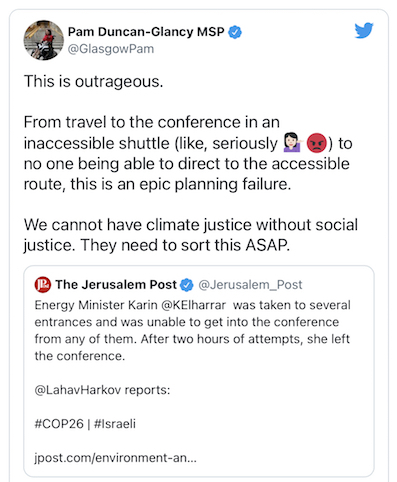
*
Above is a tweet from Pam Duncan-Glancy who has been a Labour MSP (Member of the Scottish Parliament) for Glasgow since May 2021. She is the first permanent wheelchair-user elected to the Scottish Parliament.
Last night, Israeli Energy Minister Karin Elharar told Israeli newspaper Yediot Ahronot "What happened today was scandalous and it shouldn't have happened. I came with certain goals, and I couldn't achieve them today."
She added "The UN calls on everyone to adhere to the international treaty," referring to the Convention on the Rights of Persons with Disabilities. "So it is appropriate for there to be accessibility at its events."
Israeli Foreign Minister Yair Lapid said: "It is impossible to take care of the future, the climate, and sustainability if we don't first take care of people, accessibility, and people with disabilities."
***
Tom Gross adds: Incidentally, another current member of the Israeli government, Shirly Pinto, representing the right-wing Yemina party, is deaf.
Pinto was born to deaf parents, and her mother is both deaf and blind and part of the wonderful Nalaga'at theater group, which I have seen perform:
https://en.wikipedia.org/wiki/Shirly_Pinto
https://en.wikipedia.org/wiki/Nalaga%27at
ARCHBISHOP OF CANTERBURY APOLOGIZES FOR COMPARING CLIMATE CHANGE TO NAZI HOLOCAUST
The Archbishop of Canterbury Justin Welby has apologized for telling the BBC yesterday that climate change would "allow a genocide on an infinitely greater scale than the Nazis."
Welby, the worldwide leader of the Anglican Church, made the comments in a live BBC broadcast while attending the COP26 summit.
Among those criticizing his comments was Stephen Pollard, editor of The Jewish Chronicle, who tweeted that Welby's comments were "so sickening that I simply cannot comprehend how Welby can remain as a priest, let alone Archbishop."
Welby later tweeted that he "unequivocally apologized" for "comparisons with the atrocities brought by the Nazis."

Above: British Prime Minister Boris Johnson, left, and UN Secretary-General Antonio Guterres, right, greet the Palestinian Authority Prime Minister Mohammad Shtayyeh at COP26. Shtayyeh said he will use his speech at the summit to attack Israel.
CNN REPORTS THAT "20,000 WORLD LEADERS AND DELEGATES" WERE IN EDINBURGH
There was considerable amusement yesterday when veteran CNN news anchor Wolf Blitzer stood in front of Edinburgh castle and said he was reporting from Edinburgh, "where 20,000 world leaders and delegates have gathered for the Cop26".
The Cop26 summit is in fact taking place in Glasgow, 47 miles west of Edinburgh.
CNN -- which was regularly derided as "Fake News CNN" by Donald Trump for the many errors it makes -- later moved its camera team to Glasgow, more than an hour's drive from Edinburgh.
A parody Boris Johnson twitter account quipped: "You seem to have all the necessary attributes to become my next Foreign Secretary."
Meanwhile Reuters' White House correspondent Jeff Mason tweeted a picture of the US president Joe Biden's arrival on Air Force One at Edinburgh airport, with the caption: "Arrived in Glasgow."
I attach three pieces below -- Tom Gross
ARTICLES
CRIES OF HYPOCRISY AS 400 PRIVATE JETS FILL THE GLASGOW SKY
Cop26: Cries of hypocrisy as private jets fill the Glasgow sky
By Ben Clatworthy, Transport Correspondent
The Times of London
November 2 2021
About 400 private jets will fly into Glasgow for the climate talks, prompting accusations of hypocrisy against world leaders and captains of industry.
Jeff Bezos, the founder of Amazon, led the parade in his ?48 million Gulf Stream, with the Prince of Wales, Prince Albert of Monaco and dozens of "green-minded" chief executives also arriving by private plane.
Charles is believed to have travelled from Rome, where he had been attending the G20 alongside Boris Johnson. It is thought he flew via RAF Brize Norton, where he may have picked up the Duchess of Cornwall.
A Clarence House spokesman defended the prince's decision to fly to the climate conference. He said: "His Royal Highness has personally campaigned for a shift towards sustainable aviation fuel and would only undertake travel to Rome when it was agreed that sustainable fuel would be used in the plane. Wherever possible, and recognising the challenges of supply, the intention is that sustainable fuel will increasingly be part of royal travel plans from now on."
The Duke and Duchess of Cambridge arrived in Glasgow by train yesterday morning and are believed to be using electric cars to travel between venues in the city.
The sheer volume of arrivals by private jet has prompted accusations of hypocrisy. Matt Finch, of the Transport and Environment campaign group, said: "The average private jet -- and we are not talking Air Force One -- emits two tonnes of CO2 for every hour in flight. It can't be stressed enough how bad private jets are for the environment, it is the worst way to travel, by miles.
"Our research has found that most journeys could easily be completed on scheduled flights. Private jets are very prestigious but it is difficult to avoid the hypocrisy of using one while claiming to be fighting climate change."
President Biden touched down in Edinburgh yesterday. Angela Merkel, the German chancellor, and President Macron of France arrived at Glasgow.
It is estimated that Biden will have generated 2.2 million pounds of C02 in reaching the conference. His entourage consists of a fleet of four planes, as well as his Marine One helicopter and a vast motorcade including The Beast and numerous SUVs.
A Dassault Falcon 8X belonging to the royal family of Monaco was seen arriving in Edinburgh yesterday, as was a Falcon 7X belonging to the government of Namibia. President Buhari of Nigeria disembarked from his Nigerian air force jet at Glasgow.
Planes also arrived in Glasgow from Ukraine, Pakistan, Armenia, South Korea, Australia, India, Rwanda and Angola -- none of which usually have scheduled flights to the airport.
Bezos was said to have travelled to Glasgow fresh from celebrating the 66th birthday of Bill Gates, the billionaire founder of Microsoft, on a ?2 million-a-week superyacht off the coast of Turkey. The Microsoft founder was said to have ferried his guests to and from the sprawling vessel by helicopter.
ISRAELI PM BENNETT ADDRESSES UN CLIMATE CHANGE CONFERENCE
The address by the Israeli Prime Minister Naftali Bennett addressed the UN Climate Change Conference in Glasgow, Scotland (Monday, 1 November 2021).
"Mr. President,
"Mr. Secretary General,
"Fellow leaders,
"As we gather here today in Glasgow, we know that history will judge our generation's response to this threat not by how ambitious we are, but by the actions we take.
"Israel is at the beginning of a revolution on climate change. We recently started implementing our 100-Step Plan, which means that we're currently doing more to promote clean energy and reduce greenhouse gases, than at any other time in our country's history. For the first time, Israel is committing to cutting greenhouse gas emissions to net zero by 2050, and will phase out of the use of coal by 2025.
"Yes, we're making progress, but let's be real: Israel is a small country. We're less than a third of the size of Scotland. So, our carbon footprint may be small, but our impact on climate change can be mighty.
"If we're going to move the needle, we need to contribute Israel's most valuable source of energy: The energy and brainpower of our people. You see, this is what fuels our innovation and ingenuity. This is where Israel can make a real difference. Israel may be 60% desert, but we've managed to make it bloom. We may be in one of the driest places on earth, but we've managed to become the world's number one country in water innovation.
"As the country with the most startups per capita in the world, we must channel our efforts to saving the world. Behavioral change alone will only take us so far. We're going to need new inventions and new technologies that have not yet been even imagined.
"And this is why I call upon our entrepreneurs, our innovators, in Israel and across the world: You can be the game changers. You can help save our planet. You see, instead of building yet another hyped-up internet app, why don't you launch startups that will help solve this global threat?
"Israel's national pivot to climate solutions can be only achieved with the right ecosystem. We've done it before. This is why I set up a task force called The Green Sandbox, to provide funds to help the entrepreneurs out and ensure that their path is free of bureaucratic bumps.
"My friends, as we work to keep people safe today, we will also be working for the resilience of tomorrow, where our children will breathe cleaner air, drink cleaner water and live in a world that treats the planet better than we did. Israel can become the climate innovation nation and we're ready to pave the way.
"Thank you very much."
HENRY KISSINGER: THE CHALLENGE OF BEING HUMAN IN THE AGE OF AI
The Challenge of Being Human in the Age of AI
By Henry Kissinger, Eric Schmidt and Daniel Huttenlocher
Wall Street Journal (opinion page)
November 2, 2021
The White House Office of Science and Technology Policy has called for "a bill of rights" to protect Americans in what is becoming "an AI-powered world." The concerns about AI are well-known and well-founded: that it will violate privacy and compromise transparency, and that biased input data will yield biased outcomes, including in fields essential to individual and societal flourishing such as medicine, law enforcement, hiring and loans.
But AI will compel even more fundamental change: It will challenge the primacy of human reason. For all of history, humans have sought to understand reality and our role in it. Since the Enlightenment, we have considered our reason -- our ability to investigate, understand and elaborate -- our primary means of explaining the world, and by explaining it, contributing to it. For the past 300 years, in what historians have come to call the Age of Reason, we have conducted ourselves accordingly; exploring, experimenting, inventing and building.
Now AI, a product of human ingenuity, is obviating the primacy of human reason: It is investigating and coming to perceive aspects of the world faster than we do, differently from the way we do, and, in some cases, in ways we don't understand.
In 2017, Google DeepMind created a program called AlphaZero that could win at chess by studying the game without human intervention and developing a not-quite-human strategy. When grandmaster Garry Kasparov saw it play, he described it as shaking the game "to its roots" -- not because it had played chess quickly or efficiently, but because it had conceived of chess anew.
In 2020, halicin, a novel antibiotic, was discovered by MIT researchers who instructed AI to compute beyond human capacity, modeling millions of compounds in days, and to explore previously undiscovered and unexplained methods of killing bacteria. Following the breakthrough, the researchers said that without AI, halicin would have been "prohibitively expensive" -- in other words, impossible -- to discover through traditional experimentation.
GPT-3, the language model operated by the research company OpenAI, which trains by consuming Internet text, is producing original text that meets Alan Turing's standard of displaying "intelligent" behavior indistinguishable from that of a human being.
The promise of AI is profound: translating languages; detecting diseases; combating climate change -- or at least modeling climate change better. But as AlphaZero's performance, halicin's discovery and GPT-3's composition demonstrate, the use of AI for an intended purpose may also have an unintended one: uncovering previously imperceptible but potentially vital aspects of reality.
That leaves humans needing to define -- or perhaps redefine -- our role in the world. For 300 years, the Age of Reason has been guided by the maxim "I think, therefore I am." But if AI "thinks," what are we?
If an AI writes the best screenplay of the year, should it win the Oscar? If an AI simulates or conducts the most consequential diplomatic negotiation of the year, should it win the Nobel Peace Prize? Should the human inventors? Can machines be "creative?" Or do their processes require new vocabulary to describe?
If a child with an AI assistant comes to consider it a "friend," what will become of his relationships with peers, or of his social or emotional development?
If an AI can care for a nursing-home resident -- remind her to take her medicine, alert paramedics if she falls, and otherwise keep her company -- can her family members visit her less? Should they? If her primary interaction becomes human-to-machine, rather than human-to-human, what will be the emotional state of the final chapter of her life?
And if, in the fog of war, an AI recommends an action that would cause damage or even casualties, should a commander heed it?
These questions are arising as global network platforms, such as Google, Twitter and Facebook, are employing AI to aggregate and filter more information than their users or employees can. AI, then, is making decisions about what is important -- and, increasingly, about what is true. Indeed, that Facebook knows aggregation and filtration exacerbates misinformation and mental illness is the fundamental allegation of whistleblower Frances Haugen.
Answering these questions will require concurrent efforts. One should consider not only the practical and legal implications of AI but the philosophical ones: If AI perceives aspects of reality humans cannot, how is it affecting human perception, cognition and interaction? Can AI befriend humans? What will be AI's impact on culture, humanity and history?
Another effort ought to expand the consideration of such questions beyond developers and regulators to experts in medicine, health, environment, agriculture, business, psychology, philosophy, history and other fields. The goal of both efforts should be to avoid extreme reactions -- either deferring to AI or resisting it -- and instead to seek a middle course: shaping AI with human values, including the dignity and moral agency of humans. In the U.S., a commission, administered by the government but staffed by many thinkers in many domains, should be established. The advancement of AI is inevitable, but its ultimate destination is not.
(Mr. Kissinger was secretary of state, 1973-77, and White House national security adviser, 1969-75. Mr. Schmidt was CEO of Google, 2001-11 and executive chairman of Google and its successor, Alphabet Inc., 2011-17. Mr. Huttenlocher is dean of the Schwarzman College of Computing at the Massachusetts Institute of Technology. They are authors of "The Age of AI: And Our Human Future.")
* You can also find other items that are not in these dispatches if you "like" this page on Facebook www.facebook.com/TomGrossMedia