
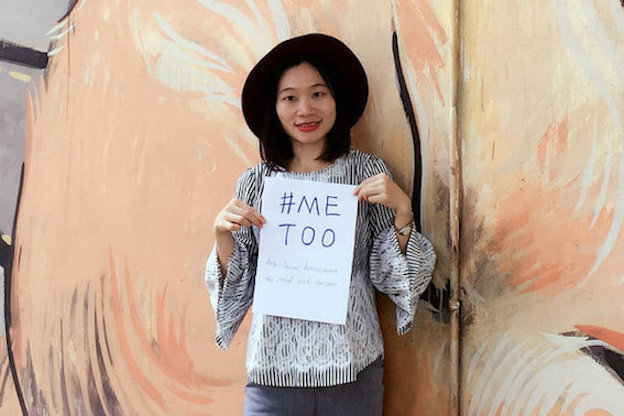
Above: journalist Huang Xueqin dared to write about China's nascent #MeToo movement on behalf of abused women. She vanished the day she left home in September to fly to Britain to study on a scholarship funded by the UK government.
NAVRATILOVA CONDEMNS AUSTRALIAN DECISION AS "PATHETIC"
[Note by Tom Gross]
I attach two articles below (both from the London Sunday Times) concerning human rights issues in the run-up to this year's two big sporting events: the Winter Olympics which start at the end of next week in China, and the Football World Cup being held later this year in Qatar.
Meanwhile, footage has emerged of human rights activists being manhandled by police in Melbourne outside the Australian Open tennis this weekend for wearing t-shirts with "Where is Peng Shuai?" printed on the back. A banner with the same message was confiscated.
Peng Shuai, the former doubles world No 1 tennis player and Wimbledon champion, has barely been seen in public since November when she posted allegations on social media of sexual assault by former Chinese vice-premier Zhang Gaoli.
The increasingly authoritarian Australian government has been accused of cozying up to China while clamping down on human rights at home under the guise of Covid restrictions.
Czech-born former world No 1 Martina Navratilova yesterday condemned as "pathetic" the decision by the Australian authorities to stop fans asking about Peng Shuai's whereabouts.
A fundraising page to raise money to print more "Where is Peng Shuai?" T-shirts to be handed out for free during the Australian women's final next Saturday has collected more than $12,000 in two days.
SCRIPTED RE-APPEARANCES FOLLOWING TORTURE ARE NOTHING NEW IN CHINA
The London Sunday Times reports that Teng Biao twice disappeared into Chinese detention. When he saw Peng crop up in a propaganda video last month, heavily promoted by state media, in which she said she was "free and happy" and had never endured sexual abuse, he immediately recognized the classic Chinese communist party playbook technique.
"Disappearances are a necessity for this dictatorship," Teng told the Sunday Times. "But China doesn't just practice enforced disappearances, it also relies on forced appearances, as we saw with Peng. They parade you in front of the cameras when it serves their purposes, to say what suits their purposes."
He knows this because he was himself forced to record a videoed confession to subversion in words written by his captors. "I was abducted off the street and taken away by the secret police," Teng said from exile in the US. "I was transferred between locations with a hood over my head. They slapped me about the face, cuffed my hands, forced me to sit on the ground in fixed position for hours, legs twisted below me, back straight. If I moved even slightly, I was severely beaten."
CHINESE GOVERNMENT FIRM SPONSORS AUSTRALIAN OPEN
The Australian Open's major commercial partner is the Chinese state-owned premium liquor brand Guojiao 1573. The fifth show court at Melbourne Park has been renamed the "1573 Arena" as part of a five-year deal estimated to be worth over $50 million.
This year's Australian Open has already proved controversial after the Australian government overruled its own courts to expel the world's greatest player and reigning Australian champion Novak Djokovic, despite the fact he tested negative for Covid.
QATAR PLANS TO BID FOR THE 2036 OLYMPICS
Regarding the second article below, on Qatar, the human rights situation for foreign laborers building the football stadiums and other World Cup facilities does appear to have improved somewhat since criticism was mounted after Qatar was first awarded the 2022 World Cup (including by me in articles such as this). But it is still very bad.
As the Sunday Times says: "The stakes for Qatar are high. It is hoping for a miracle in the desert later this year that will help it go on to become a global sporting hub. It will host a Formula One grand prix every year from next year, and stage the Asian Games, an athletics tournament, in 2030. Next up is its plan to bid for the 2036 Olympic Games."
-- Tom Gross
ARTICLES
'YOUR ONLY RIGHT IS TO OBEY': CHINA'S THOUSANDS OF DISAPPEARED
'Your only right is to obey': China's thousands of disappeared
Determined to avoid embarrassment at the Winter Olympics, Beijing is crushing dissent with a system of 'black jails' into which tens of thousands have vanished
By Philip Sherwell, Asia Correspondent
The Sunday Times (of London)
January 23, 2022
https://www.thetimes.co.uk/article/your-only-right-is-to-obey-chinas-thousands-of-disappeared-bmfmj3sx6
When the police came for Xie Yang, he knew what to expect. The human rights lawyer was first sucked into China's programme of mass disappearances in 2015, and later recounted the horrors he encountered during months in the communist state's clandestine "black jail" network.
He described how he had been shackled to a metal chair, punched and kicked. How interrogators hung him from the ceiling and beat him. How they threatened to leave him an invalid if he did not confess his crimes.
Xie used to tell friends: "Don't let silence become a habit." But the torture he suffered left a psychological scar. In court two years later, he earned his release by admitting on video that he was "brainwashed overseas" and by denying his previous claims of mistreatment.
This month he was abducted again from his home in the southern province of Hunan under the charge of "inciting subversion of state power". Orders were issued to his family not to give interviews.
His immediate "offence" was to protest about the treatment of a teacher thrown into a psychiatric hospital last month after she criticised the authorities.
But the timing suggests an additional reason: a determination to erase awkward distractions from the countdown to next month's Winter Olympics, an event intended by the Chinese Communist Party (CCP) to showcase the glory of the People's Republic in Xi Jinping's tenth year at the helm.
Last week Chinese officials warned that even foreign athletes who make political statements during the Games will be subject to "certain punishment".
The stakes for Chinese protesters are far higher.
As the country's most powerful leader since Chairman Mao Zedong, Xi has crushed rivals and critics -- real or perceived. The bedrock of that strategy is the use of systematic detention and disappearances on a huge scale.
NETWORK OF "BLACK JAILS"
Yang Maodong, an activist known by his pen name Guo Feixiong, vanished in December after a public battle to win permission to visit his terminally ill wife in the US. This month, two days after her death from cancer, his family were told that he too had been charged with subversion.
The locations of Xie, 50, and Yang, 55, are unknown, but there is every possibility that they are languishing in a vast network of "black jails" operated by the state security apparatus.
Detainees undergo "residential surveillance at a designated location" (RSDL) -- a cumbersome euphemism for being held off-grid for up to six months, with no contact with families or lawyers. Long, crushing days of isolation ensue, punctuated only by intense bouts of interrogation and torture.
Arriving in the system seven years ago, Xie received a chilling welcome.
"You are now under RSDL," he was told. "Your only right is to obey."
His experiences are among survivors' testimonies recorded in Locked Up: Inside China's RSDL Secret Jails and The People's Republic of The Disappeared, reports compiled by Safeguard Defenders, a human rights group tracking RSDL cases.
Victims describe being kept in padded suicide-proof cells, without natural light under constant supervision by guards. They relate "physical and psychological tortures including sleep deprivation, food deprivation, extended time in combined shackles and cuffs, beatings, forced medication, denial of medical treatment, sexual abuse, stress positions held for extended periods (such as being hung by the wrists) and threats of physical harm to them and their loved ones".
By scrutinising public court records, the group estimated that between 27,000 and 57,000 people went through RSDL after it was put into law in 2013. The figure peaked at up to 15,000 cases in 2020, the last year documented.
Peter Dahlin, the organisation's Swedish director, was himself detained in 2016 and eventually made a stage-managed confession that he broke the law by supporting Chinese civil rights lawyers.
Recently he spotted that the court data relating to RSDL was quietly being scrubbed. The only glimpse of the scale of disappearances was itself being disappeared.
ENFORCED DISAPPEARANCES
Survivors of the detention system see a familiar pattern in the fate one of the country's most famous Olympians -- Peng Shuai.
The tennis star and former Wimbledon doubles champion largely vanished from public view in November after accusing one of Xi's former top officials of coercing her into sex. She has not been seen at all since December 19.
Like Xie, Teng Biao is a human rights lawyer who twice disappeared into detention. When he saw Peng crop up in videos, heavily promoted by state media, in which she said she was free and happy and had never endured sexual abuse, he immediately recognised the classic CCP playbook.
"Disappearances are a necessity for this dictatorship," said Teng, 48. "But China does not just practise enforced disappearances, it also relies on forced appearances, as we saw with Peng. They parade you in front of the cameras when it serves their purposes, to say what suits their purposes."
He knows this because he was himself forced to record a videoed confession to subversion in words written by his captors. "I was abducted off the street and taken away by the secret police," Teng said from exile in the US (he and his family flew there after he was allowed to take a teaching position in Hong Kong in 2012). "I was transferred between locations with a hood over my head.
"They slapped me about the face, cuffed my hands, forced me to sit on the ground in fixed position for hours, legs twisted below me, back straight. If I moved even slightly, I was beaten.
"But the hardest part during the 70 days was the uncertainty, not the torture. You're never told how long you'll be detained, how long you'll live in the dark, knowing that your family also has no idea of your whereabouts. The isolation was complete."
Peng, 36, laid out her claims about Zhang Gaoli, 75, a former vice-premier, in a social media post that was almost immediately censored, but not before it was widely downloaded. Her case has proved particularly awkward for the Olympic movement.
She herself has played at three Olympic Games. Before his retirement, her alleged abuser ran Xi's government working group with the International Olympic Committee (IOC). Thomas Bach, the head of the IOC, which has been conspicuously uncritical of China's human rights record, then held a video call with Peng, that was widely dismissed as a "charade".
"China disappeared Peng Shuai because she had the courage to speak out against sexual abuses by a senior party official," said Michael Caster, co-founder of Safeguard Defenders.
"Beijing has disappeared tens of thousands of its citizens for no less arbitrary reasons -- to silence and intimidate. We must not allow China to use the spotlight as Olympics host to manipulate the narrative and whitewash its record."
Ai Weiwei, the artist who helped design the latticed splendour of the Bird's Nest national stadium for the 2008 Beijing Olympics, was detained for 81 days just three years later.
Since then, the system of mass disappearances and coerced appearances has been expanded and codified into law.
During Xi's decade in charge, the state has used it to consolidate power in restive regions and to curb scrutiny on sensitive issues.
In Hong Kong, pro-democracy campaigners such as the former student leader Joshua Wong and the newspaper mogul Jimmy Lai have been silenced by indefinite detention. Bo Lee, a British citizen, was one of five Hong Kong booksellers abducted and smuggled across the border to mainland China in 2015 for selling content that infuriated Beijing. He later appeared on Chinese state television to insist he had not been abducted.
In the western province of Xinjiang, an estimated one million Muslims, predominantly ethnic Uighurs, have been swept into internment camps under the guise of fighting Islamic extremism,
Before Xinjiang, Beijing honed its tactics during its brutal repression of Tibet's religion, culture and language. Among the many Tibetans who have vanished for long stints is the Panchen Lama, the second holiest figure in Tibetan Buddhism. He was abducted aged six in 1995 and has not been seen since.
Four citizen journalists were swept into RSDL after publicising accounts of life under lockdown in Wuhan that undermined the regime's propaganda about the "people's war" against Covid-19. The family of one of them, Zhang Zhan, says she is now close to death in jail on hunger strike. Huang Xueqin, a journalist, angered the authorities with her coverage of China's nascent #MeToo movement. She vanished the day she left home in September to fly to Britain to study on a scholarship funded by the UK government.
Foreign connections offer little protection. Cheng Lei, an Australian citizen and prominent television anchor for the state broadcaster, disappeared in 2020. Her close friend Haze Fan, a Chinese reporter for Bloomberg News, was last seen more than a year ago.
Michael Kovrig and Michael Spavor, two Canadians, were arrested in China in 2018 in retaliation for the detention in Vancouver of Huawei's chief financial officer. They spent almost three years in custody. Yang Hengjun, an Australian writer and democracy activist, has just entered his fourth year of incarceration for alleged espionage. Friends say his health is deteriorating rapidly.
China rarely comments on individual cases, but it has accused groups such as Safeguard Defenders and the UN working group on enforced disappearances of "maliciously" misrepresenting RSDL.
ELITES BECOME TARGETS
Xi's own father, one of communist China's founders, was purged from public view several times. Yet as leader, under the banner of fighting corruption, Xi has enthusiastically embraced such methods to eliminate rivals.
Last year, as part of a campaign to "rectify" China's law enforcement and judiciary, about 170,000 officials were prosecuted and 3,000 disappeared, according to the CCP's own figures.
The campaign of "rectification" -- a mantra under Mao -- "aims to bolster Xi's authority and eliminate potential rivals", said Maya Wang, senior China researcher at Human Rights Watch. "But it also aims to bend China's entire legal system to his will and ensure society must obey and submit."
Meng Hongwei, a serving director of Interpol, went missing while visiting his homeland in 2018 and was then jailed for 13 years for taking bribes when he was China's vice-minister of public security.
The country's entertainment and business elite are increasingly targets too, although their stature often shields them from RSDL. Fan Bingbing was China's best-paid actress, a crossover Hollywood star of the X-Men and Iron Man franchises, but she disappeared in 2018. She emerged several months later after agreeing to pay a fine of $127 million for tax evasion. Zhao Wei replaced her as the most famous name in Chinese entertainment -- an actress, film director, pop star and technology investor. Then, in August, her 68 million social media followers discovered that her accounts had disappeared. Her location and her alleged crime remain unknown. Last month, China imposed an unprecedented $210 million fine on Huang Wei -- a hugely popular "influencer" known as Viya -- for tax evasion in 2019 and 2020. She too is nowhere to be seen.
The clampdown on celebrities reflects the party's suspicion of anyone who amasses a following that could make them an alternative source of power and influence.
It also comes as state media relentlessly champions Xi's new policy of "common prosperity" -- instructing the country's wealthy that they must hand over a larger chunk of their wealth as income redistribution.
They come no richer or bigger than Jack Ma, the multibillionaire behind the Alibaba online retail empire. When Ma, a CCP member, tried to defy Beijing's regulatory crackdown on China's Big Tech, he lost the battle and, once ubiquitous, his image rapidly faded.
"The world is turning its eyes to China and China is ready," Xi declared confidently in his new year address as he looked ahead to the Olympics. He does not want those eyes to focus on coronavirus flare-ups -- vexingly persistent, despite Beijing's hardline "zero-Covid" strategy -- or diplomatic boycotts of the Games by the US, Britain and other nations.
The silencing of Xie Yang, Yang Maodong and the thousands of others who vanish each year into the sprawling machinery of China's custodial system have enabled him to keep an iron grip on the national conversation.
Later this year, the 20th party congress seems certain to award the leader an unprecedented third term in power.
When Xi takes his seat in Ai's stadium for the opening ceremony of the Winter Olympics on February 4, his position will never have looked more impregnable.
QATAR 2022: INSIDE THE MOST CONTROVERSIAL WORLD CUP EVER
Qatar 2022: inside the most controversial World Cup ever
Plagued by charges of corruption and human rights abuses, the Qatar World Cup kicks off in ten months' time. John Arlidge reveals what awaits 1.5 million fans
By John Arlidge
The Sunday Times (of London)
January 23, 2022
https://www.thetimes.co.uk/article/qatar-2022-inside-the-most-controversial-world-cup-ever-9kp3vst6v
It's noon on a Monday in December but it feels like a British summer's day. The temperature is 23C, there's scarcely a cloud in the sky and the grass is as green as on the first day of Wimbledon. Looking out from the 37th floor of Al Bidda Tower over Doha's Corniche, I can see new football stadiums in every direction -- Khalifa, Stadium 974, Lusail. Standing next to me is Hassan al-Thawadi, the man in charge of the biggest and most controversial event this year, the World Cup in Qatar, which kicks off in just ten months' time. "Any nerves?" I ask him. "Definitely," he replies.
The 43-year-old Qatari has good reason to be apprehensive. From the moment back in 2010 that Sepp Blatter, the Fifa president, announced Qatar had won the right to host the tournament, it became the most troubled sporting event since the 1980 Moscow Olympics, which some western nations boycotted after Russia's invasion of Afghanistan. Many wondered how such a small country that had never competed in a World Cup had managed to win the secret ballot to host it. How could players compete in 50C summer temperatures, critics asked.
This newspaper soon revealed that Mohamed bin Hammam, the country's top football official, used secret slush funds to make dozens of payments totalling more than ?3.8 million to senior officials in world football to create a groundswell of support for the emirate. A 2014 probe into the corruption ordered by Fifa and conducted by a lawyer cleared Qatar of wrongdoing -- but an indictment lodged by US prosecutors last year alleges that three Fifa executive committee members received payments to back Qatar's bid. After the graft was exposed, human rights abuses were revealed, notably the exploitation of migrant labourers, that still persist today. Thousands have died building stadiums and infrastructure, critics say.
Qatar bid to host the tournament "to introduce our beautiful country and the Arab world to billions of people", Thawadi tells me on the first day of a week-long visit to the emirate. I've travelled to Doha to see the stadiums and infrastructure, visit the labour camps and talk to the executives in charge of the first World Cup to be held in the Middle East.
To welcome the world, the government is spending ?5.2 billion on seven new stadiums and another ?150 billion on whizzy transport and general infrastructure. The total bill comes to ?450,000 per Qatari, but that's not a huge reach. Qatar's vast gas reserves -- the third largest in the world -- and tiny native population of 350,000 make it the wealthiest country on a per capita basis. GDP per head is more than ?400,000. The UK figure is ?30,000.
If splashing pennies from heaven were the benchmark of success, the country -- a peninsula the size of Yorkshire in the Arabian Gulf, 250 miles west of Dubai -- would already have lifted the 18-carat gold trophy. The stadiums are among the finest ever built. The 90,000-seat Lusail is a similar shape to Manchester City's Etihad ground but almost twice the size, and its lattice walls, designed by Sir Norman Foster + Partners, look as great when lit up at night as Bayern Munich's Allianz Arena. Al Bayt stadium, where I watched Qatar beat Iraq 3-0 in the Arab Cup in December, resembles a giant Bedouin tent, complete with carpeted interior walls. A huge flaming torch welcomes fans. Every game will look fantastic on television.
The ruling al-Thani family wants to do more than put on a good show, though. It hopes to use the biggest global event in history to take place in the Middle East -- and the biggest sporting event post-Covid -- to enhance Qatar's status and foster East-meets-West dialogue through "the openness and tolerance of the hospitable Qatari people", as the emir, Sheikh Tamim bin Hamad al-Thani, puts it. It's part of a multibillion-pound programme of spending on sport, education, the arts and media -- the government funds the Doha-based Al Jazeera news network -- to position Qatar as the mature, responsible face of the Gulf, somewhere between racy Dubai and conservative Saudi Arabia.
It's not going well. Qatar is struggling to put the beautiful game ahead of the ugliness surrounding the bid process and human rights abuses. Newspapers have reported that official records indicate more than 6,500 migrants who worked in Qatar from 2010-20 died, many of them construction workers. Qatar disputes the figure. Whistleblowers who have leaked evidence of human rights abuses protest they have been detained in an effort to silence or intimidate them. Some journalists flying in to report on the conditions in labour camps have been arrested and held for hours. One reporter found workers who toiled all summer in direct sunlight and had to use their drinking water to cool their burning feet.
Managers of clubs in Europe where most of the top international stars play are unhappy about the interruption to their domestic season -- Qatar 2022 became the first winter World Cup after Fifa acknowledged the heat would make a summer competition impossible. Qatar's attempts to use petrodollars to garner some much-needed positive PR have backfired. When last year David Beckham was announced as a Qatar 2022 global ambassador and one of the "faces" of the tournament in a deal thought to be worth ?100 million over several years, fellow professionals including Gary Lineker condemned him for taking the Qatari riyal. Claims that the tournament will be carbon neutral have also raised quizzical eyebrows, to put it mildly. Greening the desert and cooling stadiums -- including the stands -- uses a lot of power and water.
And this is all before a ball has been kicked. When that happens many will heed Amnesty International's call to protest. England is likely to be among many teams that ask to visit workers' camps to check on conditions. England players have been accused of hypocrisy for taking the knee before domestic league games in support of the Black Lives Matter movement while ignoring the plight of the thousands of African migrant workers who have built the Doha stadiums in which they will play. There are likely to be demonstrations on the Corniche for women's empowerment and LGBT rights: same-sex relations are illegal in Qatar and carry a punishment of up to five years in jail. There are concerns about the treatment of women's rights activists, highlighted by the case of Noof al-Maadeed, 23, who disappeared in Doha without explanation for several weeks last year.
Amid all the bad blood it's remarkable that anyone can agree on anything, but there are two things that almost everyone predicts will happen in November. The teams that have qualified, including perhaps Scotland or Wales when the play-off places are determined, will go and fans will follow. There have been calls for boycotts, but players want to play on the biggest stage and, despite some fans' political objections, most are so dedicated to their national side they would follow them even if the tournament were in North Korea. The first tranche of the three million publicly available tickets goes on sale this month and will be snapped up. Many corporate hospitality packages are sold out.
British fans who buy tickets will find getting to Qatar straightforward. Qatar Airways is one of the world's largest airlines and it partners with British Airways, which means there will be direct services to Doha from Heathrow, Gatwick, Manchester and Edinburgh. Qatar Airways' boss, Akbar al-Baker, has expanded Doha's new Hamad airport to handle 200,000 passengers a day. Supporters are unlikely to be able to bring duty-free booze with them. Alcohol is only legally available in hotel bars and restaurants in Qatar. However, beer cheaper than the ?10 a pint it usually costs will be available in fan zones near the stadiums but not inside them. There will be alcohol in some of the corporate hospitality boxes -- plutocrats are not easily separated from their champagne.
Those found to be drunk and disorderly in public outside corporate hospitality or fan zones will be "escorted away to sober up but not arrested or detained", officials say. Qatar is working with UK police forces to make sure any fans with a history of criminal behaviour do not make it past immigration.
Getting to and from games will be easy. New 12-lane highways carve giant black streaks across the sand. The box-fresh metro system is the world's first three-class "tube" with gold, standard and family carriages that can be used by women who don't want to travel alongside unmarried men -- or mobs of chanting fans. With winter temperatures around 27C by day and 20C by night, it's comfortable to walk from the taxi drop-off points or the metro stations to and from the stadiums. Dedicated fans will be able to see four games in four stadiums a day (if they hurry). Hosting the tournament in such a small country will also save fans from having to book last-minute flights and hotels in faraway cities as teams advance through the knockout stages, as usually happens.
Claims that local fans are uninterested in football and will watch largely in silence appear to be misplaced. The games I attended during the Arab Cup in December were raucous enough and the atmosphere will probably be the same when fans watch teams from outside the region. To entertain supporters between games, the Corniche will become a giant fan zone and Doha's museums and galleries are being spruced up.
However, Qatar's small size and tiny population -- 2.8 million, 90 per cent of whom are foreigners -- throw up challenges. The emirate is expecting 1.5 million visitors over the month-long tournament but will have just 130,000 rooms in hotels, on cruise ships and at "glamp" sites in the desert, 20,000 of which will be taken by teams and their staff, Fifa officials and journalists. Locals are being encouraged to share their homes with visiting supporters via Airbnb and other agents to create an extra 64,000 rooms. That still won't create enough beds at the start of the tournament, when fan numbers are at their peak. Supporters who are trying to book accommodation before they buy tickets are already complaining that they cannot find any -- or any affordable -- rooms online.
Will it all be enough of a success that the footballing and wider world can put to one side the corruption and exploitation?
The evidence on the ground suggests that the practical issues will probably be resolved by a combination of cash and the natural ingenuity and determination of football fans. Those who can't find accommodation in Qatar will easily do so in neighbouring Dubai and Abu Dhabi and fly in and out -- a one-hour hop. If the political protests are small, they'll probably pass off reasonably peacefully. Police are having "sensitivity training" and have received orders not to do what they normally do in the Gulf when demonstrators take to the streets -- crack heads. Government officials hope that once the tournament starts the thrill of the games will prove more alluring than the power of protest. They may well be right.
Workers' rights remain the big issue. Barely a week goes by without a newspaper or TV news channel unearthing fresh evidence that many contractors in Qatar regard migrant workers as largely expendable. This newspaper has reported how labourers worked shifts of up to 20 hours in summer, with only a few short breaks and insufficient water. Some have had wages withheld or unpaid altogether.
Over coffee and pastries in a local hotel, one government official concedes that by failing to address the workers' rights issue sooner "it has become a disaster". Another, speaking privately as all officials in Doha do for fear of offending the emir and losing their job, attempts an explanation. "When you're a wealthy country, a monarchy, people think you can change everything in one day. But the business lobby here is very powerful."
The Gulf states of Qatar, Dubai and Abu Dhabi have been built and have prospered using an economic model based on hyper-cheap migrant manual labour, mainly from south Asia and Africa. Persuading the biggest and most powerful contractors in the region to reverse decades-old practices that have proved very profitable "takes time", the official says.
However, there are signs of change. Ask Max Tunon from Manchester. If anyone holds the key to the success or failure of the World Cup it's him, because he's the head of the Qatar office of the International Labour Organisation (ILO), a United Nations agency that sets and monitors international labour standards. "We're in a much better position than when the ILO arrived in 2018," he tells me in his office on the sixth floor of the drably named Building 35 in downtown Doha. "The government is committed to big changes."
After three years of tense negotiations between ministers and the ILO, an ancient practice known as kafala, which prevented workers from moving jobs or quitting and going home without their employer's consent, has been scrapped. An annually reviewed minimum wage of ?210 a month has been introduced, excluding food and lodging costs which are usually met by employers. It's the first of its kind in the Gulf. Workers' representatives are now elected to work councils to negotiate with management; a multilingual online complaints system for labourers has been instituted; and two new courts for labour disputes are being set up, taking the total to five. New restrictions on working in the summer heat have also been introduced.
Critics argue the new laws do not go far enough -- nor are they adequately policed -- and point out that independent trade unions remain banned. The reforms "are for face-saving, rather than concern about workers", says Barun Ghimire, a human rights lawyer who acts for Nepalese workers. Labourers claim it is still difficult to move jobs because employers threaten to deport them or report them for "absconding", which can lead to arrest.
Tunon, 42, who worked for the ILO in India, China and Thailand before moving to Doha, acknowledges "there are gaps in implementation". He is heartened, however, by the government's recent decision to create a dedicated Ministry of Labour, headed by Dr Ali bin Smaikh al-Marri, formerly chief of the independent Qatar National Human Rights Committee.
The reforms will help to reduce deaths in future, but what about the 6,500 so far? That figure, based on records held by the governments of south Asian nations, is controversial. Qatar dismisses it as "highly misleading", because it represents all deaths among all the five million south Asian nationals who worked in Qatar from 2010-20 -- not just work-related deaths, far less World Cup work-related deaths.
Thawadi, who studied law at Sheffield University and has forensic lawyer-like focus on the issue, claims there have been just three work-related deaths at stadiums since 2010, and 35 non-work-related deaths. That's partly because Fifa wrote strict worker welfare and safety rules into tender documents for World Cup contractors. The ILO has investigated migrant worker deaths and found that in 2020 there were 50 across all of Qatar, not just on World Cup projects. Critics say all local analysis of work-related deaths underestimates the total because it relies on government figures that are limited to deaths at the workplace and do not take account of deaths from chronic conditions such as kidney disease caused by working in the harsh environment. Whatever the total, it is far too high for a country as wealthy as Qatar.
What do labourers say? Are conditions improving? I phone the government communications office and ask to visit a camp. The next morning I arrive at a dusty desert settlement where 1,800 migrants work ten-hour shifts, six days a week for the local contractor HBK, which is building the Lusail stadium. I'm introduced to Vijay Shankar, 36, a plumber from Bihar in India. "When I first came here 15 years ago to work for another company I earned ?160 a month," he says. "Now it's ?300."
He shows me his room in one of a series of three-storey dormitories. He shares with three other labourers in a space 20ft by 12ft. Each gets a low metal bed with only a pull-around curtain for the barest semblance of privacy and a small metal locker for personal possessions. There is air conditioning, wi-fi and basic -- but clean -- showers and lavatories. Laundry is done by the company and the food is OK, he says. "We complained about the thickness of the dal and they fixed it." I walk around the other rooms and confirm they are all the same.
How does it compare with his experience 15 years ago when he first came to work in Qatar? "We had 18 men in a dormitory. The toilets were holes in the floor. We had to buy and cook our own food, wash our own clothes, travel to go shopping on our own -- there's now a free bus." I ask him whether there are still bad camps in Qatar, like the ones he used to live in. He nods nervously, mindful of the fate of critics of the regime.
The HBK camp is a World Cup project where standards are supposed to be decent. So I ask the government to see an independent camp. The next day I arrive at Labour City in the industrial zone, ten miles into the desert from downtown Doha, home to some 70,000 workers who toil on mainly non-World Cup projects. There I meet Mohamed Abdullah, a 45-year-old Ghanaian security manager. He is less shy than Shankar. "I have friends in other camps and it's true that many are really not good," tells me. "Toilets are not cleaned. Too many people in one room."
His boss, Main Jarboui, 35, a Tunisian who describes himself as "a knucklehead who speaks the truth", confirms that some contractors "are playing games. It costs money for companies to comply with the new laws. The way they see it, rules cost money. Standards cost money. It's cheaper to escape the rules." Whistleblowers confirm men can still be crammed up to a dozen in a small room.
The three men's comments go to the heart of the problem Qatar 2022 faces. Big contractors working on World Cup projects have -- albeit belatedly -- raised rates of pay and standards of accommodation and food to meet the new laws and the conditions imposed by Fifa. However, some private-sector contractors that work on projects not directly related to the World Cup -- and therefore do not have to observe Fifa's standards and are less closely monitored -- are dragging their feet. Even Thawadi admits: "We have the good, the bad and the ugly."
What about the other concerns? I ask Thawadi if gay fans will really be welcome. "Everybody's welcome," he tells me, before adding quickly, "Public displays of affection, regardless of sexual orientation, are not part of our culture, so we ask people to respect that." Women will be free to enjoy the games in exactly the same way as men. Unlike in some Middle Eastern nations, Qatar has no restrictions on where women fans can sit, nor rules on what they're expected to wear.
Thawadi's claim that Qatar 2022 will be carbon neutral has prompted derision from environmentalists. Zeina Khalil Hajj, head of global campaigning at 350, a climate protection NGO, says: "Events such as these have a grave additional environmental and climate impact." Thawadi says local sourcing of materials, efficient water use, the development of an 800-megawatt solar farm, the creation of the metro, the replacement of diesel buses with electric ones and the government's purchase of carbon credits to offset flights will go a long way to minimise the carbon footprint. One stadium will be recycled -- dismantled and transferred overseas for other tournaments -- while another will be almost halved in size after the removal of the top tier of seats and a third converted into a hotel and sports health facility. Thawadi's answers reveal a man caught between the conflicting demands of liberal western critics on one side and local conservative forces on the other.
What about the ruling al-Thani family's claim that it is hosting the world's biggest party to foster tolerance and create East-meets-West dialogue? That is true. The al-Thanis have already invested more than ?20 billion in education and culture, creating two national museums and a national library, which have helped to introduce people in the region to western culture and westerners to Islamic art. There's currently a big Jeff Koons show in Doha. Sheikha al-Mayassa bint Hamad bin Khalifa al-Thani, head of Qatar Museums and sister of the emir, says, "It's important to learn from different cultures."
The trouble is that Qatar's rulers do not always learn the right lessons. "They've been very naive when it comes to the World Cup," argues one local political observer who, like all political analysts who want to stay in Qatar, speaks privately. "They should have realised sooner that their great wealth would attract greater scrutiny than previous host nations and moved faster to deal with the entirely predictable issues. They've ended up overwhelmed."
Qatar's woes have prompted some to argue it is too weakened to pull off a triumph later this year. Government officials point out that Qatar has overcome far bigger challenges. Five years ago its neighbours, led by Saudi Arabia and the UAE, imposed an economic blockade, closing borders and demanding it do everything from changing foreign policy to closing down Al Jazeera. Riyadh and Abu Dhabi were angry at what they saw as the emirate's "malign" influence on regional politics, in particular, they claimed, its support for the Muslim Brotherhood. Qatar refused to comply and established new trading routes, largely with Turkey and Iran. Eventually its opponents ended the blockade and began a new era of cold peace with the emirate.
On the last day of my week in Doha I speak to Dr Paul Brannagan, author of Qatar and the 2022 Fifa World Cup: Politics, Controversy, Change, which is published in March. In the book he uses the phrase "soft disempowerment" to describe what happens when a nation tries and fails to use sport to raise its profile and improve its image. "Governments tend to think that if you host an event it's going to boost 'soft power', but that's not always the case," he says. He cites the 2010 Commonwealth Games in Delhi, which were criticised because contractors used child labourers, ending India's hopes of hosting the Olympics.
The stakes for Qatar are similarly high. It is hoping for a miracle in the desert later this year that will help it go on to become a global sporting hub. It will host a Formula One grand prix every year from next year, and stage the Asian Games, an athletics tournament, in 2030. Next up is its plan to bid for the 2036 Olympic Games.
* You can also find other items that are not in these dispatches if you "like" this page on Facebook www.facebook.com/TomGrossMedia

Above: Just a little light humor before the rest of this serious dispatch.

Anders Behring Breivik, who murdered 77 people in Norway's worst modern peacetime atrocity in July 2011, gave a Nazi salute this morning (Tuesday) as he entered court for a parole hearing that will decide if he should be released after spending only a decade behind bars. Breivik killed eight people with a car bomb in Oslo and then gunned down 69, most of them teenagers, at a Norwegian Labour Party youth camp.
In court today he also displayed a sign printed in English that said "Stop your genocide against our white nations". Breivik, now 42, is serving Norway's maximum sentence of 21 years. Breivik lost a human rights case in 2017 when an appeals court overturned the decision of a lower court that his near-isolation in a three-room cell was "inhumane".

"HE HAD BEEN INVITED INTO THE SYNAGOGUE FOR TEA AFTER KNOCKING ON THE DOOR DURING SABBATH PRAYERS"
[Note by Tom Gross]
I attach pieces regarding Saturday's synagogue siege near Dallas from today's Guardian, Times of London, and New York Times, as well as a piece from the (London) Jewish Chronicle.
Jeff Cohen, one of the people held hostage by British Islamist terrorist Malik Faisal Akram said that the gunman told the hostages that he chose Congregation Beth Israel in Colleyville, Texas because it was the closest synagogue to the prison where the so-called "Lady al-Qaeda," Aafia Siddiqui, is being held.
Akram subscribed to multiple antisemitic conspiracy theories and was convinced that the Jews inside the tiny Congregation Beth Israel could "instruct" the US government to free the Pakistani prisoner, who is serving an 86-year sentence for terrorism.
Rabbi Charlie Cytron-Walker said he had allowed the gunman into the synagogue because it had appeared as if Akram was looking for somewhere to get warm. "He had been invited into the synagogue for tea after knocking on the door during Sabbath prayers," the rabbi said afterwards.
CONTENTS
1. "MI5 investigated Texas synagogue hostage-taker in 2020: UK intelligence concluded Malik Faisal Akram posed no threat, which allowed him to travel to US and buy gun" (The Guardian, Jan. 18, 2022)
2. "Texas synagogue siege: Hostage-taker had fixation on terrorist" (The London Times, Jan. 18, 2022)
3. "It is grotesque to assert that the Texas synagogue siege was not motivated by antisemitism" (By Rabbi Laura Janner-Klausner, Jewish Chronicle, Jan. 17, 2022)
4. "The Hostages Escaped. But Synagogues Ask, How Can They Be More Secure?" (New York Times, Jan. 17, 2022)
5. "Going to Services Should Not Be an Act of Courage" (By Prof. Deborah Lipstadt, New York Times, Jan. 18, 2022)
ARTICLES
MI5 INVESTIGATED TEXAS SYNAGOGUE HOSTAGE-TAKER
MI5 investigated Texas synagogue hostage-taker in 2020
UK intelligence concluded Malik Faisal Akram posed no threat, which allowed him to travel to US and buy gun
By Dan Sabbagh
The Guardian
January 18, 2022
https://www.theguardian.com/uk-news/2022/jan/18/mi5-investigated-texas-synagogue-hostage-taker-malik-faisal-akram-in-2020
The British man who took hostages at a Texas synagogue had been under investigation by MI5 as a possible Islamist terrorist threat as recently as 2020, Whitehall sources have acknowledged.
British intelligence closed the investigation, however, after officers had concluded Malik Faisal Akram from Blackburn posed no threat, and as a result he was able to travel freely to the US and purchase a gun.
It is understood the investigation was "mid-level" and took place in the second half of 2020 ? but once it had ended Akram was left as a closed subject of interest on MI5's records, and no information of concern appears to have been passed to the US authorities before the synagogue attack.
The Security Service's investigation lasted "over four weeks", a source said. But it ended with an assessment that Akram did not pose a jihadist terror risk and there was no reason to prevent him from travelling abroad.
The acknowledgment is a particular embarrassment to the agency, which prides itself on a close working relationship with its US counterparts. The FBI has known about MI5's previous investigation for some time, although British sources declined to say whether they had apologised.
Akram, a 44-year-old from Blackburn, was killed after an 11-hour hostage standoff at the Congregation Beth Israel synagogue in the Dallas suburb of Colleyville on Saturday evening. All four hostages survived the siege unharmed.
President Joe Biden on Sunday declared the incident an act of terrorism and the British foreign secretary, Liz Truss, said the UK government condemned "this act of terrorism and antisemitism".
Akram had a criminal record in the UK but no known terror convictions. Investigators and family members say he had a history of mental health issues.
He had been the subject of an exclusion order in 2001 banning him from Blackburn magistrates court after he made remarks about the 9/11 attacks on the US, saying he wished a court usher had been on a plane flown into buildings to commit mass murder.
Akram travelled to the US around the time of the new year, and spent time in homeless shelters in Dallas. He was brought to a shelter in downtown Dallas on 2 January by a man who hugged him and had conversations with him, said Wayne Walker, the CEO and pastor of OurCalling, which provides services to homeless people.
Asked by reporters on Sunday how Akram could have procured weapons in the US, Biden said: "The assertion was he got the weapons on the street. He purchased them when he landed."
As the siege unfolded, the FBI asked British police to get Akram's family to try to talk him into surrendering. They spoke to Akram as he held hostages, but could not convince him to give himself up.
In a statement to Sky News on Monday, Akram's brother Gulbar asked how he had been able to acquire a visa to enter the US. "He's known to police. Got a criminal record. How was he allowed to get a visa and acquire a gun?" he said.
British detectives continued to question two teenagers arrested in Manchester who are both believed to be male. They are being questioned to see if they knew anything about Akram's intentions to travel to the US to stage the attack.
TEXAS SYNAGOGUE SIEGE: HOSTAGE-TAKER HAD FIXATION ON TERRORIST
Texas synagogue siege: Hostage-taker had fixation on terrorist
By Fiona Hamilton, Duncan Gardham, Neil Johnston, Emma Yeomans, Keiran Southern in Dallas, and Haroon Janjua in Islamabad
The (London) Times
January 18, 2022
The British man shot dead after an 11-hour siege at a synagogue in Texas was fixated on the release of an Islamist prisoner known as Lady al-Qaeda and had argued with his family after moving to a conservative strand of Islam.
Malik Faisal Akram, 44, repeatedly said he wanted to go to America to demand the release of Aafia Siddiqui, a Pakistani neuroscientist linked to the terrorist group.
Akram, who went to the US a fortnight ago, demanded her release on Saturday in exchange for four hostages he took at a synagogue in Colleyville, three miles from Dallas. Siddiqui is serving an 86-year-old sentence for trying to kill US soldiers in Afghanistan. She is held in Fort Worth, Texas.
There are questions about how Akram, whose family said he had a criminal record, was able to travel to the US, where he bought a handgun. Investigators are trying to establish if he lied on his tourist visa waiver, which requires offences to be declared.
The leader of a homeless shelter where Akram stayed for three nights before the attack said he could not have been in possession of a gun there.
Bruce Butler, the chief executive of Union Gospel Mission Dallas, said all visitors are screened for weapons and there were no obvious warning signs Akram was dangerous. He added: "We check people. We have no reason to believe he had [a gun]. We checked him, we check everybody who comes in." There were "no apparent issues" with Akram, Butler said. He was "very quiet".
Whitehall officials refused to comment on claims that he was known to the Security Service. His arrival raised no red flags in the United States, where President Biden declared the incident an act of terrorism. All four hostages were freed without injury but Akram was shot dead by an FBI rescue team.
Rabbi Charlie Cytron-Walker told CBS he and the others rushed for an exit door after he threw a chair at Akram, who had referred to them as "four beautiful Jews". He had been invited into the synagogue for tea after knocking on the door during Sabbath prayers. Akram was known to have mental health problems. He was banned from Blackburn magistrates' court the day after the September 11 attacks in 2001 for telling an usher he wished he had died on the flights.
Associates in Blackburn said that Akram, who was estranged from his wife and had six children, had a temper and tried to impose his strict religious values on others. They said he had become increasingly religious, had distanced himself from his family and had taken to Wahhabism, a fundamentalist strain of Islam.
Akram's criminal record included an assault connected with a drug deal, violent disorder and driving offences. It is understood that he had never been arrested for terrorism offences.
Biden said Akram had bought a handgun in "the street" after his arrival in the US. Akram's brother, Gulbar, and other relatives spoke to him during the siege to try to persuade him to surrender. Gulbar said in a statement: "There was nothing we could have said to him or done that would have convinced him to surrender."
Two teenagers arrested in Manchester in connection with the Texas siege were being questioned last night.
PROFILE
The name Aafia Siddiqui may not mean much to most Britons but for her supporters, who include not only militant Islamists but also many fellow Pakistanis, including the prime minister Imran Khan, her case has become a rallying cry for the perceived injustices of the "war on terror" (Richard Spencer writes in The London Times).
In the US she is serving 86 years and has been called Lady al-Qaeda for her alleged ties to the group.
That sentence was for attempting to kill American soldiers, and resulted from an extraordinary incident during her interrogation for her role as a jihadist organiser and fundraiser in July 2008. She was being held for questioning in Kabul when she grabbed an M4 rifle and opened fire. She was the only person to be injured ? shot in the stomach while being subdued.
She was charged with attempted murder, but never charged with terrorism offences. That fact has proved enough to provoke years of conspiracy theories and claims of injustice.
IT IS GROTESQUE TO ASSERT THAT THE TEXAS SYNAGOGUE SIEGE WAS NOT MOTIVATED BY ANTISEMITISM
It is grotesque to assert that the Texas synagogue siege was not motivated by antisemitism
We cannot allow Jewish suffering to be erased, says Britain's former Reform senior rabbi
By Rabbi Laura Janner-Klausner
Jewish Chronicle
January 17, 2022
https://www.thejc.com/lets-talk/all/it-is-grotesque-to-assert-that-the-texas-synagogue-siege-was-not-motivated-by-antisemitism-7Aua92yuTI2CZmGIknTNTt
Let's call a spade a spade, or a Magen David a Magen David. How on earth could anyone ignore the totally Jewish context of this weekend's terrorist incident at Congregation Beth Israel in Texas? It occurred during a livestreamed bar-mitzvah service and the hostages taken included a rabbi. And yet the FBI suggested on television just a few hours after the hostages were released that the attack "was not specifically related to the Jewish community".
It's like stating that a demonstration in Parliament Square has no connection to influencing the members of Parliament opposite.
For Reform Jewish communities like Congregation Beth Israel, online Shabbat services have been a lifeline over the last two years. Ensuring that all congregants have felt catered for, including many who are elderly or live alone, rabbis and lay leaders have used technology to provide socially distanced pastoral and spiritual content. During an uncertain and difficult pandemic, these online spaces have been an oasis of stability and comfort. Many could only watch with horror as their community, their physical and virtual sanctuary, was violated by an armed terrorist.
Places of worship should be safe spaces by default. This has not always been the case ? particularly in the US. Antisemitic attacks in recent years, such as the Tree of Life massacre in 2018 or the Poway synagogue shooting in 2019, have targeted all Jewish denominations with the same brands of hate. In both of those cases, white supremacist terrorists (subscribing to 'white genocide' conspiracy theories obsessed with Jews) have singled out Jewish spaces as part of their racist agendas.
Saturday's attack took on a different flavour, committed by a terrorist in the name of Islam using a language of "liberation" towards his "sister" Aafia Siddiqui (her family have denied any relationship), a convicted deeply antisemitic terrorist jailed in the US for the attempted murder of its citizens. Similar attacks are not without tragic precedent, especially in Europe; in 2015 the kosher supermarket attack in Paris and the Copenhagen Synagogue shooting were both fatal.
We must face such hateful ideologies head-on.
The FBI seemed to claim at first that the suspect in Texas was "singularly focused" on Aafia Siddiqui's release, not on the Jewish community per se. This implies that the worshippers in the synagogue were just in the wrong place at the wrong time, that the suspect would have held up anywhere to make his point. Within a few moments, Jewish suffering was being erased from a clearly antisemitic attack.
We cannot allow this to happen. We must centre the Jewish community in discussions around synagogue attacks and work harder to include Jews in antiracist and anti-extremist activism.
To reach the FBI's conclusion we would have to switch off our mental faculties totally and ignore the fact that Siddiqui, a member of Al-Qaeda, has suggested that Jews "backstab" those who "take pity on them", leading to "repeated holocausts". At her trial, Siddiqui demanded that prospective jurors were DNA tested to check for a "Zionist background", stating that the case against her was a Jewish conspiracy and, in order to give her a "fair" trial, Jewish lawyers and jurors be excluded from the courtroom.
This attack was clearly motivated, in no small part, by Jew-hatred. To assert otherwise only enables complacency around Western or Islamist antisemitism to grow. This is something that the Jewish community cannot afford, especially in Texas, where Jews have experienced continuous attacks throughout Covid-19 at the hands of Goyim.tv and other antisemitic organisations.
In 2018 the Muslim-Jewish Advisory Council opened a Dallas branch near to Congregation Beth Israel, proving there is local, national and international appetite among both minority groups for collaboration on shared issues and to further cohesion between communities. Facing the wider world together makes us all stronger and diminishes the voice of hate-peddlers. Meanwhile, the universal care and concern directed towards the Jewish community from a diverse host of quarters over the last 48 hours must be commended. Yet this cannot just be lip service against antisemitism - it must translate into action.
Jewish communities - and any groups bound together by shared identities or destinies - must not be afraid to continue to operate proudly and adapt. Sadly, many Jewish communities have longstanding and necessary security protocols, and while Beth Israel did not have an active security patrol, it did have an existing relationship with local law enforcement. Practising our right to assemble and worship as a community is more crucial now than ever.
We must not be cowed by the forces of regression hoping to instil fear and drive us away from our much-needed communal institutions, wherever these voices come from. In a new landscape of Zoom services and 'Facebook Lives', the joy of being together as a community must be protected as a precious resource. In an interconnected world, the trauma, and then the relief, of Beth Israel can be shared by all of us who saw videos of the livestream.
We must not equivocate. This came out of antisemitism, and until we confront the reality that there is an epidemic of it threatening our online and in-person communities, we have no hope of tackling it.
THE HOSTAGES ESCAPED. BUT SYNAGOGUES ASK, HOW CAN THEY BE MORE SECURE?
The Hostages Escaped. But Synagogues Ask, How Can They Be More Secure?
The hostages whispered instructions and edged closer to the door ? part of invaluable training that anxious congregations are using.
New York Times
Jan. 17, 2022
https://www.nytimes.com/2022/01/17/us/texas-synagogue-hostages-escape.html
DALLAS ? For 11 hours, the hostages talked to the ranting gunman, hoping that he would see them as human. They whispered about strategies. And they surreptitiously edged toward the nearest exit.
But when the gunman ordered the men to kneel, they decided they had to take action. The rabbi grabbed a chair and heaved it at the gunman. The hostages ran for the door.
The rabbi, Charlie Cytron-Walker, has been called heroic for his cool head and the decisive leadership that led to the dramatic escape of three hostages on Saturday from Congregation Beth Israel of Colleyville, in suburban Fort Worth, Texas.
But by his own account on Monday, and that of another hostage, Jeffrey Cohen, it was years of security training, prompted by threats to synagogues, that allowed them to escape.
In an interview, Rabbi Cytron-Walker said he had taken part in at least four separate trainings in recent years, from the Colleyville Police Department, the F.B.I., the Anti-Defamation League and the Secure Community Network, a nonprofit group that provides security resources to Jewish institutions nationally.
The sessions taught him that "if you get in this situation, you have to do whatever you can," he said. "It gave me the courage and the sensibility to act when we were able."
Acts of sudden violence have become a grim part of American life. In cities and small towns, churches, schools and concert venues have become the settings for terrifying scenes of mayhem.
Synagogues have been even more acutely aware of threats since 2018, when an assailant armed with an AR-15-style assault rifle and multiple handguns entered the Tree of Life Congregation in Pittsburgh on a Saturday morning. The man, who was shouting antisemitic slurs, killed 11 people.
"The Jewish community security world is looked at as pre-Tree of Life and post-Tree of Life," said Stuart Frisch, a national training and exercise adviser at the Secure Community Network.
In August, Mr. Frisch provided an hourslong training session to Rabbi Cytron-Walker and several dozen congregants in the sanctuary at Congregation Beth Israel.
Jonathan Greenblatt, who leads the Anti-Defamation League, said that Jewish congregants and synagogue leaders are more actively participating. "They've all done active shooter drills," he said. "They've all learned how to handle a hostage situation. They've all learned how to cope with terrorism."
Rabbi Cytron-Walker compared the courses he took to C.P.R. training, noting that it is rarely needed, but crucial when the moment arises.
"This kind of instruction is necessary for all of us as a society," he said. "Whether it's synagogues or grocery stores or mosques or shopping malls, it can happen."
On Sunday, President Biden called the Colleyville attack an "act of terror," and the F.B.I. was investigating it as a "terrorism-related matter." The suspect, Malik Faisal Akram, a 44-year-old British citizen, died, according to the police.
Mitchell D. Silber, the executive director of the community security initiative at the Jewish Community Relations Council of New York, said that there was a palpable fear that copycat attacks could occur in the coming weeks.
"More and more, the Jewish community has accepted that unfortunately what it means to be a Jew in the United States in 2022 is that your institution needs to have guards, checkpoints and security," Mr. Silber said.
The training in Colleyville helped the hostages escape.
Mr. Cohen, who is identified on the synagogue's website as its vice president, said in a Facebook post on Monday that the training from the Secure Community Network "saved our lives ? I am not speaking in hyperbole here."
He described a series of subtle strategies that set up the hostages with the opportunity to make an escape. When he was instructed to sit down, he chose a row with clear access to an exit. When he had an opportunity to rub a fellow hostage's shoulders, he whispered to him about the exit door. And when pizza was delivered, he suggested another hostage retrieve it from the door. Eventually all the hostages were within 20 feet of the exit.
At another point, Mr. Cohen used his feet to slowly move chairs in front of himself to potentially divert bullets or shrapnel.
In the beginning, there were four hostages, Rabbi Cytron-Walker said, and they were able to build enough good will with the gunman that one of them was released around 5 p.m. The other three remained as night fell, but conversations with law enforcement were not going well.
"There was a lot more yelling, a lot more threatening," Rabbi Cytron-Walker said.
By around 9 p.m., the three men were near enough to an exit and were poised to run "if the opportunity arose," he said. "There was a real immediacy."
Mr. Cohen wrote that he was prepared to wrap his prayer shawl around Mr. Akram's neck or shooting hand, but he did not get the chance.
When Mr. Akram instructed the hostages to get on their knees, he wrote, "I reared up in my chair, stared at him sternly. I think I slowly moved my head and mouthed NO."
At that moment, Rabbi Cytron-Walker told the men to run, threw the chair, and bolted for the exit, where a SWAT team ushered them to safety. Law enforcement then entered the building.
"We escaped," Mr. Cohen wrote in his account on Facebook. "We weren't released or freed."
Their escape, however, won't be the last word on how to handle security.
The Colleyville attack is likely to force congregations to debate something central to a congregation's sense of self: just how wide to open their doors.
Mr. Akram was let in as an act of kindness. Rabbi Cytron-Walker said that he had let the stranger in before Shabbat services that morning. It was an unusually cold day in North Texas, and the rabbi thought he was just coming in to get warm. He said that he made the man some hot tea.
Stacey Silverman, until recently a member of Congregation Beth Israel, wondered why Mr. Akram would have been let inside on Saturday morning. After the deadly shootings at the at the Tree of Life temple in Pittsburgh and Chabad Poway in Poway, Ca., Ms. Silverman said the congregation began locking the doors consistently, Ms. Silverman said.
More American synagogues seemed to be embracing security measures like the ones in Europe, said Mr. Greenblatt, who leads the Anti-Defamation League.
"In Europe, Jews have learned to live ? from Istanbul to Madrid, to London, Paris, Berlin, Brussels, Copenhagen ? with very intense security precautions," he said. "And what I would suggest to you is that a number of leaders in our community are concerned that that is now here."
Over the weekend, the Jewish Federations of North America announced that it was speeding up the launch of a $54 million program to drastically expand its security initiatives. The Secure Community Network is a partner in the effort.
Rabbi Jeffrey Myers, who survived the massacre at the Tree of Life synagogue in Pittsburgh, took classes on security and situational awareness through the Jewish Federation shortly before the shooting there.
"I'm alive today because I had that kind of training," he reflected on Monday. "The sense of sanctuary that houses of worship in America used to be able to provide has disappeared."
As it is, the anxieties spurred by the hostage-taking in Texas have reverberated across communities in the New York City region, which is home to more than one million Jews, the world's largest Jewish population outside of Israel.
The New York Police Department temporarily sent extra patrols to several synagogues and "key Jewish institutions" around the city over the weekend, though they had not received any credible threats.
At Park East Synagogue, a Modern Orthodox congregation on the Upper East Side of Manhattan, Benny Rogosnitzky, a cantor, said that leaders are "always on high alert." Still, after Saturday's hostage taking spurred deeper anxieties among congregants, the synagogue plans to post additional security guards at entrances and closely monitor foot traffic.
"You think to yourself that if this goes to Texas, in a tiny community with so few people attending services, it really can happen anywhere," Cantor Rogosnitzky said, adding that finding a balance between safety and neighborliness has become a significant challenge.
"It's a very, very sensitive line that we have to walk," he said. "You want the house of God to be a place that's open to people. If you walk past our building and to get into the synagogue, and you see two or three armed security guards, that doesn't give you a feeling of closeness or intimacy with God."
GOING TO SERVICES SHOULD NOT BE AN ACT OF COURAGE
Going to Services Should Not Be an Act of Courage
By Deborah E. Lipstadt
New York Times
Jan. 18, 2022
https://www.nytimes.com/2022/01/18/opinion/texas-colleyville-antisemitism.html
Baruch atah Adonai, eloheinu melech ha-olam, matir asurim. Blessed are you, God, sovereign of the universe, who frees the captives.
Look in virtually any prayer book of any stream of Judaism and you will find this prayer in the section known as Blessings of the Dawn. The invocation comes right at the beginning. So integral is this idea to the Jewish psyche, we praise God again for freeing captives during the Amidah, one of the liturgy's most central prayers.
Late Saturday night, as news came of the safe conclusion of the hostage-taking at Congregation Beth Israel in Colleyville, Texas, I ? together with many other Jews around the world ? recited that blessing. Tears, for many of us, flowed freely. We shared it. We posted it. We felt it.
Another tragedy had been averted. But the scars remain. They will take a long time to heal. I thought of the Beth Israel rabbi's two daughters who waited all day to hear of their father's fate. One rabbi recently told me that some of her colleagues' children don't want them to be congregational rabbis anymore. "It's too dangerous." They don't want to have to worry every time their parent goes to the office. The parent's office is the synagogue.
My rabbi, Adam Starr, posted to Facebook that on Sunday morning, when he went into synagogue for daily prayer, it felt like "an act of courage, defiance and faith." Another friend told me that whenever she walks into a synagogue she makes a mental check of the nearest exit and figures out where the safest place to hide is. Under a pew? In a storage closet? Behind the ark, which holds the sacred Torah scrolls? She was shocked when I said I don't do that. Yet.
Jews have learned to be afraid beyond the synagogue. In May during the Gaza conflagration, people eating at a kosher restaurant in Los Angeles were beaten up by a mob. In London, a phalanx of cars moved through Jewish neighborhoods chanting "Kill Jews, rape their daughters." In Times Square in New York, a Jew wearing a kipa, or skullcap, was punched and pepper-sprayed.
When the attack is on a synagogue, during prayer, the pain is particularly intense. Each incident of vandalism ? antisemitic graffiti at a Tucson synagogue, desecration of synagogues in the Bronx in the spring ? or worse, arson at an Austin, Texas, synagogue this fall, is felt by Jews far beyond the confines of that specific community.
Jews have long thought of their synagogues as both a place to pray and a place to find community. As Rabbi Charlie Cytron-Walker noted after his heroic escape from the gunman in Colleyville, a synagogue is called a beit knesset, a house of gathering. That is why, when traveling abroad, even Jews who are not regular synagogue attendees often seek out the local synagogue.
For decades, when I got directions to synagogues in countries outside my own ? be it in Germany, Turkey, Poland, Italy or Colombia ? I would be advised that, to make my search easier, I didn't have to know the precise address. When I got to the street on which the building was situated, I was told, I should just look for the police officers with the submachine guns. That's where the synagogue would be. Also: Bring my passport. And be prepared for questions.
In some cities, synagogues ask that you call ahead to let them know you are coming. In Stockholm two years ago, the guard outside had been alerted to my coming. But he took no chances. So I found myself on a snowy street, reciting select prayers for him. Only after proving my bona fides did he let me in.
That was once an experience limited to when I traveled abroad. Now American Jews like myself experience it at home ? in our own synagogues, and in those we attend in American cities across this country. We look across the street at the big church and can't help but notice that there are no guards there.
A couple of summers ago, I was in the Berkshires on a Sunday morning driving through one of those innumerable picturesque small towns. Along the way, I passed a large church, right on the main street. It dated back to Revolutionary times. Something seemed off to me. The four large entry doors were wide open. Congregants stood happily greeting people as they entered. Then I realized what was discordant. No armed guard. No security check. No one told to "please use the side entrance, because it's more secure." Just an open invitation: Come in. Welcome.
I have not walked through the main entrance to my synagogue since October 2018, after the shootings at Pittsburgh's Tree of Life Synagogue. For over three years now, that door has remained locked. When I asked why, I was told, "It's too wide open, it can't be made secure." I understood. You won't find wide-open doors at any synagogue in Europe or North America. It is only after you get past the guards that you find welcome, though welcome is still there for those who seek it.
It is not just the large synagogues that fear for security. I hear from students that they think twice about going to Hillel services, the campus Jewish chaplaincy. Some out of fear for physical safety. Some out of worry about the slings and barbs that might come from other students in the dorm. I met parents whose child had been accepted to a very selective college. He wears a kipa and was struggling with whether to replace it for the next four years with a baseball cap. Increasingly I hear: Jews are contemplating going underground.
We are shaken. We are not OK. But we will bounce back. We are resilient because we cannot afford not to be. That resiliency is part of the Jewish DNA. Without it, we would have disappeared centuries ago. We refuse to go away. But we are exhausted.
Rabbi Cytron-Walker credited his survival to the active-shooter training and security courses that he and his congregants took in order to prepare for just such a moment. He knew to stay calm and knew the right moment to fling a chair at his captor and dash for the exit with the other captives. The Jewish community offers such training on a regular basis to an array of Jewish institutions, especially to our synagogues and our schools.
It is not radical to say that going to services, whether to converse with God or with the neighbors you see only once a week, should not be an act of courage. And yet this weekend we were once again reminded that it can be precisely that.
Among those morning blessings that are part of Blessings of the Dawn is one that thanks God for opening up the eyes of the blind. Jewish eyes did not need to be opened. But this week we wonder if the eyes of our non-Jewish friends and neighbors, particularly the ones who didn't call to see if we were OK, have been opened just a bit.
There is an additional blessing during these early prayers that thanks God for allowing us to stand tall and straight. We are standing tall and we are standing straight.
But we are checking for the exits.
(Deborah Lipstadt is a professor of modern Jewish history and Holocaust studies at Emory University. She has been nominated by President Biden to be the State Department special envoy to monitor and combat antisemitism abroad. She is also a subscriber to this email list.)
* You can also find other items that are not in these dispatches if you "like" this page on Facebook www.facebook.com/TomGrossMedia
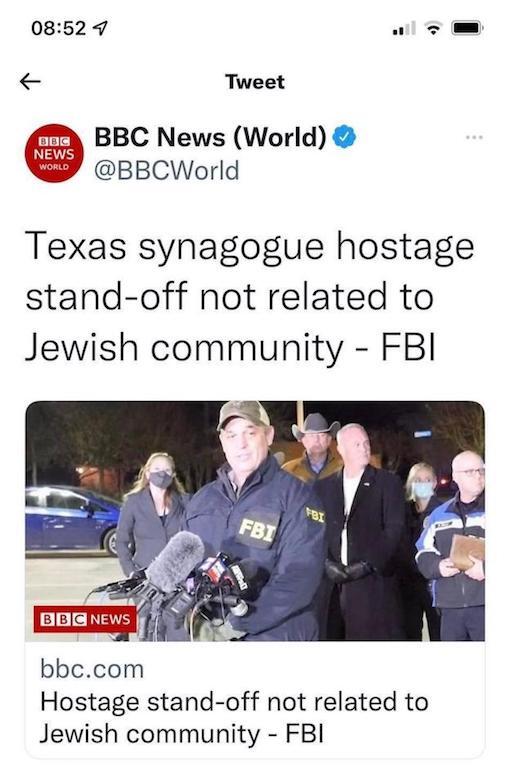
What kind of headline is this? The attack near Dallas yesterday took place during Jewish Shabbat services in a synagogue.
A SWAT team last night rescued a rabbi and several hostages who had been held in the synagogue by a man, who claimed to have weapons and explosives, ending a harrowing 12-hour standoff. The hostage-taker, who died as police stormed the synagogue, is believed to be a British citizen of Pakistani origin.
The hostage-taker demanded the release of so-called 'Lady Al Qaeda' (Aafia Siddiqui) a Pakistani American-educated academic (and notorious antisemite) serving 86 years for terrorist offenses, including planning a chemical attack.
"I am grateful to be alive," the Rabbi held hostage in the synagogue said afterwards. The synagogue was relatively empty because of the ongoing Covid pandemic.
-- Tom Gross
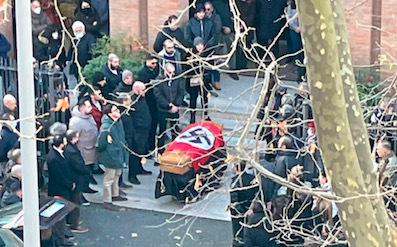
The Catholic Church has condemned as "offensive, unacceptable and irreconcilable with Christianity" a funeral procession outside a church in Rome last Monday in which the casket (above) was draped in a Nazi flag.
Video of the scene outside St. Lucia church on Monday showed mourners giving the right arm fascist salute following the funeral of 44-year-old Alessia Augello, a member of the extreme right-wing group Forza Nuova. She died of a blood clot last weekend. A similar incident took place outside another church in Rome in March last year.
"IT ALSO JUSTIFIES THE NEXT JEWISH GENOCIDE"
[Note by Tom Gross]
I attach two new articles below about antisemitism, from the (center-left) Washington Post and from (the left-wing magazine) The Nation. Both ask why some leftwingers are antisemitic.
In the Washington Post, the writer says:
"? false fulminations about Jews committing genocide have found a home on certain parts of the left as well. ? They offer tantalizing rewards that make them irresistible to a certain brand of bigot. First, they weaponize the greatest Jewish trauma against Jewish people. As the Marxist political theorist Norm Geras put it, "To say to Jews that what they are doing is just like what the Nazis did to them is to appeal to the comparison that is most hateful." There is no better way to hurt someone than to fashion their own most painful experience into a club with which to beat them. It's not hard to imagine how turning the Holocaust on Jewish people, like turning slavery on Black people, provides a delicious transgressive thrill.
"Second, casting Jews as the perpetrators of a new, fictitious Holocaust frees non-Jews from the obligation to learn the lessons of the actual Holocaust. ? After all, making the Jews guilty of genocide doesn't just obviate non-Jewish guilt for permitting Jewish genocide. It also justifies the next Jewish genocide."
The writer in The Nation says:
"If the left wishes to advance a framework that values self-determination for ethnic minorities, it has to acknowledge that US Jews are an ethnic minority too, living in a state with a clear Christian hegemony, where the vast majority of people are massively ignorant of our history, traumas, traditions, and complexities."
ARTICLES
WHY PEOPLE LOVE ACCUSING JEWS OF GENOCIDE
Why people love accusing Jews of genocide
The latest antisemitic conspiracy theory seems absurd -- and it is, but it's also dangerous
By Yair Rosenberg
The Washington Post
January 10, 2022
https://www.washingtonpost.com/outlook/2022/01/10/antisemitism-jews-genocide/
Last week, David Bateman, a prominent Utah entrepreneur and Republican political donor, sent an unusual email to his state's business and political leaders, including Gov. Spencer Cox. The subject line? "Genocide." The topic: Jews. But Bateman's message was not about the Holocaust, or about Jews being the victims of mass murder. Instead, he accused them of perpetrating it.
"I believe there is a sadistic effort underway to euthanize the American people," Bateman wrote. "I believe the Jews are behind this. ? I believe the pandemic and systematic extermination of billions of people will lead to an effort to consolidate all the countries in the world under a single flag with totalitarian rule. ? No one is reporting on it, but the Hasidic Jews in the US instituted a law for their people that they are not to be vaccinated for any reason." (No such law exists.)
Reached for comment by a bemused reporter, Bateman insisted that "some of my closest friends are Jews." He resigned from his industry positions shortly afterward.
It's tempting to write this off as the ridiculous ramblings of an Internet-poisoned tech magnate too rich to have ever been told "no" by those around him. On the surface, Bateman's ham-handed harangue certainly looks like a fringe -- even funny -- story. But it's not. That's because the libel that Jews are committing genocide has exploded in popularity across anti-Jewish discourse. It crosses ideological lines and is increasingly expressed in polite company.
Five myths about antisemitism
Indeed, once you start looking, it's hard to escape the fact that people just love accusing Jews of genocide. "The Jews will use the vaccine to change DNA making the person susceptible to designer viruses the Jews will create," wrote one poster on the neo-Nazi forum Stormfront in December 2020. "This is one way the Jews will attempt to kill off the White Race." That same month, the Anti-Defamation League reported that Ishmael Muhammad, a student minister in Louis Farrakhan's Nation of Islam, "referenced the 'Synagogue of Satan' (an antisemitic phrase used to refer to Jews) for allegedly promoting vaccines to sterilize Black people," in a live sermon from the organization's headquarters in Chicago. "Those of you who are really big supporters of the vaccination program, whether you realize it or not, you are a new Nazi," intoned the antisemitic pastor Rick Wiles last month. "This is mass genocide." (Wiles is best known for dubbing the impeachment of President Donald Trump a "Jew coup.")
So far, so fringe. But the same cannot be said for the broader "white genocide" conspiracy theory, which posits that Jews are conspiring to wipe out the White race through the promotion of mass immigration, interracial marriage and other supposedly sinister social schemes. Fear of this farcical "great replacement" infamously inspired the neo-Nazi marchers in Charlottesville, who in 2017 chanted that "Jews will not replace us." And it featured prominently in the social media feeds of Robert Bowers, the white supremacist who massacred 11 Jews at Pittsburgh's Tree of Life synagogue in 2018.
Then, last year, the most popular political personality on American television took it mainstream. "The left and all the little gatekeepers on Twitter become literally hysterical if you use the term 'replacement,' if you suggest that the Democratic Party is trying to replace the current electorate, the voters now casting ballots, with new people, more obedient voters from the Third World," declared Fox News's Tucker Carlson this past April. "But they become hysterical because that's what's happening actually."
The Pittsburgh shooter didn't hate 'religion,' he hated Jews. We should say so.
Of course, even if one were to accept the questionable premise of this accusation, adding new people to the United States does not remove the previous inhabitants. There is no "replacement" unfolding, other than in the fevered imagination of the country's white nationalists. Carlson knows this. But he also knows the extremists in his audience and their preferred parlance. And so he chose to politely popularize the conspiratorial claims that had motivated the mass murder of American Jews. The message was received. "Tucker Carlson is talking about replacement theory; well, I knew it was going on way back then, way back in 1991," exalted former KKK leader David Duke.
Many liberals strongly condemned Carlson's remarks. And yet, false fulminations about Jews committing genocide have found a home on certain parts of the left as well. Last May, award-winning actor and outspoken Israel critic Mark Ruffalo apologized for publicly accusing the Jewish state of genocide. "It's not accurate, it's inflammatory, disrespectful & is being used to justify antisemitism here & abroad," he wrote on Twitter.
Israel occupies the Palestinian people and the two have fought multiple wars. The Israeli military deserves scrutiny and criticism for every Palestinian civilian casualty. But occupation and discrimination are not genocide. In actuality, according to the Palestinian Central Bureau of Statistics, the Palestinian population in Israel, Gaza and the West Bank has increased around fourfold since Israel's founding. By contrast, the Holocaust killed two out of three European Jews. Within Israel itself, where 20 percent of the population is Arab, the most popular male baby name for the past decade has been Muhammad.
Whatever one thinks of Israel, that's obviously the opposite of genocide. Like most conspiracy theories, this one takes a kernel of truth -- about Israel's treatment of Palestinians -- and inflates it into a crazed calumny. In other words, Ruffalo was right to back off his remarks. But the fact that this incendiary claim filtered all the way up to a Hollywood star, who initially felt comfortable repeating it in public, demonstrates how acceptable this libel is even in some putatively progressive circles.
Obviously, not all these allegations are equivalent. Some are spread through ignorance, others through malice. But by now, it should be clear that people don't make these accusations because they make sense. Rather, false charges of Jewish genocide continue to proliferate because they offer tantalizing rewards that make them irresistible to a certain brand of bigot.
First, they weaponize the greatest Jewish trauma against Jewish people. As the Marxist political theorist Norm Geras put it, "To say to Jews that what they are doing is just like what the Nazis did to them is to appeal to the comparison that is most hateful." There is no better way to hurt someone than to fashion their own most painful experience into a club with which to beat them. It's not hard to imagine how turning the Holocaust on Jewish people, like turning slavery on Black people, provides a delicious transgressive thrill.
Second, casting Jews as the perpetrators of a new, fictitious Holocaust frees non-Jews from the obligation to learn the lessons of the actual Holocaust. "For thousands of years, for much of the world, part of the cultural patrimony enjoyed by all non-Jews -- spiritual and secular, Church and Mosque, enlightenment and romantic, European and Middle Eastern -- was the unquestionable right to stand superior over Jews," wrote University of California at Berkeley's David Schraub in 2016. "It was that right which the Holocaust took away, or at least called into question: the unthinking faith of knowing you were the more enlightened one, the spiritually purer one, the more rational one, the dispenser of morality rather than the object of it."
Anti-vaxxers are claiming centuries of Jewish suffering to look like martyrs
In a masterful maneuver of moral jujitsu, pinning genocide on the Jews allows the bigot to swipe the "Holocaust card" and play it against them. The victims are transformed into perpetrators, and their judgment is called into question. "Many people deeply resent the Jews for what Auschwitz took away from them -- the easy knowledge that their vantage point was elevated over and superior to that of the Jews," notes Schraub. "The desire to neuter the Holocaust is a desire to return to that old state of affairs."
This ominous outcome is why it is a mistake to dismiss efforts to fabricate a Jewish genocide as merely marginal or inconsequential. Fundamentally, the impulse to hang the Holocaust on the Jews is an attempt to return humanity to where it was before the Holocaust -- which enables such things to happen again.
After all, making the Jews guilty of genocide doesn't just obviate non-Jewish guilt for permitting Jewish genocide. It also justifies the next Jewish genocide.
HOW THE LEFT ALIENATES JEWS
How the Left Alienates Jews
Jewish voices are too often excluded from precisely the conversations they should be leading.
By Alexis Grenell
The Nation
January 24/31, 2022 issue
https://www.thenation.com/article/society/bds-dsa-antisemitism-israel/
Eons ago -- in 2019 -- Linda Sarsour, Tamika Mallory, and Bob Bland stepped down from their leadership positions on the Women's March board after a series of self-inflicted wounds. Aside from the widespread mismanagement that starved state chapters of funding and alienated them over trademark wars, the leadership's failure to grapple with its own anti-Semitism (i.e. cozying up to Louis Farrakhan then offering the weakest possible denunciation of his racist, homophobic vitriol under the guise of intersectionality) exposed a gaping ignorance that many, especially Jewish women, simply could not abide.
Two years later, the Democratic Socialists of America seem determined to make the same mistake, one that's common on the US left: offending Jews. This is a bad idea. It's bad because Jews vote in higher numbers than the electorate at large. It's bad because Jews have a long history of left-leaning activism. And it's bad because -- especially after Charlottesville and the Tree of Life synagogue massacre -- it ought to be obvious that anti-Semitism, even in the United States, is no fucking joke.
The latest and perhaps most ridiculous example of this self-defeating strategy is the DSA's dust-up with Representative Jamaal Bowman of New York over his recent trip to Israel with the lobbying group J Street and his refusal to back the boycott, divestment, and sanctions movement, or BDS. Bowman is being raked over the coals by the DSA's National Political Committee, and several chapters across the country have called for his ouster. In a sloppy and selective application of principle that further exacerbate DSA's racial blind spot, the Madison, Wis., chapter has gone beyond condemning Bowman for failing to uphold Palestinian solidarity and has taken him to task over a tweet he posted mourning the death of Colin Powell: "As a Black man just trying to figure out the world, Colin Powell was an inspiration. He was from NYC, went to City College, and rose to the highest ranks of our nation.")
Never mind the fact that Bernie Sanders -- the most high-profile democratic socialist and a Jewish supporter of Palestinian rights who spent time on a kibbutz in Israel -- doesn't support BDS either. After weeks of rancor, the National Committee finally issued a 10-paragraph statement declining to expel Bowman, while repeatedly positioning the DSA as an opponent of the "Zionist lobby" and reiterating its commitment to BDS.
Bowman defeated Eliot Engel, a pro-Likud Israel hawk, to represent a district with a significant Jewish population. Surveys consistently show overwhelming opposition to BDS among American Jewry, including young people and those who identify as secular or "cultural" Jews. Despite its purpose as a standard political campaign against a state entity, BDS strikes profoundly emotional chords that can't be denied. Maybe that's because a boycott recalls the "Don't buy from Jews" dictum the Nazis issued as a prelude to confiscating Jewish assets and cutting our world population by more than a third, thus necessitating the building of a modern nation-state as a refuge from mass extinction. Maybe it's because a public and oft-stated goal of many of Israel's neighboring countries is to annihilate the Jewish state -- hence the need for an Iron Dome defense system to protect against missiles that target civilians. Or maybe it's because in the Jewish liturgy "Am Yisrael" refers to the "nation of Israel," often used interchangeably to mean the Jewish people, and our collective identity is inextricably bound up with centuries of forced exile from a historic homeland.
The DSA and many of those aligned with it don't seem much concerned by any of that, insisting that criticism of Israel is not inherently or always anti-Semitic (true) and that any pushback against such criticism to that effect is inherently in bad faith (not true). The problem is that in the taxonomy of oppression, the left doesn't leave much room for the experience or perspective of Jews, in part because we're mostly racialized as white and enjoy the benefits thereof. The corollary to that designation, however -- which is where the wheels come off the wagon -- is the notion that we're not "systemically" discriminated against. Indeed, compared with Black people, we're not: White Jews do not fear state violence or experience disproportionately harsher outcomes in the criminal justice system. Visibly Jewish people absolutely are subject to violence in the US, though -- as was seen this past spring, when people nominally protesting Israel's bombing of Gaza drove through New York City's heavily Jewish Diamond District (rather than, say, protesting at the Israeli embassy) and violently assaulted a man wearing a yarmulke. Those of us who aren't immediately identifiable as Jews still contend with widespread conspiracy theories about how we secretly control the media, the money supply, and all the world's power. When we point out the double standard on the left that routinely downplays the violence and racism against us, or stand up against our own discrimination, we're selectively carved out of the prerogative afforded to every other minority group to serve as the authority on our own oppression. The blowback from the Women's March included accusations that white Jewish women were inappropriately centering themselves. Sarsour had previously proclaimed that women who support Israel cannot be feminists.
Which brings us back to BDS and Palestinian rights. More US Jews support the latter than the former, including J Street (once angrily described by former Israeli prime minister Benjamin Netanyahu as a "radical US leftist organization" for repeatedly opposing him), which advocates a two-state solution. It's a compromise position that reflects a historical reality dating back thousands of years, one that most self-described anti-Zionists seem uninterested in learning anything about. The whole thing gets collapsed into an intellectual shortcut that equates Jews with white colonists: White colonialism is bad, ergo Israel is bad.
None of this is to absolve Netanyahu's reign or excuse the oppression of the Palestinian people. But the DSA's anti-Israel position is often thoughtless, self-righteous, and anti-Semitic. Also, claiming that it's worse on the right doesn't make the fact of it any less true on the left. It only leaves Jews who are inclined to support DSA's politics but who are put off by its virulently anti-Israel position searching for a political home somewhere else. If the left wishes to advance a framework that values self-determination for ethnic minorities, it has to acknowledge that US Jews are an ethnic minority too, living in a state with a clear Christian hegemony, where the vast majority of people are massively ignorant of our history, traumas, traditions, and complexities.
* You can also find other items that are not in these dispatches if you "like" this page on Facebook www.facebook.com/TomGrossMedia
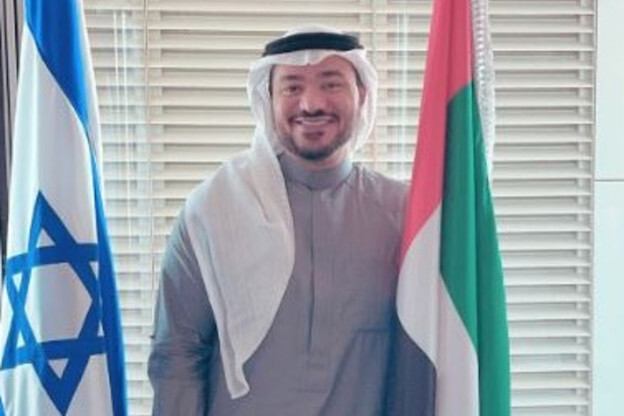
Above: Loay Al-Shareef, one of an emerging group of pro-Zionist Arabs. Al-Shareef, 39, is originally from Saudi Arabia and now lives in Abu Dhabi. He has 180,000 followers in Arabic on Twitter, and more than 80,000 on Instagram, where he has posted messages supportive of Israel.

Visitors at the recent Dubai air show

A joint live evening broadcast with TV stations in the UAE, Israel & Bahrain
CONTENTS
1. Meet the Arab Zionists
2. Number of Arab visitors to Israel's national library more than doubles to 650,000
3. Signing a memorandum with the National Archives of the UAE
4. Video: "Behind the scenes: Arabs in the IDF" (i24News, Jan. 4, 2022)
5. What BDS?
6. Indonesia, the world's most populous Muslim state, moves closer to Israel
7. US House and Senate launch bipartisan Abraham Accords Caucus
8. "A stronger Israel in a less stable world"
9. "A new wave of pro-Israel influencers are promoting the Jewish state" (By Jonathan Sacerdoti, Jewish Chronicle, Jan. 7, 2022)
10. "Israel's national library sees Arabic site traffic boom" (Washington Post / AP, Jan. 9, 2022)
MEET THE ARAB ZIONISTS
[Notes by Tom Gross]
I attach a feature article by Jonathan Sacerdoti in the current issue of the (London) Jewish Chronicle "Meet the Arab Zionists: a new wave of pro-Israel influencers are promoting the Jewish state".
Syrians, Saudis and Bahrainis are interviewed by the Jewish Chronicle.
Among them, Fatema Al-Harbi who worked for seven years in Bahrain's Ministry of Education and then studied for a second Masters degree in Human Resources, while also working as a writer. Ms Al-Harbi was very excited when the Abraham Accords were signed, describing the historic deal as "something impossible being possible".
She visited Israel in October 2020, and returned for another visit to Israel in October 2021. Ms Al-Harbi remembers a transformational visit to Yad Vashem.
She said: "For us in an Arab country, we only know the minimum about the Holocaust. My friends [visiting Jerusalem with me from Bahrain] actually were crying on the tour. The first thing I did was share the whole experience with my followers through Instagram and Twitter. "I have around 9,000 followers on Instagram, so I shared the experience with them.
I am also quoted towards the end of the piece:
Positive feeling towards Israel among Arab countries is not necessarily new, but open expression of those feelings is becoming more commonplace.
Middle East commentator Tom Gross has witnessed this first hand. He said: "For years I've been attending clandestine and not so clandestine meetings with Israelis, Europeans and people from almost every Arab country.
"The goodwill has always been there. I've witnessed far more hostility towards Israel among leftists in London and Paris and by some European-born Muslims, than people I have got to know who actually live in Bahrain, Saudi Arabia, Yemen and Iraq."
NUMBER OF ARAB VISITORS TO ISRAEL'S NATIONAL LIBRARY MORE THAN DOUBLES TO 650,000
The Washington Post reported on Sunday (via the AP):
Israel's national library says the number of visitors to its Arabic website more than doubled last year, driven by a growing collection of digitized materials and an outreach campaign to the Arab world.
650,000 individual users, largely from the Palestinian territories, Egypt, Saudi Arabia, Jordan and Algeria, visited the National Library of Israel's English and Arabic sites in 2021.
(Full article below.)
See more here: https://blog.nli.org.il/ar/
And there is much material in English that may interest you too: https://blog.nli.org.il/en/
SIGNING A MEMORANDUM WITH THE NATIONAL ARCHIVES OF THE UNITED ARAB EMIRATES
Tom Gross adds:
Last year, the National Archives of the United Arab Emirates and the National Library of Israel signed a memorandum of understanding amid increased interest in regional collaboration in the wake of the Abraham Accords.
https://www.nli.org.il/en/at-your-service/announcements/uae-agreement
According to the head of digital collections at the NLI, "Technology allows culture and the written word to cross boundaries and reach new places previously inaccessible. The fact that so many people from across the Arab world are expressing such a high level of interest in the cultural treasures freely available via the library's website shows just how relevant these things are, even for the younger generation living in our region."
BEHIND THE SCENES: ARABS IN THE IDF
Arab-Israeli journalist Yoseph Haddad reports on an Arab unit in the IDF, and gives us a rare glimpse into the lives of young people in Arab society who have chosen to volunteer for the Israeli army. (January 4, 2022 on i24News.)
https://www.youtube.com/watch?v=4r9KvtCGsug
WHAT BDS?
Tom Gross writes:
While some European leftists are demanding a boycott of Israel, Palestinians in the West Bank are actually increasing economic ties with Israel.
The Palestine Central Bureau of Statistics reports in new figures in October 2021 (the most recent month for which data is available) that exports of Palestinian goods and produce to Israel totaled $132.9 million, an increase of 19 percent from the previous month. Palestinians imported $624.7 million worth of goods and services in October, a 22 percent jump.
INDONESIA, THE WORLD'S MOST POPULOUS MUSLIM STATE, MOVES CLOSER TO ISRAEL
Various meetings and reports in the last few months suggest that Israel and Indonesia, the world's most populous Muslim state, have grown closer.
The two countries do not have formal diplomatic relations, but they cooperate in trade and tourism.
And Indonesia has increasingly sought Israeli help and technology particularly in agriculture and food security.
Reports suggest that Jakarta was in talks with the Trump administration in December 2020 to normalize ties with Jerusalem. The Biden administration has since become involved in the quest for Israel-Indonesian peace.
Last November, Indonesian Defense Minister Prabowo Subianto met with Israeli National Security Adviser Eyal Hulata at a conference in Manama in Bahrain. After a photo of them together was published, Subianto issued a statement asserting that it was not prohibited for him to speak to Israeli officials "when it is in the national interest". Last October, Subianto announced he planned to run for president of Indonesia in 2024.
US HOUSE AND SENATE LAUNCH BIPARTISAN ABRAHAM ACCORDS CAUCUS
A bipartisan group of congressional lawmakers in Washington announced on Monday that they are establishing a new caucus to support the Trump-era Abraham Accords.
Among the eight co-founders are Senators James Lankford (R-Oklahoma), Jacky Rosen (D-Nevada), Joni Ernst (R-Iowa), and Cory Booker (D-New Jersey). The House members are Rep. Cathy McMorris Rogers (R-Washington), Brad Schneider (D-Illinois), Anne Wagner (R-Missouri), and David Trone (D-Maryland).
"The caucus will provide an opportunity to strengthen the Abraham Accords by encouraging partnerships among the existing Abraham Accords countries and expanding the agreement to include countries that do not currently have diplomatic relations with Israel," the lawmakers said in a statement.
They will engage partner countries, including European allies, "in multilateral efforts to promote the Abraham Accords," they said, and "to advance cooperative and sustainable development partnerships [between Israel and Muslim countries] in the areas of energy security, water infrastructure, biomedicine, cybersecurity, and emerging technologies."
MOSSAD CHIEF BARNEA MEETS WITH LIBYAN PM IN JORDAN TO TALK NORMALIZATION
UPDATE: Saudi and Libyan media outlets reported this evening (January 12) that Mossad Director David Barnea and Libyan prime minister Abdulhamid Mohammed Al-Dabaiba recently met in Jordan to discuss normalization and security cooperation.
In November, Haaretz reported that Saddam Haftar, son of Libyan warlord Gen. Khalifa Haftar, flew to Ben Gurion Airport in Tel Aviv for meetings with Israeli officials regarding potential normalization.
"A STRONGER ISRAEL IN A LESS STABLE WORLD"
I've given several interviews over the last year. I realize people don't have time to listen to many, but you may find this one interesting if you have time:
"A stronger Israel in a less stable world"
https://www.youtube.com/watch?v=leBb_qR4kPA
Also here: https://www.youtube.com/watch?v=DhRnbq2HHKM
***
Two articles are attached below.
ARTICLES
A NEW WAVE OF PRO-ISRAEL INFLUENCERS ARE PROMOTING THE JEWISH STATE
Meet the Arab Zionists: a new generation of online pioneers
A new wave of pro-Israel influencers are promoting the Jewish state
By Jonathan Sacerdoti
The Jewish Chronicle
January 7, 2022
"The Golan Heights is the only area in Syria that hasn't been destroyed and had its people killed."
With these words, a Syrian blogger began a video begging the Israeli government to "occupy" the entire country of Syria to save more lives.
In another video, an Arab academic dressed in a long white kandura is moved to tears by visiting Yad Vashem, promising: "Today, together, Muslims Jews and Christians, we promise you, it will never happen again."
The huge growth of social media has in recent years allowed the world to see a different Middle East ? one where individuals have been able to directly communicate their honest views on Jews and Israel to the world.
But in 2020, something changed again. The signing of the Abraham Accords in September that year was a watershed moment: it allowed many Arabs to speak out openly about Israel without fear of a backlash ? while opening the door to positive experiences of Israel, whether via the news or trips to the Jewish state.
Now, in a growing trend, pioneering Arab Zionists and pro-Israel influencers ? who once would have been labelled traitors ? are promoting Israel to their hundreds and thousands of followers.
Loay Al-Shareef, 39, is an Abu Dhabi-based social-media influencer and a self-declared Zionist. He has 180,000 followers on Twitter, and more than 80,000 on Instagram, thanks largely to his regular posts about languages and etymology.
Originally from Jeddah in Saudi Arabia, he studied software engineering in America, and in 2010 spent some time living with a Jewish family in Paris, learning French. "That was the real life-changing point for me with the Jewish people, because I got to know the Jews more closely," he said.
Thus began his mission to investigate biblical history, archaeology and the history of the Near East and Mesopotamia, all of which led him to believe in the legitimacy of the state of Israel.
"It's very righteous for the Jews to have their ancestral homeland in the land of Israel," he said.
He peppers his conversation with frequent references to Jewish scripture, saying he came to the conclusion that "Jews are not colonialists or conquerors in the land of Israel, because if we would believe that then we would believe that David, Solomon, Isaiah and Yirmiyahu and the prophets were actually colonisers, and that would kill the Islamic faith."
Like Mr Al-Shareef, Fatema Al-Harbi, 30, is an online influencer, though she is based in Bahrain.
She has spent time abroad and credits having studied in Australia for giving her experience of different cultures and people.
"My family is very open-minded. I've always been surrounded by people from different religions," she said.
She worked for seven years in Bahrain's Ministry of Education and then studied for a second Masters degree in Human Resources, while also working as a writer. Ms Al-Harbi was very excited when the Abraham Accords were signed, describing the historic deal as "something impossible being possible".
Sharing her enthusiasm on Twitter and Instagram, she was soon invited to visit Israel by online friends she had made there. She accepted immediately. She said: "Who wouldn't want to know the unknown? It's something unknown for us people in the Arab region."
Arriving in Israel just two months later, Ms Al-Harbi became the first non-government Bahraini to visit. "To be honest, I was a bit afraid," she said.
"Family and friends around me were like, 'Oh, my God, are you seriously going to Israel?', because they all hear about it through the media in the Arab world, and it's all bad stuff."
Unlike Ms Al-Harbi, Mr Al-Shareef has never visited Israel, but still declares himself a proud Zionist. He started posting pro-Israel content to his social-media accounts in 2018, two years before the Abraham Accords were signed, and found they were not well received.
"I paid a great price," he said, referring to the negative reaction he received from some. But once the normalisation agreements were signed, he actually gained extra followers online.
"Baruch Hashem, so many people came on board," he said.
After Ms Al-Harbi's first trip to Israel in October 2020, she also received negative attention, including death threats. On returning to Bahrain, she found she had achieved notoriety as "the girl who went to Israel".
But that didn't dissuade her from visiting Israel again, in October 2021. Over the intervening 12 months, things had improved and most responses were positive.
"Some people actually approached me asking, 'How can we go and visit Israel?' So a lot has changed in just one year."
Trips like those taken by Ms Al-Harbi have mostly been organised by newly established NGOs working to foster warm relations between Israel and its Abraham Accords partners at civil society level. Hers, organised by the NGO Sharaka, helped her overcome preconceived ideas about Israelis.
"As soon as I landed there, we got to the hotel and I saw how friendly the people were. Arabs, Muslims, Jewish people, all from different backgrounds. They were even more happy than we were that we'd come.
"We wore our traditional clothes, so it was easy to spot us in the streets of Israel. People we didn't know at all kept approaching us, asking, 'Are you from Bahrain or Dubai?' They kept saying, 'Welcome to Israel!'"
These trips can also have a much broader effect, challenging wider antisemitism and even educating participants about the Holocaust. Ms Al-Harbi remembers a transformational visit to Yad Vashem.
She said: "For us in an Arab country, we only know the minimum about the Holocaust. 'I'm a writer and I like to read, so I know a bit more than most people in Bahrain, but they don't speak about it and they don't teach us about it."
Learning about the Shoah for the first time proved to be emotional for her group.
"My friends actually were crying on the tour. The first thing I did was share the whole experience with my followers through Instagram and Twitter.
"I have around 9,000 followers on Instagram, so I shared the experience with them.
"I wanted them to know what I learned that day, because people in our countries don't know."
Indeed, the most effective online content shared by pro-Israel Arabs is often cultural or historical, rather than political.
"I don't engage in politics, right or left, Likud or Kahol Lavan," Mr Al-Shareef said. He started by writing about biblical history.
"I was trying to educate my audience more about the Hebrew language, and more about the ancient existence of the Jews in this region, that the Jews are part of this region," he added.
Arab support for Israel has often wavered because of loyalty to the Palestinian cause. But even that has changed since the Accords.
"We've given them lots of money that could turn Gaza into a Silicon Valley," Mr Al-Shareef said.
"Enough money that would turn the West Bank into a new Singapore. Where is this money going?" he asked.
Looking to the future, both Mr Al-Shareef and Ms Al-Harbi are optimistic. He feels certain that Saudi Arabia, where he was born, will eventually also normalise relations with Israel: "This is the real direction that everyone is going in. More peace, lowering tensions, no more wars."
Dan Feferman, Global Affairs Director at Sharaka and a founding member of the UAE-Israel Business Council, said: "For most of their lives, people from the Gulf have been taught that Israelis are the bad guys, the occupiers. But they meet us abroad and we seem like normal, nice people. They hear about the tech, the Nobel prizes, the academia, and something doesn't make sense. Now they have government support to do so, they're interested in getting to know Israelis themselves."
Positive feeling towards Israel among Arab countries is not necessarily new, but open expression of those feelings is becoming more commonplace.
Middle East commentator Tom Gross has witnessed this first hand. He said: "For years I've been attending clandestine and not so clandestine meetings with Israelis, Europeans and people from almost every Arab country.
"The goodwill has always been there. I've witnessed far more hostility towards Israel among leftists in London and Paris and by some European-born Muslims, than people I have got to know who actually live in Bahrain, Saudi Arabia, Yemen and Iraq."
For now, pro-Israel Arab voices are still notable for their rarity. But where innovators venture, others often follow. Even with a change in leadership in America and Israel since the Accords were signed, relations have remained firm.
Consequently, a new wave of warmth towards Israel is sweeping across the internet from the Middle East like a pro-Zionist Gulf Stream.
ISRAEL'S NATIONAL LIBRARY SEES ARABIC SITE TRAFFIC BOOM
Israel's national library sees Arabic site traffic boom
By Ilan Ben Zion
Washington Post via AP
January 9, 2022
https://www.washingtonpost.com/world/israels-national-library-sees-arabic-site-traffic-boom/2022/01/09/464e6cb2-716a-11ec-a26d-1c21c16b1c93_story.html
JERUSALEM ? Israel's national library says the number of visitors to its Arabic website more than doubled last year, driven by a growing collection of digitized materials and an aggressive outreach campaign to the Arab world.
Around 650,000 users, predominantly from the Palestinian territories, Egypt, Saudi Arabia, Jordan and Algeria, visited the National Library of Israel's English and Arabic sites in 2021, said library spokesman Zack Rothbart.
One of the most heavily trafficked resources on the Arabic website is a newspaper archive with more than 200,000 pages of Arabic publications from Ottoman and British Mandate Palestine, said Raquel Ukeles, head of the library's collections.
"We have been working on outreach to the Arab world, into the Arabic speaking public here in Israel for over a decade, and we have slowly built up a rich set of resources on our websites," she said. They include the digital newspaper archives, manuscripts, posters, electronic books and music, she said. They are open access, allowing scholars and curious web browsers to visit.
The Jerusalem library is home to an extensive collection of Islamic and Arabic texts, including thousands of rare books and manuscripts in Arabic, Persian and Turkish ranging from the 9th to the 20th centuries.
"We're in the midst of a project to digitize our entire collection, to scan all of our Arabic, Persian and Turkish manuscripts," said Samuel Thrope, curator of the library's Islam and Middle East Collection. "Ninety-five percent of it has already been completed."
Among the jewels in the crown of the collection are a 9th-century Quran from modern-day Iran with the earliest known example of Persian written in the Arabic script; an illuminated manuscript from 17th century India with illustrations of the life of Alexander the Great; and a 16th century Ottoman Turkish text on ophthalmology.
* You can also find other items that are not in these dispatches if you "like" this page on Facebook www.facebook.com/TomGrossMedia