
I attach a variety of articles (all but one from today) that you may find of interest. I extracted a few paragraphs from them first, for those who don't have time to read the pieces in full.
-- Tom Gross
CONTENTS
1. "Why Is Putin at War Again? Because He Keeps Winning" (By Chris Miller, New York Times, Feb. 25, 2022)
2. "After Ukraine, officials fear Putin will move to curb Israel's Syria operations" (By Yaniv Kubovich, Haaretz, Feb. 25, 2022)
3. "Gergiev must condemn Russian attack to continue to perform at La Scala says mayor" (Italian news agency, Feb. 25, 2022)
4. "How deep has Chinese intelligence penetrated Israel?" (By Amos Harel, Haaretz, Feb. 25, 2022)
5. "NSO Never Engaged in Illegal Mass Surveillance" (By Shalev Hulio, Wall Street Journal, Feb. 25, 2022)
6. "Queens Jewish leader slams AOC for suggesting Israel 'cages' Palestinian kids" (New York Post, Feb. 21, 2022)
SHORT EXTRACTS
* Chris Miller: "There is no world leader today with a better track record when it comes to using military power than President Putin of Russia. Whether against Georgia in 2008, Ukraine in 2014, or in Syria since 2015, the Russian military has repeatedly converted battlefield success into political victories. Russia's rearmament over the past decade and a half has been unmatched by a comparable increase in Western capabilities. So it is no surprise why Russia feels emboldened to use its military power while the West stands by. Russia's past three wars are textbook examples of how to use military force in limited ways to achieve political goals."
* Yaniv Kubovich: Israel has been trying to avoid any statements or actions that may upset Russia, so much so that senior defense officials were asked not to publicly comment on the situation in Ukraine. The defense establishment's main concern the obstruction of the delicate Israeli-Russian ties on Syria, where the Israeli military has been reportedly operating regularly against Iran-backed forces, namely Lebanese group Hezbollah.
Israeli officials also assess that Russia may decide to transfer more advanced weapons to Syria and other countries in the region with the aim of generating revenues from big arms deals, while also creating a new balance of terror vis-a-vis Western military forces in the Middle East (and against Israel)...
The latest development in Ukraine may also bring Russia closer to Iran at a sensitive time, according to the Israeli assessment. Negotiations in Vienna between Tehran and world power on Iran's nuclear program near a conclusion, diplomats involved in the talks have said in recent days.
* Milan Mayor Giuseppe Sala said conductor Valery Gergiev, a supporter of Russian President Vladimir Putin, must condemn the attack on Ukraine if he wants to continue his collaboration with Teatro alla Scala, where he is currently directing Tchaikovsky's Pique Dame.
* Amos Harel: "Israel is seen by China as a leading technological power. Israel's advanced capabilities in elite technology, cyber, medicine, agriculture and more have the potential to contribute technologically to almost every aspect of China's build-up plans ... Consequently, alongside the overt and agreed-upon activity, it is likely that China's intelligence agencies are working in Israel to attain its objectives in espionage efforts, as well as in other countries of value to it. As in the United States, it cannot be ruled out that government ministries, defense industries and civilian companies in Israel have been attacked in the service of China's intelligence objectives...
Last August a coordinated cyberattack from China was uncovered on dozens of private and governmental bodies in Israel.
China is not an enemy, and Israel's economic ties with that country are of great importance. However, its methods of operation pose a considerable challenge to Israel, "as an attractive target and a source of advanced technology."
* NSO CEO Shalev Hulio:
In recent weeks, a media story dubbed "the Pegasus Affair" by the Israeli news outlet Calcalist has riveted Israelis. The report alleges that the Israeli police used a technological tool called Pegasus to infiltrate phones without a warrant, essentially conducting mass surveillance of high-profile politicians, opposition leaders and activists without proper legal authority. Earlier this week, Deputy Attorney General Amit Marari, along with Shin Bet and Mossad representatives, found no evidence of wrongdoing after conducting an investigation into the allegations. Shortly after, Calcalist announced it was investigating its own reporting.
For the past several years my company, NSO, the creator of Pegasus, has been bashed through irresponsible headlines and inaccurate, incomplete and unsubstantiated reporting [by papers including he New York Times and The Guardian].
* The head of a major Jewish advocacy group in Queens is slamming Rep. Alexandria Ocasio-Cortez for suggesting that Israel cages Palestinian children.
"I don't believe that a child should be in a cage on our border, and I don't believe a child should be in a cage in the West Bank," AOC said in a videotaped remark in Texas.
Michael Nussbaum, president of the Queens Jewish Community Council, says Ocasio-Cortez was spewing an unfounded smear against Israel.
ARTICLES
WHY IS PUTIN AT WAR AGAIN? BECAUSE HE KEEPS WINNING
Why Is Putin at War Again? Because He Keeps Winning
By Chris Miller
New York Times
Feb. 25, 2022
https://www.nytimes.com/2022/02/25/opinion/putin-war-russia-military.html
There is no world leader today with a better track record when it comes to using military power than President Vladimir V. Putin of Russia. Whether against Georgia in 2008, Ukraine in 2014, or in Syria since 2015, the Russian military has repeatedly converted battlefield success into political victories. Russia's rearmament over the past decade and a half has been unmatched by a comparable increase in Western capabilities. So it is no surprise why Russia feels emboldened to use its military power while the West stands by.
Russia's past three wars are textbook examples of how to use military force in limited ways to achieve political goals. The invasion of Georgia in 2008 lasted five days but forced that country into humiliating political concessions. In Ukraine in 2014, regular Russian military units were deployed at scale for a few weeks, but this proved enough to force Kyiv to sign a painful peace deal. When Russia intervened in Syria in 2015, some Western analysts predicted a disaster along the lines of the Soviet invasion of Afghanistan, which began in 1979 and ended, after a decade of quagmire, in retreat. Instead, that Syria's civil war served as a testing ground for Russia's most advanced weaponry.
For the past decade, Americans have come to believe that Russia's strength lies in hybrid tactics -- cyber-warfare, misinformation campaigns, covert operations -- and its ability to meddle in other countries' domestic politics. Yet as we have searched for Russian phantoms behind every misinformed Facebook post, Russia has replaced the poorly equipped army it inherited from the Soviet Union with a modern fighting force, featuring everything from new missiles to advanced electronic warfare systems. Today, the threat to Europe's security is not hybrid warfare but hard power, visible in the cruise missiles that have struck across Ukraine.
"We are 50 percent plus of global G.D.P.," Jake Sullivan, President Biden's national security adviser, argued recently, contrasting this to Russia's unimpressive 3 percent share of the world's economic output. However, economies don't fight wars; militaries do. America's economic power was tested when Mr. Biden threatened tough sanctions if Russia were to invade Ukraine; Mr. Putin did so anyway, betting that hard power would carry the day.
There's still no doubt that America's military has better trained soldiers and more capable systems in aggregate. However, what matters is not theoretical military matchups but the ability to use force for specific aims. Russia has developed precisely the capabilities needed to rebuild its influence in Eastern Europe. The United States, meanwhile, has watched its room for maneuver in the region steadily shrinking, hemmed in by Russian antiaircraft systems and cyber and electronic warfare threats.
Letting the military balance in Europe shift in Russia's favor was a choice. The United States has itself partly to blame. Even after Russia's first attacks on Ukraine in 2014, America's reinforcements on the continent were only enough to slow the rate of improvement in Russia's position. The Biden administration has presided over military spending cuts once inflation is considered. America's roughly $700 billion defense budget may look impressive, but Russia has the advantage of paying less for soldiers' salaries and for domestically produced equipment. Adjusting for these differences, Russia's defense budget has grown far more rapidly than America's over the past two decades. European allies have even more to answer for: Germany and other European countries must wake up from the fantasy that peace is their birthright. They used to have serious fighting power. It is time to rebuild it.
It may be that, in trying to swallow all of Ukraine, Mr. Putin has finally overstepped. A long occupation of Ukraine would stretch Russia's capabilities, especially because its military advantages will be less significant if the conflict shifts into Ukraine's populous cities. However, we should not simply assume that Ukraine will become Putin's Afghanistan or his Iraq because other leaders have made their own errors. Mr. Putin could simply choose to destroy Ukraine and leave the West to pick up the pieces. Such a dismembered, dysfunctional Ukraine could well suit his interests. Russia's recent wars have been carefully calculated and limited in cost. There's no guarantee that this conflict won't be, too.
The U.S. strategy of making public intelligence about Russia's military buildup around Ukraine was clever, but Mr. Putin has called our bluff. It was once popular to mock the Russian president for his 19th-century worldview, but his use of military power to bolster Russia's influence has worked in the 21st century, too. The West's assumption that the arc of history naturally bends in its direction is looking naive. So, too, is the decision to let our military advantage slip. Soft power and economic influence are fine capabilities to have, but they cannot stop Russian armor as it rolls toward Kyiv.
(Chris Miller is an assistant professor at the Fletcher School at Tufts University.)
AFTER UKRAINE, OFFICIALS FEAR PUTIN WILL MOVE TO CURB ISRAEL'S SYRIA OPERATIONS
After Ukraine, officials fear Putin will move to curb Israel's Syria operations
By Yaniv Kubovich
Haaretz
Feb. 25, 2022
https://www.haaretz.com/israel-news/.premium-after-ukraine-officials-fear-putin-will-move-to-curb-israel-s-syria-operations-1.10635064
Israeli officials have been closely following Russia's advance on Ukraine, as well as the West's response to it, fearing they could have serious implications on Israel's efforts to keep Iran and its regional proxies in check.
Israel has been trying to avoid any statements or actions that may upset Russia, so much so that senior defense officials were asked not to publicly comment on the situation in Ukraine. The defense establishment's main concern the obstruction of the delicate Israeli-Russian ties on Syria, where the Israeli military has been reportedly operating regularly against Iran-backed forces, namely Lebanese group Hezbollah.
In terms of military power, Israeli defense officials understand Russia clearly has the upper hand, but from an economic standpoint, President Vladimir Putin may end the war bruised and humiliated after being subjected to harsh sanctions.
Under these circumstances, Putin is more likely to change his policy on Israel's operations in Syria and elsewhere in the Middle East. In a bid to regain his standing, Putin could move to limit Israel's ability to act against Iranian entrenchment in the framework of the deconfliction mechanism between Israel and Russia in Syria.
Israeli officials also assess that Russia may decide to transfer more advanced weapons to Syria and other countries in the region with the aim of generating revenues from big arms deals, while also creating a new balance of terror vis-a-vis Western military forces in the Middle East.
Another concern for Israel is that Russia may employ advanced systems for disrupting GPS guidance systems and other electronic warfare measures and cyberattacks to disrupt NATO or Western operations in the Mediterranean, senior officials said. This could also restrict the Israeli military's freedom of action or disrupt military and civilian technology in Israel.
While there has been no change in Russia's policy as of yet, senior officials say that might change in the near future. A Russian statement on Friday reiterating that Moscow doesn't recognize Israel's sovereignty over the Golan Heights, which were annexed after the 1967 Six-Day War, could be a sign of an impending shift in Putin's approach to Israel's military activity in Syria.
The latest development in Ukraine may also bring Russia closer to Iran at a sensitive time, according to the Israeli assessment. Negotiations in Vienna between Tehran and world power on Iran's nuclear program near a conclusion, diplomats involved in the talks have said in recent days.
Until recently, Israel believed that Russia was not interested in seeing a more substantial Iranian presence in Syria -- a critical gateway to the Mediterranean in Putin's view -- where Moscow wants to play a key part in the country's reconstruction after more than a decade of war.
Now, defense officials say they are concerned that as part of the attempt to bring Iran closer to Russia, Putin will grant Tehran more freedom to operate in Syria -- much more than Israel would like to see.
GERGIEV MUST CONDEMN RUSSIAN ATTACK TO CONTINUE TO PERFORM AT LA SCALA SAYS MAYOR
Gergiev must condemn Russian attack to continue to perform at La Scala says Milan mayor
ANSA Italian news agency
Feb. 25, 2022
https://www.ansa.it/english/news/2022/02/24/ukraine-gergiev-must-condemn-russian-attack-says-sala_b103e6b9-c70c-4090-9b75-910106ddf590.html
Milan Mayor Giuseppe Sala said conductor Valery Gergiev, a supporter of Russian President Vladimir Putin, must condemn the attack on Ukraine if he wants to continue his collaboration with Teatro alla Scala, where he is currently directing Tchaikovsky's Pique Dame.
"We have at the Scala (theater) 'Pique Dame' directed by Maestro Valery Gergiev who has repeatedly declared that he is close to Putin", Sala said. "We have been asking him, with the theater's superintendent, to take a clear position against this invasion and, if he will not do it, we will be forced to end this collaboration", said the mayor, commenting the latest events in Ukraine during a debate with the former center-right mayoral candidate in Milan and municipal councilor, Luca Bernardo.
"We must intervene when faced with these situations", he concluded.
HOW DEEP HAS CHINESE INTELLIGENCE PENETRATED ISRAEL?
How deep has Chinese intelligence penetrated Israel?
By Amos Harel
Haaretz
Feb. 25, 2022
https://www.haaretz.com/israel-news/.premium-how-deep-has-chinese-intelligence-penetrated-israel-1.10633942
To what extent has Chinese intelligence penetrated Israel in the realm of industrial-technological espionage or for purposes of exerting influence? When senior figures in the defense establishment are asked this question, an uneasy silence usually follows. The sensitivity is clear. Israel has for years been navigating between the desire to strengthen its relations with China and fear of angering the United States, which still considers China its major rival (notwithstanding the current crisis with Moscow).
Netanyahu, as prime minister, pushed hard to promote technological transactions with the vast Chinese market. But in his last years in office, and even more so in the Naftali Bennett era, Israel has been compelled to curb this progress in light of American objections. Flagrant examples of this tendency were the American veto of Israeli deals with China to acquire a fifth-generation cellular infrastructure, and the upgrading of the Israeli governmental mechanism for supervising foreign investments (at the request of Washington, which is still not satisfied).
Until about a year ago, Nir Ben Moshe was in charge of security in the defense establishment (Malmab, Hebrew acronym for "director of security of the defense establishment") and dealt intensively with the issue of Chinese penetration of Israel. So an article by Ben Moshe about Chinese espionage on the website of the Institute for National Security Studies is of special interest. Ben Moshe adds a number of presumptions and reservations to his exceptional text, but the reader can probably forgo them. This is the rare case of one who truly knows.
"Israel," he writes, "is seen by China as a leading technological power. Israel's advanced capabilities in elite technology, cyber, medicine, agriculture and more have the potential to contribute technologically to almost every aspect of China's build-up plans ... Consequently, alongside the overt and agreed-upon activity, it is likely that China's intelligence agencies are working in Israel to attain its objectives in espionage efforts, as well as in other countries of value to it. As in the United States, it cannot be ruled out that government ministries, defense industries and civilian companies in Israel have been attacked in the service of China's intelligence objectives.
"It is also likely that a substantial focus of interest in the eyes of Chinese intelligence is the complex system of relations between Israel and its ally, the United States. The security establishment and the IDF are likely a target of said Chinese intelligence efforts, both in themselves and considering their deep connections with their counterparts in the United States."
Israel, he notes, "is quite exposed to cyberattacks that aim to steal knowledge. This is due to the extensive use of computers and digital information, alongside well-established communications infrastructure in Israel, as well as the relative ease of attaining remote access, with little risk to attackers." Ben Moshe recalls that last August a coordinated cyberattack from China was uncovered on dozens of private and governmental bodies in Israel.
China, he sums up, is not an enemy, and Israel's economic ties with that country are of great importance. However, its methods of operation pose a considerable challenge to Israel, "as an attractive target and a source of advanced technology. There are few real public indications of Chinese espionage in Israel, but it is likely that the intelligence community in Israel sees a broader and deeper picture... The intelligence threat to the military-industrial system, with an emphasis on its relations with the United States, is especially significant... A first essential step for coping with the challenge is increasing awareness of the risk and its implications," he sums up.
"NSO NEVER ENGAGED IN ILLEGAL MASS SURVEILLANCE"
NSO Never Engaged in Illegal Mass Surveillance
The media has called it the 'Pegasus Affair.' Yet government investigations have found no evidence of wrongdoing by my company.
By Shalev Hulio
Wall Street Journal
Feb. 25, 2022
https://www.wsj.com/articles/the-pegasus-affair-debunked-nso-group-israel-government-investigation-media-wrong-cyber-intelligence-11645742835
Herzliya, Israel -- In recent weeks, a media story dubbed "the Pegasus Affair" by the Israeli news outlet Calcalist has riveted Israelis. The report alleges that the Israeli police used a technological tool called Pegasus to infiltrate phones without a warrant, essentially conducting mass surveillance of high-profile politicians, opposition leaders and activists without proper legal authority. Earlier this week, Deputy Attorney General Amit Marari, along with Shin Bet and Mossad representatives, found no evidence of wrongdoing after conducting an investigation into the allegations. Shortly after, Calcalist announced it was investigating its own reporting.
For the past several years my company, NSO, the creator of Pegasus, has been bashed through irresponsible headlines and inaccurate, incomplete and unsubstantiated reporting. It has all been part of a well-orchestrated campaign by advocacy organizations that use politically motivated sources to produce "reports" designed to shame our employees and put NSO, and Israel's entire cyber industry, out of business.
We have patiently responded to hundreds of media inquiries over the past few years, walking reporters through our due-diligence program, pointing to the company's Transparency and Responsibility Report, and stating that while the company is restricted in what it can say because of confidentiality and national-security issues, many of these allegations are false and some are contractually and technically impossible. The allegation that our products were used on President Emmanuel Macron, Jeff Bezos and Jamal Khashoggi is untrue.
Advocacy organizations like Amnesty International have joined forces with some in the media to produce reports making allegations that rely on evidence and data that NSO could have used to verify or refute their claims. Unfortunately that evidence and data was never provided. NSO has cooperated repeatedly with governmental investigations, such as the recent Israeli Ministry of Justice inquiry. Governmental investigations are the legitimate venues to determine misuse and promptly publicize any findings to maintain public confidence. In these instances NSO has been able to learn from various findings and reports and improve its technological safeguards, customer vetting process, and ability to investigate potential misuses by customers. We will continue to cooperate with any governmental inquiry, probe or investigation to find the truth.
NSO was the first cyberintelligence company founded in Israel. Many other successful companies followed. It was the first regulated cyberintelligence company and the first to adopt the United Nations Guiding Principles for maintaining human rights. It was the first company to terminate contracts once suspicion of misuse of its technologies arose, even when it meant losing tens of millions of dollars. Pegasus is sold only to vetted agencies of governments allied with the U.S. and Israel, and NSO has refused to sell its product to some 90 countries owing to human-rights concerns.
Cyberintelligence solutions are powerful, and strict regulation, enforcement and technical mechanisms are needed to ensure government agencies use these technologies appropriately and responsibly. There is a fine line between keeping the public safe and maintaining the right of privacy. We are eager to educate the public and policy makers about the importance of cyberintelligence in the daily fight against crime and terrorism in an age when evildoers easily can plot on encrypted platforms.
I am proud of our company and its work to address the critical need for cyberintelligence technology. Tools like Pegasus save lives by thwarting terrorist attacks, aiding in the capture of pedophiles, ISIS and al Qaeda members, human traffickers and drug lords. The public should understand that governments and law enforcement agencies use NSO technology to keep them safe.
Cyberintelligence is a complicated and sensitive issue. There is no current alternative to collect valuable evidence from encrypted platforms. We can't leave law enforcement blind and incapable of fighting crime. These challenges require the 21st-century solutions NSO provides.
(Mr. Hulio is CEO of NSO Group)
QUEENS JEWISH LEADER SLAMS AOC FOR SUGGESTING ISRAEL 'CAGES' PALESTINIAN KIDS
Queens Jewish leader slams AOC for suggesting Israel 'cages' Palestinian kids
By Carl Campanile
New York Post
Feb. 21, 2022
https://nypost.com/2022/02/20/queens-jewish-leader-slams-aoc-for-suggesting-israel-cages-palestinian-kids/
The head of a major Jewish advocacy group in Queens is slamming Rep. Alexandria Ocasio-Cortez for suggesting that Israel cages Palestinian children.
Ocasio-Cortez made her controversial comments during a Democratic Socialists of America event in Austin, Texas, last week, when she also stumped for local House candidates Greg Casar and Jessica Cisneros.
"I don't believe that a child should be in a cage on our border, and I don't believe a child should be in a cage in the West Bank," AOC said in a videotaped remark after being heckled by pro-Palestinian protesters.
Michael Nussbaum, president of the Queens Jewish Community Council, says Ocasio-Cortez was spewing an unfounded smear against Israel.
The congresswoman represents parts of Queens and The Bronx.
"The Queens Jewish community is concerned when a local elected official makes spurious and reckless suggestions aimed at Israel," Nussbaum said in a statement provided to The Post.
"Bombastic suggestions and lies are dangerous when spewed by sitting politicians anywhere on the political spectrum. When the far left mimics the far right in lies and exaggerations, democracy and dialogue suffers."
AOC's Texas trip has become a public-relations headache for her -- and not just over what she said.
The Post exclusively reported over the weekend that the self-proclaimed socialist who is down with working-class folks was spotted flying first class on her plane trip back to New York.
As for AOC's comments in Texas, Nussbaum said her words do matter because she is the face of the Democratic Socialists of America, the left-leaning political group that supports the Boycott, Divestment and Sanctions movement against Israel
The DSA supports the BDS movement in terms of "ending [Israel's] occupation and colonization of all Arab lands and dismantling the Wall; recognizing the fundamental rights of the Arab-Palestinian citizens of Israel to full equality; and respecting, protecting and promoting the rights of Palestinian refugees to return to their homes and properties as stipulated in UN Resolution 194."
Supporters of Israel said the BDS movement seeks to dismantle the Jewish State.
Ocasio also said during her speeches in Austin, "With media, with all this stuff, Palestine is basically a banned word. It's censored. We don't talk about it. No one knows about it.
"Thank you for bringing it up, honestly, because we shouldn't have to tiptoe around these things. We should be able to talk about it. And we shouldn't allow people's humanity to be censored,'' she said.
"I want to be unequivocal, we are here to stand up for the rights of Palestinians and Palestinian children. One hundred percent. Don't get it twisted. Because disinformation is not the vibe.
"Believing in the basic human dignity and the ability for a person to not be jailed or beaten for who they are, it does not mean that you are bigoted against any other community," Ocasio-Cortez said. "And we gotta call that for what it is."
Nussbaum said AOC's inflammatory anti-Israel rhetoric appeals to Jew hatred.
"AOC is always asking for the `other side' to understand her positions and that of the DSA and the BDS followers who wish to eliminate Israel from the Middle East map," he said.
"If you wish to have a real discussion, the Queens Jewish Community Council is willing to engage you in an honest and open conversation,'' he added, addressing AOC. "We will defend Israel, you will have to defend the indefensible... lies and distortions that spew hate and anti-Semitism.
"Enough is enough. At some point, people need to be held accountable for their political lies."
During a subsequent Post interview, Nussbaum said he's baffled by AOC's smearing of Israel because she is "brilliant and smart" and should know better.
He credited her with making an effort recently to have a dialogue with Jewish leaders in the borough.
"But I'm disappointed in the comments she made in Texas. This is not an isolated incident. It's a continuation," Nussbaum said.
A representative for Ocasio-Cortez issued a statement defending her "cage" remark.
"The Congresswoman was referring to reports issued by the Human Rights Watch and others that have found an estimated 10,000 Palestinian children have been detained by Israeli security forces and prosecuted in the Israeli military court system since 2000," said Ocasio-Cortez spokeswoman Lauren Hitt.
"Independent monitors have documented that these children are subject to abuse and, in some cases, torture -- specifically citing the use of chokeholds, beatings, and coercive interrogation on children between the ages of 11 and 15."
AOC's "cage" comment is just the most recent in which she's attacked Israel and expressed sympathy toward Palestinians.
She criticized US funding for Israel's Iron Dome defense-missile system to destroy Palestinian-fired rockets aimed at the Jewish State. The congresswoman also has criticized President Biden's comments backing Israel's right to defend itself from Palestinian or other enemy attacks.
Longtime Jewish activist and former CUNY trustee Jeffrey Wiesenfeld complained that influential Jewish lawmakers in Congress are giving AOC and other critics of Israel a pass for sticking it to the Jewish State.
* You can also find other items that are not in these dispatches if you "like" this page on Facebook www.facebook.com/TomGrossMedia

Above: Yaakov Baruch, founder of the new Holocaust museum in the Indonesian town of Tondano, speaking to visitors.
He says he wants to honor the 6 million murdered Jews as well as specifically his own Dutch-Jewish mother's relatives, most of whom died in the camps.
"THE MESSAGE OF THE MUSEUM IS THAT RACISM AND HATRED MUST BE FOUGHT FROM EARLY ON BEFORE IT IS TOO LATE"
[Note by Tom Gross]
Yaakov Baruch opened the first Holocaust museum in Indonesia two weeks ago, on January 27, International Holocaust Remembrance Day.
Over 100 dignitaries attended, among them local and district government representatives and foreign diplomats including the German ambassador.
"Our goal is that it is not only for Jews. The message of the museum is that racism and hatred must be fought from early on before it is too late," Baruch, who lost relatives in the Holocaust, says.
But now the Indonesia Ulema Council, a group of scholars that oversees Islamic affairs in the world's most populous Muslim country, has called for the museum to be shut, as has Hidayat Nur Wahid, a vice-speaker of Indonesia's national legislature.
I attach two articles, from The Wall Street Journal, and from The Sydney Morning Herald.
ARTICLES
A SMALL HOLOCAUST MUSEUM SPRINGS UP IN A REMOTE TOWN -- AND STIRS A BIG BACKLASH
A Small Holocaust Museum Springs Up in a Remote Town -- and Stirs a Big Backlash
The newly opened space on the Indonesian island of Sulawesi is opposed by Muslim clerics and politicians
The Wall Street Journal
February 12, 2022
https://www.wsj.com/articles/a-small-holocaust-museum-springs-up-in-a-remote-townand-stirs-a-big-backlash-11644677414
When Yaakov Baruch, a member of majority-Muslim Indonesia's tiny Jewish community, set out to build a Holocaust museum in his country, he wanted it to stand as a symbol against genocide and bigotry. He reached out to Yad Vashem, the main Holocaust museum in Israel, for images and other exhibition material illustrating Nazi horrors against European Jews. Late last month, on Holocaust Remembrance Day, he hosted an opening ceremony that was attended by the German ambassador to Indonesia.
The museum -- a modest single-story structure in the lakeside town of Tondano on Indonesia's Sulawesi island -- now faces calls for its closure.
A number of Muslim clerics and Islamist politicians have argued it has no place in Indonesia, which, like many predominantly Muslim nations, doesn't have diplomatic relations with Israel. By focusing on historical wrongs against Jews, they say, it distracts from Israel's present-day treatment of Palestinians.
A major Indonesian television network, tvOne, hosted a 90-minute prime-time debate this past week titled, "Fuss Over the Jewish Museum." The program featured conservative Muslim figures, one of whom used dehumanizing and inflammatory language and called the Holocaust a giant hoax. Mr. Baruch, also on the program, pushed back.
Mr. Baruch says the museum has nothing to do with the Israeli-Palestinian conflict or other political debates. In a white-walled hall inside, posters document the rise of anti-Semitism in the early 20th century and the stories of some of the six million Jews who were killed.
He was motivated to build the museum, he said, in part by his own family history. An Indonesian raised in a secular home, he learned of his heritage as a teenager from his mother's aunt, a Dutch Jew who had moved to Indonesia with her family before World War II. Much of his family's Dutch-Jewish side was killed during the Holocaust, relatives told him.
"When she told me I was surprised. I almost didn't believe her," said Mr. Baruch, now 39 years old.
He changed his name to his current Hebrew one and began studying Judaism, which over many years took him to Singapore, Israel and Brooklyn, N.Y. In 2004, he opened a small synagogue in Tondano, where he leads prayer in consultation with a New York-based rabbi.
Tondano is roughly an hour's drive from the religiously diverse port city of Manado, where Mr. Baruch spent part of his childhood. About 30 Jews live in the area, some of them converts, he said. He said he and others in the Jewish community decided to build the synagogue in majority-Christian Tondano, where his family owned a parcel of land. The town's relative isolation helped keep the synagogue safe, he said.
The U.S. supports efforts by Muslim countries to establish formal ties with Israel, including, recently, the United Arab Emirates and Bahrain. Teuku Faizasyah, an Indonesian foreign-ministry spokesman, said U.S. Secretary of State Antony Blinken raised the issue during a December visit to the country. Mr. Faizasyah said Indonesia's government responded by highlighting the country's longstanding support for Palestinians and a two-state solution to the Israeli-Palestinian conflict.
Michael Quinlan, a spokesman for the U.S. Embassy in Jakarta, said he couldn't provide details on a private diplomatic conversation. He said the U.S. welcomes the normalization of relations between Muslim countries and Israel, though, he said, that isn't a substitute for Israeli-Palestinian peace.
A 2021 poll of 1,200 Indonesians found more than 80% aware of the conflict, with 71% of those who are aware placing blame on Israel.
In the days after the Holocaust museum's Jan. 27 opening, senior clerics with Majelis Ulama Indonesia, an influential clerical body, gave interviews to local television networks criticizing the project. Sudarnoto Abdul Hakim, who heads the organization's international-relations division, said although he condemns the Holocaust, the situation in the Middle East means the timing isn't right for a museum covering it.
Hidayat Nur Wahid, a vice-speaker of Indonesia's national legislature, called on local political leaders to reject the museum, saying it could be part of a campaign for normalizing ties with Israel, and could be used by Israel as a propaganda tool.
"I was shocked this became viral and received such strong disapproval," said Mr. Baruch. Still, he said, he was heartened by the support he had since received from members of the local community in Manado, including some Muslims.
"I'm not going to step back just because of pressure from intolerant groups," he said.
KEEPING THE FAITH, QUIETLY: INSIDE MUSLIM INDONESIA'S HIDDEN JEWISH COMMUNITY
Keeping the faith, quietly: Inside Muslim Indonesia's hidden Jewish community
By Chris Barrett and Karuni Rompies
The Sydney Morning Herald
February 7, 2022
https://www.smh.com.au/world/asia/keeping-the-faith-quietly-inside-muslim-indonesia-s-hidden-jewish-community-20220203-p59tnv.html
In Tondano, near the north-east tip of the island of Sulawesi, south-east Asia's first Holocaust museum was unveiled last month.
The brainchild of Rabbi Yaakov Baruch, who operates Indonesia's only synagogue in the lakeside town, its opening on International Holocaust Remembrance Day was witnessed by more than 100 invitees, among them local and district government representatives and foreign diplomats including the ambassador of Germany.
On show inside the synagogue compound so far is simply a photo exhibition, but for Baruch it is the fulfilment of a long-held ambition.
"I had a dream that one day I could open up a museum in Indonesia to educate people about the Holocaust," he said.
"Our goal is that it is not only for Jews. The message of the museum is that racism and hatred must be fought from early on before it is too late."
In the world's most populous Muslim-majority country, however, its establishment has not been welcomed by all with open arms.
The Indonesia Ulema Council (MUI), a group of scholars that oversees Islamic affairs, has called for the museum to be shut.
"I beg the local government -- this hurts the Palestinian people," said Sudarnoto Abdul Hakim, the head of the MUI's international relations unit.
Hidayat Nur Wahid, a senior figure in the Islamist faith-based Prosperous Justice Party and the deputy speaker of Indonesia's upper house, was also scathing. He said he believed the museum to be a ploy by Israel to try and normalise relations with Indonesia, which has long rejected diplomatic ties because of its support for the Palestinian cause.
It's an issue that has been in the headlines lately after US Secretary of State Antony Blinken raised the prospect of establishing formal relations between Indonesia and Israel during a visit to Jakarta in December. The controversy about the photo exhibition prompted reporters to last week again pose questions to Indonesia's foreign ministry about where it stands on Israel.
Indonesia's position, though, remains unchanged. "We support the Palestinian people and we continue to work for the independence of Palestine within the two-state solution framework," foreign ministry spokesman Teuku Faizasyah said.
"Most Indonesian are not aware of the presence of a small Jewish community in the country"
Baruch insists the exhibition in Tondano has nothing to do with conflict in the Middle East. He told The Sydney Morning Herald and The Age he forbids members of the synagogue displaying the Israeli flag "because it only provokes people".
"I support the [Indonesian] government's position," he said. "We are talking about faith here, we are not talking about politics."
The furore over the museum's opening, however, offers a glimpse into the life of the tiny Jewish community in a nation of 230 million Muslims.
Baruch estimates there are about 50 Indonesian Jews across the archipelago, descendants of Dutch colonialists and immigrants from Iraq, and a further 500 expatriates living in Jakarta and Bali. "It is difficult to find them because they hide their identity," he said.
Indonesia has traditionally been known for its moderate form of Islam and in Tondano as well the nearby provincial capital of Manado, which has a large Christian population, the small Jewish community is embraced and feels safe to openly display and practise their faith and mark holy days. Before the pandemic, visitors from a prominent Islamic boarding school in Gontor, East Java, even came to the synagogue twice a year to study Judaism.
Rising religious conservatism and intolerance in Indonesia, though, has given the sprinkling of Jews beyond that inclusive corner of Sulawesi extra reason to keep a low profile.
"I had a bad experience when I was in Jakarta," Baruch said, recalling an incident in the capital a decade ago. "I was with my [pregnant] wife at a mall and five big men shouted at me saying 'crazy Jew'. They said they would kill me unless I took off my kippah. They wanted to hit me but the mall security suddenly arrived and saved us, so we could get away."
When he has returned to Jakarta since, he has led religious rituals behind closed doors inside a five-star hotel for security.
Maureen Elias, a 73-year-old Jewish woman who lives on the outskirts of the Indonesian metropolis, knows all about worshipping in secret.
"We do the Sabbath by ourselves and it's just ourselves celebrating our own festive days," she said.
"We're not looking for trouble. Safety first. The most important thing is that the soul goes to heaven."
She believes it is "very sad", however, that people aren't buried according to Jewish customs as Judaism is not one of the six officially recognised religions in Indonesia.
"We can choose what [religion] to state in our ID cards, be it Islam, Christian, Hindu, whatever. But my grandma chose Christian," she said. "So, we will be buried in the Christian way as stated in our ID card. It is the norm in Indonesia."
Discrimination is deeply embedded. Research in 2014 by the Anti-Defamation League, a Jewish non-government organisation, concluded as many as 75 million Indonesians, or 48 per cent of the adult population, harboured anti-Semitic attitudes. It was a figure eclipsed in south-east Asia only in Malaysia, according to the ADL.
Mun'im Sirry, an assistant professor of theology at the University of Notre Dame in the US, conducted his own study in 2018 and 2019, interviewing 700 university students around Indonesia as well as 500 high school students in East Java province. Asked to rank who they disliked the most, Jews came in third behind LGBTI people and communists, he said.
"Indonesia, in the past few years, underwent certain type of radicalisation. [Anti-Semitism] is certainly a very serious problem there," Sirry said.
"But most Indonesians are not aware of the presence of a small Jewish community in the country. And they cannot even conceptualise Judaism as a religion because Judaism is not one of the officially recognised religions in the country."
Ultimately, Baruch would like the minute Jewish minority in Indonesia to be comfortable in revealing their true religious identity, arguing that concealing it was a problem in itself.
"We are trying to be ourselves, to be the way we are," he said. "I'm asking them now to have guts by wearing the kippah and by interacting in the inter-religious groups."
After decades of keeping their religious affiliation under wraps, though, it's not an approach that will be easy to persuade Indonesian Jews to take up.
"What is the benefit that people know who we are?" said Elias, the Jewish woman from Jakarta. "We have been in silence since the day of the Indonesian independence.
"It is better to be low-profile. Just study the Torah and do your Sabbath at home. I study the Koran and the Bible as well, so I can have conversations with my friends. In Judaism, we don't need to evangelise."
* You can also find other items that are not in these dispatches if you "like" this page on Facebook www.facebook.com/TomGrossMedia
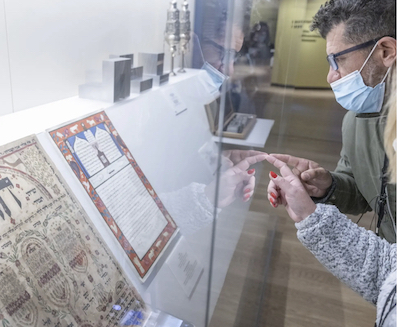
An increasing number of Arab tour guides are taking courses so they can bring their clients to the redesigned "Museum of the Jewish People," on the campus of Tel Aviv University
GETTING TO KNOW "THE OTHER"
[Note by Tom Gross]
I attach a lengthy article from Haaretz, that some of you may find interesting, about the Israeli-Arab and Palestinian tour guides who have been taking guiding courses at the newly-reopened and redesigned "Museum of the Jewish People," on the campus of Tel Aviv University.
Not mentioned in the Haaretz article is that Israel hopes that its covid-battered tourist industry will soon enjoy an influx of visitors (who will require Arabic-speaking tour guides) from Arab countries, as well as local Israeli Arabs.
There are now almost daily flights to Tel Aviv from Israel's new Arab allies including Morocco, the UAE and Bahrain and tourists from these countries have started to arrive. All of this was unthinkable a few years ago before the Netanyahu-brokered peace accords.
(Incidentally, Israeli Prime Minister Naftali Bennett is visiting Bahrain today, and moreover Saudi Arabia now allows Israeli planes to use Saudi airspace to fly to the Gulf and Asia. Bennett arrived last night to a red carpet welcome and was and escorted through the airport by the Bahraini foreign minister, both men smiling and chatting as they did so.)
INSTILLING A CULTURE OF EDUCATION
Ayub Salah, from the small Muslim town of Yarka in northern Israel, says he is enthusiastic about the guiding course at Tel Aviv's "Museum of the Jewish People," and hopes to bring his clients to the museum in future. "I think it's superb, a 10 out of 10. I've been a tour guide for 10 years and I never knew about all this," he told Haaretz. "This museum here is for Arabs, Christians and Bedouin, to get to know the Other. Without knowing the Other you don't respect them. Do you see? We are already building our own museum, so I'm getting a lot of tips."
Khalid Abu Tir, an Arab Muslim guide from the village of Umm Touba, near east Jerusalem, who specializes in tours for Christian pilgrims around Israel says:
"Look, it's really interesting. I've heard reactions like, 'What are Arabs doing here?' pretty often. When I enter a synagogue with a group of Christians, do they have to be Jewish to be there? No. They learn about the people. You come here tomorrow with schoolchildren? You don't have to force them to convert to Judaism. You teach them about this nation, its history."
Odeh Mula, from a Druze town in northern Israel (and a cousin of a Likud party Druze Member of the Knesset, Patin Mula) says: "When I show my groups that two billion Muslims have produced 13 Nobel laureates, while 15 million Jews have received 182 Nobels between them, I tell them, 'People, take the strong points from the Jewish people, learn from them.' How did they achieve what they did? Very simple: a culture of education, which brought prosperity, brought successes, brought about great and influential figures throughout history. I aim to instill a culture of education in people."
OUTSTANDING CONTRIBUTION TO IMPROVING AND SAVING LIFE
Tom Gross adds: Before the Haaretz article, here is a repeat of an item I wrote in a dispatch in 2020:
I should hardly need to point this out, but given the amount of antisemitism there is on and off the internet, including about "avoiding Jew Jabs" to fight Covid, and claims that Jews "create viruses to kill gentiles" (conspiracy theories that date back to long before the Black Death, almost to the advent of Christianity), people may not be aware of the full extent of Jewish Nobel Prize winners for medicine. Here is a partial list of some of the Jews who have helped improve the health of us all.
Of course, there could have been many more, had not over half the world's Jews been killed in pogroms and then in the Holocaust.
(This list does not include other outstanding Jewish scientists, such as Jonas Salk who discovered the Polio vaccine but was never awarded a Nobel Prize.)
1908 Mechnikov, Elie, jointly for his work on immunity
1908 Ehrlich, Paul, jointly for his on immunity
1914 Barany, Robert, for work on the physiology and pathology of the vestibular apparatus
1922 Meyerhof, Otto Fritz, for his discovery of the fixed relationship between the consumption of oxygen and the metabolism of lactic acid in the muscle
1930 Landsteiner, Karl, for his discovery of human blood groups
1936 Loewi, Otto, for discoveries relating to chemical transmission of nerve impulses
1944 Erlanger, Joseph, for discoveries relating to the highly differentiated functions of single nerve fibres
1945 Chain, Ernst Boris, for the discovery of penicillin and its curative effect in various infectious diseases
1946 Muller, Hermann J., for the discovery of the production of mutations by means of x-ray irradiation
1947 Cori, Gerty Theresa, Radnitz, for discovery of the course of the catalytic conversion of glycogen
1950 Reichstein, Tadeus, for discoveries relating to the hormones of the adrenal cortex, their structure and biological effects
1952 Waksman, Selman A., for his discovery of streptomycin, the first antibiotic effective against tuberculosis
1953 Lipmann, Fritz Albert, for his discovery of co-enzyme a and its importance for intermediary metabolism
1953 Krebs, Hans Adolf, for his discovery of the citric acid cycle
1958 Lederberg, Joshua, for his discoveries concerning genetic recombination and the organization of the genetic material of bacteria
1959 Kornberg, Arthur, for discovery of the mechanisms in the biological synthesis of ribonucleic acid and deoxyribonucleic acid
1964 Bloch, Konrad, for discoveries concerning the mechanism and regulation of the cholesterol and fatty acid metabolism
1965 Jacob, Francois, for discoveries concerning genetic control of enzyme and virus synthesis
1965 Lwoff, Andre, for discoveries concerning genetic control of enzyme and virus synthesis
1967 Wald, George, for discoveries concerning the primary physiological and chemical visual processes in the eye
1968 Nirenberg, Marshall W., for interpretation of the genetic code and its function in protein synthesis
1969 Luria, Salvador E., for discoveries concerning the replication mechanism and the genetic structure of viruses
1970 Katz, Bernard, for discoveries concerning the humoral transmitters in the nerve terminals and the mechanism, for their storage, release and inactivation
1970 Axelrod, Julius, for their discoveries concerning the humoral transmitters in the nerve terminals and the mechanism, for their storage, release and inactivation
1972 Edelman, Gerald M., for discoveries concerning the chemical structure of antibodies
1975 Temin, Howard M., for discoveries concerning the interaction between tumor viruses and the genetic material of the cell
1975 Baltimore, David, for their discoveries concerning the interaction between tumor viruses and the genetic material of the cell
1976 Blumberg, Baruch S., for their discoveries concerning new mechanisms for the origin and dissemination of infectious diseases
1977 Yalow, Rosalyn, for the development of radioimmunoassays of peptide hormones
1977 Schally, Andrew V., for their discoveries concerning the peptide hormone production of the brain
1978 Nathans, Daniel, for the discovery of restriction enzymes and their application to problems of molecular genetics
1980 Benacerraf, Baruj, for their discoveries concerning genetically determined structures on the cell surface that regulate immunological reactions
1984 Milstein, Cesar, for theories concerning the specificity in development and control of the immune system and the discovery of the principle for production of monoclonal antibodies
1985 Brown, Michael S., for discoveries concerning the regulation of cholesterol metabolism
1985 Goldstein, Joseph L., for discoveries concerning the regulation of cholesterol metabolism
1986 Cohen, Stanley, for discoveries of growth factors
1986 Levi-Montalcini, Rita, for discoveries of growth factors
1988 Elion, Gertrude B., for discoveries of important principles for drug treatment
1989 Varmus, Harold E., for discovery of the cellular origin of retroviral oncogenes
1994 Rodbell, Martin, for Discovery of G-proteins and the role of these proteins in signal transduction in cells
1994 Gilman, Alfred G., for discovery of G-proteins and the role of these proteins in signal transduction in cells
1997 Prusiner, Stanley B., for discovery of prions - a new biological principle of infection
1998 Furchgott, Robert F., for discoveries concerning nitric oxide as a signaling molecule in the cardiovascular system
2000 Greengard, Paul, for discoveries concerning signal transduction in the nervous system
2000 Kandel, Eric R., for discoveries concerning signal transduction in the nervous system
2002 Brenner, Sydney, for discoveries concerning genetic regulation of organ development and programmed cell death
2002 Horvitz, H. Robert, for discoveries concerning genetic regulation of organ development and programmed cell death
2004 Axel, Richard, for Discoveries of odorant receptors and the organization of the olfactory system
2006 Fire, Andrew Z. for their discovery of Rna Interference - Gene Silencing by double-stranded Rna
2011 Steinman, Ralph M. for their discoveries concerning the activation of innate immunity
2011 Beutler, Bruce A. for discoveries concerning the activation of innate immunity
2013 Schekman, Randy W. for discoveries of machinery regulating vesicle traffic, a major transport system in our cells
2013 Rothman, James E., for discoveries of machinery regulating vesicle traffic, a major transport system in our cells
2017 Rosbash, Michael, for discoveries of molecular mechanisms controlling the circadian rhythm
NOBELS FOR CHEMISTRY TOO
The Israeli Nobel prize winners for chemistry Aaron Ciechanover and Avram Hershko discovered a protein that has helped lead to drugs for various diseases.
And Ada Yonath (of Israel's Weizmann Insitute) also won a chemistry Nobel Prize for 'ribosomes' which led to medical advances. Yonath was the first woman from the Middle East to win a Nobel prize in the sciences and the first woman in 45 years to win the Nobel Prize for Chemistry.
-- Tom Gross
ARTICLE
WHAT IT'S LIKE TO BE A PALESTINIAN GUIDE AT THE MUSEUM OF THE JEWISH PEOPLE
What it's like to be a Palestinian guide at the Museum of the Jewish People
By Moran Sharir
Haaretz
Feb. 10, 2022
https://www.haaretz.com/israel-news/.premium.HIGHLIGHT.MAGAZINE-what-it-s-like-to-be-a-palestinian-guide-at-the-museum-of-jewish-people-1.10604311
Meira, a guide at ANU -- Museum of the Jewish People in Tel Aviv, leads a group of visitors around the museum's upper floor.
They pass by a guitar that belonged to Leonard Cohen and an embroidered collar worn by Justice Ruth Bader Ginsburg. She points out an interactive display devoted to recipes of different communities.
Displayed in the children's exhibition entitled "Heroes -- Trailblazers of the Jewish People" are renderings by illustrator Yirmi Pinkus of something of a who's who of the Jewish people: Freud, Kafka, Leon Blum, Gertrude Stein, Jonas Salk, Helena Rubinstein, Bob Dylan and dozens of others.
Nearby are 52 portraits by artist and designer Lena Revenko, each representing a different Jewish community worldwide through one of its greatest sons or daughters.
Here the visitor will find the Austrian confectioner Franz Sacher, the creator of the Sachertorte, the South African politician and anti-apartheid activist Helen Suzman and the iconic American baseball player Sandy Koufax, who declined to pitch the first game of the 1965 World Series for the Los Angeles Dodgers because it fell on Yom Kippur.
"THE DUDE"
Meira gives her group a few minutes to wander freely among the exhibits. They peruse exhibitions spotlighting the achievements of the Jewish people in the realm of culture, among them a large photograph of The Dude from the Coen brothers' film "The Big Lebowksi," a model of E.T. (created for the 1982 film by Steven Spielberg), and a ladle signed by Larry Thomas, who played the Soup Nazi in "Seinfeld."
Between the displays there are quotes by great gentiles, such as Mark Twain and Winston Churchill, exalting the uniqueness and genius of the members of the Mosaic faith. The museum, formerly called the Diaspora Museum (Beit Hatfutsot), is newly revamped but emits an old and pleasant aura of pride: how good it is to be a Jew.
Knowledgeable and energetic, Meira tries to squeeze as much as possible into the brief time allotted to her. She talks about the Inquisition, the Emancipation, about the medieval Jewish traveler Benjamin of Tudela and about Gene Simmons from the rock band Kiss, about Maimonides' innovations with respect to halakha (Jewish religious law) and the choreography of "West Side Story." Her audience of 15 consists of men and women in their 40s and 50s who also make a living by guiding groups.
Anyone who thought that the Jews are a stiff-necked people has obviously never met any Israeli tour guides. From my experience, being among the guided isn't easy. Tour guides tend to be amassers of information and connoisseurs of controversy who like to parade their knowledge before a captive audience. That particular recent morning the group listened to Meira attentively.
Even before their tour got underway, one of the participants -- we'll call her Revital -- asked in a voice that echoed around the first floor: "Does the museum differentiate between Judaism before and after the period of the Enlightenment? Because those are two completely different things, you know." Meira answered her patiently.
THE BATTERED TOURIST INDUSTRY
This a low period for tour guides in Israel. Those who relied on a foreign clientele have found themselves in an employment and identity crisis during the two-year coronavirus crisis. About a month and a half ago, Transportation Minister Merav Michaeli stated in a cabinet meeting that "it's legitimate to sacrifice the tourism industry," and Finance Minister Avigdor Lieberman suggested that guides should look for a different profession.
He later retracted that comment but that didn't change the depressing reality or mitigate the affront. Tour guides typically enter the profession with a passion -- for traveling, for knowledge, for speaking before an audience. Many of them are now returning to previous professions, others are trying to reinvent themselves within the new boundaries dictated by the pandemic.
A four-day course is now being offered to tour guides, within the framework of what is called the G2G: Generation to Generation program sponsored by the Social Equality Ministry in cooperation with the Education Ministry and ANU -- Museum of the Jewish People (anu means "we" or "us" in Hebrew). The goal: to encourage the guides to bring their groups on a visit there.
Meira's group is in a hall on the ground floor hearing lectures on the history, essence and distinctive nature of the Jewish people. Are we talking about a religion or an ethnic group? What's the connection between a 17th-century Jew in Holland and an Australian Jew in 2022? "Are Messianic Jews represented in the museum?" Revital asks.
Other participants try to understand what the institution's mandate is -- for example, why the guitar of a Jewish musician is on display if his music has virtually nothing to do with his Jewishness. Is circumcision a sufficient condition for a person to gain entry to the museum's pantheon? Good questions.
Also in the hall were a few individuals whom my grandmother might call "nisht fun undzeren" -- meaning, "not one of us": that is, Christian, Muslim and Druze tour guides who had come to learn about the People of the Book, its past, its diversity and the celebs it has produced. This is the first time that non-Jews are participating in the museum's tour guide program.
ISRAEL'S DRUZE
During the lunch break, the three Druze members of the group sit together on the terrace of the Aroma cafe branch in the museum. "I've only been a tour guide for three years. The pandemic struck just when I got started, so I am not so active," says Odeh Mula, silver-haired man from the Druze town of Yarka in northern Israel (and a cousin of Likud MK Patin Mula).
"The non-Jewish people of Israel don't have a museum culture," Mula says. "I once took pensioners from Jadeidi-Makr [an Arab town near Acre] to the center of the country and I combined it with a visit to an art museum in Caesarea. Of the 17,400 inhabitants of Yarka, I'm a million percent sure that more than 10,000 of them have never been in an art museum in their life. We lack the museum culture, and when I say 'culture' I even go beyond museums: We are lacking in culture. We are a people whose culture has not yet crystallized. I would like to take a second-grade class from Yarka or Julis and show them that a people that respects its culture and its religion -- and stays united and forges a culture for itself -- is a strong people. We Druze are a community and not a people, but it's time for us to become strong and express ourselves more intensively."
Mula continues to speak, his restraint belying his ardor. "My father, whom I still help bathe every morning and keep at home at the age of 87, went to school until the fourth grade and was very limited when it came to knowledge about the outside world. So this is a drastic change for us, because Jews lived in France and were exposed to museum culture and literature as early as the 19th century, and encountered many types of culture there. I don't know if my father even happened to go to a movie theater in Haifa when a film with [the Syrian-born actor] Farid al-Atrash was playing. Maybe he saw three movies in his life. I've seen 200, and I'm positive that my son will take even more interest in culture."
You're saying that the Druze culture hasn't become solidified?
"It's nonexistent. When it comes to heritage, the Druze have no heritage other than their religious one. The wooden plow that my grandfather and my father used until the 1970s has existed for 2,000 years among all the Eastern peoples. I can't call that my heritage. There is a heritage in the religious context."
Dr. Raja Faraj, from the village of Yanuh in Western Galilee, is listening patiently to our conversation. Sporting glasses and a mustache, he's wearing a fedora. "I used to be a school principal," he says. "I have published four books in Hebrew and four in Arabic on historical topics: for example, a study about the relations between Jews and Druze before 1948, and on the subjects of pedagogic entrepreneurship as a lever for education in the coming generations, reincarnation."
THE HOLOCAUST
Faraj adds proudly that while serving for two years as the Education Ministry's inspector-coordinator for history in the Druze community, he introduced the study of the Holocaust into the curriculum.
"I view the Jewish Holocaust from three aspects," he continues. "The first is human, universal and interpersonal; second is a civil aspect, whereby I, as a citizen of Israel, am interested in the people that is building this country -- how they feel, how they are continuing on their path after the Holocaust; and the third aspect is the similarity between the history of the Druze people and that of the Jewish people. These are two small peoples that were constantly persecuted and were compelled to move from place to place. If we draw on these three points of view, the headline for me both as an educator and as a father is that I want my Druze son and my Druze student to also learn from the experience of the Jewish people when it comes to curatorship and museology."
What is there to be learned?
"The Druze Heritage House is now being built in Isfiya, near Haifa. I think I can learn from the curating and contribute my part as a historian of my people's heritage. I picked up a lot of ideas here that can be copy-pasted."
"I THINK IT'S SUPERB"
Ayub Salah, a tour guide from Yarka who specializes in Islam, is also enthusiastic about the museum course. "I think it's superb, a 10 out of 10. I've been a tour guide for 10 years and I never knew about this thing. This thing here is for Arabs, Christians and Bedouin, to get to know the Other. Without knowing the Other you don't respect them. Do you see? We are already building our own museum, so I'm getting a lot of tips."
Was there nothing that has bothered either of you here?
I tell my groups, 'People, take the strong points from the Jewish people, learn from them.' How did they achieve what they did? Very simple: a culture of education.
Faraj: "One aspect didn't stand out as much as I would have wished, as a member of a minority: I am referring to the context of and the connections between the Jewish people and other cultures and other peoples. That should be reinforced."
Salah complains that the exhibit about Benjamin of Tudela (a 12th-century rabbi who documented Jewish life in Europe and Asia) doesn't mention his encounters with Druze. "If I bring people and groups here," he says, "they see it written in red: 'a nation among nations -- not the 'Chosen People -- in Hebrew and English. Why not in Arabic?" (The exhibits have no explanations in the Arabic language.)
NOBEL PRIZES
And don't exhibits of the greatest Jews in history give you "the Chosen People" feeling?
Salah: "That's not written here."
True, but isn't that the message they're trying to convey?
Mula: "When I show my groups that two billion Muslims have produced 13 Nobel laureates, while 15 million Jews have received 182 Nobels between them, I tell them, 'People, take the strong points from the Jewish people, learn from them.' How did they achieve what they did? Very simple: a culture of education, which brought prosperity, brought successes, brought about great and influential figures throughout history. I aim to instill a culture of education in people."
Is your experience here, as Druze, different from Palestinians from East Jerusalem who visit here?
Mula: "Definitely. They reject it all from the outset, they automatically defend themselves in every encounter with the Jewish people. Look at the approach of [Joint List MK] Ahmad Tibi in the Knesset -- he always needs to defend himself and be on the attack. I respect him. A tour guide from East Jerusalem who came here asked me, 'Why would I bring Palestinians from Sheikh Jarrah and Beit Hanina here?' So I told him, 'I would bring a Druze pupil here and show him the strong points about the Jewish people, so he'll learn from the content."
Faraj: "Bravo!"
Mula: "So he says, 'Ah, there's something to that. We can work with that.' If I bring a class from the 10th grade in Yarka to the museum here, and there's a kid of 15, who in another 20 years will serve as a council head -- by the way, as of now there isn't a single theater in any of the country's 16 Druze locales -- maybe he'll build a theater. As council head, he'll say, 'Folks, I'm leaving any work involving paving and improving roadways for two years, accumulating a budget and building a theater, building a movie theater, building culture. A people with no culture is a disintegrating, weak people."
Salah: "In short, this is a nice place. It's a real 10. You have to know how to bring the audience here."
As we speak, Wissam Suleiman is sitting alone, smoking. He describes himself as a Palestinian Israeli, from the local council of Bu'eine Nujeidat in Galilee, who has lived in Jaffa for the past 20 years. "I am a fellah and but also a bit of an urban type," he says.
Suleiman relates that he is active in the protest by guides seeking government compensation for the beleaguered tourism industry during the current crisis. Before the pandemic he worked with Italians, Germans, Swedes, Britons and also Israelis, "in the mixed cities in general and in Jaffa in particular. I lead tours that focus on urban development and upheavals in contemporary Jaffa, from 1948 to our day. Jaffa hasn't emerged from 1948; it's still stuck there."
Why are you here?
Suleiman: "First, because of the money."
You get money for taking part in this course?
"Yes."
From who?
In contrast to you -- and I'm talking about the Jews -- we are more open to learning from and becoming acquainted with the other than you imagine.
"From the museum itself. They're recruiting Arabic-speaking docents. They don't have any, and they want to attract an Arabic-speaking audience -- from the north, for example."
Will there be an audience for this, do you think?
"Very small, I would think, but you have to start somewhere."
Why?
"Because it's too complex and rich a subject for a target audience of Arab schoolchildren. You need to bring university students, perhaps, people from a public that is slightly more informed about contemporary Israeli and Jewish affairs."
Could there be opposition from home?
"No, no."
Won't parents say, "We have enough just teaching about our own people -- why teach about the Jews?"
"First of all, we don't have enough things of our own [being taught] in Arab schools, be they Druze, Muslim, Christian and so on. In contrast to you -- and I'm talking about the Jews -- we are more open to learning from and becoming acquainted with the other than you imagine."
Wouldn't it be odd for you to come here with a group of non-Jews and tell them about the Jewish religion?
"Why odd? It's very attractive."
Neither you nor they are part of this people.
"True. The truth is that it's easier here to explain things to Catholic tourists or to non-religious Jews. French or English liberals who come to Israel. Learning is the finest experience, it's the best thing a person can do."
I've heard reactions like, 'What are Arabs doing here?' pretty often... You come here with schoolchildren? You don't have to force them to convert to Judaism. You teach them about this nation, its history.
If a Jew, say, were to direct films that have nothing to do with Jewish subjects, would you display him here?
"If he is successful and if he's famous and influential -- yes. Because his Jewishness influenced his way of life."
Isn't there a feeling of boasting here in the exhibits about how Jews have a great many celebrities and scientists and thinkers?
"Clearly, clearly. Every museum is boastful. The very existence of this building is a certain type of boasting. But that doesn't detract from it."
Don't you see here an implicit assertion that we Jews are a special or even chosen people?
"That is the basis of your belief -- that you are the Chosen People. So what's the big deal?"
And you wouldn't have a problem guiding a class from Jaffa or from the Galilee and passing that message on to them?
"I wouldn't transmit the message that [the Jews are] the Chosen People, the exalted people. I would convey a message of, 'Look at how this people preserves its culture, its values, how it unites and empowers those who promote cultural, musical, literary, philosophical, political activity and so on, across the world -- and yes, we should behave like that. We need to empower ourselves, we must uphold our heritage, we should not lose ourselves and should not be ashamed of who we are, whether we are talking about our Palestinian ethnos, our Arabic language or our Christian, Muslim or Druze religion."
"OUTSIDE THINKERS"
ANU -- Museum of the Jewish People, as it is now called, opened about a year ago on the campus of Tel Aviv University. (Full disclosure: Much of its funding came from the Nevzlin family, which is a co-owner of Haaretz.)
The new name doesn't sit so well on the tongue (the previous one was perhaps better) but the museum is undeniably well endowed and extremely impressive. In their conversations with participants in the courses, the senior staff at ANU like to emphasize that it is the world's largest Jewish museum, the product of 10 years of planning and construction, and that it is no longer the Diaspora Museum, but something entirely new.
On the second day of the course, participants in Meira's group hear a talk by the museum's chief curator, Dr. Orit Shaham Gover. She tells about the decisions that were made parallel to collecting and displaying the artifacts in the museum.
Dr. Faraj stands up to make a remark: "I want to tell you a bit crudely, please excuse this, that I didn't see in the museum's three floors [displays relating to any] personalities, key figures from different religions, communities and civilizations that influenced and shaped not only the Jewish people but also the Jewish religion."
As examples, he mentions the biblical figure of Jethro and the seventh-century Berber warrior-queen Dihya al-Kahina. Shaham Gover replies that quite a few "outside thinkers" who influenced the Jewish people are represented in the museum, noting that there is a portrait of Al-Kahina on the second floor. As for Jethro, he was omitted as part of a sweeping decision to avoid references to the Bible in order not to get embroiled in the debate concerning myth versus history.
Speaking with a French accent, another guide asks why there isn't more mention of French Jews in the museum. The chief curator's response is that in her eyes the French have not been short-changed. Revital interrupts her to say, "Why is an LGBT couple displayed? That's not a form of Judaism, you know. It's obvious that there are Jewish LGBTs, it's almost an affront, I would say. If I were from the LGBT community, I would be offended by it." The curator is compelled to answer her, and in doing so, displays greater forbearance than the Jews showed in 2,000 years of exile.
During the break, Khalid Abu Tir, a guide from the village of Umm Touba, adjacent to the post-1967 Jerusalem neighborhood of Har Homa, sits over on the side. "Half of Har Homa is actually on our land," says Abu Tir, who specializes in tours for Christian pilgrims around the country but had been out of work lately. "I did what Lieberman requested: I switched professions."
What do you do now?
Abu Tir: "I'm a bus driver."
Then why are you here?
"Look, it's really interesting. I've heard reactions like, 'What are Arabs doing here?' pretty often. When I enter a synagogue with a group of Christians, do they have to be Jewish to be there? No. They learn about the people. You come here tomorrow with schoolchildren? You don't have to force them to convert to Judaism. You teach them about this nation, its history."
Do you feel that the museum is strictly confined to history, or that there's also an attempt to convey a message or preach about something?
"On the contrary: The truth is that when I first came here I was upset as an Arab person -- I thought there would be racism in the lectures, but thank God I didn't find that. That's what encouraged me to return. Yesterday I told myself that I would come for the first day, and if I see that it's moving in the right direction for me -- okay; if not, I'm not obligated to be here. And I'm very pleased and happy that it doesn't conflict with my religious beliefs."
Ayub Salah and another course participant, a Palestinian from East Jerusalem, pass by. Salah says: "Here, I've brought you another one!" Seeing me speaking with Abu Tir, Salah says, "If you could, please let us know afterward how this went. It's important for me to know what his approach is."
You could ask him.
Salah: "It's important for us to know what's being talked about."
Abu Tir: "What do you mean, 'to know what's being talked about'? Is there some secret that needs to be talked about?"
Jesus was born, lived and died as a Jew. So what happened? He is the most influential Jew in the world. He wasn't mentioned here!
Salah: "No. I mean: What's your opinion of the museum, how do you see it, what does it contribute to you?"
Abu Tir: "What do you mean, 'contribute'? If you take a group of Christians to a synagogue, do they need to be moved by the visit? They need to look at it."
Salah: "No, you didn't understand me ..."
Abu Tir: "Don't tell me I didn't understand."
Salah switches to Arabic. The only words I understand are "Jethro" and "Nabi Musa" -- a reference to the West Bank site near Jerusalem associated in Muslim tradition with Moses' burial place.
Abu Tir: "We're not getting into religion now."
Salah: "But there is a connection."
Abu Tir: "You go to the United States and visit a monastery -- what do you care what's there? If you're okay with it, go in; if not, go home."
Salah: "If you're not impressed, you won't bring any group."
Abu Tir: "If there's work, then why not?"
Salah: "What I mean is, you bring Arabs here, take the positive things. You don't understand."
Abu Tir: "Don't say that I don't understand again. There's a difference between Jaffa and here. Jaffa is archaeology, the sea. Here there's history."
Salah: "God forbid, it was not my intention to offend, just the opposite." He says a few more things in Arabic in an apologetic tone, and walks off.
Abu Tir: "This is the work of a guide: You take a group of children to the museum, you have to teach them. You didn't bring them so as to exert influence over them. You came in order to tell them: Here is where Jews came from Morocco, from Egypt and all those stories. Two, two and a half hours, then goodbye and see you later. You don't have to marry them or convert them. You don't have to ask questions of what and why."
The day progresses with another lecture and another tour of the museum. Outside the hall two guides, one wearing a cap, are arguing about aqueducts. Revital asks a member of the staff why there is no mention of the Subbotniks, 18th-century converts to Judaism from Christianity in Russia.
Ruby Azrak, 49, from Beit Hanina, who guides Christian pilgrims, relates that while it's hard not to work, at least she has more time for the grandchildren. She says she's fascinated by the museum's course: "Judaism for me is something I like to delve into and learn more about, it's an experience. From the first day I've been here in the auditorium, listening to the lectures, my head has been somewhere else: How I can bring groups here?"
Have you considered bringing pilgrims?
Azrak: "Yes. Christians pray to the Bible every day; Jesus was a Jew, so Judaism and its whole culture relate to us. The more you understand the Jewish people, the more you understand yourself."
Don't you find it odd that Jesus isn't mentioned here as a famous Jew?
"I asked people here about it: 'You mention the false messiah Shabbetai Zvi, [the 17th-century mystic] whom the Jews didn't like and who converted to Islam, who didn't even remain a Jew. Jesus was at least born, lived and died as a Jew; he didn't convert. So what happened? He is the most influential Jew in the world. Millions and billions of followers. He wasn't mentioned here! At least something small, even negative, that he did this or that. A mention. He was a Jew."
What did they say?
"That they had thought about it and there were discussions, and that the subject is a red line for very many Jews. It's sensitive. I also asked how they define 'Jew.' They told me, 'Anyone who considers himself a Jew.'"
Awad Jalal, who lives in the East Jerusalem neighborhood of Isawiyah, guides tourists in Hebrew, Arabic and English. "We are usually afraid of people we don't know," he says. "In the United States, where I lived for more than 20 years, they say, 'The enemy is the person whose story you haven't heard yet.' My great aunt, who lived with my family in Isawiyah for many years, always blamed the Jews for everything that wasn't right, and said: 'God will curse the Jews.'
"If she were still alive," he continues, "I would take her to the museum and ask her which Jews she is cursing. Is it Layla Murad, the Egyptian singer whom she would have liked without knowing she was Jewish? Or would it be Jerry Seinfeld, whose series I used to watch in order not to feel lonely when I lived alone in San Francisco? Or is it Bob Dylan, whose music I liked listening to, but never knew his Jewish name of Robert Allen Zimmerman?
"Maybe it's too late for my great aunt," Jalal says, "but it's still not too late for thousands of Arab students who attend Israeli schools separately from the Jewish students. The time has come for them to get to know the moving Jewish stories that are told here. There is no doubt it will improve their perception of their Jewish neighbors. Otherwise, how will Arab children revise the negative images of Jews that they encounter in so many places?"
* You can also find other items that are not in these dispatches if you "like" this page on Facebook www.facebook.com/TomGrossMedia
*** This dispatch will be posted soon ***