

PALESTINIANS SHOULD NEGOTIATE OR RISK BECOMING A FORGOTTEN CONFLICT LIKE NORTHERN CYPRUS
I attach han interview I gave yesterday to BBC Arabic TV, which broadcasts across the Middle East.
Among the points I made:
The Palestinians have been badly advised by some of their left-wing friends in Europe and America, people like John Kerry, who told them not to negotiate for the last four years. This was a huge mistake. Whoever wins next week’s US elections, the Palestinian Authority should return to open negotiations with Israel without pre-conditions and under American auspices. Otherwise history may pass them by as the rest of the Arab world makes peace with Israel, and the Palestinians risk becoming a forgotten conflict like Northern Cyprus.
Instead of continuing to praise suicide bombers and arrest Palestinians who want to have good relations with Israel, Fatah and Hamas should allow the many Palestinians who want to do so, to reach out culturally to Israelis in the way that Emiratis and Bahrainis are currently doing.
This is the original English interview before it was dubbed into Arabic:
INSTAGRAM JOINS TWITTER AND REFUSES TO REMOVE IRANIAN HOLOCAUST DENIAL POSTS
Following up yesterday’s dispatch
Despite reports to the contrary this morning, upon checking, Instagram (which is owned by Facebook) has not removed the latest post (from Wednesday) by Iran’s leader Ayatollah Khamenei questioning whether the Holocaust happened. It also remains up on twitter. (Two weeks ago, Facebook CEO Mark Zuckerberg claimed Facebook was going to disallow such posts.)
After I and others drew attention to the tweet yesterday, by the long-standing prime minister of Malaysia saying Muslims have a right to “kill millions of French people,” Dr. Mahathir Mohamad edited his tweet to his 1.3 million followers.
“WILL TRUMP’S PRO-ISRAEL MOVES STAND THE TEST OF TIME?”
Below is an analysis published today by Jonathan Tobin about what a Biden administration might mean for the ongoing Trump Middle East policies.
(Not mentioned in Tobin’s article is the concern by some about the influence that Senator Bernie Sanders and his supporters may have in a Biden administration. There was dismay among many Jews that Sanders used a speech this week to mark the second anniversary of the Pittsburg synagogue shooting, in which 11 Jews were murdered, to take a swipe at and smear Israel.)
Will Trump’s pro-Israel moves stand the test of time?
By Jonathan S. Tobin
Jewish news Service
October 30, 2020
For President Donald Trump’s Jewish supporters, these last moves are just the icing on the cake. Both the decision to remove any territorial restrictions on scientific and academic bilateral agreements, which puts into action the administration’s 2019 ruling that West Bank settlements should no longer be regarded as “illegal,” and the ruling that American citizens born in Jerusalem will be able to name their place of birth as “Israel” are the culmination of a revolution in American Middle East policy.
Critics of the president are putting this down to politics rather than principle. But at this point, the question to be asked about Trump’s policies towards Israel is not whether they are going to help him get re-elected (which is highly unlikely), but whether his decisions will withstand the test of time if the polls are correct and he’s defeated by former Vice President Joe Biden.
The magnitude of the shift of policies dating back to 1967 and even 1948 cannot be overestimated. Trump’s decision to recognize Jerusalem as Israel’s capital and move the U.S. embassy from Tel Aviv to Jerusalem was a longstanding demand of the pro-Israel community. It was also one that even most activists, let alone Israel’s government, had long since given up on ever seeing happen.
Nor did anyone in the pro-Israel community dream four years ago that after a half-century of agreeing with the rest of the world that Jewish communities in the West Bank were illegal, the State Department would issue a legal opinion that would reverse that stand.
Yet he changed all that and more, including recognizing Israeli sovereignty on the Golan Heights and putting into place policies towards the Palestinian Authority that halted aid until it rescinded its funding for terrorism.
Foreign-policy veterans gravely predicted that going through with any of these measures, especially the shifts on Jerusalem and the settlements, would set the region on fire as outrage against Trump’s stands spread throughout the Arab and Islamic world. But to the dismay of his opponents and the shock of Obama administration alumni, these earthshaking reversals did not result in widespread violence and chaos. To the contrary, Trump’s foreign-policy team helped midwife the Abraham Accords, a remarkable turn of events in which the United Arab Emirates, Bahrain and Sudan – with the promise of others following suit before long – normalized relations with Israel.
A few years ago, critics of Israeli Prime Minister Benjamin Netanyahu were warning of a “diplomatic tsunami” orchestrated by the Palestinians and former President Barack Obama that would leave the Jewish state isolated.
Today, thanks to their intransigence to even meet Obama halfway as he desperately sought to revive negotiations whose goal was to grant them statehood and a deal that would push Israel back to the 1967 lines with a few minor adjustments, it’s the Palestinians who are isolated. This is due, in large measure, to Obama’s efforts to appease Iran that essentially forced Saudi Arabia and other Gulf States into Israel’s arms. Though they still pay occasional lip service to the Palestinian cause, they have given up on them, rightly convinced that Palestinian Authority leader Mahmoud Abbas and his Fatah Party, as well as their Hamas rivals, are simply incapable of making peace with Israel on any terms.
Trump’s stand didn’t make a Palestinian state impossible. But should his rulings positions remain in place, they do fundamentally alter the terms for any future negotiations, compelling the Palestinians to acknowledge that even if they were willing to make peace, there would be no wholesale evictions of hundreds of thousands of Jews from their homes in Judea and Samaria, let alone Jerusalem. Any talks would be conducted on a basis that considered the West Bank disputed territory rather than, “Palestinian land,” as is the assumption of the rest of the world, a position that erased both Jewish rights and international agreements which contradicted the assumption that Israel had no legitimate claim.
But what happens if Biden is sworn in next January, and veterans of the Obama administration and other foreign-policy establishment favorites replace Trump’s people? Does this mean that Trump’s Middle East revolution will be swept away?
While the answer to that question would be up to Biden and his chief advisers, the answer is that even if they wanted to, not all of Trump’s rulings or his achievements could be replaced easily. And if Biden is wise, he’ll avoid the temptation to expunge evidence of the Trump presidency when it comes to Israel and the Mideast.
Biden plans to return the United States to the weak and disastrous 2015 Iran nuclear deal. Whether he goes so far as to lift sanctions on Tehran is open to question, but there’s no doubt that, like the Palestinians, Iran is very much hoping for Biden to win while the Arab states (as well as most Israelis) are rooting for Trump.
It would also only take a stroke of the pen for Biden to reverse Trump’s stand about the settlements being illegal. And it’s likely that he’ll do so since pressure on Israel to accept a massive territorial surrender as part of the price for a comprehensive peace and a two-state solution that the Palestinians don’t really want is one issue on which an inveterate flip-flopper like the former vice president has never wavered throughout his career.
But don’t expect him to move the embassy or waste much time actually trying to revive peace talks.
Biden has already signaled that the embassy will remain in place since, although he regrets Trump’s decision, moving it or making formal statements undoing the recognition will merely generate futile arguments that won’t help him accomplish a thing. And surely even Biden understands that Obama wasted precious time, energy and political capital engaging in endless and pointless quarrels with Israel that never moved the Palestinians to negotiate seriously.
Should the Democrats return to power, Biden will have his hands full dealing with the coronavirus pandemic, a devastated economy and a host of other problems. Many in the left-wing activist base of his party would cheer attacks on Israel. But it’s likely that even the left will prioritize his adopting other elements of their radical and destructive agenda like court-packing and the Green New Deal. Expending the kind of political capital it would require to move the embassy or a major diplomatic offensive aimed at reviving talks with the Palestinians would be a blunder as well as a fool’s errand.
Even his most virulent critics should understand that Trump’s legacy on this issue will not be so easily forgotten.
There’s more to what he accomplished in the Middle East than a new embassy or agreements that Democrats thought were impossible. The leap of imagination that it took for him and his team to label previous American policies as mistakes, coupled with the warnings of the foreign-policy establishment as fiction, has forever changed the way Americans think about the region.
The Jerusalem decision and the Abraham Accords – and all that went with them – exposed the policies of Trump’s predecessors and the dire warnings of State Department veterans as myths and even lies. Though many of Trump’s decisions may be reversed, the so-called return to “normalcy” won’t change the facts on the ground, make peace with the Palestinians or cause the Arab states to cease acting in their own interests by treating Israel as an ally.
Israel may face grave difficulties in the next four years, but never again will it be possible for its critics to say that the policies that Trump carried out would be disastrous since we’ve already seen how successful they were in advancing the cause of peace. Trump may soon be gone. Still, there’s no turning back the clock so as to allow us to pretend that his establishment critics know what they’re talking about when it comes to the Middle East.
* You can also find other items that are not in these dispatches if you “like” this page on Facebook www.facebook.com/TomGrossMedia

TWITTER ALLOWS MALAYSIAN AND IRANIAN LEADERS TO INCITE MURDER
[Note by Tom Gross]
Just hours after an attacker yelling “Allahu akbar!” beheaded one woman and killed two others in a church in France this morning, the long-standing prime minister of Malaysia said Muslims have “a right to be angry and kill millions of French people”.
As I write, twitter is continuing to refuse to remove his tweet to his 1.3 million followers. (Update: He has now edited his tweet to tone it down.)
Only yesterday the CEO of twitter was again justifying to a US Senate committee his continuing to block the twitter account of America’s fourth most read newspaper the New York Post and other journalists (including those from Politico) who have dared to raise the serious corruption allegations made against Joe Biden and his family involving China and Ukraine. Yet twitter continues to allow genocidal statements to be made on its platform both by Malaysian prime minister Dr. Mahathir Mohamad, and others by Iran’s leader the Ayatollah Khamanei effectively calling for the murder of Jews and other posts denying the Holocaust.
Dr. Mahathir Mohamad, who was until March 2020 the Malaysian prime minister, has in the past also made the most horrible antisemitic statements.
Despite his long history of antisemitism Dr. Mohamad was invited as an honored guest last year both by Oxford University in England and by Columbia University in New York.
The latest Islamist attack in France today – the third in as many weeks - happened just half a mile from the Islamist terror attack that killed 86 people in Nice 5 years ago.
Meanwhile the British Labour party today took the dramatic step of suspending its former leader Jeremy Corbyn from the party over his continued attitude to the issue of antisemitism within the party.
* You can also find other items that are not in these dispatches if you “like” this page on Facebook www.facebook.com/TomGrossMedia
* New poll: 80 percent of Saudis now “support normal relations with Israel”
* Mossad head:“If Trump wins next week, the Saudi agreement with Israel could be announced immediately. If Biden wins, the timeline for the agreement is murkier.”
* Tom Gross: If Biden wins, the Saudis are expected to try to prevent a new Biden administration from reducing the pressure on Iran’s Islamic regime, and use the prospect of a peace deal with Israel as leverage to try and prevent Biden from re-entering the JCPOA nuclear deal which many people in the Arab world and Israel view as a dangerous agreement that naively paves the way for Iran to acquire nuclear weapons.
* As the head of the International Atomic Energy Agency (IAEA) confirms Iran is building an underground centrifuge assembly plant and stockpiling increased amounts of low-enriched uranium, the US Congress may allow the sale to Israel of bunker-buster bombs capable of penetrating heavily fortified underground structures.

A girl running on a hill near Debaga camp. At least 400,000 Iraqis who fled ISIS in 2014 are still housed in a series of camps in Kurdish territory in northern Iraq. They are being prevented from returning to their homes in Mosul and elsewhere in Iraq, by Iranian regime-backed Shia militia groups.

Above, an Etihad Airways flight from the United Arab Emirates lands at Tel Aviv’s Ben Gurion Airport last week. The warming of ties between Israel and the Arab world appears to be moving faster now than at any time in history, according to my estimate.
Every day there are new breakthroughs announced. For example, yesterday the soccer leagues of Israel and the United Arab Emirates signed an agreement to hold matches between the professional football clubs of each country. Other Arab countries are expecting to sign on to the agreement soon.
CONTENTS
1. Trump says “we have 10 countries” waiting to join Israeli-Arab deals after US election
2. US helps guide Sudan away from Iran into “the peace camp”
3. Mossad: timing of Saudi-Israel peace announcement depends on US election winner
4. 80 percent of Saudis “support normal relations with Israel”
5. Oman may sign peace deal with Israel “very soon”
6. IAEA: Iran currently building nuclear facility underground
7. Trump imposes sanctions on Iran’s oil, tries to tie Biden’s hands
8. US drones and allies kill several Qaeda leaders and operatives
9. Fresh Russian airstrikes kill dozens in Syria “as warning to Turkey”
10. Gaza court convicts Palestinian peace activists for zoom call with Israelis
11. Bahraini institute partners with US to combat anti-Semitism and anti-Zionism
[Notes by Tom Gross]
TRUMP SAYS “WE HAVE 10” COUNTRIES WAITING TO JOIN ISRAELI-ARAB DEALS AFTER U.S. ELECTION
U.S. President Donald Trump said yesterday that up to 10 more Arab countries are in negotiations to normalize ties with Israel, following agreements that his Secretary of State Mike Pompeo and special advisor Jared Kushner helped broker in recent weeks between Israel and the United Arab Emirates, Bahrain and Sudan.
According to Trump, further agreements between Israel and Arab countries will be signed after the U.S. election on November 3.
When asked by reporters yesterday whether other countries will normalize ties with Israel, Trump replied: “We have five, but we really have probably nine or ten that are right in the mix. I’ll think we’ll have all of them … It will be after the election. We’re doing a lot of work right now.”
Trump added that “I’m involved in all of these deals.”
US HELPS GUIDE SUDAN AWAY FROM IRAN INTO “THE PEACE CAMP”
On Friday, Trump announced that Israel and Sudan had agreed to normalize relations in a joint phone call broadcast live from the White House with Israeli Prime Minister Benjamin Netanyahu and Sudanese Prime Minister Abdalla Hamdok and Transitional Council Head Abdel Fattah al-Burhan.
An official Sudanese-Israeli signing ceremony will likely be held at the White House in the coming weeks, a spokesperson for Trump said. He added that Israeli-Sudanese ties will initially focus on economy and trade, with Israeli know-how helping to improve Sudanese agriculture.
Until recently Sudan was closely allied with Iran and was also a sponsor of terrorism internationally.
Many opponents of Trump who disagree with all or most of his domestic policies, nevertheless acknowledge that his approach to peace making – which is the very opposite of the overly sympathetic approach by the previous US administration toward the Iranian and Palestinian regimes – has paved the way for ties between Israel and Arab countries.
Trump said yesterday that ‘all’ Middle Eastern states will eventually normalize ties with Israel.
Some observers, including myself, have long supported this approach to peace making, long arguing that Fatah, Hamas, and even the Iranian regime were far more likely to agree to make peace with Israel only after they see that the rest of the Arab and Muslim world was doing so.
MOSSAD: THE TIMING OF SAUDI-ISRAEL PEACE ANNOUNCEMENT DEPENDS ON WHO WINS THE US ELECTION
Israeli intelligence sources say that Saudi Arabia will quickly announce a normalization deal with Israel if Trump wins the U.S. presidential election
If Biden wins the Saudis will likely try to prevent a new Biden administration from reaching out too quickly towards Iran’s Islamic regime, and use the prospect of a peace deal with Israel as leverage to try and prevent the new US government from doing so.
Every other Arab country (with the possible exception of Iran’s ally Syria) is concerned that Biden may appoint to senior positions those same Obama-era officials who remain enthusiastic about the JCPOA Iran nuclear deal which many people in the Arab world and Israel view as a very dangerous agreement that naively paved the way to Iran acquiring nuclear weapons.
Biden has promised that if elected he will discuss re-entering the 2015 nuclear agreement that Trump withdrew from in 2018.
“Trump’s withdrawal from the Iran deal showed the Arab world that the US has our backs, and helped us to decide to make peace with Israel,” an Arab ambassador in Europe told me earlier this year.
“If Trump wins,” Mossad director Yossi Cohen reportedly said, “the Saudi normalization announcement could be made immediately. If Biden wins, the timeline for the agreement is murkier.”
For more on Trump’s foreign policy please also see my video discussions
New York Times columnist Bret Stephens:
Guardian columnist Jonathan Freedland (who also mentioned in this conversation that he was a mentor to Sasha Baron Cohen before he became Borat)
The Times of Israel editor David Horovitz
80 PERCENT OF SAUDIS “SUPPORT NORMAL RELATIONS WITH ISRAEL”
According to a poll of Saudis conducted by Zogby Research, 80 percent of Saudis now support normalization with Israel.
In a separate poll of Israelis by the Mitvim Institute, Israelis considered normalization with Saudi Arabia the most strategically important country with whom Israel should normalize relations.
OMAN MAY SIGN PEACE DEAL WITH ISRAEL “VERY SOON”
The Gulf kingdom of Oman is also likely to announce normalization with the Jewish state in the near future, Israeli Channel 12 news reported citing unnamed Israeli officials, possibly even before the US election.
Oman has been forthright in its praise for the recent normalization agreements between the UAE, Bahrain, and Israel, saying the Abraham Accords “contribute to achieving a comprehensive, just and lasting peace in the Middle East.”
Israeli Prime Minister Netanyahu was given a warm welcome in Oman in 2018, even though the two countries are officially at war.
Yesterday, Israeli Defense Minister Benny Gantz also said that Lebanon had indicated a new willingness to make peace with Israel. In recent days the two countries have started technical maritime border talks under US auspices.
IAEA: IRAN CURRENTLY BUILDING NUCLEAR FACILITY UNDERGROUND
The head of the International Atomic Energy Agency (IAEA) confirmed in an interview with the Associated Press yesterday that Iran is building an underground centrifuge assembly plant in Natanz. (Netanyahu has long accused Iran of doing so.)
Rafael Grossi, director-general of the IAEA said that the Iranians “have started, but it’s not completed. It’s a long process,” but would not give further details.
According to the IAEA, Iran is also stockpiling increased amounts of low-enriched uranium.
The US Congress will later this week discuss a bipartisan bill to allow the sale of Massive Ordnance Penetrator (MOP) to Israel. The MOP is a bunker-buster bomb capable of penetrating heavily fortified underground structures.
TRUMP IMPOSES SANCTIONS ON IRAN’S OIL, TRIES TO TIE BIDEN’S HANDS
The Trump administration imposed sweeping economic sanctions against Iran’s oil sector on Monday.
The Treasury Department announced sanctions on Iran’s Ministry of Petroleum, the National Iranian Oil Company and its oil-tanker subsidiary for providing financial support to Iran’s Islamic Revolutionary Guards Corps, the elite military unit that is designated as a terrorist group by the United States and has played a key role in the killing of civilians in Syria, Iraq and elsewhere.
Treasury Secretary Steven Mnuchin said the Iranian government “uses the petroleum sector to fund the destabilizing activities” of the Revolutionary Guards Corps, adding that Iranian leaders continue “to prioritize its support for terrorist entities and its nuclear program over the needs of the Iranian people.”
The New York Times notes that: “The Trump administration is trying to fortify its campaign of maximum pressure against Iran from being reversed by a potential Biden administration.”
“A [renewed] negotiating process could require unwinding a series of sanctions that Mr. Trump has levied on Iran. But given the number of actions Mr. Trump has enacted, it could become difficult for Mr. Biden to undo them.”
“A future President Biden would have a tough time lifting these sanctions given the inextricable link of the energy sector to terrorism and the IRGC,” said Mark Dubowitz, of the Foundation for Defense of Democracies.
AMERICAN DRONES AND ALLIES KILL SEVERAL QAEDA LEADERS AND OPERATIVES
The New York Times reports today:
“Last week was a bad week for Al Qaeda around the world. At least seven top Qaeda operatives were killed in the latest of a recent spate of U.S. Special Operations drone strikes in northwest Syria.
“Afghan commandos killed a senior Qaeda propagandist in a raid in a Taliban-controlled district. And the United States continues to pressure the Qaeda affiliate in Somalia, the Shabab, which may be undergoing a leadership shake-up.
“Yet nearly two decades after the 9/11 attacks and with many of its top leaders dead, both Al Qaeda and the Islamic State, as well as their global affiliates and supporters, remain resilient and has ‘ingrained itself in local communities and conflicts’ spanning the globe, from West Africa to Yemen to Afghanistan, a U.N. counterterrorism report concluded.”
FRESH RUSSIAN AIRSTRIKES KILL DOZENS IN SYRIA “AS WARNING TO TURKEY”
In violation of a seven-month truce in northern Syria, on Monday Russian warplanes killed at least 72 people including Turkish-backed Syrian fighters, and civilians harvesting olives nearby.
Some observers said that the Russian airstrikes were a warning to Turkey not to further increase its military support for Azerbaijan against Russia’s ally Armenia, in the ongoing fighting in the southern Caucasus.
GAZA COURT CONVICTS PALESTINIAN PEACE ACTIVISTS FOR VIDEO CALL WITH ISRAELIS
While much of the rest of the Arab world is making peace with Israelis and holding various online peace meetings, a military court in Gaza on Monday convicted three Palestinian peace activists for organizing a video call with Israelis in April.
The activists belong to the Gaza Youth Committee, which held a two-hour zoom peace meeting with Israelis in English.
BAHRAINI INSTITUTE PARTNERS WITH US TO COMBAT ANTI-SEMITISM AND ANTI-ZIONISM
A Bahraini institute has signed an agreement with the US State Department “to combat anti-Semitism, anti-Zionism and the antisemitic delegitimization of Israel.”
The agreement was signed in Washington by Sheikh Khalid bin Khalifa Al Khalifa, a member of Bahrain’s royal family. He is chairman of the King Hamad Global Centre for Peaceful Coexistence. “We all know that hatred is the enemy of peace,” Khalifa said at the signing ceremony.
The document also accepts the definition of anti-Semitism of the International Holocaust Remembrance Alliance, which includes comparing Israel to the Nazis.
44 parliaments or governments have adopted the IHRA definition, most recently on Thursday Albania, a secular Muslim country. Various left-wingers in the US and Europe continue to argue that it is not a form of anti-Semitism to compare Israel and the Nazis.
Tom Gross adds: Several Bahrainis I know have long been much more sympathetic to Jews than various Europeans I know.
Two particularly interesting ones who are also subscribers to this Mideast list, are waiting for more Arab countries to formally make peace with Israel before agreeing to do public zoom conversations as part of my series that I have shared with this Mideast list:
https://tomgross100.wixsite.com/chatswithtom
* You can also find other items that are not in these dispatches if you “like” this page on Facebook www.facebook.com/TomGrossMedia
Here is another discussion in my series “Conversations with friends”.
New York Times columnist Bret Stephens
Bret Stephens, a Pulitzer Prize winning columnist for the New York Times and before that the Wall Street Journal, talks about his upbringing in Mexico, his family background in Europe, and becoming a journalist.
Bret and Tom Gross discuss America’s place in the world, the ongoing ‘culture wars’ in the US, the pitfalls of Donald Trump’s presidency (but whether it is dangerous for some to suggest he’s a ‘fascist’ or ‘Nazi’), what Trump has got wrong but what he may have got right regarding China, the Mideast and the Balkans, and Bret’s own role at the New York Times, and the Times’ role in the world.
(Discussion by zoom on October 20, 2020.)
Eminent violinist & Holocaust survivor Bela Dekany (Budapest / London)
“Music is my religion”
Bela Dekany, a highly distinguished violinist, was for decades the lead musician for the BBC symphony orchestra (including at the Last Night of The Proms) and played with many other orchestras and conductors. He was born to a Jewish family in Budapest, and as teenager survived a slave labor camp in Austria, the Belsen death camp in Germany, and Theresienstadt (Terezin) north of Prague. Bela’s mother died of starvation within hours of her liberation at Terezin.
Now almost 93, Bela hasn’t left his home since the coronavirus pandemic began in March. Bela says he is happy listening to “music, which is my religion, my spiritual experience and leaves me in seventh heaven”.
In this conversation with Tom Gross, Bela also discusses his childhood teacher and mentor Moshe Hershko, to whom he was very close, and Moshe’s son, a fellow child Holocaust survivor Avram Hershko, who went on to become a professor at Israel’s Technion and win the Nobel prize for chemistry in 2004. They also talk about how Bela’s grandfather, David Raab, was from the same part of northern Hungary (now Slovakia) as British Foreign secretary Dominic Raab’s Jewish family (who escaped Czechoslovakia just before the Holocaust), so they may be related.
(Discussion by zoom on October 19, 2020.)
* A reminder that for all these conversation videos on YouTube, for those hard of hearing or who are not fluent in English, you may want to press the “CC” button at the foot of the YouTube video and subtitles will be automatically generated by YouTube.
They are essentially accurate but do make some mistakes with regard to the spellings of names and dates.
Times of Israel editor David Horovitz
David Horovitz talks about his upbringing in London, about editing the Times of Israel (and before that, the Jerusalem Post), and about interviewing Paul McCartney and others. David and Tom discuss the difficulties of striving for fair and independent journalism in an era of fakery and misrepresentation, and discuss the reporting on Netanyahu, Trump and others.
(Discussion by zoom on October 8, 2020.)
Tom Gross
https://www.youtube.com/watch?v=T4Pg-IDYJYE
Paul Lewis asks Tom Gross about his own life experiences and views: growing up surrounded by cultural and literary luminaries in London and New York; Sunday brunches with Elvis Presley’s songwriter; crossing Checkpoint Charlie into East Berlin with his grandmother during communism; helping the Roma when almost no one else would; Tom’s close relationship with his godmother Sonia Orwell (the model for the heroine Julia of her husband’s masterpiece ‘1984’); being in Manhattan on 9/11; the Mideast; the importance and legacy of the Holocaust; and other matters.
(Discussion by zoom on June 28, 2020.)
World acclaimed pianist Evgeny Kissin (Prague)
Described by The Economist magazine as “the world’s most acclaimed classical pianist” Moscow-born Evgeny Kissin talks about being a child prodigy; his favorite concert halls and musicians; learning new repertoires and visiting Kafka’s grave during coronavirus lockdown; about Stalin’s murder of Yiddish writers, his own love for Yiddish, his support for Israel, and his political views about Russia and the West.
(Discussion by zoom, while under coronavirus lockdown in Prague, on May 24, 2020.)
* You can see shorter extracts from the conversation with Evgeny Kissin here: Conversations with friends: Evgeny Kissin on music, the Yiddish language, Israel and the Soviet Union
Mostafa Elostaz (Paris / Jerusalem)
https://www.youtube.com/watch?v=WduAASj4C4k
Tom Gross speaks to Palestinian academic and peace activist Mostafa Elostaz about his life and views. Mostafa grew up in Kuwait to parents who moved there from Gaza, and were originally from Majdal Asqalan (Arabic) / Ashkelon (Hebrew). Mostafa taught many years at Al Quds university in east Jerusalem, and now teaches at Tel Aviv University. Should the Palestinians welcome the UAE-Israel peace deal? Should they take up Trump and Netanyahu’s offers to negotiate?
In case you want to skip to the political parts, these start at 15 minutes into this interview, where we begin our discussion about the Israel-UAE deal, the Trump plan, and how the Palestinians should best react to Israeli peace offers, and offer to negotiate.
(Discussion by zoom on August 19, 2020.)
Zoe Johnson (Oxfordshire)
Zoe Johnson is the second woman ever to be appointed Senior Treasury Counsel by the attorney general to prosecute the UK’s most serious cases including Islamic terrorism, organized crime, abuse of public office, and honor killings. And she has done all this with the added difficulty of being confined to a wheelchair for almost her whole life.
(Discussion by zoom on August 12, 2020.)
Jonathan Freedland
https://www.youtube.com/watch?v=Y_3phYh8WMU
Award-winning Guardian columnist Jonathan Freedland in conversation with Tom Gross about the state of the world; the Trump presidency (and whether some of his policies might be good); Britain’s coronavirus failures; early Zionism; whether Britain can still learn from the American constitution and system of government; and as a teenager how Jonathan was a mentor to Sasha Baron Cohen before he became Ali G and Borat.
* There is also a separate shorter conversation: Should statues of antisemites come down?
Jonathan Freedland & Tom Gross discuss left-wing antisemitism, and English antisemitism
Jonathan Freedland: Most British people aren’t aware that “one of Britain’s gifts to the world, which originated in England, is the blood libel” -- which led to countless Jewish deaths over many centuries of European history.
Tom Gross: Should the large statue outside the British Parliament of Richard the Lionheart (who was responsible for murder of tens of thousands of Jews) and the bust of Karl Marx (who wrote about Jewish vermin) come down?
(Answer: no they should remain. But schoolchildren should be taught at least a bit about historic English antisemitism, in addition to the wrongs, as well as rights, of the British Empire.)
(Conversation by zoom while under coronavirus lockdown on June 18, 2020)
The last Nazi-hunter Efraim Zuroff (Jerusalem)
Efraim Zuroff speaks about why he became a Nazi hunter, his pursuit of war criminals all over the world over many decades, and his efforts to make countries such as Lithuania, Latvia and Croatia admit to their own nation’s very substantial collaboration with the Nazi genocide. As the last survivors die out where does Holocaust education and memory go from here?
Why did it take Steven Spielberg’s 1993 film Schindler’s List to make Holocaust education finally become incorporated into the British education system some years later? Why did western countries and the Vatican and Red Cross help Nazi criminals escape at the end of the war? Why were so many doctors Nazis?
We also discuss the trial of Bruno Dey (charged for his part in the murder of 5,230 people at Stutthof death camp) which is continuing now in Hamburg – it is 75 years late but the German judge insisted it continue despite the coronavirus restrictions.
(Discussion by zoom, while under coronavirus lockdown in Jerusalem, on June 8, 2020.)
Oscar-nominated filmmaker Hossein Amini (London)
Born in Tehran to a distinguished Iranian family (his grandfather was prime minister under the shah) Oscar-nominated screenwriter and film director Hossein Amini speaks about Iran before and after the Islamic revolution, his career as a filmmaker, his work with Martin Scorsese and Harvey Weinstein, his favorite films, and says that ‘it’s no accident that the MeToo movement started in tolerant Hollywood’. We also discuss racism in Britain.
(Discussion by zoom, while under coronavirus lockdown in London, on May 30, 2020.)
David Pryce-Jones (London, Wales, Florence)
Writer David Pryce-Jones discusses his childhood escape from the Nazis, his friendships with Isaac Bashevis Singer, Arthur Koestler, Stalin’s daughter Svetlana, John Gross and others; and Israel, Italy, and the New York Times.
(Discussion by zoom, while under coronavirus lockdown in Wales, on May 21, 2020.)
Former Israeli Deputy National Security Advisor Eran Lerman
Eran Lerman was Israel’s Deputy National Security Advisor in the governments of Prime Minister Benjamin Netanyahu from 2009-15. He previously served more than 20 years in military intelligence. We discuss present issues concerning the Gulf states, why most Arab countries prefer Israel keep control of the Jordan Valley, how the Palestinians refused the offer of a Palestinian state by Netanyahu during Barack Obama’s second presidential term, when Saudi Arabia might officially make peace with Israel, and the emerging strategic importance of the eastern Mediterranean.
(Discussion by zoom on September 2, 2020.)
John O’Sullivan (Budapest)
Born to modest parents near Liverpool (his father was a ship steward, his mother a shop girl) John O’Sullivan rose to become one of Margaret Thatcher’s most trusted aides and advisors in 10 Downing Street. In this zoom conversation, he discusses Thatcher’s personality and how she developed her views, and other leading figures he met. (On one occasion John had breakfast with Thatcher in London, then flew to Washington and had dinner with President Reagan that same evening.) He and Tom Gross also discuss Donald Trump’s presidency; the future of journalism; and his lifelong love for musical theatre.
(Discussion by zoom, while under coronavirus lockdown in Budapest, on May 29, 2020.)
Amanda Foreman
https://www.youtube.com/watch?v=lFHkJcf0qO0
Historian and writer Amanda Foreman talks with Tom Gross about her life and career; her father Carl Foreman (who wrote the films Bridge on the River Kwai, High Noon, and Guns of Navarone, but who was then driven out of town by Senator McCarthy’s witchhunts); Amanda’s own encounter with John Wayne; her books; her TV series on the ascent of women; and about curating an exhibition last year on Queen Victoria for the current English queen in Buckingham Palace. Amanda also discusses why statues and icons are such popular targets in History wars.
(Discussion by zoom to New York on July 14, 2020.)
Rt Hon Lord (David) Young of Graffham
Lord David Young talks about his life, his ten years in Downing Street working closely with Margaret Thatcher, his five years in Downing Street with David Cameron, and about Boris Johnson, Donald Trump, and modern multicultural Britain.
(Discussion by zoom in Graffham, Sussex, in England, while under coronavirus lockdown, on May 20, 2020.)
Bahra Saleh (Kirkuk, Iraq)
Tom Gross talks with Bahra Saleh about her life and about Kurdistan.
(Discussion by zoom in Kirkuk, Iraq, while under coronavirus lockdown, on May 20, 2020.)
Shmuel Bar (Herzliya)
https://www.youtube.com/watch?v=j_ekSPVLMAg
Shmuel Bar, who worked for Israel’s government for 30 years in various clandestine analytical and operational capacities, and who is a world-class expert in a variety of fields, discusses the state of America, Europe, the Mideast and the world, and what dangers may lay ahead.
(Discussion by zoom, on July 2, 2020.)
Orit Yasu (Shoham, near Tel Aviv)
Born to recently arrived Ethiopian-Israeli parents, Orit Yasu talks with Tom Gross about growing up in Kiryat Malachi, the rescue of Ethiopian Jews by the Mossad, her participation in the 1999 Columbine High School shooting memorial while on a school trip to Colorado, on how NYC is too crowded, her trip to see her parents village Ethiopia, and why many Ethiopian-Israelis vote Likud.
(Discussion by zoom, while under coronavirus lockdown, on May 31, 2020.)
Charlotte Cunningham (Yorkshire / London / Luxembourg)
https://www.youtube.com/watch?v=kva8JQ1Jgsw
Charlotte, who has established a successful arts organization in England that helps people with mental and physical disabilities, has managed to forge her own path distinct from her illustrious family background -- her grandmother was the ruling monarch of Luxembourg after whom Charlotte is named; and her grandfather was US secretary of state under a Republican, Eisenhower, and then US treasury secretary under two Democrats, Kennedy and Johnson.
(Discussion by zoom, while under coronavirus lockdown in London, on June 19, 2020.)
Nidra Poller (Paris)
Writer Nidra Poller discusses hanging out with James Baldwin and other African-American writers and musicians in 1970s Paris, the origins of the name Nidra, how her Japanese partner introduced her to Israel, and the position of women in the modern world.
(Discussion by zoom, while under coronavirus lockdown in Paris, on May 19, 2020.)
Susan Loewenthal Lourenco (Berlin)
Educator Susan Lourenco talks about being the child of refugees from Berlin, her life in four different countries and how she reconciled herself with modern Germany.
(Discussion by zoom, while under coronavirus lockdown in Berlin, on May 12, 2020.)
* You can also find other items that are not in these dispatches if you “like” this page on Facebook www.facebook.com/TomGrossMedia
Here is another discussion in my series “Conversations with friends”.
Eminent violinist & Holocaust survivor Bela Dekany (Budapest / London)
“Music is my religion”
Bela Dekany, a highly distinguished violinist, was for decades the lead musician for the BBC symphony orchestra (including at the Last Night of The Proms) and played with many other orchestras and conductors. He was born to a Jewish family in Budapest, and as teenager survived a slave labor camp in Austria, the Belsen death camp in Germany, and Theresienstadt (Terezin) north of Prague. Bela’s mother died of starvation within hours of her liberation at Terezin.
Now almost 93, Bela hasn’t left his home since the coronavirus pandemic began in March. Bela says he is happy listening to “music, which is my religion, my spiritual experience and leaves me in seventh heaven”.
In this conversation with Tom Gross, Bela also discusses his childhood teacher and mentor Moshe Hershko, to whom he was very close, and Moshe’s son, a fellow child Holocaust survivor Avram Hershko, who went on to become a professor at Israel’s Technion and win the Nobel prize for chemistry in 2004. They also talk about how Bela’s grandfather, David Raab, was from the same part of northern Hungary (now Slovakia) as British Foreign secretary Dominic Raab’s Jewish family (who escaped Czechoslovakia just before the Holocaust), so they may be related.
(Discussion by zoom on October 19, 2020.)
* A reminder that for all these conversation videos on YouTube, for those hard of hearing or who are not fluent in English, you may want to press the “CC” button at the foot of the YouTube video and subtitles will be automatically generated by YouTube.
They are essentially accurate but do make some mistakes with regard to the spellings of names and dates.
New York Times columnist Bret Stephens
Bret Stephens, a Pulitzer Prize winning columnist for the New York Times and before that the Wall Street Journal, talks about his upbringing in Mexico, his family background in Europe, and becoming a journalist.
Bret and Tom Gross discuss America’s place in the world, the ongoing ‘culture wars’ in the US, the pitfalls of Donald Trump’s presidency (but whether it is dangerous for some to suggest he’s a ‘fascist’ or ‘Nazi’), what Trump has got wrong but what he may have got right regarding China, the Mideast and the Balkans, and Bret’s own role at the New York Times, and the Times’ role in the world.
(Discussion by zoom on October 20, 2020.)
Times of Israel editor David Horovitz
David Horovitz talks about his upbringing in London, about editing the Times of Israel (and before that, the Jerusalem Post), and about interviewing Paul McCartney and others. David and Tom discuss the difficulties of striving for fair and independent journalism in an era of fakery and misrepresentation, and discuss the reporting on Netanyahu, Trump and others.
(Discussion by zoom on October 8, 2020.)
Tom Gross
https://www.youtube.com/watch?v=T4Pg-IDYJYE
Paul Lewis asks Tom Gross about his own life experiences and views: growing up surrounded by cultural and literary luminaries in London and New York; Sunday brunches with Elvis Presley’s songwriter; crossing Checkpoint Charlie into East Berlin with his grandmother during communism; helping the Roma when almost no one else would; Tom’s close relationship with his godmother Sonia Orwell (the model for the heroine Julia of her husband’s masterpiece ‘1984’); being in Manhattan on 9/11; the Mideast; the importance and legacy of the Holocaust; and other matters.
(Discussion by zoom on June 28, 2020.)
World acclaimed pianist Evgeny Kissin (Prague)
Described by The Economist magazine as “the world’s most acclaimed classical pianist” Moscow-born Evgeny Kissin talks about being a child prodigy; his favorite concert halls and musicians; learning new repertoires and visiting Kafka’s grave during coronavirus lockdown; about Stalin’s murder of Yiddish writers, his own love for Yiddish, his support for Israel, and his political views about Russia and the West.
(Discussion by zoom, while under coronavirus lockdown in Prague, on May 24, 2020.)
* You can see shorter extracts from the conversation with Evgeny Kissin here: Conversations with friends: Evgeny Kissin on music, the Yiddish language, Israel and the Soviet Union
Mostafa Elostaz (Paris / Jerusalem)
https://www.youtube.com/watch?v=WduAASj4C4k
Tom Gross speaks to Palestinian academic and peace activist Mostafa Elostaz about his life and views. Mostafa grew up in Kuwait to parents who moved there from Gaza, and were originally from Majdal Asqalan (Arabic) / Ashkelon (Hebrew). Mostafa taught many years at Al Quds university in east Jerusalem, and now teaches at Tel Aviv University. Should the Palestinians welcome the UAE-Israel peace deal? Should they take up Trump and Netanyahu’s offers to negotiate?
In case you want to skip to the political parts, these start at 15 minutes into this interview, where we begin our discussion about the Israel-UAE deal, the Trump plan, and how the Palestinians should best react to Israeli peace offers, and offer to negotiate.
(Discussion by zoom on August 19, 2020.)
Zoe Johnson (Oxfordshire)
Zoe Johnson is the second woman ever to be appointed Senior Treasury Counsel by the attorney general to prosecute the UK’s most serious cases including Islamic terrorism, organized crime, abuse of public office, and honor killings. And she has done all this with the added difficulty of being confined to a wheelchair for almost her whole life.
(Discussion by zoom on August 12, 2020.)
Jonathan Freedland
https://www.youtube.com/watch?v=Y_3phYh8WMU
Award-winning Guardian columnist Jonathan Freedland in conversation with Tom Gross about the state of the world; the Trump presidency (and whether some of his policies might be good); Britain’s coronavirus failures; early Zionism; whether Britain can still learn from the American constitution and system of government; and as a teenager how Jonathan was a mentor to Sasha Baron Cohen before he became Ali G and Borat.
* There is also a separate shorter conversation: Should statues of antisemites come down?
Jonathan Freedland & Tom Gross discuss left-wing antisemitism, and English antisemitism
Jonathan Freedland: Most British people aren’t aware that “one of Britain’s gifts to the world, which originated in England, is the blood libel” -- which led to countless Jewish deaths over many centuries of European history.
Tom Gross: Should the large statue outside the British Parliament of Richard the Lionheart (who was responsible for murder of tens of thousands of Jews) and the bust of Karl Marx (who wrote about Jewish vermin) come down?
(Answer: no they should remain. But schoolchildren should be taught at least a bit about historic English antisemitism, in addition to the wrongs, as well as rights, of the British Empire.)
(Conversation by zoom while under coronavirus lockdown on June 18, 2020)
The last Nazi-hunter Efraim Zuroff (Jerusalem)
Efraim Zuroff speaks about why he became a Nazi hunter, his pursuit of war criminals all over the world over many decades, and his efforts to make countries such as Lithuania, Latvia and Croatia admit to their own nation’s very substantial collaboration with the Nazi genocide. As the last survivors die out where does Holocaust education and memory go from here?
Why did it take Steven Spielberg’s 1993 film Schindler’s List to make Holocaust education finally become incorporated into the British education system some years later? Why did western countries and the Vatican and Red Cross help Nazi criminals escape at the end of the war? Why were so many doctors Nazis?
We also discuss the trial of Bruno Dey (charged for his part in the murder of 5,230 people at Stutthof death camp) which is continuing now in Hamburg – it is 75 years late but the German judge insisted it continue despite the coronavirus restrictions.
(Discussion by zoom, while under coronavirus lockdown in Jerusalem, on June 8, 2020.)
Oscar-nominated filmmaker Hossein Amini (London)
Born in Tehran to a distinguished Iranian family (his grandfather was prime minister under the shah) Oscar-nominated screenwriter and film director Hossein Amini speaks about Iran before and after the Islamic revolution, his career as a filmmaker, his work with Martin Scorsese and Harvey Weinstein, his favorite films, and says that ‘it’s no accident that the MeToo movement started in tolerant Hollywood’. We also discuss racism in Britain.
(Discussion by zoom, while under coronavirus lockdown in London, on May 30, 2020.)
David Pryce-Jones (London, Wales, Florence)
Writer David Pryce-Jones discusses his childhood escape from the Nazis, his friendships with Isaac Bashevis Singer, Arthur Koestler, Stalin’s daughter Svetlana, John Gross and others; and Israel, Italy, and the New York Times.
(Discussion by zoom, while under coronavirus lockdown in Wales, on May 21, 2020.)
Former Israeli Deputy National Security Advisor Eran Lerman
Eran Lerman was Israel’s Deputy National Security Advisor in the governments of Prime Minister Benjamin Netanyahu from 2009-15. He previously served more than 20 years in military intelligence. We discuss present issues concerning the Gulf states, why most Arab countries prefer Israel keep control of the Jordan Valley, how the Palestinians refused the offer of a Palestinian state by Netanyahu during Barack Obama’s second presidential term, when Saudi Arabia might officially make peace with Israel, and the emerging strategic importance of the eastern Mediterranean.
(Discussion by zoom on September 2, 2020.)
John O’Sullivan (Budapest)
Born to modest parents near Liverpool (his father was a ship steward, his mother a shop girl) John O’Sullivan rose to become one of Margaret Thatcher’s most trusted aides and advisors in 10 Downing Street. In this zoom conversation, he discusses Thatcher’s personality and how she developed her views, and other leading figures he met. (On one occasion John had breakfast with Thatcher in London, then flew to Washington and had dinner with President Reagan that same evening.) He and Tom Gross also discuss Donald Trump’s presidency; the future of journalism; and his lifelong love for musical theatre.
(Discussion by zoom, while under coronavirus lockdown in Budapest, on May 29, 2020.)
Amanda Foreman
https://www.youtube.com/watch?v=lFHkJcf0qO0
Historian and writer Amanda Foreman talks with Tom Gross about her life and career; her father Carl Foreman (who wrote the films Bridge on the River Kwai, High Noon, and Guns of Navarone, but who was then driven out of town by Senator McCarthy’s witchhunts); Amanda’s own encounter with John Wayne; her books; her TV series on the ascent of women; and about curating an exhibition last year on Queen Victoria for the current English queen in Buckingham Palace. Amanda also discusses why statues and icons are such popular targets in History wars.
(Discussion by zoom to New York on July 14, 2020.)
Rt Hon Lord (David) Young of Graffham
Lord David Young talks about his life, his ten years in Downing Street working closely with Margaret Thatcher, his five years in Downing Street with David Cameron, and about Boris Johnson, Donald Trump, and modern multicultural Britain.
(Discussion by zoom in Graffham, Sussex, in England, while under coronavirus lockdown, on May 20, 2020.)
Bahra Saleh (Kirkuk, Iraq)
Tom Gross talks with Bahra Saleh about her life and about Kurdistan.
(Discussion by zoom in Kirkuk, Iraq, while under coronavirus lockdown, on May 20, 2020.)
Shmuel Bar (Herzliya)
https://www.youtube.com/watch?v=j_ekSPVLMAg
Shmuel Bar, who worked for Israel’s government for 30 years in various clandestine analytical and operational capacities, and who is a world-class expert in a variety of fields, discusses the state of America, Europe, the Mideast and the world, and what dangers may lay ahead.
(Discussion by zoom, on July 2, 2020.)
Orit Yasu (Shoham, near Tel Aviv)
Born to recently arrived Ethiopian-Israeli parents, Orit Yasu talks with Tom Gross about growing up in Kiryat Malachi, the rescue of Ethiopian Jews by the Mossad, her participation in the 1999 Columbine High School shooting memorial while on a school trip to Colorado, on how NYC is too crowded, her trip to see her parents village Ethiopia, and why many Ethiopian-Israelis vote Likud.
(Discussion by zoom, while under coronavirus lockdown, on May 31, 2020.)
Charlotte Cunningham (Yorkshire / London / Luxembourg)
https://www.youtube.com/watch?v=kva8JQ1Jgsw
Charlotte, who has established a successful arts organization in England that helps people with mental and physical disabilities, has managed to forge her own path distinct from her illustrious family background -- her grandmother was the ruling monarch of Luxembourg after whom Charlotte is named; and her grandfather was US secretary of state under a Republican, Eisenhower, and then US treasury secretary under two Democrats, Kennedy and Johnson.
(Discussion by zoom, while under coronavirus lockdown in London, on June 19, 2020.)
Nidra Poller (Paris)
Writer Nidra Poller discusses hanging out with James Baldwin and other African-American writers and musicians in 1970s Paris, the origins of the name Nidra, how her Japanese partner introduced her to Israel, and the position of women in the modern world.
(Discussion by zoom, while under coronavirus lockdown in Paris, on May 19, 2020.)
Susan Loewenthal Lourenco (Berlin)
Educator Susan Lourenco talks about being the child of refugees from Berlin, her life in four different countries and how she reconciled herself with modern Germany.
(Discussion by zoom, while under coronavirus lockdown in Berlin, on May 12, 2020.)
* You can also find other items that are not in these dispatches if you “like” this page on Facebook www.facebook.com/TomGrossMedia
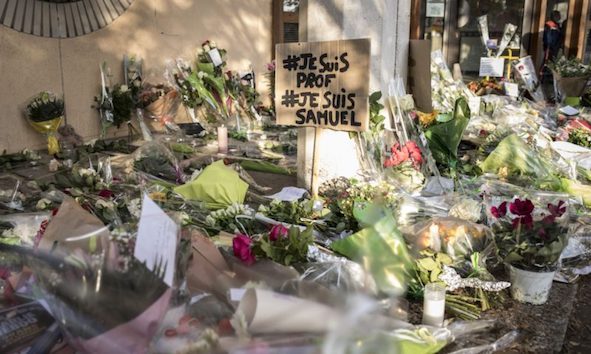
“AND YET THE SELF-STYLED ANTI-FASCISTS OF THE EUROPEAN AND AMERICAN LEFT HAVE SAID BARELY A WORD”
[Note by Tom Gross]
I attach three comment articles on the reaction (or lack thereof) among many western “human rights” and “civil society” activists to the decapitation of French high school teacher Samuel Paty as he was leaving his school in Paris on Friday afternoon, by an 18-year-old Islamist assailant shouting “Allah Akbar”.
The French are particularly shocked by this brutal murder because the victim was a mild mannered middle-aged history and geography teacher simply doing his job.
French commentators noted that there was hope following other terror attacks in France (in which hundreds have died in recent years) that teachers could educate the next generation of school pupils to be tolerant, and this attack has shocked them more than some of the other terror attacks of recent years.
I attach extracts to these articles first, for those who don’t have time to read them in full.
EXTRACTS
“NO, JUST A PERFUNCTORY, PROBABLY BEGRUDGED TWEET ESSENTIALLY SAYING THE KILLING WAS A BIT SAD”
Brendan O’Neill (Spiked online):
Anti-fascists are incredibly quiet about the fascist in France who cut off a man’s head because he displayed some cartoons in a classroom. It is two days since the gruesome Islamist murder of schoolteacher Samuel Paty. And yet the self-styled anti-fascists of the European and American left have said barely a word. There have been no big protests outside of France, no angry rallies, no Twitterstorms, no knee-taking or fist-raising, no promises by ‘Antifa’ to face down these extremists who slaughter schoolteachers for talking about liberty. Their craven, cowardly silence is as revealing as it is depressing.
After every Islamist terror attack, we hear the same thing from significant sections of the Western left, including those who style themselves as anti-fascist. Their first concern is always, but always, that an Islamist terror attack might give rise to an ‘Islamophobic’ backlash. ... Imagine if, following an act of far-right violence carried out by a white man, someone said ‘Let’s not get too angry about this because we might alienate white people and put them at risk’. Imagine if, in the wake of the terrorist attacks by Anders Breivik in Norway or Brenton Tarrant in New Zealand, people’s first response was to wonder if white people would be okay, if white men were feeling safe. That is how crazy leftists sound when their Pavlovian response to the mass murder of children in Manchester or the slaughter of Bastille Day celebrants in Nice or the mowing down of Christmas shoppers in Berlin is to say: ‘I hope Muslims will be okay.’
… Consider the response of the National Education Union in the UK. When George Floyd was killed by cops in Minneapolis, the NEU issued a strongly worded, highly political statement, condemning ‘the systemic racism that caused his killing’. But in response to the murder of Paty, a teacher, the NEU put out a lame, half-hearted tweet which said this is a ‘sad day’ for France. No mention of Paty’s name, no mention of what was done to him, no mention of why it was done to him – because he was teaching his pupils to think critically. No, just a perfunctory, probably begrudged tweet essentially saying the killing was a bit sad…
This glaring disparity between the left’s fury over far-right violence and their snivelling silence in response to Islamist violence was painfully illustrated in August 2017. On 12 August, when a far-right activist used a car to plough into left-wing protesters in Charlottesville, Virginia, killing one, there was global condemnation and agitation from the left. Fascism is back, they claimed, and we have to defeat it. Yet when, just five days later, an Islamist terrorist used a van to slaughter 13 people in Barcelona, there was silence. Let it fade from memory. And for many, it has. It seems unquestionable to me that among left-leaning millennials in particular, the memory of the events of Charlottesville is probably quite strong, whereas the slaughter in Barcelona will have been all but forgotten…
There is the censorious instinct – the urge, now institutionalised in the modern left, to protect Islam from any kind of criticism … so-called anti-fascists share in common with radical Islamists an impulse to censor public discussion and to condemn critics of Islam. The anti-fascists are largely silent on the murder of Mr Paty because they are genuinely not sure which side they are on in this existential battle between regressive Islamists and people who believe in freedom of speech. In short, because they are not anti-fascist at all.
“TERMING THE SYSTEMATIC MURDER OF AFRICAN-AMERICANS BY THE KKK AS “RANDOM” WOULD MISS THE NATURE OF THE TERROR CAMPAIGN BEING CONDUCTED”
Seth Frantzman (Jerusalem Post):
… The problem with this coverage is that it would be like telling the story of lynchings in the US South by the KKK as a series of “extremists” killing “random people.”
The 2015 attack on the kosher market in Paris was described by US president Barack Obama as “a bunch of violent, vicious zealots who behead people or randomly shoot a bunch of folks in a deli in Paris.”
But it wasn’t random. [The Islamist murderer was boasting on live-feed body camera that he wanted to kill Jews as he found Jews to kill, and praising Allah as he did so.]
Terming the systematic murder of African-Americans by the KKK as “random” would miss the nature of the terror campaign being conducted. The KKK sought out specific targets to spread fear, not just random people. The same methodology tends to underpin killings like the murder of the teacher.
This leads to questions about whether calling the KKK “violent extremists” would be better than reporting more narrowly on its white supremacist motivations. “Religious supremacist” is a term rarely, if ever, used to describe the terror attacks in places like France, but at the root of beheadings is a form of far-right, religious, supremacist attacks.
Re-focusing the attacks on the outcome, such as police shooting the perpetrator, tends to move the focus to the perpetrator rather than the victim and leave behind questions of motive and worldview.
… The New York Times [online] headline describing the incident [the murder of Paty] was originally “French police shoot and kill man after a fatal knife attack on the street.”
Many online took screenshots of the headline on Friday and asserted that it focused more on the police shooting the perpetrator than on the brutal attack.
The headline was a reminder of biased reporting against Israel over the years where murders have often been sanitized in headlines, or focus changed to Israeli security forces killing terrorists. These discussions raise several questions about how media frame stories about terrorism.
… In 2016, a priest in France was also beheaded in a church by two ISIS supporters. To ignore the obvious connection between numerous beheadings, or the targets of their attacks, is to ignore what they are trying to do: impose their extremist religious beliefs on a country.
Tom Gross adds:
I have written about this subject on several occasion over the years.
See for example: The BBC discovers ‘terrorism,’ briefly.
http://www.tomgrossmedia.com/BBCDiscoversTerrorism.html
In that article I note that “On July 7, 2005, Britain suffered its first suicide bomb attacks. 52 people were killed on London’s transport system, and all of a sudden, the BBC used the word “terrorism” and “terrorist.”
“But not for long. The following day the BBC subtly and retroactively started to alter the text of stories on its website in order to remove the word “terrorist” to describe those behind the London bombings.”
“THE BEHEADING OF MR PATY WAS A MILITARISED EXPRESSION OF CANCEL CULTURE”
Brendan O’Neill (Spiked online) (in an earlier piece I posted on Facebook at the time it was published):
“Every Islamic extremist attack over the past five years has been shocking and disturbing. In France alone, around 250 people have been massacred by radical Islamists since 2015. But there is something especially horrific about the premeditated targeting of a teacher for doing his job – that is, encouraging his pupils to think critically. Parents of his pupils say he was a kind, enthusiastic teacher who always encouraged children to think about issues in depth...
“The beheading of Mr Paty was a militarised expression of cancel culture. That killer was the armed wing of political correctness, a self-styled enforcer of the now mainstream idea that it is ‘phobic’ (that is, evil) to criticise Islam. Indeed, the interplay between the mainstream chilling of discussion about Islam and the extremist attacks on individuals who ‘blaspheme’ against Islam can be seen in the fact that Mr Paty was the subject of complaints from parents before he became the target of a murderous terrorist. Indeed, it seems he only came to the attention of his executioner because of a social-media fuss over his lessons on freedom of speech. The everyday instinct for cancelling problematic people feeds the monster of extremist violent censorship...”
(Both Brendan O’Neill and Seth Frantzman are subscribers to this dispatch list.)
PARIS MOSQUE APOLOGIZES FOR SHARING ‘FATWA’ VIDEO PRIOR TO ISLAMIC BEHEADING ATTACK
A mosque in Paris has apologized for sharing a video from a parent who called for a “action” against Samuel Paty, the teacher who was beheaded shortly afterwards.
The leader of the Pantin mosque in Paris, M’hammed Henniche, has admitted to sharing a video, which detailed Samuel Paty’s identity and address. Following the dissemination of the video, Paty was beheaded in an Islamist attack.
“In hindsight, given what happened we regret having published it. We are now exploring how in the future we can take a step back before getting carried away with things like that,” the mosque leader said per FranceTVInfo.
Henniche claimed that the video was widely shared through Muslim circles in the city, telling the French newspaper Libération: “At least ten people sent it to me. It circulated a lot, especially through WhatsApp groups.”
QATARI SOCIOLOGIST: PATY’S DEATH MAY HAVE BEEN CARRIED OUT BY THE WEST, LIKE 9/11
Video:
FULL ARTICLES
THE BEHEADING OF A TEACHER IN FRANCE IS THE BARBARIC LOGICAL CONCLUSION TO CANCEL CULTURE
Je suis Samuel
The beheading of a teacher in France is the barbaric logical conclusion to cancel culture.
By Brendan O’Neill
Spiked online
October 17, 2020
https://www.spiked-online.com/2020/10/17/je-suis-samuel/
Yesterday, cancel culture turned murderous. It became positively medieval. On a suburban street on the outskirts of Paris a schoolteacher was beheaded in broad daylight for the supposed crime of showing caricatures of Muhammad to his pupils during a classroom discussion about freedom of speech. Decapitated for dissing the prophet, in France, in the 21st century. In essence, the teacher was cancelled, in the most thorough and depraved way imaginable. Enough is enough – everyone must now stand against all snivelling apologists for censorship and cancellation and defend unfettered freedom of speech as the cornerstone of civilised society.
The news from France was truly grim. Samuel Paty, a 47-year-old teacher of geography and history at a middle school in Conflans-Sainte-Honorine, was murdered and beheaded by an 18-year-old Chechen Islamic extremist. The murderous censor was heard yelling out ‘Allahu Akbar’. Then we discovered why Mr Paty was slaughtered in such a deranged, premodern fashion: because he dared to show some of Charlie Hebdo’s cartoons of Muhammad to his pupils during a lesson on why the liberties of thought and speech are so essential to the French Republic. That he reportedly offered his Muslim pupils the opportunity to leave the classroom while the Muhammad caricatures were being discussed wasn’t enough to protect him from the 7th-century fury of his executioner, who no doubt felt ‘offended’ by Mr Paty’s behaviour.
Every Islamic extremist attack over the past five years has been shocking and disturbing. In France alone, around 250 people have been massacred by radical Islamists since 2015. But there is something especially horrific about the premeditated targeting of a teacher for doing his job – that is, encouraging his pupils to think critically. Parents of his pupils say he was a kind, enthusiastic teacher who always encouraged children to think about issues in depth. Sophie Vénétitay of the SNES-FSU teachers’ union was right to say that he was murdered for doing what good teachers are meant to do – ‘teach critical thought’. This attack targeted one man, but its aim was to terrorise an entire republic; to send a dire, Middle Ages-style warning to public servants that they will put themselves in danger if they dare, in the terrorist’s own words, to ‘belittle Muhammad’.
So Mr Paty was beheaded for the crime of blasphemy. He was the victim of a barbaric one-man inquisition. Yet even as we balk at the depravity of this act of terror, we also have to confront the fact that it did not take place in a vacuum. Nor did the massacre at Charlie Hebdo’s offices five years ago, or the barely discussed attack with a meat cleaver carried out by a Pakistani man at the site of Charlie Hebdo’s old offices just three weeks ago, in which two people were wounded. No, all of these attacks, all of these explicit acts of vengeance for the supposed speechcrime of ‘blaspheming’ against Muhammad, took place in an era in which criticism of Islam is described as ‘Islamophobia’ and in which offending Muslims is apparently one of the worst things you can do. There’s a context to these barbaric attacks – it’s the context of the cult of cancellation and the ridiculous, regressive idea that people have a right not to be offended.
These attacks are an expression of two of the most worrying trends in Western European societies right now: Islamic extremism and cancel culture. Strikingly, open, frank discussion of these two problems is constantly discouraged by the political and cultural elites. After Islamic-extremist attacks we are implored not to look back in anger, to forget about it, essentially, and move on. Dwell for too long on something like the Manchester Arena bombing in 2017 or the Nice truck attack on Bastille Day in 2016 and you run the risk of being branded ‘Islamophobic’, that catch-all term of demonisation that is designed to chill debate about radical Islam, the crisis of integration, and the social and cultural divisions fostered by the ideology of multiculturalism. As for cancel culture, it doesn’t exist, the chattering classes tell us; it’s the concoction of right-wing culture warriors who just don’t like being ‘called out’.
But these things do exist. Islamic extremism is a genuine problem in 21st-century Europe and the trend for cancelling people deemed guilty of wrongthink – whether it’s feminists who question aspects of transgenderism or people concerned about mass immigration – is a real and growing phenomenon. Indeed, cancel culture is applied with particular vigour against anyone who criticises Islam. They will be branded ‘phobic’ or racist. People have lost their jobs and even been dragged to court in European countries for ‘blaspheming’ against Muhammad. And who can forget the reluctance of significant sections of the cultural establishment – including columnists and novelists – to stand by Charlie Hebdo following the massacre of so many of its cartoonists and writers in 2015? Sure, no one should have been killed, they said, but that magazine is ‘Islamophobic’; it ‘punches down’, whatever the hell that means.
All these spineless excuse-makers for religious censorship, all these people who failed time and again to stand with people who were being chastised, censured or even physically attacked for questioning or making fun of Islam, ought to be taking a long, hard look in the mirror this morning. For they have contributed to this climate in which extremists take it upon themselves to punish ‘blasphemers’. The elites’ mainstreaming of the idea of ‘Islamophobia’, their treatment of criticism of Islam as a racist scourge that must be cancelled, gives a green light to Islamists to take even more punishing action against anyone who dares to disrespect their religion. The terrible truth is this: the No Platforming of people for being critical of Islam and the murder of people for being critical of Islam differ only by degree, only by severity. In both cases, the exact same warped ideology is being applied: that it is legitimate to punish ‘offensive’ speech, especially if it is offensive to some Muslims.
The beheading of Mr Paty was a militarised expression of cancel culture. That killer was the armed wing of political correctness, a self-styled enforcer of the now mainstream idea that it is ‘phobic’ (that is, evil) to criticise Islam. Indeed, the interplay between the mainstream chilling of discussion about Islam and the extremist attacks on individuals who ‘blaspheme’ against Islam can be seen in the fact that Mr Paty was the subject of complaints from parents before he became the target of a murderous terrorist. Indeed, it seems he only came to the attention of his executioner because of a social-media fuss over his lessons on freedom of speech. The everyday instinct for cancelling problematic people feeds the monster of extremist violent censorship.
‘Freedom of speech has consequences’ – that is the cri de coeur of the censorious woke left and the illiberal cultural elites. Well, guess what? It will have been the cri de coeur of the piece of shit who murdered Mr Paty, too. That oh-so-common cry that free speech has consequences is one of the most chilling ideas of our time. It doesn’t mean that freedom of speech has the consequence of disagreement and debate and ridicule, of people using their speech to challenge your speech – this is something all of us accept and actively welcome. No, it means that if you express certain ideas, you will suffer. Make no mistake: it is a threat. Speak your mind and you will suffer the consequences – job loss, banishment from campus, public shaming, even hounding in the streets, as we have seen in recent furious confrontations between correct-thinking mobs and people who dare to hold different opinions. All that radical Islamists do is add a further ‘consequence’ to freedom of speech – extrajudicial execution.
Enough is enough. If the slaying of Samuel Paty doesn’t act as a wake-up call to the censorious elites, then we really are in serious trouble. Teaching unions across Europe should absolutely condemn his murder and defend the right of teachers and professors to challenge their pupils and students, including with caricatures of Muhammad. Campuses must cease all their regressive No Platforming and speech-policing policies. Cancel culture needs to be cancelled. And we need to normalise criticism of Islam – alongside criticism of Christianity and every other religion – in order to send a clear message to everyone: that no god, prophet, faith or fad is beyond questioning in our free societies. Let’s all say ‘Je suis Samuel’ and confront the apologists who created this world in which people fantasise that they have a right not to be offended.
FRENCH TEACHER’S MURDER BRINGS MEDIA TERMINOLOGY INTO SPOTLIGHT
French teacher’s murder brings media terminology into spotlight
The murder has led to controversy online about how the killing was covered, particularly with the wording used in headlines that appeared to focus attention on the murderer rather than the victim.
By Seth Frantzman
Jerusalem Post
October 18, 2020
https://www.jpost.com/international/french-teachers-murder-brings-media-terminology-into-spotlight-analysis-646095
French teacher Samuel Paty was murdered in Paris on Friday in a brutal killing by a religious extremist who targeted him after hearing rumors he had shown images that he considered to be blasphemous, in his classroom.
The killing was one of many in France in recent years where newspapers, religious figures and others have been targeted by Islamist-inspired extremists. The murder has led to controversy online about how the killing was covered, particularly with the wording used in headlines that appeared to focus attention on the murderer, rather than the victim.
According to France24, Paty was teaching his class on freedom of expression, and provided an example of the Charlie Hebdo cartoon controversy where images of the Islamic Prophet Mohammed were shown. A father of one of the students then began a social media campaign against the teacher.
An eighteen-year-old who was granted asylum in France from Chechnya more than a decade ago then traveled to the school and hunted down the teacher. The suspect, named as ‘Abdullakh A.’ was later shot and killed by police.
The New York Times [online] headline describing the incident was originally “French police shoot and kill man after a fatal knife attack on the street.”
Many online took screenshots of the headline and asserted that it focused more on the police shooting the perpetrator than on the brutal attack. Others pointed out that while the online headline focused on the police shooting, the print edition was headlined “man kills teacher in Paris suburb, decapitating him.”
There was focus on how the headline was a reminder of biased reporting against Israel over the years where murders have often been sanitized in headlines, or focus changed to Israeli security forces killing terrorists. These discussions raise several questions about how media frame stories about terrorism.
Firstly, there are terms such as “militants” that are used to obscure what are generally brutal murderers. Then there is terminology such as “terrorist” or “violent extremist” used to describe certain attacks.
There are questions about how victims and attacks are framed, such as criticism that purposeful attacks are described as “blasts” that “bomb buses” as opposed to naming the individuals responsible. These questions are important because the media often use different terms when describing other types of attacks.
For instance, the ramming attack in Charlottesville in 2017 was described as a “white nationalist who killed a woman by ramming his car into a crowd” and headlines describe him as a “white supremacist.”
In September 2020, a man was killed by police in a shootout in California. The headline said: “White supremacist killed in shootout.”
There are also questions of religious and political motivations. A recent report in June by the Center for Strategic and International Studies (CSIS) found that “violence by far-right groups and individuals has emerged as one of the most dangerous terrorist threats faced by US law enforcement.”
The bifurcation of the terms “jihadist and right-wing extremists” is sometimes used by major media to create groups of extremists that use violence, without much thought or explanation given as to why “jihadists” are not defined as “far-right.”
In another instance a New York Times opinion piece in February 2017 argued that “saying ‘radical Islamic terrorism’ isn’t enough.”
The author, Richard Stengel, who advocated using more general terms such as “violent extremism,” noted that for years in the Obama administration, officials purposely avoided words that might link attacks to religion.
Different countries use different terms; different media do the same. This leads to questions about how the media reports may downplay the severity of crimes or sanitize attacks. This sanitization works both ways. Some countries use the term “neutralized” to describe killing alleged “terrorists.” Some countries use terms such as “jihadist” and “Islamist” and others do not.
There is often not much reporting on the actual statements of the murderers themselves. For instance, the use of beheading to kill the teacher in Paris is linked to many other beheadings which are the method used by religious extremists to kill people they term as the “kuffar” or infidels, who they view as sub-human. That means that the method of – in their view – “execution” is tied to the nature of what they see as a “crime” of blasphemy.
In 2016, a priest in France was also beheaded in a church by two ISIS supporters. To ignore the obvious connection between numerous beheadings, or the targets of their attacks, is to ignore what they are trying to do: impose their extremist religious beliefs on a country. This is also why a Jewish school was targeted in Toulouse in 2012 and a kosher supermarket was targeted in 2015 by the same group that attacked Charlie Hebdo.
It’s not a coincidence that Jews were targeted, because hatred of Jews is part of the worldview of hatred of “kuffar” as well as support for ISIS and the intolerance preached by the extremists who motivate the killers. That narrative is not widely dealt with in the media, which prefer the simpler story of a man who was radicalized, killed someone and was then shot by police – end of story.
The problem with this coverage is that it would be like telling the story of lynchings in the US South by the KKK as a series of “extremists” killing “random people.”
For instance, the 2015 attack on the kosher market in Paris was described by US president Barack Obama as “a bunch of violent, vicious zealots who behead people or randomly shoot a bunch of folks in a deli in Paris.”
But it wasn’t random. Terming the systematic murder of African-Americans by the KKK as “random” would miss the nature of the terror campaign being conducted. The KKK sought out specific targets to spread fear, not just random people. The same methodology tends to underpin killings like the murder of the teacher.
This leads to questions about whether calling the KKK “violent extremists” would be better than reporting more narrowly on its white supremacist motivations. “Religious supremacist” is a term rarely, if ever, used to describe the terror attacks in places like France, but at the root of beheadings is a form of far-right, religious, supremacist attacks.
Re-focusing the attacks on the outcome, such as police shooting the perpetrator, tends to move the focus to the perpetrator rather than the victim and leave behind questions of motive and worldview.
Twenty years after the US declared a global war on terror, governments and the media still struggle with how to define these kinds of attacks.
WHERE IS THE OUTRAGE OVER THE MEDIEVAL MURDER OF SAMUEL PATY?
The silence of the anti-fascists
By Brendan O’Neill
Spiked online
October 18, 2020
https://www.spiked-online.com/2020/10/18/the-silence-of-the-anti-fascists/
Anti-fascists are incredibly quiet about the fascist in France who cut off a man’s head because he displayed some cartoons in a classroom. It is two days since the gruesome Islamist murder of schoolteacher Samuel Paty for the supposed crime of showing caricatures of Muhammad to his pupils during a classroom discussion about freedom of speech. And yet the self-styled anti-fascists of the European and American left have said barely a word. There have been no big protests outside of France, no angry rallies, no Twitterstorms, no knee-taking or fist-raising, no promises by ‘Antifa’ to face down these extremists who slaughter schoolteachers for talking about liberty. Their craven, cowardly silence is as revealing as it is depressing.
After every Islamist terror attack, we hear the same thing from significant sections of the Western left, including those who style themselves as anti-fascist. Their first concern is always, but always, that an Islamist terror attack might give rise to an ‘Islamophobic’ backlash. We have to be careful about how we talk about Islamist terrorism, they say, or we might help to make Muslim communities into targets for racist violence. This is such a morally warped response to the extremist violence of radical Islamists. Imagine if, following an act of far-right violence carried out by a white man, someone said ‘Let’s not get too angry about this because we might alienate white people and put them at risk’. Imagine if, in the wake of the terrorist attacks by Anders Breivik in Norway or Brenton Tarrant in New Zealand, people’s first response was to wonder if white people would be okay, if white men were feeling safe. That is how crazy leftists sound when their Pavlovian response to the mass murder of children in Manchester or the slaughter of Bastille Day celebrants in Nice or the mowing down of Christmas shoppers in Berlin is to say: ‘I hope Muslims will be okay.’
Their instinct is always to hush and chill discussion of radical Islam. They have developed numerous strategies for doing this. The first, as described above, is to imply that there could be violence against Muslims if we get too angry or heated about an Islamist attack – a form of moral blackmail designed to stymie frank discussion of Islamist violence. Another is to promiscuously deploy the insult of ‘Islamophobe’ against anybody who raises awkward questions about the frequency and bloodiness of Islamist attacks in Europe, or who even uses that i-word at all (Islamist) to describe these acts of violence.
Indeed, in mainstream institutions there have been efforts to expunge words like ‘Islamist’ from the discussion about Islamist terrorism. Police forces in the UK have seriously considered replacing terms like ‘Islamist terrorism’ and ‘jihadis’ with ‘faith-claimed terrorism’ and ‘terrorists abusing religious motivations’. This warped impulse to deny that these acts are motivated by Islamism is designed to disorientate the public response to terrorism and ensure there is no deep or focused discussion about its causes and ideologies. The left continually parrot this institutionalised cowardice by obsessively policing the language that people use and the emotions we express in the wake of Islamist attacks. ‘Don’t say “Islamic violence” because this has nothing to do with Islam’, they say. And of course, ‘Don’t look back in anger’. Cry, change your social-media picture for a week or two, and then move on. Nothing to see here.
This spineless unwillingness to be honest about the ideological motivation behind Islamist violence, or to confront the fact that it has become an increasingly widespread form of violence that has caused the deaths of hundreds of people in Europe in recent years, has been on full display following the beheading of Samuel Paty. Consider the response of the National Education Union in the UK. When George Floyd was killed by cops in Minneapolis, the NEU issued a strongly worded, highly political statement, condemning ‘the systemic racism that caused his killing’. But in response to the murder of Paty, a teacher, the NEU put out a lame, half-hearted tweet which said this is a ‘sad day’ for France. No mention of Paty’s name, no mention of what was done to him, no mention of why it was done to him – because he was teaching his pupils to think critically. No, just a perfunctory, probably begrudged tweet essentially saying the killing was a bit sad. This sums up the moral cowardice of sections of the left when it comes to Islamist violence. They just don’t want to talk about it. They want things to be forgotten as quickly as possible.
And, alarmingly, this is already happening in relation to the killing of Mr Paty. It is falling down the news schedules. It is fading from social media. People aren’t really talking about it. This might change later today, temporarily, given that a rally for Mr Paty is due to take place in Paris later on. Perhaps the sight of the good people of France taking to the streets in defiance of the censorious executioners of radical Islam will shame hitherto silent anti-fascists into saying something. But generally, it feels like the killing of Samuel Paty is already drifting from public consciousness. The post-terrorism strategy of playing things down, or flat-out igorning them, or saying that talking too much about this act of violence will itself cause violence, is proving successful once again. Another victory for intellectual cowardice.
The reluctance of self-styled anti-fascists to say anything coherent or principled about Islamist terrorism stands in stark contrast to their response to acts of far-right violence. Whether it was the mosque massacres in New Zealand or the Tree of Life synagogue massacre in Pittsburgh, so-called Antifa leftists always strongly condemn attacks by white nationalists and try to galvanise people in opposition to the ideology that fuelled them. In these cases they do want to talk about the ideological engine to the violence. They don’t condemn people for saying ‘fascist’ in the way they condemn people who say ‘Islamist’ after Islamist attacks. They don’t say ‘Let’s not get angry’ – they say ‘Let’s get really angry’.
This glaring disparity between the left’s fury over far-right violence and their snivelling silence in response to Islamist violence was painfully illustrated in August 2017. On 12 August, when a far-right activist used a car to plough into left-wing protesters in Charlottesville, Virginia, killing one, there was global condemnation and agitation from the left. Fascism is back, they claimed, and we have to defeat it. Yet when, just five days later, an Islamist terrorist used a van to slaughter 13 people in Barcelona, there was silence. They stared at their feet. Don’t dwell on it. Don’t focus on it. Let it fade from memory. And for many, it has. It seems unquestionable to me that among left-leaning millennials in particular, the memory of the events of Charlottesville is probably quite strong, whereas the slaughter in Barcelona will have been all but forgotten.
What’s this about, this silence of the anti-fascists in response to certain forms of neo-fascism? There is a mix of regressive fears and ideas in the left’s stark hypocrisy over extremist violence. There is an element of racial paternalism, where the left feels it must protect Muslim communities from open, frank debate about radical Islam, lest they feel offended. There is the influence of identity politics, too, which dictates that white people are privileged (ie, bad) and brown people are oppressed (ie, good), and the radical Islamist problem just muddies this identitarian narrative too much. There is a calculated cowardice to it too, where the left is reluctant to dig down into the role of institutional multiculturalism in fostering the ethnic and religious tensions in Western countries that have helped to nurture Islamist violence.
And then there is the censorious instinct – the urge, now institutionalised in the modern left, to protect Islam from any kind of criticism or ridicule. This is where we get to the darkest reason why the murder of Samuel Paty hasn’t caused the fury that it ought to have – because there are many people in mainstream political and cultural circles who actually agree that it is wicked to criticise Islam. No, they don’t support the killing of people who criticise Islam, but they do support their punishment, whether that be in the form of No Platforming, or sackings, or expulsion from polite society. This is the problem: so-called anti-fascists share in common with radical Islamists an impulse to censor public discussion and to condemn critics of Islam. The anti-fascists are largely silent on the murder of Mr Paty because they are genuinely not sure which side they are on in this existential battle between regressive Islamists and people who believe in freedom of speech and the right to offend. In short, because they are not anti-fascist at all.
* You can also find other items that are not in these dispatches if you “like” this page on Facebook www.facebook.com/TomGrossMedia
In yet another expression of friendship towards Israel and Jews by Gulf Arabs since the signing of the peace deal last month, UAE Minister for Youth Affairs Shamma Al Mazrui, aged 27, last week referred to the “wisdom of the Shabbat” and called herself a “new student of the Jewish tradition, wisdom, values, and ethics.”
“Our youth want to learn from Israel,” she added. “Our nation wants to learn from different nations. And likewise, we invite you to come sit with us at the table.”
In the above photo, four female UAE government ministers together in Abu Dhabi: Reem Ibrahim Al Hashimi, Minister for International Cooperation, Ohood Al Roumi, Minister for Happiness, Shamma Al Mazrui, Minister for Youth, and Noura Al Kaabi, Minister for FNC Affairs.
Last week UAE’s foreign minister wrote “Never again” in the guest book during a visit to the Holocaust museum in Berlin.
Here is another discussion in my series “Conversations with friends”:
Times of Israel editor David Horovitz
David Horovitz talks about his upbringing in London, about editing the Times of Israel (and before that, the Jerusalem Post), and about interviewing Paul McCartney and others. David and Tom discuss the difficulties of striving for fair and independent journalism in an era of fakery and misrepresentation, and discuss the reporting on Netanyahu, Trump and others.
(Discussion by zoom on October 8, 2020.)
Other conversations in this series:
Tom Gross
https://www.youtube.com/watch?v=T4Pg-IDYJYE
Paul Lewis asks Tom Gross about his own life experiences and views: growing up surrounded by cultural and literary luminaries in London and New York; Sunday brunches with Elvis Presley’s songwriter; crossing Checkpoint Charlie into East Berlin with his grandmother during communism; helping the Roma when almost no one else would; Tom’s close relationship with his godmother Sonia Orwell (the model for the heroine Julia of her husband’s masterpiece ‘1984’); being in Manhattan on 9/11; the Mideast; the importance and legacy of the Holocaust; and other matters.
(Discussion by zoom on June 28, 2020.)
World acclaimed pianist Evgeny Kissin (Prague)
Described by The Economist magazine as “the world’s most acclaimed classical pianist” Moscow-born Evgeny Kissin talks about being a child prodigy; his favorite concert halls and musicians; learning new repertoires and visiting Kafka’s grave during coronavirus lockdown; about Stalin’s murder of Yiddish writers, his own love for Yiddish, his support for Israel, and his political views about Russia and the West.
(Discussion by zoom, while under coronavirus lockdown in Prague, on May 24, 2020.)
* You can see shorter extracts from the conversation with Evgeny Kissin here: Conversations with friends: Evgeny Kissin on music, the Yiddish language, Israel and the Soviet Union
Mostafa Elostaz (Paris / Jerusalem)
https://www.youtube.com/watch?v=WduAASj4C4k
Tom Gross speaks to Palestinian academic and peace activist Mostafa Elostaz about his life and views. Mostafa grew up in Kuwait to parents who moved there from Gaza, and were originally from Majdal Asqalan (Arabic) / Ashkelon (Hebrew). Mostafa taught many years at Al Quds university in east Jerusalem, and now teaches at Tel Aviv University. Should the Palestinians welcome the UAE-Israel peace deal? Should they take up Trump and Netanyahu’s offers to negotiate?
In case you want to skip to the political parts, these start at 15 minutes into this interview, where we begin our discussion about the Israel-UAE deal, the Trump plan, and how the Palestinians should best react to Israeli peace offers, and offer to negotiate.
(Discussion by zoom on August 19, 2020.)
Zoe Johnson (Oxfordshire)
Zoe Johnson is the second woman ever to be appointed Senior Treasury Counsel by the attorney general to prosecute the UK’s most serious cases including Islamic terrorism, organized crime, abuse of public office, and honor killings. And she has done all this with the added difficulty of being confined to a wheelchair for almost her whole life.
(Discussion by zoom on August 12, 2020.)
Jonathan Freedland
https://www.youtube.com/watch?v=Y_3phYh8WMU
Award-winning Guardian columnist Jonathan Freedland in conversation with Tom Gross about the state of the world; the Trump presidency (and whether some of his policies might be good); Britain’s coronavirus failures; early Zionism; whether Britain can still learn from the American constitution and system of government; and as a teenager how Jonathan was a mentor to Sasha Baron Cohen before he became Ali G and Borat.
* There is also a separate shorter conversation: Should statues of antisemites come down?
Jonathan Freedland & Tom Gross discuss left-wing antisemitism, and English antisemitism
Jonathan Freedland: Most British people aren’t aware that “one of Britain’s gifts to the world, which originated in England, is the blood libel” -- which led to countless Jewish deaths over many centuries of European history.
Tom Gross: Should the large statue outside the British Parliament of Richard the Lionheart (who was responsible for murder of tens of thousands of Jews) and the bust of Karl Marx (who wrote about Jewish vermin) come down?
(Answer: no they should remain. But schoolchildren should be taught at least a bit about historic English antisemitism, in addition to the wrongs, as well as rights, of the British Empire.)
(Conversation by zoom while under coronavirus lockdown on June 18, 2020)
The last Nazi-hunter Efraim Zuroff (Jerusalem)
Efraim Zuroff speaks about why he became a Nazi hunter, his pursuit of war criminals all over the world over many decades, and his efforts to make countries such as Lithuania, Latvia and Croatia admit to their own nation’s very substantial collaboration with the Nazi genocide. As the last survivors die out where does Holocaust education and memory go from here?
Why did it take Steven Spielberg’s 1993 film Schindler’s List to make Holocaust education finally become incorporated into the British education system some years later? Why did western countries and the Vatican and Red Cross help Nazi criminals escape at the end of the war? Why were so many doctors Nazis?
We also discuss the trial of Bruno Dey (charged for his part in the murder of 5,230 people at Stutthof death camp) which is continuing now in Hamburg – it is 75 years late but the German judge insisted it continue despite the coronavirus restrictions.
(Discussion by zoom, while under coronavirus lockdown in Jerusalem, on June 8, 2020.)
Oscar-nominated filmmaker Hossein Amini (London)
Born in Tehran to a distinguished Iranian family (his grandfather was prime minister under the shah) Oscar-nominated screenwriter and film director Hossein Amini speaks about Iran before and after the Islamic revolution, his career as a filmmaker, his work with Martin Scorsese and Harvey Weinstein, his favorite films, and says that ‘it’s no accident that the MeToo movement started in tolerant Hollywood’. We also discuss racism in Britain.
(Discussion by zoom, while under coronavirus lockdown in London, on May 30, 2020.)
David Pryce-Jones (London, Wales, Florence)
Writer David Pryce-Jones discusses his childhood escape from the Nazis, his friendships with Isaac Bashevis Singer, Arthur Koestler, Stalin’s daughter Svetlana, John Gross and others; and Israel, Italy, and the New York Times.
(Discussion by zoom, while under coronavirus lockdown in Wales, on May 21, 2020.)
Former Israeli Deputy National Security Advisor Eran Lerman
Eran Lerman was Israel’s Deputy National Security Advisor in the governments of Prime Minister Benjamin Netanyahu from 2009-15. He previously served more than 20 years in military intelligence. We discuss present issues concerning the Gulf states, why most Arab countries prefer Israel keep control of the Jordan Valley, how the Palestinians refused the offer of a Palestinian state by Netanyahu during Barack Obama’s second presidential term, when Saudi Arabia might officially make peace with Israel, and the emerging strategic importance of the eastern Mediterranean.
(Discussion by zoom on September 2, 2020.)
John O’Sullivan (Budapest)
Born to modest parents near Liverpool (his father was a ship steward, his mother a shop girl) John O’Sullivan rose to become one of Margaret Thatcher’s most trusted aides and advisors in 10 Downing Street. In this zoom conversation, he discusses Thatcher’s personality and how she developed her views, and other leading figures he met. (On one occasion John had breakfast with Thatcher in London, then flew to Washington and had dinner with President Reagan that same evening.) He and Tom Gross also discuss Donald Trump’s presidency; the future of journalism; and his lifelong love for musical theatre.
(Discussion by zoom, while under coronavirus lockdown in Budapest, on May 29, 2020.)
Amanda Foreman
https://www.youtube.com/watch?v=lFHkJcf0qO0
Historian and writer Amanda Foreman talks with Tom Gross about her life and career; her father Carl Foreman (who wrote the films Bridge on the River Kwai, High Noon, and Guns of Navarone, but who was then driven out of town by Senator McCarthy’s witchhunts); Amanda’s own encounter with John Wayne; her books; her TV series on the ascent of women; and about curating an exhibition last year on Queen Victoria for the current English queen in Buckingham Palace. Amanda also discusses why statues and icons are such popular targets in History wars.
(Discussion by zoom to New York on July 14, 2020.)
Rt Hon Lord (David) Young of Graffham
Lord David Young talks about his life, his ten years in Downing Street working closely with Margaret Thatcher, his five years in Downing Street with David Cameron, and about Boris Johnson, Donald Trump, and modern multicultural Britain.
(Discussion by zoom in Graffham, Sussex, in England, while under coronavirus lockdown, on May 20, 2020.)
Bahra Saleh (Kirkuk, Iraq)
Tom Gross talks with Bahra Saleh about her life and about Kurdistan.
(Discussion by zoom in Kirkuk, Iraq, while under coronavirus lockdown, on May 20, 2020.)
Shmuel Bar (Herzliya)
https://www.youtube.com/watch?v=j_ekSPVLMAg
Shmuel Bar, who worked for Israel’s government for 30 years in various clandestine analytical and operational capacities, and who is a world-class expert in a variety of fields, discusses the state of America, Europe, the Mideast and the world, and what dangers may lay ahead.
(Discussion by zoom, on July 2, 2020.)
Orit Yasu (Shoham, near Tel Aviv)
Born to recently arrived Ethiopian-Israeli parents, Orit Yasu talks with Tom Gross about growing up in Kiryat Malachi, the rescue of Ethiopian Jews by the Mossad, her participation in the 1999 Columbine High School shooting memorial while on a school trip to Colorado, on how NYC is too crowded, her trip to see her parents village Ethiopia, and why many Ethiopian-Israelis vote Likud.
(Discussion by zoom, while under coronavirus lockdown, on May 31, 2020.)
Charlotte Cunningham (Yorkshire / London / Luxembourg)
https://www.youtube.com/watch?v=kva8JQ1Jgsw
Charlotte, who has established a successful arts organization in England that helps people with mental and physical disabilities, has managed to forge her own path distinct from her illustrious family background -- her grandmother was the ruling monarch of Luxembourg after whom Charlotte is named; and her grandfather was US secretary of state under a Republican, Eisenhower, and then US treasury secretary under two Democrats, Kennedy and Johnson.
(Discussion by zoom, while under coronavirus lockdown in London, on June 19, 2020.)
Nidra Poller (Paris)
Writer Nidra Poller discusses hanging out with James Baldwin and other African-American writers and musicians in 1970s Paris, the origins of the name Nidra, how her Japanese partner introduced her to Israel, and the position of women in the modern world.
(Discussion by zoom, while under coronavirus lockdown in Paris, on May 19, 2020.)
Susan Loewenthal Lourenco (Berlin)
Educator Susan Lourenco talks about being the child of refugees from Berlin, her life in four different countries and how she reconciled herself with modern Germany.
(Discussion by zoom, while under coronavirus lockdown in Berlin, on May 12, 2020.)
* You can also find other items that are not in these dispatches if you “like” this page on Facebook www.facebook.com/TomGrossMedia

Photos from last month’s Israel-UAE-Bahrain peace ceremony at the White House
SAUDI EX-INTEL CHIEF SLAMS PALESTINIAN CRITICISM OF UAE DEAL
[Note by Tom Gross]
I attach several articles below.
In the first, the Reuters news agency reports that Saudi Arabia’s influential former intelligence chief and ambassador to the United States, Prince Bandar bin Sultan bin Abdulaziz, yesterday evening slammed the Palestinian leadership’s criticism of the UAE-Israel and Bahrain-Israel peace deals.
In remarks in Arabic to one of the Arab world’s major news networks Al Arabiya, he said “There is something that successive Palestinian leadership historically share in common: they always bet on the losing side, and that comes at a price.”
Tom Gross adds: Prince Bandar remains one of the most important people in Saudi Arabia. His daughter is currently Saudi ambassador to Washington and his son (who I know personally) is ambassador to London. They are cousins of, and close to, the crown prince.
ISRAELI AND EMIRATI FOREIGN MINISTERS TO MEET TODAY IN BERLIN. TRIP INCLUDES JOINT VISIT TO HOLOCAUST MUSEUM
The Foreign Ministers of Israel, Gabi Ashkenazi, and of the United Arab Emirates, Sheikh Abdullah bin Zayed Al Nahyan, are due to meet in Berlin today, at the invitation of German Foreign Minister Heiko Maas. Ashkenazi left Israel this morning on a German military plane.
The ministers will visit the Holocaust Museum together and will hold a ceremony at the Holocaust Memorial. While the two have spoken by phone, this will be their first (known) meeting.
Afterwards, they will hold one-on-one and trilateral meetings on a variety of issues, including aviation, trade, and establishing embassies in each other’s countries.
German Foreign Minister Haas called the peace agreement between Israel and the UAE and Bahrain brokered by President Trump’s son-in-law Jared Kushner “the first good news in the Middle East for a long time.”
In his first interview with an Emirati publication last month, Ashkenazi praised the UAE’s leadership and called on the Palestinians to follow the Emirates’ example in normalizing relations with Israel.
His father, Yosef Ashkenazi, was a Bulgarian-Jewish Holocaust survivor and many of his relatives were murdered. His mother is from a Syrian-Jewish family.
CONTENTS
1. Saudi former Intel chief slams Palestinian leadership’s criticism of UAE-Israel deal (Reuters, Oct. 6, 2020)
2. Behind new Khashoggi group are anti-Israel activists (Washington Free Beacon, Oct. 5, 2020)
3. Iran sets coronavirus record as capital returns to lockdown (Wall St Journal, Oct. 6, 2020)
4. In third week of lockdown, Israel shows tentative signs of slowing coronavirus spread (Haaretz, Oct. 5, 2020)
5. Long buoyed by high-flying Emirates, Dubai now shares its woes (Wall St Journal, Oct. 4, 2020)
ARTICLES
SAUDI FORMER INTEL CHIEF SLAMS PALESTINIAN LEADERSHIP’S CRITICISM OF UAE-ISRAEL DEAL
Saudi former intel chief slams Palestinian leadership’s criticism of UAE-Israel deal
By Reuters
October 6, 2020
Saudi Arabia’s former intelligence chief and ambassador to the United States, Prince Bandar bin Sultan bin Abdulaziz, slammed the Palestinian leadership for criticizing the decision of some Gulf states to normalize ties with Israel.
In an interview with Saudi-owned Al Arabiya television aired on Monday, the prince labeled the Palestinian authorities’ criticism a “transgression” and “reprehensible discourse.”
“The Palestinian cause is a just cause but its advocates are failures, and the Israeli cause is unjust but its advocates have proven to be successful. That sums up the events of the last 70 or 75 years,” he said in the first of a three-part airing of the interview.
“There is something that successive Palestinian leadership historically share in common: they always bet on the losing side, and that comes at a price.”
The United Arab Emirates agreed a historic deal to normalize relations with Israel in August, and the Gulf state of Bahrain, a close Saudi ally, followed suit in September.
Palestinians fear the moves will weaken a long-standing pan-Arab position - known as the Arab Peace Initiative - that calls for Israeli withdrawal from occupied territory and acceptance of Palestinian statehood in return for normal relations with Arab states.
President Mahmoud Abbas said the Palestinian leadership regarded the UAE’s move as “a betrayal.” Veteran Palestinian negotiator Hanan Ashrawi told Reuters the deal was “a complete sell-out.”
Saudi Arabia, the birthplace of Islam, has not directly commented on the normalization deals, but has said it remains committed to peace on the basis of the Arab Peace Initiative.
Prince Bandar noted the decades-long support of successive Saudi kings to the Palestinian cause and said the Palestinian people should remember that the kingdom has always been there for them to offer help and advice.
“This low level of discourse is not what we expect from officials who seek to gain global support for their cause,” he said.
While Saudi Arabia is not expected to follow the example of its Gulf allies any time soon, experts and diplomats believe the kingdom has started shifting the public discourse on Israel.
Prince Bandar’s daughter, Princess Reema, is the current Saudi ambassador to the United States.
BEHIND NEW KHASHOGGI GROUP ARE ANTI-ISRAEL ACTIVISTS
Behind New Khashoggi Group Are Anti-Israel Activists
By Adam Kredo
Washington Free Beacon
October 5, 2020
A new organization intended to carry out the vision of late Saudi dissident Jamal Khashoggi is led and staffed by prominent anti-Israel activists, including a controversial lawyer who defended a dozen people allegedly involved in the 9/11 terror attacks.
Democracy for the Arab World Now (DAWN) bills itself as a new human rights group that seeks to “focus on violations by the United States’ closest Arab allies,” according to a New York Times report this week on the group’s foundation. Khashoggi was reportedly working to launch the organization when he was killed in Saudi Arabia in 2018.
While the group positions itself as a pro-democracy watchdog, its leadership is comprised of controversial anti-Israel voices who have targeted the Jewish state. The group’s executive director, Sarah Leah Whitson, is a well-known Israel critic who most recently served as managing director for research and policy at the Quincy Institute for Responsible Statecraft, an isolationist think tank that has pushed anti-Israel and pro-Iran viewpoints.
Whitson attracted widespread criticism in March when she likened Israel’s tough coronavirus quarantine measures to the plight of Palestinians living in the disputed territories. “Such a tiny taste. Missing a tablespoon of blood,” Whitson wrote in a tweet that she later deleted after it prompted accusations of anti-Semitism.
DAWN’s board of directors includes the founder of the Council on American-Islamic Relations (CAIR), an anti-Israel group that was embroiled in an FBI probe into whether it was funneling cash to the terror group Hamas. Another board member served as legal counsel for Sudan when it was taken to court for alleged involvement in the 9/11 terror attacks.
DAWN’s leaders say the organization is meant to boost Khashoggi’s vision for democracy across the Middle East. He reportedly seeded the idea in 2017, after he fled Saudi Arabia and relocated to Washington, D.C., where he became a frequent critic of Saudi leadership.
“The fundamental premise that democracy and human rights are the only solution for stability, security and dignity in the Middle East is 100 percent Jamal’s point of view,” Whitson said in an interview with the New York Times. “That is what he wanted this organization to be about.”
Among those serving on the organization’s board of directors is Asim Ghafoor, a prominent national security lawyer who has represented the Sudanese government against American victims in litigation stemming from the 9/11 terror attacks, the bombing of the U.S. embassy in Sudan, and the bombing of the U.S.S. Cole.
CAIR’s cofounder Nihad Awad is also a DAWN board member. Prior to joining CAIR, Awad served as the public relations director for the now-defunct Islamic Association for Palestine, a group “described by the U.S. government as part of ‘Hamas’ propaganda apparatus,’” according to information from the Anti-Defamation League (ADL), which combats anti-Semitism.
CAIR’s leadership has been embroiled in controversy over its connections to the terror group Hamas. The ADL, which offers muted praise for the group’s work, has warned that “at times the organization’s positions and work have been shadowed by early connections between some of CAIR’s top leadership and organizations that are or were affiliated with Hamas” and that “antipathy towards Israel has been a CAIR staple since the group was founded.”
Awad was an early supporter of Hamas, stating in 1994: “After I researched the situation inside Palestine and outside, I am in support of the Hamas movement more than the PLO.” Asked by Al Jazeera in 2000 if he would condemn Hamas, Awad stated, “We do not condemn, and we will not condemn any liberation movement inside Palestine or inside Lebanon.”
Prior to joining Dawn, Whitson spent a short time at the Quincy Institute, which is funded by billionaires Charles Koch and George Soros. Her anti-Israel Twitter outburst contributed to allegations that Quincy was founded to push anti-Israel causes and attack the Jewish state.
Whitson also worked at Human Rights Watch, another advocacy group that has spent years criticizing the Israeli government and its policies in the West Bank area. She made headlines during her time there for attempting to raise money in Saudi Arabia by highlighting the group’s anti-Israel work.
IRAN SETS CORONAVIRUS RECORD AS CAPITAL RETURNS TO LOCKDOWN
Iran Sets Coronavirus Record as Capital Returns to Lockdown
Government shuts schools, movie theaters, beauty salons, coffee shops, mosques and other businesses and institutions
By Aresu Eqbal
Wall Street Journal
Oct. 6, 2020
“The transmission of this virus is getting out of control,” Payam Tabarsi, head of the infection ward at Tehran’s Masih Daneshvari hospital for respiratory diseases, told the reformist Mardomsalari newspaper Monday. Some 80% of health workers at the hospital have been infected with the coronavirus.
“Health-care personnel are exhausted and fatigued, and the number of critical patients increases every day,” he said.
Iran is in the throes of a third surge of coronavirus infections. On Monday it added 3,902 infections and 235 deaths to its total toll – a record number of deaths that it also hit in late July. Roughly 475,000 people in Iran have been confirmed as infected, and more than 27,000 have died from Covid-19.
While most of the country has seen rising infection rates, Tehran and its suburbs, a metropolitan area of some 16 million residents, has been a main coronavirus hot spot since the outbreak in Iran began in February.
As in other countries, the easing of Iran’s first lockdown increased the contagion risk by allowing people to gather in closer proximity. The most recent surge follows a national religious holiday, during which many Iranians travelled.
The government has largely blamed residents for failing to adhere to health guidelines, including social distancing and mask wearing, and weeks ago warned that travel during the holidays would lead to a surge in infections.
The difficulty in getting the virus under control reflects an attempt by Iranian authorities to balance public health concerns with a need to keep the country’s sanctions-battered economy alive.
The pandemic hit Iran’s economy particularly hard, as the Islamic Republic was already struggling under U.S. sanctions imposed after President Trump in 2018 withdrew from an international nuclear accord between Iran and six world powers.
The new U.S. sanctions isolated Iran from global financial markets and diminished its exports, including oil, leaving Tehran with fewer engines than most other countries to keep up economic activity when forced to go into lockdown to contain Covid-19.
Such restrictions slashed the purchasing power of Iranian citizens as they rattled Iran’s volatile currency. The open-market value of the rial hit a record of 300,000 to the U.S. dollar last week, up from around 140,000 in February, before the pandemic. Officially, the rial trades at 42,000 to the dollar.
Bans on religious tourism have added to Iran’s economic pain. Weeks ago, Iran canceled ceremonies for Muharram, one of the most important religious holidays for the world’s Shiite Muslims. This week, processions for Arbaeen, another important religious holiday, also were canceled.
The deep economic crisis has made the government reluctant to impose another lockdown, after loosening the first one in April. But health officials recommend even stricter measures.
Alireza Zali, head of the capital’s corona task force, called for the shutdown to be extended for longer than a week.
“A one-week shutdown won’t have any diminishing impact on the transmission of the disease,” Mr. Zali told the national medical council’s website. “The situation in Tehran is completely critical.”
The health ministry said 28 of the country’s 31 provinces were now coded “red,” indicating the highest level of contagion risk. Health officials said restrictions might be imposed on travel around the country, which previously helped spread the virus.
“Hospitals are full. There is no space for new patients and ICU beds have been occupied to a great extent,” Masoud Mardani, a member of the national corona task force’s scientific committee, told state television. “If people travel we will probably have to set up field hospitals.”
Health officials have warned that the country’s hospitals are overwhelmed with new cases, and its health personnel are increasingly falling victim to the virus.
IN THIRD WEEK OF LOCKDOWN, ISRAEL SHOWS TENTATIVE SIGNS OF SLOWING CORONAVIRUS SPREAD
In Third Week of Lockdown, Israel Shows Tentative Signs of Slowing Coronavirus Spread
Health expert attributes the drop-off in the overall incidences of infection to the lockdown, but ultra-Orthodox community continues to buck the trend
By Ido Efrati
Haaretz (Tel Aviv)
Oct. 5, 2020
Israel’s rate of coronovirus infection – which is among the highest in the world – may be slowing down, according to data from the past few days. But it will take another week or two to see if these preliminary indications reflect a real change.
Health Ministry officials are cautiously optimistic about the possibility of a slowdown, but analysis of the data also show an ongoing rise in the spread of the disease in the ultra-Orthodox community.
The number of new daily cases per million people in Israel is 720 (based on a weekly average) compared to only 155 on September 3. This is far higher than the United States (128 per million), the EU (92) and well over the global average of 37. The number of daily deaths in Israel from COVID-19 (based on a weekly average) is 3.76 per million people, compared to 1.52 in early September.
Along with these disturbing numbers are two worrisome trends. One is the rise in infections in the ultra-Orthodox community, which constitutes 40 percent of the new confirmed cases over the past two weeks, and has contributed to the rise in the seriously ill patients and deaths, according to coronavirus czar Prof. Ronni Gamzu. The second is the state of the health system, which is suffering extreme overloads that are undermining the health services provided to non-coronavirus patients.
However, the data from the past few days may be indicative of a slowdown. A week ago, on Yom Kippur (September 28) and the following day, September 29, the percentage of the daily tests that emerged positive was 15 percent. That could have been a reflection of the relatively low number of tests (7,700 on Yom Kippur and around 33,000 tests the next day). On September 30 there were more than 9,000 positive tests out of 67,000, a rate of 13.7 percent. On October 1, there 63,600 tests of which 12.1 percent were positive. On October 2, of some 60,000 tests, 11.8 percent were positive, while on October 3, of 23,000 tests, 11 percent were positive.
“It must be said that morbidity is still high, but at least it’s not getting higher,” said Weizmann Institute Prof. Eran Segal, who heads one of the analysis teams accompanying the government’s Magen Yisrael initiative to curb the spread of the virus. Segal said that Health Ministry data show a “significant drop” in the infection coefficient (the number of new infections estimated to stem from a single case) in the Arab community to below R=1. Among the general public there is also a drop to below R=1. “By contrast, in the Haredi community we are seeing that not only is there no slowdown, there’s a rise,” he said, adding that “the number of dead from the coronavirus in the Haredi sector has doubled in a week.”
According to the data analysis by Segal and his team, most of the increase in infections in Israel derives from the Haredi community. Last Thursday, for example, there was a 9 percent increase in the number of confirmed cases in the Haredi community over the previous day, compared to a 6 percent drop in the Arab community and no change in the rest of the population, leading to an overall 2 percent increase on a national level. With regard to patients in serious condition, that same day there was a 6 percent increase in the Haredi community, a 2 percent drop in the Arab community, and no change in the rest of the population. There were 10 percent more deaths in the Haredi community than the previous day, compared to 1 percent more in the Arab community and 6 percent in the rest of the population.
An analysis of the weekly data shows even more starkly the spike in the infection rate in the Haredi community compared to the rest of the Israeli population. The number of confirmed cases in the Haredi community rose 79 percent between the week of September 16 to 23 and the week of September 23 to 30. In contrast, the number of new cases in the Arab community dropped by 33 percent in this same period, while there was a 1 percent rise of new cases in the rest of the population. Moderate to serious cases shot up by 47 percent in the Haredi community, fell 13 percent in the Arab community and rose 3 percent in the general population between those same two weeks. Even more alarming was the coronavirus death rate, which rose 100 percent in the Haredi community, six percent in the Arab community and 48 percent in the general population in that second week.
According to Segal, the slight slowdown in the overall incidence of infection is the result of the lockdown. But the increase in the spread of the virus within the Haredi community reflects the flouting of the rules and the holding of mass events during the holidays. He cited Yom Kippur, in particular, and said that we have probably not yet felt the full impact of that day on the infection rate in the Haredi community. “As far as [the impact of] Sukkot is concerned, we’ll have to continue to monitor things.”
During a press briefing last Thursday, Gamzu said, “The lockdown was necessary. The numbers [of daily new cases] were rising quickly and significantly from 1,500 to 4,000 and at the start of the lockdown to 7,000. Everyone knows I didn’t want the lockdown but when... the hospitals started to exhibit distress, I didn’t hesitate.” He added that the lockdown was already proving to be effective as evidenced by a drop in traffic and less contact between people. But he added that it would not bring the same reduction in the spread of the virus as the Passover lockdown achieved.
LONG BUOYED BY HIGH-FLYING EMIRATES, DUBAI NOW SHARES ITS WOES
Long Buoyed by High-Flying Emirates, Dubai Now Shares Its Woes
The coronavirus is hurting the world’s largest carrier and the city’s travel-dependent economy
By Rory Jones
Wall Street Journal
Oct. 4, 2020
DUBAI – Emirates Airline powered Dubai’s rise from desert backwater to teeming Mideast metropolis, making the city one of the world’s biggest intercontinental hubs and generating a yearslong economic boom.
But now, the coronavirus pandemic and the economic devastation it has wrought have forced the first major downsizing for an airline that has weathered Middle East conflicts and oil-market shocks. As a result, the state-owned carrier’s woes are tearing through Dubai’s economy.
The airline’s parent company, one of Dubai’s biggest employers, has slashed tens of thousands of jobs from its 100,000-strong workforce after the pandemic halted much of global air travel, a fall from grace for an airline that long outmuscled competitors in the U.S. and Europe for landing rights and passengers.
That has in turn driven an exodus of Dubai-based expatriates linked to the airlines, shrinking spending at restaurants, bars and even private schools.
“It is extremely difficult for the hospitality sector, the restaurateurs, the hoteliers, but they are not alone,” Emirates Airline President Tim Clark said in an interview. “The number of people coming into Dubai has significantly reduced. Everything has got to go into a deep freeze.”
Dubai’s Rock Bottom Cafe, near an apartment building where Emirates houses hundreds of staff, once teemed with partyers until the early hours. Now it serves only about 50 people on the weekends, said Mitendra Sharma, the general manager of the Ramee Group, which owns the cafe as well as four hotels in Dubai. The group has cut staff from 1,000 to 300 as its hotels are at 10-15% occupancy, compared with nearly 95% this time last year, he said.
“Emirates was the driving force for the tourists, and it is cutting jobs and reducing destinations,” Mr. Sharma added. “All industries are affected as a result.”
Dubai’s government established Emirates in 1985 with $10 million and two leased aircraft from Pakistan International Airlines. The current ruler, Sheikh Mohammed bin Rashid Al Maktoum, helped set up the carrier and ordered that it had to “be good, look good and make money.”
The airline soon became one of the world’s biggest, using a fleet of wide-body jets to ferry passengers through its Dubai hub. Many travelers began to stop in the city, driving hotel and shopping mall construction. That helped contribute to a bubble in the real-estate market and a dramatic collapse during the financial crisis in 2009.
By building a global network that served developing markets, Emirates endured the economic pain in Dubai. It also added to the growing cityscape, building accommodations to house its staff and expanding into hotel operations. In 2014, Dubai International overtook London’s Heathrow as the world’s busiest airport for international travelers, largely driven by Emirates. The city became a playground for Europeans seeking winter sun and Saudis deprived of entertainment options in their more conservative kingdom.
The numbers of pilots, cabin crew and other staff also swelled. “Ladies Night” became popular with Emirates’ majority-female cabin crew in bars on Tuesdays and bottomless Friday brunches multiplied across the city’s hotels and restaurants, fueled in part by aviation professionals.
These same places are dealing not only with Emirates’s job cuts but coronavirus-related restrictions – a double whammy that has wrung the life out of some establishments.
David Cattanach, the general manager of the Irish Village, a popular bar located near Emirates training facilities at Dubai International Airport, said it has to contend with both fewer customers and rules that patrons must keep 6 feet apart. “We won’t break even until the vaccine comes,” he says.
While Dubai reopened to tourists on July 7 after a three-month closure, travel from its top feeder markets – India, the U.K., Saudi Arabia, China and Russia – has remained depressed due to high levels of infections or travel restrictions. The surge in cases globally means Emirates is now carrying 12% of the passengers it did this time last year, according to Mr. Clark.
Dubai’s travel and tourism sector has contracted each month since January, mirroring a decline in activity across the emirate, according to an index compiled by IHS Market. Real-estate firm Colliers International predicts Dubai hotels will see occupancy of just 45% to 50% during 2020. S&P Global Ratings said Saturday it expects Dubai’s economy will contract by around 11% in 2020, citing the city-state’s concentration in travel and tourism.
The U.A.E. reported 1,231 new daily coronavirus cases Saturday, a record, taking its total to 97,760 cases and 426 deaths since the pandemic began.
To entice people to travel, Emirates is committing to covering passengers’ medical expenses if they are diagnosed with Covid-19.
“That’s been really, really helpful,” said Kabir Mulchandani, who runs the luxury five-star Five Hotel on Dubai’s palm-shaped island. It saw occupancy among tourists collapse at the start of the pandemic but is now welcoming more foreigner travelers.
Emirates passengers coming to the United Arab Emirates must present a negative Covid-19 test four days before departure. Dubai doesn’t break out figures on cases, but its population makes up a third of the nearly 10 million people in the U.A.E., which on Sept. 21 surpassed China in total confirmed infections.
Dubai officials have long wanted the airline to operate without further cash injections from the state and to remain profitable in its own right. Emirates said it would need a bailout in March. Officials moved quickly to shore up the airline with $2 billion in equity, the first time the government had provided fresh capital since its establishment.
The Dubai government didn’t respond to questions on the bailout or broader impact of Emirates’ downsizing. The airline declined to comment on cost savings from the job cuts.
GymNation, a fitness center operator popular with cabin crew, lost members after Emirates job cuts and for a moment considered nixing plans to open a new branch near staff apartments but decided to move ahead, hoping the airline would rehire once the global travel market rebounds, according to CEO Loren Holland.
The Dubai branch of private school Kent College – a U.K. institution that Mr. Clark attended as a child – is now negotiating discounts with parents of Emirates staff who have lost their jobs, according to Principal Anthony Cashin. Pilots still employed also have had education allowances trimmed, further straining the school’s finances, he said.
“It’s a tough time,” Mr. Cashin added. “We’re working with families case by case.”
* You can also find other items that are not in these dispatches if you “like” this page on Facebook www.facebook.com/TomGrossMedia